![]() |
| Starlink terminals at the Lviv IT Cluster |
![]() |
| Identifying targets using drones with night-vision cameras |
![]() |
| Russian tanks, stranded after the destruction of Russian supply trucks |
Internet applications and technology and their implications for individuals, organizations and society
![]() |
| Starlink terminals at the Lviv IT Cluster |
![]() |
| Identifying targets using drones with night-vision cameras |
![]() |
| Russian tanks, stranded after the destruction of Russian supply trucks |
Posted by
Larry Press
at
Permanent link as of 4:45 PM
0
comments
![]() |
| Covering the US flag on a Russian rocket (image source) |
![]() |
| The plaques on the "wall of patents" at Tesla were replaced by a mural (image source) |
In 2014, Musk made a similar decision in support of his goal of transitioning the world to sustainable energy when he released Tesla's 249 patents into the public domain, saying "All Our Patent Are Belong To You" (derived from an obscure meme). He open-sourced them.
Update 4/22/2022Update 3/27/2023
OneWeb has given up on retrieving satellites left in Russia.
Posted by
Larry Press
at
Permanent link as of 3:24 PM
0
comments
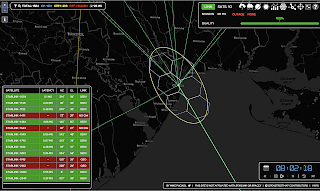
| Ten Starlink satellites serving Odessa through ground stations in Turkey, Lithuania, and Poland |
Last week I wrote about the arrival of a truckload of SpaceX Starlink terminals in Ukraine and their potential value to government and resistance leaders. A lot has happened in the ensuing week -- this is an update.
Last week, using Mike Puchol's Starlink tracking service, I found that users in Kyiv would have 100 percent uptime with connections through as many as nine satellites to ground stations in Turkey, Poland, and Lithuania. When the Turkish ground station was unreachable it dropped to as few as five, but uptime remained 100%.
I've since used his service to check connectivity snapshots in three geographically dispersed cities -- Odessa, Lviv, and Kharkiv. I always found between seven and ten satellites in service in Odessa and Lviv and between two and six in Kharkiv. This is not surprising since Lviv is west of Kyiv, hence closer to the Polish and Lithuanian ground stations, Odessa in the south is closer to the one in Turkey and Kharkiv is to the east -- near Russia.
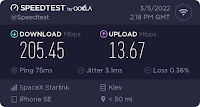
| Starlink Speedtest in Kyiv |
Update 3/14/2022
Photos of Starlink terminals in various locations have been posted on Telegram's Ukrainian IT Army and Facebook's SpaceX Starlink in Ukraine groups, but little was said about their use and users.
Posted by
Larry Press
at
Permanent link as of 8:43 AM
0
comments
| Kyiv connects thru satellites (blue) to ground stations (orange). |
Posted by
Larry Press
at
Permanent link as of 1:49 PM
0
comments
| A failed roaming test |
David's experience is not unique -- others have reported similar inconsistency on social media, but if one is willing to change the registered address of their terminal, it can be moved -- if there is available capacity at the new location.
Consider the experience of Marcus and Julie Tuck, who have been digital nomads for eight years and Starlink users since April 2021. As of December 16, 2021, they had registered at one hundred different addresses and had service at 157 locations.| The Tucks and their truck |
When David Lang brought his terminal to my home, he would have risked losing the ability to connect when he returned home if he had temporarily registered his terminal at my address. When the Tuck's experience becomes available, users will be able to leave home for a trip and return without risking the ability to reconnect at home.
David's visit was a week after the Tuck's experience, so roaming has not yet been rolled out. Perhaps the Tucks were in a limited test area or were selected by SpaceX because of their frequent address changes.
The Tucks had fixed roaming, not the in-motion connectivity Elon Musk promised, but it is a first step and there are still unanswered questions about roaming like:
Posted by
Larry Press
at
Permanent link as of 5:01 PM
0
comments
In 2020, China applied to operate GuoWang, a constellation of 12,992 low-Earth orbit (LEO) broadband Internet satellites, and in 2021, it became clear that it was intended to become China's global LEO broadband constellation. Can they do it? Maybe, but it will take a long time.
Launch capability
| Chinese launch startups (source) |
| GalaxySpace satellite "super factory" (source) |
As Deville put it, "2022 could be year one of the significant if not massive deployment of Chinese small satellites." He cited the example of the completion of the GalaxySpace satellite production line at their "super factory" in Nantong and showed the first six broadband communication satellites that were just completed. He also described several other satellite manufacturing companies including auto manufacturer Geely, which has a factory capable of producing 500 satellites per year and deep mass production experience.
Optical links and ground infrastructure
Inter-satellite optical links are a priority for LEO constellations -- they will reduce latency and the need for ground stations -- and China has relatively poor access to global ground infrastructure. As with launch and satellite manufacture, there are promising optical communication start-ups, but China lags established companies like Mynaric and Tesat and is precluded from using their products by the current technology cold war and Xi's Made in China 2025 policy.
Optical links between satellites and the ground could compensate in part for a lack of radio-frequency ground stations and China's recently released Five-year Perspective white paper says they have tested satellite-ground laser communication. Ground station load can also be reduced by relaying data through geostationary satellites and the Five-year Perspective includes a commitment to a coordinated multi-orbit communication system.
Amazon offers ground-station service; AWS Aerospace and Satellite Solutions offers space/terrestrial systems consulting service and Microsoft offers Azure Orbital ground station service, which enables satellite access to its Azure cloud services. Will Chinese Web services and terrestrial infrastructure companies integrate with GuoWang?
Politics
| Belt and Road nations, January 2021 (source) |
This division shields GuoWang from competitive market pressure and it locks in global waste and economic inefficiency by ensuring that LEO constellations will be able to route traffic but will otherwise be idle while orbiting over "enemy" nations.
I've reviewed three areas in which GuoWang needs to catch up, but GuoWang, Starlink and the other would-be broadband Internet service providers also face joint constraints like LEO debris and spectrum scarcity, (Note that SpaceX has also applied to launch 30,000 more broadband satellites). Optical links between constellations and the ground may relax the spectrum constraint if inter-satellite routing algorithms are climate-sensitive but global collaboration is needed to deal with debris, collision avoidance, and spectrum scarcity.
GuoWang is facing an uphill battle. If SpaceX and the others do not go bankrupt, they will have been operating for years before GuoWang completes a 12,992-satellite constellation. On the other hand, the Chinese government has given GuoWang high priority, their lunar, Martian, and space station programs started long after ours, and China plans to "build a satellite communications network with high and low orbit coordination" within the next five years.
Update 2/22/2022
GuoWang got political affirmation recently when China Satnet signed a strategic cooperation agreement with the Shanghai Municipal Government. (Like state governments in the US, Chinese municipal governments often support commercial efforts). Satnet is a state-owned enterprise, but its executives visited commercial satellite constellation operator Guodian Gaoke signaling openness to cooperation with Chinese commercial space firms.
It seems clear now that GuoWang will be China's global broadband provider, not Hongyun and Hongyan, less ambitious broadband constellation projects of powerful state-owned enterprises CASC and CASIC.
Update 3/13/2022
The Dongfang Hour reports that the Long March 9 will not be ready to launch for 8-10 years. How many satellites will GuoWang's competitors have in orbit by then? They also reported that the six broadband communication satellites mentioned above were launched. The satellites have a mass of 190kg and a throughput of 40 Gbps.
Several companies are ramping up to build satellites, so a coalition may be able to equip GuoWang, but launch capacity seems to be an even more significant constraint. Either way, they have a long way to go. Here's a wild dream -- SpaceX could launch GuoWang satellites. Elon Musk has been known to help competitors -- he put 249 Tesla patents in the public domain in 2014.
Update 7/22/2022
As we saw earlier, the Long March 9 was expected to be ready for launch in 8-10 years, but a revised design is being considered. Andrew Jones reports that Long Lehao, a veteran chief designer of the Long March rocket series, presented plans for a new reusable methane-liquid oxygen launch vehicle to be ready in 2035. He described a two-stage rocket capable of launching 150 tons to low-Earth orbit. That sounds a lot like SpaceX Starship, but without mention of the launch/land pad with "chopstick" arms to capture a returning booster.
![]() |
| Presentation on the revised Long March 9 (source) |
Posted by
Larry Press
at
Permanent link as of 11:23 AM
0
comments
Labels: Chine SatNet, GuoWang
The United States and its allies are in a technology cold war with China and its allies. This is evidenced by major battles like the US ban on Huawei and China's drive for technological independence and their global infrastructure program to create a digital silk road. (The cold war began under Trump, but President Biden is continuing it).
There are other, less well-known battles like the battle over optical communication in space. For example, Mynaric, a 20-year old German optical communication company with a cutting edge line of space, aircraft, and ground terminals, was forced to take sides in the tech cold war:
Posted by
Larry Press
at
Permanent link as of 11:15 AM
0
comments
Speech by ReadSpeaker