Showing posts with label competition. Show all posts

Thursday, April 18, 2019

Open data leads to competition

When evaluating proposed mergers and breakups, control of data should be considered along with market impact.

In a previous post, I spoke of Amazon's use of customer and market data in restraint of trade, but they are not alone. For example, leaked internal documents show that plans to sell access to user data were discussed for years and received support from Facebook’s most senior executives. Facebook gave Amazon extended access to user data because Amazon was spending money on advertising and partnered with them on the launch of the Fire smartphone. In another case, Facebook discussed cutting off access to user data for a messaging app that had grown too popular and was viewed as a competitor.

As former FCC Chairman Tom Wheeler points out in a recent post, proprietary data is a source of market control and he cites two examples where opening data has led to competition. In the US, a law mandating open access to video content enabled satellite companies to compete with cable companies and in the UK, open access to customer banking data led about 200 organizations to offer new services in its first year.

Wheeler's position is elaborated in Unlocking Digital Competition, a report from the Digital Competition Expert Panel convened by the British Treasury Department. Their data-related recommended actions are:
  • Establishing data mobility and open standards between services: overcoming network effects which cause markets to tip by requiring systems to ‘talk’ to each other using open, standardised formats. This will mean consumers can port their data between networks, interact with users on other, similar networks, and smaller firms can plug their services into those of bigger ones. New business opportunities will open up that use, manage, and combine data made available. Consumers, in turn, will have new choices of digital services, with switching made much easier.
  • Securing access to non-personal and anonymised data: tackling the data barrier to entry for smaller and newer firms, while protecting privacy. The power of bulk data driving economies of scale and scope is a key reason new firms struggle to compete and bring innovative services to consumers. Overcoming this barrier will allow the digital economy to remain dynamic.
These are only two of the 20 recommended actions in the 140-page report. Those actions are grouped under six strategic recommendations for the government:
  • Sustain and promote effective competition in digital markets, by establishing a pro-competition digital markets unit, tasked with securing competition, innovation, and beneficial outcomes for consumers and businesses.
  • Take more frequent and firmer action to challenge mergers that could be detrimental to consumer welfare through reducing future levels of innovation and competition, supported by changes to legislation where necessary.
  • Update and effectively use tools against anti-competitive conduct to help them play their important role in protecting and promoting competition in the digital economy.
  • Continue to monitor how the use of machine learning algorithms and artificial intelligence evolves to ensure it does not lead to an anti-competitive activity or consumer detriment, in particular to vulnerable consumers.
  • Conduct a market study into the digital advertising market encompassing the entire value chain, using its investigatory powers to examine whether competition is working effectively and whether consumer harms are arising.
  • Engage internationally on the recommendations it chooses to adopt from this review, encouraging closer cross-border co-operation between competition authorities in sharing best practice and developing a common approach to issues across international digital markets.
The two open-data actions mentioned above fall under the first strategic recommendation of promoting competition, but control of data is involved in the others as well. When Amazon acquired Zappos and Whole Foods, they gained access to data on relatively affluent shoppers. Facebook's acquisition of Instagram and WhatsApp and Google's acquisition of Waze also yielded data in addition to eliminating competition. The machine learning recommendation involves training data. When evaluating proposed mergers and breakups, control of data should be considered along with market impact.

The last strategic recommendation -- international engagement -- recognizes the global nature of the Intenet. (Note that the Digital Competition Expert Panel was chaired by an American). Nations like China and the US have different goals with respect to competition, but democratic, capitalist nations should strive to adopt compatible institutions and policies. In the era of Brexit and MAGA, we need to work with other nations -- I'd rather end up with two Internets than fifty.

Thursday, May 18, 2017

Comcast and Charter -- declining competition among ISPs

I am not an expert on the retail ISP industry -- just a dissatisfied customer of the monopoly service provider in my neighborhood -- but the following events have caught my attention during recent years.

In 2012, Comcast and Verizon agreed to stay out of each other's markets -- Comcast would focus on landline Internet and Verizon mobile Internet.

Last year, Charter Communications merged with two other companies to become the second largest ISP in the country.

This month, Comcast and Charter Communication have agreed to cooperate on mobile connectivity, to "explore potential opportunities for operational cooperation" -- "creating common operating platforms, technical standards development, and harmonization, device forward and reverse logistics, and emerging wireless technology platforms."

They also agreed not to make a major acquisition in the wireless sector without the other’s involvement for one year.

They will both resell Verizon wireless service.

President Obama & the Comcast CEO
(source)
A visual inspection of the coverage maps of Charter and Comcast does not reveal a lot of geographic overlap in their current service areas. (I'd be curious to see the actual statistics).

Many of us had only one or two choices for a landline ISP during the Obama administration and mobile connectivity remained a stable oligopoly. It does not sound like Charter and Comcast will be fierce mobile connectivity competitors, does it?

Capitalism needs competition to work well and a lack of competition offers a partial explanation for the US, home of the ARPANet, being ranked 15th on the International Telecommunication Union ICT Development Index. It certainly does not look like we can expect more ISP competition during the Trump administration.


Tuesday, April 18, 2017

No longer a cord-cutter -- I've spliced the cord

My 2014 post "How I cut my Time Warner bill by 33%" has been viewed 152,846 times -- the most of any in the history of this blog. The bill-cutting technique is simple -- threaten to cancel your service and the ISP will renegotiate the price.

I recently repeated the process, with a twist.

I was an early cord-cutter -- getting my local TV with a rabbit ears antenna and streaming the rest from the Internet. That worked fairly well, but I could not get local content in some of the rooms of my house and even in the best room, there would be an occasional glitch and I had to play around with the antenna orientation. I tried amplified antennas, but none were better than my rabbit ears and I am too lazy to install a rooftop antenna. (The local TV transmitters are on a mountain 24.5 miles as the crow flies from my home).

My monopoly ISP bill crept up over time, as monopoly ISP bills do, and my old monopoly ISP, time-Warner Cable (TWC), had sold to a new monopoly ISP, Spectrum.

Spectrum started sending out flyers offering good deals to new subscribers -- Internet, phone and cable-TV service for a little less than I had been paying TWC. I called and offered to switch to the introductory offer and they accepted -- I spliced the cord.

I now get rock-solid local TV and a DVR for less than I was paying before. That is an improvement, but nothing like I could get by moving to place with a competitve Internet service market like Riga, Stockholm or Korea.

Are you hoping new wireless technology like 5G mobile or PCell technology from Google will provide ISP competition? The technology remains to be seen in the field but, if it turns out to be a threat, the ISPs will work hard to fight competition, for example, by outlawing the sharing of public infrastructure.

In spite of periodic renegotiation with my ISP, the cost is drifting up and I pay for streaming services like Netflix and Amazon Prime, but I seldom go out to a movie these days. It looks like the long-run losers will be movie theaters and the public.

Wednesday, June 04, 2014

A tale of two industries: package delivery and Internet service

Why do customers like the package delivery industry and dislike information delivery service? Competition and the US Postal Service.

Comcast CEO Brian Roberts recently complained that Netflix paid the Post Office for delivery of small packages (DVDs), but did not want to pay Internet service providers (ISPs) to deliver the same content over the Internet.

In his view, the Post Office is in the consumer package delivery business and Comcast and other ISPs are in the information delivery business and both should be paid for their service.

The University of Michigan publishes the American Customer Satisfaction Index in which they rate both companies and industries. Let's look at their latest ratings of the consumer package delivery and ISP industries.


They rate 48 industries and it turns out that the package delivery industry is rated seventh overall and the ISP industry is 48th. Furthermore, merger hopefuls Time Warner Cable and Comcast are the lowest rated.

How might we explain the differences in customer satisfaction in these two images that Mr. Roberts considers similar? The difference is that there is competition in customer package delivery between Federal Express, UPS and the Post Office. We would normally expect three companies to tacitly establish oligopoly prices, but in this case the Post Office is disruptive -- Federal Express and UPS must compete with a government agency.

Monday, June 02, 2014

The best video ever on network neutrality and the state of the Internet in the US

As long as analysts, geeks and lobbyists are the only folks who care about Internet infrastructure and policy, we can be pretty sure that nothing will improve, but what if the general public becomes interested?

Last night I watched episode five of the HBO comedy news cast "Last Week Tonight" in which host John Oliver narrated a 13 minute segment on network neutrality and the sorry state of the Internet in the United States.


I may be a biased geek and disgruntled consumer, but the segment was right on and, more important, extremely funny.

Is the Internet finally becoming a politically important issue? (Be sure to listen to the audience reaction at the end of the clip before you answer).

----
Update 6/26/2014

FCC Chairman Tom Wheeler responded to the video and Oliver followed up with another very funny segment.

------
Update 6/28/2014

Terry Gross interviewed John Oliver about his new HBO show -- the first 7 minutes are devoted to Oliver's Internet piece -- funny and informative.


Consumer groups and big corporations like Google and Facebook agreeing on net neutrality is like Lex Luther agreeing with Superman.

Comcast CEO Brian Roberts explained that there is no competition between Comcast and Time Warner Cable.

Picking Tom Wheeler to head the FCC is like hiring a dingo as your baby sitter.

President Obama golfing with Comcast CEO Brian Roberts

Saturday, May 31, 2014

Comcast CEO Brian Roberts opens his mouth and inserts his foot -- who will invest in Internet infrastructure?

If ISPs have insufficient incentive to invest in infrastructure, who will? Google? Telcos? Government (at all levels)? Premises owners?

At a recent conference, Comcast CEO Brian Roberts rationalized charging Netflix to deliver content by comparing Comcast to the Post Office, saying that Netflix pays to mail DVDs to its customers but now expects to be able to deliver the same content over the internet for free. He forgot to mention that the Post Office does not charge recipients for those DVDs.

The issue is infrastructure investment and it is in our collective interest for that investment to be made. Comcast could invest in the infrastructure needed to insure rapid delivery of Netflix and other's traffic and pass that cost on to the paying customers at a fair rate of return on the investment. But, they make more money by refusing to upgrade their infrastructure, thereby slowing delivery of content and making their customers dissatisfied with content providers like Netflix. If there were competition in the ISP market, customers would switch to the ISP that provided the best price/performance, but since there is not competition, Comcast is able to reap monopoly profits. If they happen to have a competitor in a given location, perhaps AT&T, they together reap oligopoly profits.

What is the solution? One hope is for Google Fiber to provide meaningful investment and competition, which might work in the short run, but one has to wonder about the long run -- cities with Google Fiber would still be oligopolies.

Another hope is Verizon and other phone companies competing agressively, but it seems the cable and phone companies have reached a gentleman's non-competition agreement with phone companies focusing on mobile connectivity and cable companies on fixed connectivity.

If the ISPs will not make the necessary investments, government (at all levels) must make wholesale infrastructure investments and apply regulation as we do with roads and utilities. There is also a role for home and building owners investing in the last "100 meter" infrastructure as we do with water, gas and sewers.

-----
Update 6/2/2014

Data on Comcast performance before and after their agreement with Netflix


-----
Update 6/5/2014

Americans consumers are less satisfied with the ISP industry than any other industry, yet are satisfied with the package delivery industry. Both deliver things, but the package delivery industry has private and public competition.


-----
Update 6/7/2014

There is a long of discussion (250 comments) of this post on Slashdot.

Thursday, May 08, 2014

ISPs have the lowest American Customer Satisfaction Index.

The ISP industry ranks 48th out of 48 industries on the American Customer Satisfaction Index. Subscription TV is 47th.

Individual companies are also rated. Large companies are rated separately and smaller ISPs are lumped into "all other." Here are the ISP customer satisfaction indices:

Verizon Communications (FiOS) 71
Cox Communications 71
AT&T (U-verse) 68
Charter Communications 65
CenturyLink 65
Time Warner Cable 63
Comcast 62
All others 71

I am happy to see that my ISP, Time Warner Cable, which I have commented upon in previous posts, is not the lowest rated company in this dismal industry -- that honor belongs to their hopeful merger buddy, Comcast.

-----
Update 5/19/2014

The latest quarterly survey results are out and Internet service providers are now the lowest ranked industry and merger buddies Time Warner Cable and Comcast are now the two lowest ranked companies of all industries. The inverse correlation between size and customer satisfaction still holds for the ISP industry, so I am confident that if Comcast acquires TWC, they will continue to set dissatisfaction records for years to come.


-----
Update 6/11/2014

I just got a copy of the latest ACSI company ratings from the University of Michigan. Comcast is no longer the second lowest rated company in the survey -- that honor now belongs to Time Warner Cable (TV). My ISP, Time Warner Cable (ISP), retained its position as the lowest ranked company -- 230th out of 230 companies.

The ISP industry remains at the bottom of the list, with subscription television services next to last

The American public is fed up with the cable TV and Internet service companies (and we are ridiculing them) -- let's hope that translates into political pressure.

-----
Update 6/23/2016

Time Warner Cable and Charter Communication recently merged. Now a US Senate report concludes that they routinely overcharged customers and failed to issue refunds.

ISPs are aggressively pursuing their goal of remaining the industry with the lowest customer satisfaction index and worst customer service in the US.

The Senate subcommittee’s report also said that consumers are frustrated by the ongoing rise of the cost for cable and satellite TV, with some packages increasing up to 33% since 2011 A copy of the report is available here.

Don't you love monopolies?

Wednesday, April 09, 2014

My son pays $30/month for symmetric, 100 Mbps Internet service ... in South Korea

My son lives in a relatively small city about 50 miles from Seoul.

He has a choice of three major Internet providers -- their monthly list prices for symmetric 100 Mbps Internet connectivity are as follows:

KT Corp: 31,680 ₩
SK Broadband: 33,000 ₩
LG Corp: 31,350 ₩
1,000 won is just under one dollar – about 96 cents, so, they are all around $30 per month.

Here is a copy of his latest bill from SK Broadband:


The top line is his charge for the month. (The second line shows the balance due from the previous month).

The charge is 35,000 ₩ (I guess there are some taxes), but he has a 13,000 ₩ discount because he signed a two year contract. With that contract he is paying about $22 per month for 100 Mbps connectivity.

How does that compare to your Internet service bill and speed?

How about customer service? Here is a quote from a comparative review of South Korean ISPs:
As mentioned earlier of fierce competition between a much-similar service providers, they will dispatch a repairman within a few hours of your call, even on WeekEnd!
How is it that Korea has achieved intense ISP competition? There is no simple answer, but the government has pursued a multifaceted policy encouraging investment and demand creation and providing common infrastructure, which is used by compteting ISPs (as in Singapore, Sweden or Latvia)

By contrast, we have little ISP competition in the U. S., leaving customers in a weak position -- dealing with non-competitve providers of a necessary service.

-----
Update 4/11/2014

My son saw this post and offered a couple of corrections. He sent me prices for the three major ISPs he can choose from, but says there are a number of smaller ones -- he said I understated the level of competition. He also said that the difference between his bill and the list price I quoted was not due to taxes, but the fact that the list price comparison he sent me was from a blog post and may not have been current. His list price is 35,000 ₩, not 33,000 ₩, but the general point remains true.

Saturday, March 22, 2014

Netflix CEO Reed Hastings has posted a call for “strong net neutrality.”

In a post entitled Internet Tolls And The Case For Strong Net Neutrality, Netflix CEO Reed Hastings says that deteriorating customer experience fored him to agree to pay Comcast an interconnection fee. While that was a necessary short term step, he argues that, in the long run, such tolls would lead to escalating fees. Soon, every large ISP would be charging interconnection feesa toll, as depicted here:


Here are a couple of quotes from Hastings’ post:
For any given U.S. household, there is often only one or two choices for getting high-speed (10 Mbps) Internet access and that’s unlikely to change.

and

When an ISP sells a consumer a 10 or 50 megabits-per-second Internet package, the consumer should get that rate, no matter where the data is coming from.
As a consumer, I like the sound of that second quote -- I think that is what Hastings considers “strong net neutrality.” But, if the ISPs are not allowed to charge a “toll” for your traffic, won’t they pass their interconnect cost on to us consumers?

Isn't the monopoly market the real problem? If Netflix and others do not pay a fee to the ISP, won't they raise consumer prices?

What can be done to solve the real problem (for individuals and society) -- a lack of ISP competition?

Regulation or competition from local government-operated networks are two traditional answers and there are hopeful signs on both fronts. The FCC wants to formulate new rules with regard to net neutrality and is considering measures to overturn state laws restricting public broadband. Perhaps the citizens (voters) are getting fed up and the FCC is beginning to hear them -- is there a glimmer of light at the end of the tunnel?

-----
Update 9/24/2014

Netflix CEO Reed Hastings was on a panel at the Cable and Telecommunications Association for Marketing EuroSummit Conference in Copenhagen last week. Mike Fries, CEO of Liberty Global was a fellow panelist. Hastings "jokingly" offered Fries the following deal:
Consumers are choosing Netflix and if we’re supposed to pay some of the cost of the network, maybe we should get some of the broadband revenue ... we’ll pay 10% of your network costs if we get 10% of broadband revenue. Or we’ll pay 10% of your network costs if you want to pay 10% of our content costs.
Hastings also stated that
The crazy thing in this whole debate is the actual amount of money being talked about is trivial to both of us – but we’re both worried on both sides about the precedent and what does it mean in the longterm?

Monday, March 17, 2014

Recommended podcast: Cable Barons (6:18)

Brooke Gladstone of On The Media interviews communication scholar Susan Crawford, author of "Captive Audience: The Telecom Industry and Monopoly Power in the New Gilded Age."

Crawford opposes the Comcast takeover of Time Warner Cable, and it is not yet a done deal. She says its impact on the markets for content and equipment will be considered along with the ISP market.

Regardless of the Comcast takeover, the Crawford feels the ISP's local monopolies must be addressed through either regulation or alternative (local government) networks.


Saturday, March 08, 2014

You are in a weak position when dealing with the monopoly provider of a necessary service

I wrote a post on the conversation I had with a Time Warner Cable (TWC) retention agent, in which I cut nearly $40 from my monthly bill by threatening to cancel my account.

The post was referenced on Slashdot, causing it to be viewed over 45,000 times, and it occurred to me that it might be noticed by someone at TWC, who could reverse my savings in retaliation. To document my promised promotions, I started a chat session with Rueben, a TWC online representative.

It turns out that was a mistake.

The day before the ill-fated chat session, I was getting the following performance:


At one point during the chat (the red line in the transcript below), Rueben said he needed to talk with someone. It seems that they concluded that the representative who gave me a break in the first place had given me too good a break, and they throttled my speed. This is what it looks like now:


When this entire transaction began, I was on a plan with up to 20 mbps download and up to 2 mbps upload. The first representative evidently increased that to 20/5, and Rueben cut it back to 15/1.

So, I am paying less than I was before, but for slower service. The first rep had improved my service level, the second rep reversed that and then some.

TWC’s negotiation policy is opaque and capricious – perhaps expected when haggling at a garage sale, but not in dealing with a professional service provider. But, as the monopoly provider of an essential service, TWC can do whatever they please.

Here is the transcript of my chat with their “analyst:”

User LAURENCE_ has entered room
Analyst Rueben has entered room
Analyst has left room
Rueben>Thank you for contacting Time Warner Cable. At the end of our chat you will be given the option of taking a brief survey. My name is Rueben and I would be happy to help you.
Rueben>Hello Laurence!
Rueben>How can I be of your assistance?
LAURENCE_>Yesterday, your rep gave my account a promotional rate. Can I get the savings pro-rated for the balance of this month?
Rueben>Thank you for sharing the information with me.
Rueben>I will be happy to help you with the information regarding the billing and promotion on your account.
Rueben>Before we begin, I would like to review your account, allow me a moment here.
Rueben>I have checked your account and you are subscribed to Standard Internet and Home phone services for $64.99.
Rueben>The charge for modem is $5.99.
Rueben>There is a credit balance of $15.59 on your account.
LAURENCE_>Right, but my last month's bill was more -- before the promotion. Can that be prorated?
Rueben>Yes, that is correct.
Rueben>I do understand that you are concerned about the "Partial Month" charges reflecting on your bill. Any time a service is added or removed from your account, this line will appear on your bill. Your cable bill charges for one month's service in advance. All services are therefore prepaid prior to usage. The "Partial Month" (known as a Pro Rate) covers the period that you had service in addition to your "Monthly Service" charge. If your service was just installed or you’ve recently changed your service, partial month charges may be shown on your bill. This ensures that you will only be charged for the correct number of days for your service.
Rueben>Previously the charge for phone and internet services on your account was $83.99.
Rueben>Currently you have the same services for $64.99.
Rueben>As the services were changed in between your billing cycle, there are pro-rates applied on your account for the old and new package for phone and internet services.
LAURENCE_>You say my previous rate was $83.99, but I was billed $115 -- why?
Rueben>The charge for Turbo upgrade was $10, Home Wifi was $4.95.
Rueben>The charge for Voice mail was $3.95.
LAURENCE_>The rep told me my Internet service would be the same speed -- is Turbo faster than I currently have?
Rueben>Yes, that is correct.
Rueben>The download speed for Turbo is up to 20 mbps and Standard is up to 15 mbps.
LAURENCE_>So she was incorrect when she told me it would be unchanged?

Rueben>Please give me a moment while I check that for you.

Rueben>Thank you for waiting. I really appreciate that!
Rueben>I have checked the account details and Standard Internet and Home phone package was added on your account.
Rueben>If you wish, I can add Turbo upgrade on your account.
Rueben>The charge for Turbo upgrade is $10/mo, on top of current monthly charge.
LAURENCE_>So she was mistaken?
Rueben>I have checked the order details and Turbo 15 plan was added on your account.
Rueben>With our Turbo 15 Internet plan, you get download speeds up to 15 Mbps, upload speeds up to 2 Mbps.
Rueben>Previously, you had the Turbo plan which had the same download speed as of Standard plan. However, the upload speed is 1 mbps higher than Standard Internet plan.
LAURENCE_>I'm confused -- you said I previously had Turbo at 20mbps, then that it was changed to standard at 15 and now it is Turbo 15, which is the same speed as standard?
Rueben>I apologize for the confusion.
Rueben>We have Turbo 15 and Turbo 20 plan available.
LAURENCE_>So, I now have Turbo 15, not standard -- is that correct?
Rueben>Currently you have Standard plan on your account and Turbo 15 plan was removed from your account.
Rueben>The download speed for both the plans is the same.
Rueben>However, upload speed is 1 mbps higher for Turbo 15 plan.
LAURENCE_>I see -- now both my upload and download speeds are slower than previously. What was my old uplload speed?
Rueben>With our Standard Internet plan, you get download speeds up to 15 Mbps, upload speeds up to 1 Mbps.
Rueben>With our Turbo 15 Internet plan, you get download speeds up to 15 Mbps, upload speeds up to 2 Mbps.
LAURENCE_>And with my previous plane it was 20 down and 3 up?
Rueben>The Turbo 15 plan had 15 mbps download and 2 mbps upload.
LAURENCE_>And my initil Turbo plan was 20 down and 3 up, right?
Rueben>Let me check this for you right away.
Rueben>I am sorry, but we do not have a Turbo plan with 20 mbps down and 3 mbps up.
LAURENCE_>You mentioned turbo 20 above -- is that 20 down and 2 up?
Rueben>Yes, that is correct.
LAURENCE_>And is that what I had previously?
Rueben>Previously you had Turbo 15 - 15 mbps down and 2 mbps up.
LAURENCE_>Sorry, I thought you had said I had turbo 20 before. So, my standard plan is the same download speed as before, but the upload speed is lower. Right?
Rueben>Yes, that is correct.
LAURENCE_>So she was mistaken to say it was the same.
Rueben>Let me explain the plan change order.
Rueben>Previously you had Standard Internet + Home phone package for $83.99, Turbo 15 for $10, Home Wifi for $4.95, Modem for $5.99 and Voice mail for $3.95. Currently you have Standard Internet + Home phone package for $64.99 and Modem for $5.99.
Rueben>The download speeds are not affected by the package change, however, the upload speed is lowered by 1 mbps.
LAURENCE_>I get it now -- she was correct on the download speed, but not the upload speed.
Rueben>I do apologize for this inconvenience caused to you.
LAURENCE_>No inconvenience, just confusion.
Rueben>I apologize for the confusion.
LAURENCE_>I wish your rep had been straight with me.
Rueben>I will take this as a feedback and pass this to our Management. Your feedback is very important to us, as we thrive to improve our services. This will definitely help us to deliver quality services in future.
LAURENCE_>OK.
Rueben>Do you have any further questions I can assist you with?
LAURENCE_>No.
Rueben>Again, my name is Rueben. Thank you for chatting with Time Warner Cable. We value you as a customer and are here to assist you 24 hours a day, 7 days a week. If you would like to take a brief survey, please click on close and the survey will load.

Wednesday, March 05, 2014

ISP competition -- testing a Time Warner Cable public WiFi access site

As mentioned earlier, a welcome bit of infrastructure deployment competition seems to brewing between the telephone and cable companies. At the Mobile World Congress last week, Philips and Ericsson announced WiFi-ready streetlights and a coalition of five cable companies has formed to roll out open WiFi hotspots.


I am a Time Warner Cable (TWC) customer, so I decided to try it out. I checked in my neighborhood and found a WiFi hotspot at a school two blocks from my house. I drove over, parked on the street in front of the school and logged in using my TWC account credentials. I had a solid, five-bar connection (whatever that means).

I ran Speedtest, which showed 16 ms ping time, 40.6 mbps download and 5.06 mbps upload -- considerably faster than the service at my home.


Our phones are able to switch seamlessly between WiFi and the cellular network (see, for example, Republic Wireless). I do not want to be bothered knowing which I am using at any time -- I just want my phone to pick the best connection available given my ISP terms and the application I am running.

I've beaten up on TWC and the other ISPs for exploiting their non-competitive markets in many blog posts, so it is only fair that this post congratulate them on providing a meaningful, competitive service.

Today the five-ISP coalition lists 200,000 hotspots in their database. How many will they have in five years? Might the cable companies have outsmarted the phone companies in splitting up mobile and landline access?
-----
Update 4/12/2014

Comcast has revealed that they have a million public access points, with at least 800,00 of them in the homes of their broadband subscribers and, if they succeed in acquiring Time Warner, that footprint will expand significantly.

We may be witnessing a race between cable companies deploying WiFi and phone companies deploying 4G (and later 5G) infrastructure. That might lead to increased competition or, more likely, they will gerrymander access so as to limit competition (following the example of the U. S. House of Representatives).

-----
Update 5/29/2014

FON's public WiFi routers are gaining steam. I've had one of their dual-SSID routers for years, but never used it because there are so few in my neighborhood, but they are catching on with ISPs in other nations.

Monday, March 03, 2014

Cable versus telcos: the race between cellular and WiFi

We can think roughly of mobile, portable and fixed Internet access. It seems the cable and incumbent telephone companies have declared a, perhaps uneasy, truce with Verizon and AT&T focusing on mobile access, the cable companies focusing on fixed access, leaving portable access to go either way.

Do the cable folks hope to move in on portable and mobile users by rolling out WiFi hotspots while the phone companies put their radios on telephone poles and anywhere else they can? (Readers over a certain age will recall the short-lived Ricochet wireless network, which also used light poles).

It seems we have a bit of actual competition in this race to install wireless infrastructure.

Friday, February 28, 2014

How I cut my Time Warner Cable bill by 33%

It started when I decided to get a new WiFi router. I bought one and installed it, then called my ISP, Time Warner Cable (TWC), to let them know. They told me to bring the old router to their store.

I went to the store and, after giving back the router, the very courteous representative thanked me and said "that was it" -- she was was finished with me and ready to go on to the next customer.

I almost left, but first asked her what my new monthly bill would be. She replied that it would be $110, said it had been $115 before I returned the router, thanked me again and was ready for her next customer.

But the $110 bill surprised me -- it seemed high -- so I kept the conversation going:

Me: How does that $110 break down between Internet and phone service? (I do not get cable TV).

Rep (after tapping on her keyboard): the phone is $41.84 per month.

Me: That is outrageous, I want to cancel the phone service.

Rep: I can lower your bill.

Me: OK.

Rep: (after a few more keyboard taps) Your bill is now $100, not $110.

Me: How did you do that?

Rep: I put you on a promotion.

Me: So my phone bill is now $31.84, right?

Rep: No, I lowered your Internet bill, not your phone bill, but, don't worry, the speed will remain unchanged.

Me: Then cancel the phone.

Rep: Let me try something else. (after quite a few taps on the keyboard) Now your bill is $76.37 -- $50 for the Internet, $20 for the phone and $6.37 tax.

Me: How did you do that?

Rep: I put you on a different promotion.

Me: So, after 1 year, the bill will go up to $110, right?

Rep: No, it will only go up by $5-10.

Me: Then how did it get so high after my initial promotion ended?

Rep: It goes up by $5-10 every year after a promotion ends.

Well, I am kind of embarrassed to tell you this story. I have written many blog posts about the lack of competition in the ISP market, but have been too busy and too lazy to be an active consumer. So, shame on me.

But, shame on TWC too. Their courteous rep wanted to get me out of the store without telling me I was overpaying. I am sure she was following TWC policy. Is it ethical to not tell a customer that he or she could be paying less for the same service if they asked to?

I do not recall what my initial bill was, but it had evidently jumped when my promotion ran out and then continued rising $5-10 each year thereafter. Did their cost go up by 5-10% per year? If not, are they exploiting their monopoly hold on me? (My "alternative" service is Verizon DSL at 1.5 mbps).

Well, shame on both me and TWC. I promise to be more watchful in the future, but they will not change their policy. But what would happen if every one of their 11.1 million residential high-speed data subscribers did the same thing as I did? That would be too cool!

-----
Update 3/7/2014

There was a long (205 comment) discussion of this post on Slashdot. The comments are of varying quality, but there were tips from ex-ISP "retention reps" and suggestions of other ways to cut your bill -- primarily through alternative phone service.

-----
Update 3/8/2014

I held a chat session with another TWC representative in an attempt to document this transaction and he reduced the speed of my connection. I lost. You are in a weak position when dealing with a monopoly provider of an essential service.

-----
Update 7/15/2014

Check out this bizarre recording of a call to a Comcast phone representative requesting termination of service. The Comcast rep makes the Time Warner Cable rep sound good and he out-panders Time Warner -- hinting at huge speed increases and price cuts. I guess this is what we can expect from a merged TWC/Comcast. These guys make door-to-door magazine salesmen look good.

-----
Update 7/18/2014

A senior vice president at Comcast publicly apologized for the call, stating:

We are very embarrassed by the way our employee spoke with Mr. Block and Ms. Belmont and are contacting them to personally apologize. The way in which our representative communicated with them is unacceptable and not consistent with how we train our customer service representatives. We are investigating this situation and will take quick action. While the overwhelming majority of our employees work very hard to do the right thing every day, we are using this very unfortunate experience to reinforce how important it is to always treat our customers with the utmost respect.

Great -- except that Lauren Bruce, a former Comcast customer account executive says the customer service rep in the recording was not going rogue, but adhering to company policy. Bruce says the Comcast rep in the recording was trying to upsell the caller and also complete a mandatory questionnaire they had for each call. She says it was sometimes easier to make up answers than get them out of irate customers and that the customer rep in this call is being made a scapegoat.

-----
Update 8/7/2014

Here is a copy of the Comcast retention representative handbook -- the call rating system encourages them to be persistent and -- "take control, ask targeted questions, make an offer", etc. I'd hate to have their job -- it's like working on an electronics assembly line.

-----
Update 8/11/2014

Comcast COO Dave Watson posted a note on a company blog saying the employee in the above retention call ”did a lot of what we trained him and paid him — and thousands of other Retention agents — to do ... He tried to save a customer." It's nice to see Comcast assume responsibility -- let's hope they revise their policy and incentive system.

Monday, February 24, 2014

Comcast is probably not cheating ... yet

Within the last few days, Comcast agreed to purchase Time Warner Cable and Netflix agreed to pay Comcast for direct access to their network. Will Netflix pass the Comcast payments along to us consumers? Will we get better quality and fewer pauses for buffering? Is this the end of network neutrality regardless of anything the FCC might do to restore it? Is this the beginning of the end for the good old Internet we have grown to love?

Maybe not.

It is true that Netflix will be paying Comcast for direct access to their network, but they will save what they had previously been paying intermeidate transit networks like Cogent. The overall cost to Netflix may be more, less or the same -- terms of the deal have not been disclosed. Don't get me wrong -- I doubt that they will be saving money, and, if they do, I am sure they will not pass the savings on to us consumers.

How about speed increases? Netflix has acknowledged performance problems, and this deal should help. It is practically certain that we will see improved performance, even if the blockage was done on purpose. (Hey, that was some good news).

This may not even be a violation of network neutrality. Couldn't the delays have been due to capacity problems of intermediate networks rather than Comcast? Is there evidence that Comcast was dropping or delaying Netflix packets? This is not to say that Comcast was not discriminating against Netflix traffic or that they may not in the future, but, as far as I know, there is no evidence that they did. (Where is Edward Snowden when you need him)?

Don't get me wrong -- I have nothing good to say about my ISP -- Time Warner Cable -- and I am confident that the situation will be even worse if the Comcast deal is approved. That sort of concentrated power cannot be good for anyone except those who have it.

Timothy Lee points out that one result of that concentration may be the elimination of the transit ISPs like Cogent, who are in a competitive market. Comcast and other companies that connect consumers face little or no competition.

GigaOm's Stacey Higginbotham has suggested that transparency -- opening the terms of these deals to public scrutiny -- might be a solution, but I am skeptical.

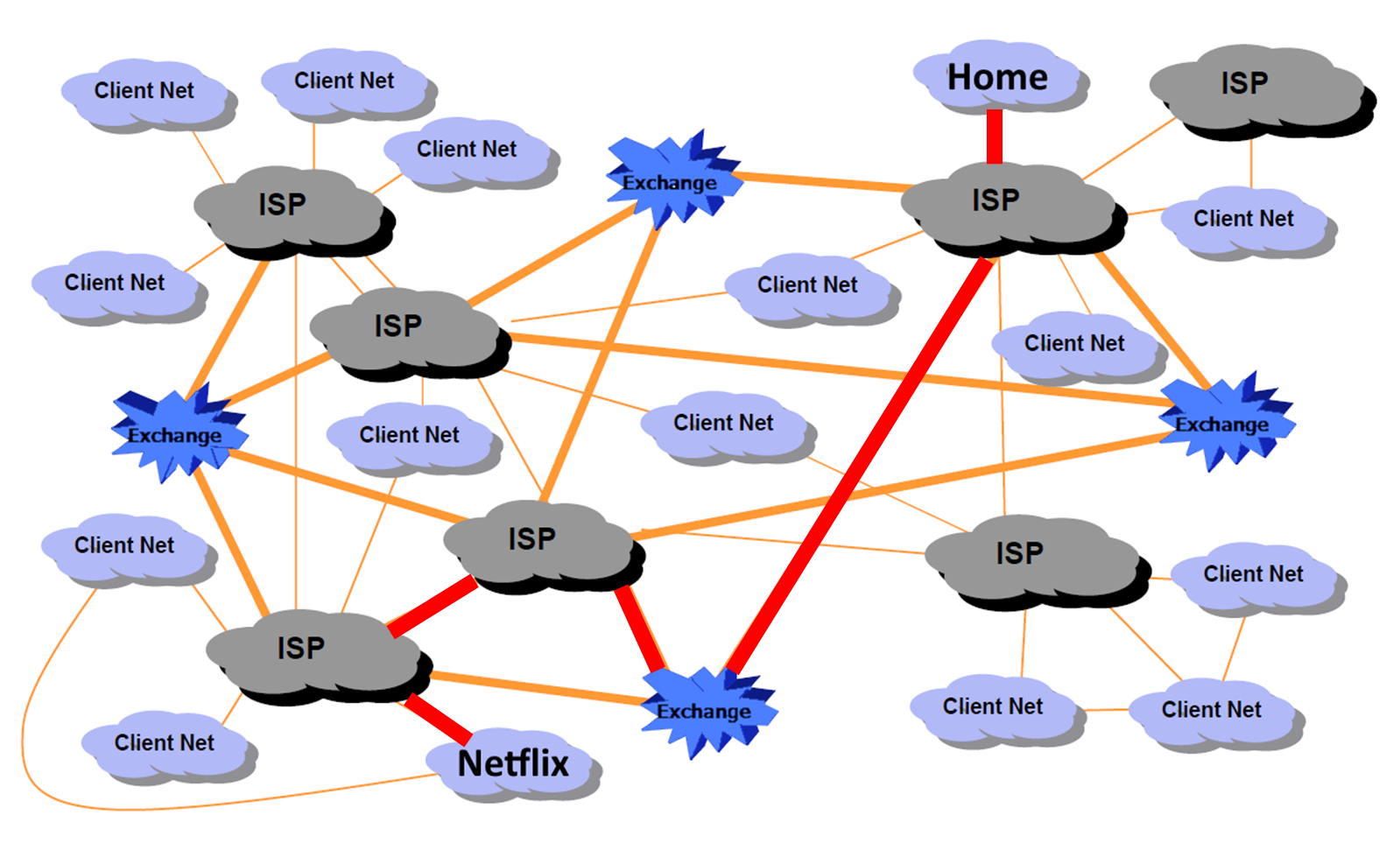
The following images show the route between one's home and Netflix before the agreement with Comcast, the way it is now that the deal has been done and the way it will end up if Comcast has their way.

Before the agreement, transit ISPs connected us to Netflix servers.
Now our ISPs connect us straight to Comcast.
After the merger, Comcast will be my ISP.

Saturday, February 22, 2014

Google may give us some ISP competition

Just after we heard the competition-reducing news of Comcast buying Time Warner Cable, Google has announced that they may become a competitor in the ISP market -- they are evaluating 34 cities in 9 metropolitan areas as potential Google Fiber installations.

This is not a complete surprise. A Google executive announced their intention to expand last year, stating that Google Fiber is "a great business to be in."

Google is evaluating nine metropolitan areas, but none are big like New York or Chicago. I know a large installation would be daunting, but it would also be a learning experience and at least one big city mayor, Eric Garcetti in Los Angeles, is looking for a fiber partner.

(Full disclosure on that last "hint" for Google -- I live in Los Angeles, and my chance for getting fiber dropped to zero when my phone company, Verizon, decided to get out of that business).

Friday, January 31, 2014

Cable companies back bill to prohibit municipal broadband in Kansas -- the same old story

Google Fiber started in Kansas City Missouri, but it has spread to nearby communities in Kansas and there has been speculation that it might expand nation wide. Olathe, Kansas is to be the first Google Fiber community in Kansas.

Well, the cable companies don't like that so they have introduced a bill in the Kansas Legislature to prohibit cities from offering or partnering to offer Internet service.

The bill is called the "Municipal Communications Network and Private Telecommunications Investment Safeguards Act." Opponents suggest that it should have been called the "Incumbent Telecommunications Company Protection Act."

Congress attempted to create competition with the 1996 Telecommunications Act. This is just the latest in endless court and legislative battles waged by incumbent phone and cable companies to thwart the will of Congress and stifle competition.

(I worked on a municipal network in Hermosa Beach, California that was stopped in 2006 by pressure the local cable company put on the City Council).
-----

Update 2/4/2014

Hearings on community broadband services bill have been postponed (http://bit.ly/1brRTCU). It sounds like they are getting some negative feedback, as well they should.

Monday, September 23, 2013

Beware of the Nexus 7 and the Hush-a-Phone -- they may damage your network

I heard a rant by Jeff Jarvis on the This Week in Google podcast. It seems that he got a new Nexus 7 tablet and Verizon refused to add it to his LTE account because it had not yet been verified. He tested it with a SIM from a different device and it worked fine. He also pointed out that Google had advertised that it would work on the Verizon network and that the terms of Verizon's FCC license required open access to any compliant device.

(He has documented the story in this blog post).

Verizon said they had to certify the device -- have it tested to be sure it would not harm their network.

That reminded me of the Hush-a-Phone. In 1956, the courts overruled an FCC ban on Hush-a-Phone, rejecting AT&T's claim that it posed a risk to the network and would degrade call quality.

Here is a picture of the Hush-a-Phone -- you can decide how grave the risk was:


What if AT&T had prevailed in the Hush-a-Phone case and the subsequent case of the Carterphone, a device for patching radio calls into the telephone network? (Yeah, hams used to do that).


It seems that Verizon is unclear on the meaning of "open" -- they are still nostalgic about the good old days, when only the phone company could sell you things like phones, modems, DSL routers, answering machines, etc.

Wednesday, May 08, 2013

Will Google Fiber go nationwide?

Today's New York Times has an article on yanking US broadband out of the slow lane. Might Google Fiber inspire broadband competition? Better yet, might it be broadband competition? (One also wonders why this article appeared now -- might it have been encouraged by Google PR)?

The article presents a good overview of the mediocre state of broadband connectivity in the US. It prominently features Google Fiber as a possible solution, quoting Milo Medin, who heads the Google Fiber project and was a co-founder of @ Home Networks, a pioneering first attempt to bring broadband to homes shortly after the passage of the 1996 Telecommunication Act (which was designed to create competition, but failed).

Google's announcement that they would install Google Fiber in Provo, Utah, drove speculation that they were planning to go nation wide. This article does nothing to dampen that speculation.

-----

Update 5/31/2013

Speaking at the Fiber-to-the-Home Council meeting, Milo Medin, Vice President of Access Services for Google, told an audience of city planners, engineers, and mayors that Google Fiber is a business that they expect to make money from -- "a great business to be in."

Medin admitted that at first Google didn't see Google Fiber as a viable business -- it was to be a testbed for Google services. At that time, Google was lobbying for a Gigabit networking bill in Congress, but "someone on the management team" said "If we really think this is important, why whine to the government, when we can do it ourselves?"

Rather than worry about Federal or State governments and subsidies, as the phone and cable companies do, it seems that cooperation with cities is a strategic part of their plan.

The project began with a call for proposals from cities wishing to become the first gigabit testbed. Medin said "We thought a handful of cities would say they were interested ... Then we saw that 1,100 communities replied. No one at the time thought there was a real business here. But that changed when we saw the interest."

Google wants to be your ISP! Wow -- when do the come to Los Angeles?

-----

Update 6/25/2013

Seattle will have gigabit connectivity for $80 per month with no installation fee with a one year contract. This sounds pretty much like Google Fiber and lends credence to Google's claim that this is a real business.

One caveat -- it is not clear which parts of the city will be covered. As of last December, they spoke of 14 neighborhoods, shown on this map:


-----

Update 7/2/2013

This article and picture gallery profiles Startup Village, home to more than 20 startups in a cluster of small houses in Kansas City. The village was established to take advantage of Google Fiber, but the community of local start-ups is even more important than 1Gbps speed.


-----

Update 7/15/2013

More innovation spurred by Google Fiber -- The KC Gigabit Education Project.


-----

Update 8/1/2013

Google to offer Starbucks WiFi (http://bit.ly/142g2Mp). Google says that most locations should see 10x faster Internet speeds than currently available. Every single one of the over 7,000 locations will see this increase in speeds, and the rollout should be completed over the next 18 months. And, Starbucks in areas with Google Fiber access will utilize Google Fiber and its gigabit Internet speeds.

Bob Frankston (http://bit.ly/1edA9J7) has pointed out that as browsing speed rises, ad clicks rise, so Google has a hidden motive for gigabit speed.

-----

Update 8/5/2013

Japan and Korea lead in fiber penetration -- US 14th

The Organisation for Economic Co-operation and Development (OECD) reports that Japan and Korea lead the world in fiber broadband penetration. The US is 14th, trailing Turkey. I've given up on ever seeing FIOS in my neighborhood -- let's root for Google Fiber.

More statistics at the OECD Broadband Portal.

-----

Update 8/15/2013

DSL Reports has seen an internal memo sent to Comcast employees, which says they will revise their bundle offerings and pricing in Provo, Utah in response to Google Fiber.  Google is offering aggressive competition, and, if the leaked report is accurate, Comcast will still be much slower than Google.

_____
Update 10/26/2014

Google has a 180 day license to experiment with millimeter wirelss transmission. The high frequency transmission would cover only short distances, but, if they are thinking of taking Google Fiber nationwide, they may be looking for a technology to cover the last few hundred yards from an access point on a street to the houses on the block. Google (or municipally owned fiber) would provide high speed backhaul.

_____
Update 10/27/2014

Google is evaluating 34 cities for the possibility of installing Google Fiber.


-----
Update 10/29/2014

Google has a 180 day license to experiment with millimeter wireless transmission. The high frequency transmission would cover only short distances, but, if they are thinking of taking Google Fiber nationwide, they may be looking for a technology to cover the last few hundred yards from an access point on a street to the houses on the block. Google fiber (or municipal fiber, as in Stockholm) would provide high speed backhaul.

-----
Update 3/2/2015

Milo Medin, VP of Access Services at Google Fiber, spoke of problems they have dealing with city bureaucracy at the Comtel Summit last week.

Medin mentioned byzantine permission processes, inaccurate information about infrastructure and the reluctance of owners of multi-unit buildings to cooperate as hurting some cities chance to attract Google Fiber.

His remarks must have left folks from the incumbent ISPs smiling and mumbling "we told you so." They also make me curious as to the nature of the deals Google makes with the cities. Does Google expect some sort of advantage over the incumbents? Do they prohibit municipal ownership of infrastructure in the future?

Google is offering a terrific deal in Fiber cities today, but what will happen in, say, ten years if Google advertising revenue has flattened and the company has a lot of employees and overhead? Will they become just another oligopolistic ISP?

-----
Update 3/4/2015

Under Title II, Google can now access telephone poles, simplifying the installation of Google fiber, but what fees do they have to pay for that access and what sort of red tape permitting may they face?

When the 1996 Telecommunications Act ordered incumbent telephone companies to grant competitors access to their lines, the incumbents stifled those efforts. Could something similar happen with respect to phone pole access? (That is not a rhetorical question -- I don't know).

Saturday, February 09, 2013

Why I signed a petition to name Susan Crawford next head of the FCC

I just electronically signed the Whitehouse.gov petition to appoint Susan Crawford as the next head of the Federal Communications Commission. Let me tell you why.

The Internet was invented and deployed in the US. At one time, nearly all international traffic flowed through our National Science Foundation network. Today, our Internet is mediocre by the standards of developing nations and slipping.

In a recent interview by Bill Moyers, Crawford says U.S. Internet access is slow, costly and unfair and tells how we got in this fix. (The video is embedded below).

Here are a few quotes from the interview:
"What's happened is that these enormous telecommunications companies, Comcast and Time Warner on the wired side, Verizon and AT&T on the wireless side, have divided up markets, put themselves in the position where they're subject to no competition and no oversight from any regulatory authority. And they're charging us a lot for internet access and giving us second class access."

"So there's been a division. Cable takes wired, Verizon/AT&T take wireless. They're actually cooperating."

"In almost 20 states in America it's either illegal or very difficult for municipalities to make this decision for themselves."

"This is a moment when we have to separate out content from conduit. It should not be possible for a local cable actor or any distributor to withhold programming based on volume ...Everybody should get access to the same stuff at the same price and they should be announced prices."

"Michael Powell, who served as F.C.C. chairman for four years in the mid-2000s, is now the cable and telecom industry's top D.C. lobbyist."

"Meredith Attwell Baker who was one of the F.C.C. commissioners who approved Comcast's merger with NBCUniversal, left the agency four months later to join Comcast as a highly paid lobbyist."
Further reading:
Dan Gillmor, director of the Knight center for digital media entrepreneurship at Arizona State University, explains why Susan Crawford should be the next head of the Federal Communications Commission (http://bit.ly/XjaNEm).

Cory Doctorow, Internet activist, journalist and science fiction, agrees that Crawford should run the FCC ( http://bit.ly/WYv8fm).
I searched for a rebuttal -- someone arguing against Crawford's appointment -- but was unable to find one. Please let me know if you know of one.
-----

Update 1/28/2014

How cable companies "compete" -- dividing up the cable market

Comcast is near a deal to buy New York City, North Carolina and New England cable assets from Charter Communications Inc., but that sale is contingent upon shareholders approving Charter’s takeover bid for Time Warner Cable. Since Comcast would no longer be in the running for Time Warner Cable, they will probably accept Charter's offer.

This trading of monopoly territory reminds me of the way rival drug gangs divide up corners and housing projects -- I wonder if these guys watch "The Wire."