Showing posts with label Comcast. Show all posts

Thursday, May 18, 2017

Comcast and Charter -- declining competition among ISPs

I am not an expert on the retail ISP industry -- just a dissatisfied customer of the monopoly service provider in my neighborhood -- but the following events have caught my attention during recent years.

In 2012, Comcast and Verizon agreed to stay out of each other's markets -- Comcast would focus on landline Internet and Verizon mobile Internet.

Last year, Charter Communications merged with two other companies to become the second largest ISP in the country.

This month, Comcast and Charter Communication have agreed to cooperate on mobile connectivity, to "explore potential opportunities for operational cooperation" -- "creating common operating platforms, technical standards development, and harmonization, device forward and reverse logistics, and emerging wireless technology platforms."

They also agreed not to make a major acquisition in the wireless sector without the other’s involvement for one year.

They will both resell Verizon wireless service.

President Obama & the Comcast CEO
(source)
A visual inspection of the coverage maps of Charter and Comcast does not reveal a lot of geographic overlap in their current service areas. (I'd be curious to see the actual statistics).

Many of us had only one or two choices for a landline ISP during the Obama administration and mobile connectivity remained a stable oligopoly. It does not sound like Charter and Comcast will be fierce mobile connectivity competitors, does it?

Capitalism needs competition to work well and a lack of competition offers a partial explanation for the US, home of the ARPANet, being ranked 15th on the International Telecommunication Union ICT Development Index. It certainly does not look like we can expect more ISP competition during the Trump administration.


Monday, August 11, 2014

An estimate of Netflix's "fast lane" fee to Comcast -- $.86 per subscriber per month

Netflix, ISPs and transit providers blame each other for poor Internet performance. The public would be well served by transparency -- seeing the cost and traffic data underlying the debates on network neutrality and, more important, the high cost of US Internet service and lagging investment in US Internet infrastructure.

Generator Research has estimated the cost of delivering Netflix content in their report Over-the-Top Television, 2014, which includes an estimate of the cost to Netflix and Comcast of delivering Netflix content and of the fee Netflix is paying Comcast.

They begin by noting that Netflix's total cost of revenue (including content, delivery and other costs) was reported as $1,849 million in 2013 and they had an average of 29 million US subscribers for the year, then make the following assumptions:
  • The cost of content is 80% of the total cost.
  • The cost of delivery is 80% of the remaining cost.
  • 75% of delivery cost is in the access network, 25% in the ISP network.
  • Comcast earns $30 per month per subscriber, $24 of which is as a result of delivering Netflix traffic.
  • 80% of Comcast traffic is due to Netflix.
Based on this, they estimate the total cost of delivering Netflix content as $2 per subscriber per month, with Netflix paying $.86 and Comcast $1.15. Assuming they split the cost in proportion to their monthly revenue ($7.99 for Netflix and $24 for Comcast), Generator guesses that Netflix's fee to Comcast is around $.28 per month per subscriber -- less than 5% pf the cost of a subscription. (Compare that to my ISP increasing my bill by 5-10% every year because, as a monopoly provider, they can).

Generator's conclusion is based upon several assumptions, which you may question, but it is a starting point in estimating cost of content delivery.

-----
Update 8/26/2014

Whatever the marginal cost, someone has to pay for investment in Internet infrastructure. Netflix CEO Reed Hastings says it would cost the ISPs very little to upgrade in order to provide the level of service they advertise to their customers.
It's worth noting that Netflix connects directly with hundreds of ISPs globally, and 99 percent of those agreements don't involve access fees. It is only a handful of the largest U.S. ISPs, which control the majority of consumer connections, demanding this toll. Why would more profitable, larger companies charge for connections and capacity that smaller companies provide for free? Because they can.
Hastings' post is one in a series on How to Save the Net running at Wired.com.

-----
Update 9/24/2014

Netflix CEO Reed Hastings was on a panel at the Cable and Telecommunications Association for Marketing EuroSummit Conference in Copenhagen last week. Mike Fries, CEO of Liberty Global was a fellow panelist. Hastings "jokingly" offered Fries the following deal:
Consumers are choosing Netflix and if we’re supposed to pay some of the cost of the network, maybe we should get some of the broadband revenue ... we’ll pay 10% of your network costs if we get 10% of broadband revenue. Or we’ll pay 10% of your network costs if you want to pay 10% of our content costs.
Hastings also stated that
The crazy thing in this whole debate is the actual amount of money being talked about is trivial to both of us – but we’re both worried on both sides about the precedent and what does it mean in the longterm?

Monday, June 09, 2014

Netflix blames Verizon, Verizon blames Netflix -- let's see the data.

Netflix says Verizon is a streaming bottleneck, Verizon says the congestion is upstream -- we need data not accusations.

Netflix recently showed messages like this one when they had to adjust the bit-rate on their streams to FIOS customers:

Verizon responded, claiming that the congestion was upstream from FIOS, and threatened legal action. Netflix says they will drop the messages for now.

The public and regulators need more data and transparency, not less. For example, here are Netflix data rate histories for Google Fiber, Comcast, Verizon FIOS and Verizon DSL:

This data clearly shows the improvement in Comcast speeds when they and Netflix agreed to terms in February. (One wonders how that rapid improvement was achieved and how much investment it required).

Verizon DSL is slow because of the technology. Those Verizon customers who can get FIOS are surely better off, but one wonders why Verizon fiber is so much slower than Google fiber and Comcast cable.

If Netflix congestion is upstream from Verizon, they should present data demonstrating that.

-----
Update 6/10/2014

Google also publishes data on YouTube streaming performance for ISPs. I checked the performance of Time Warner Cable, my not-so friendly ISP, in Los Angeles, my city.

The following graph shows YouTube video consumption for time slots beginning at 6 AM and peaking at 9 PM.


Google also reports the percent of the time an ISP delivers high definition (720p), standard definition (360p) and lower quality. For me, the worst performance, HD 81% of the time and SD 19%, occurs between 9-10 PM.


This is one more source of ISP performance data -- check it out and see how your ISP rates compared to others in your location (if there are others).

-----
Update 6/13/2014

The FCC will scrutinize the pay for service deals Netflix and Comcast and Verizon. They will also look at others, including Google.

FCC Chairman, Tom Wheeler, said he already had copies of the contracts, but I hope he asks the companies to provide traffic data and also disclose the cost of the infrastructure investments they make to keep service reasonable.

-----
Update 7/7/2014

YouTube has joined Netflix in linking to data when video delivery slows down. I was watching a YouTube video that began to stutter. When it paused to rebuffer, I saw this message:

When I clicked on the find out why link, it took me to Google's Video Playback Checklist, which lists things that might go wrong and suggests fixes -- no blame on your ISP -- so far. If none of those fixes help, they also provide a link to the Google Video Quality Report (described above). As we asked -- they show us the data.

-----
Update 7/19/2014

I've asked to see congestion data and to know the cost of alleviating the bandwidth shortage noted by Netflix customers and other Internet users. Mark Taylor, VP of Content and Media at Level 3, a transit provider used by Netflix, has given us some data and some costs. This diagram shows data at one of the of the ten exchange points between Verizon and Level 3:


We see that the congestion between Level 3's customer (Netflix) and a Verizon retail customer occurs in the forwarding of packets between their routers (in the same building). Both the Level 3 and Verizon networks are uncongested (green) but the links between their routers are congested (red).

That is the data for this exchange point, but what about the cost of alleviating the problem? Taylor says it is a few thousand dollars and five minutes work to install 10gb port cards in the routers. He says they have been asking Verizon to install the cards for many months and offers to have Level 3 pay for them. He says he will throw in the short cables between the routers.

If more capacity were needed after those eight port cards were installed, new equipment would have to be purchased, but that would be a small fraction of the cost of the networks the routers connect.

Note that the above diagram is based on a Verizon post describing the situation at the Los Angeles exchange point. Furthermore, it shows under utilization on the Verizon network -- no need for data caps in that case :-).

-----
Update 7/24/2014

David Young, Verizon's Vice President for Regulatory Affairs, has posted a reply to the claim by Mark Taylor of Level 3 that Verizon is causing Internet congestion. Young says the problem is not datacenter exchange point congestion, as Taylor claims, but congestion in the Level 3 network. In fact he says that:
Level 3 insists on only using its existing settlement-free peering links even though, as Level 3 surprisingly admits in their blog, these links are experiencing significant congestion.
This is Verizon's view of the situation -- transit providers like Level 3 are the problem:

But, when I looked back at Mark Taylor's post, I saw no such admission. In fact, Taylor says "our network has plenty of available capacity" and goes on to state that:
I can confirm once again that all of those thousands of links on the Level 3 network are managed carefully so that the peak utilizations look very similar to those Verizon show for their own network – IN BOTH DIRECTIONS (his caps).
These are conflicting statements -- who to believe?

Considering Verizon's track record, I'd give the benefit of the doubt to Level 3. Verizon promised to install FIOS fiber in my neighborhood several years ago, but subsequently changed their mind and decided instead on a "gentleman's agreement" dividing the wireless (Verizon) and land-line (cable companies) ISP markets. Indeed Verizon has a track record of broken promises -- Bruce Kushnick has documented 300 billion dollars worth of them.

That history makes me suspicious that Level 3 is telling the truth, but it is not proof. Proof would require transparency on both sides. Level 3 and Verizon should show us the data -- let's see the traffic logs for your networks. (Or at least let the FCC staff see them).

-----
Update 10/15/2014

I've asked to see the data. It's not congestion data, but Generator Research has estimated the cost of delivering Netflix content in their report Over-the-Top Television, 2014, which includes an estimate of the cost to Netflix and Comcast of delivering Netflix content and of the fee Netflix is paying Comcast.

Their estimate of Netflix's "fast lane" fee to Comcast is $.86 per subscriber per month. That is a small portion of the inflated monopoly/oligopoly prices we pay to Comcast and other Internet service providers. It seems to me that we should be paying more attention to the lack of competition in the ISP industry than to network neutrality.

-----
Update 11/9/2014

M-Lab monitors Internet performance and has published a report on ISP Interconnection and its Impact on Consumer Internet Performance.

The report concludes that
Using Measurement Lab data, and constraining our research to the United States, we observed sustained performance degradation experienced by customers of Access ISPs AT&T, Comcast, Centurylink, Time Warner Cable, and Verizon when their traffic passed over interconnections with Transit ISPs Cogent Communications (Cogent), Level 3 Communications (Level 3), and XO Communications (XO). In a large number of cases we observed similar patterns of performance degradation whenever and wherever specific pairs of Access/Transit ISPs interconnected. From this we conclude that ISP interconnection has a substantial impact on consumer internet performance -- sometimes a severely negative impact -- and that business relationships between ISPs, and not major technical problems, are at the root of the problems we observed.

It seems that interconnection between transit ISPs and ISPs that connect customers (access ISPs) is indeed the weak link in the content delivery chain.


The above figure gives an overview of download throughput between Access ISP and Transit ISP pairs during 2013. For each of the 28 graphs, the Y axis shows the % of hours with the given download throughput, and the X axis shows the download throughput (Mbps). Red, on the left, indicates sub-broadband speeds (download throughput below 4 Mbps). What this table demonstrates is not simply a proliferation of performance issues, but that these issues cannot be laid at the feet of any one Access ISP, or any one Transit ISP: no Access ISP performs badly to all Transit ISPs, and no Transit ISP performs badly for all Access ISPs. Therefore, if the problem is not at one end, and not at the other, it must be in the middle around the interconnection between the two.

For example, my ISP, Time Warner falls below 4 Mbps (red) over 30% of the time when delivering Cogent packets, but does much better with data from other transit ISPs.

Wednesday, June 04, 2014

A tale of two industries: package delivery and Internet service

Why do customers like the package delivery industry and dislike information delivery service? Competition and the US Postal Service.

Comcast CEO Brian Roberts recently complained that Netflix paid the Post Office for delivery of small packages (DVDs), but did not want to pay Internet service providers (ISPs) to deliver the same content over the Internet.

In his view, the Post Office is in the consumer package delivery business and Comcast and other ISPs are in the information delivery business and both should be paid for their service.

The University of Michigan publishes the American Customer Satisfaction Index in which they rate both companies and industries. Let's look at their latest ratings of the consumer package delivery and ISP industries.


They rate 48 industries and it turns out that the package delivery industry is rated seventh overall and the ISP industry is 48th. Furthermore, merger hopefuls Time Warner Cable and Comcast are the lowest rated.

How might we explain the differences in customer satisfaction in these two images that Mr. Roberts considers similar? The difference is that there is competition in customer package delivery between Federal Express, UPS and the Post Office. We would normally expect three companies to tacitly establish oligopoly prices, but in this case the Post Office is disruptive -- Federal Express and UPS must compete with a government agency.

Monday, June 02, 2014

The best video ever on network neutrality and the state of the Internet in the US

As long as analysts, geeks and lobbyists are the only folks who care about Internet infrastructure and policy, we can be pretty sure that nothing will improve, but what if the general public becomes interested?

Last night I watched episode five of the HBO comedy news cast "Last Week Tonight" in which host John Oliver narrated a 13 minute segment on network neutrality and the sorry state of the Internet in the United States.


I may be a biased geek and disgruntled consumer, but the segment was right on and, more important, extremely funny.

Is the Internet finally becoming a politically important issue? (Be sure to listen to the audience reaction at the end of the clip before you answer).

----
Update 6/26/2014

FCC Chairman Tom Wheeler responded to the video and Oliver followed up with another very funny segment.

------
Update 6/28/2014

Terry Gross interviewed John Oliver about his new HBO show -- the first 7 minutes are devoted to Oliver's Internet piece -- funny and informative.


Consumer groups and big corporations like Google and Facebook agreeing on net neutrality is like Lex Luther agreeing with Superman.

Comcast CEO Brian Roberts explained that there is no competition between Comcast and Time Warner Cable.

Picking Tom Wheeler to head the FCC is like hiring a dingo as your baby sitter.

President Obama golfing with Comcast CEO Brian Roberts

Comcast speed dips then recovers rapidly after the Netflix agreement is made

What caused the sudden improvement in Comcast service and how much did it cost?

As shown here, Netflix download speed began dropping for Comcast customers last November and began picking up in February. It rose another 2% in April.


What happened? The cynical, but quite plausible, answer is that Comcast refused to upgrade their equipment while negotiating with Netflix on fees for faster service, resulting in poor performance and angry customers, and they made the necessary investment after a deal was concluded in February.

Infrastructure investment is central to the network neutrality debate. If this improvement was due to investment upstream from Comcast, they should present data demonstrating that. Regardless of who made it, I would like to know how much we are talking about here -- what did it cost to increase performance so dramatically?

The public, the FCC and the FTC need that sort of transparency to formulate policy that will incent infrastructure investment.

Saturday, May 31, 2014

Comcast CEO Brian Roberts opens his mouth and inserts his foot -- who will invest in Internet infrastructure?

If ISPs have insufficient incentive to invest in infrastructure, who will? Google? Telcos? Government (at all levels)? Premises owners?

At a recent conference, Comcast CEO Brian Roberts rationalized charging Netflix to deliver content by comparing Comcast to the Post Office, saying that Netflix pays to mail DVDs to its customers but now expects to be able to deliver the same content over the internet for free. He forgot to mention that the Post Office does not charge recipients for those DVDs.

The issue is infrastructure investment and it is in our collective interest for that investment to be made. Comcast could invest in the infrastructure needed to insure rapid delivery of Netflix and other's traffic and pass that cost on to the paying customers at a fair rate of return on the investment. But, they make more money by refusing to upgrade their infrastructure, thereby slowing delivery of content and making their customers dissatisfied with content providers like Netflix. If there were competition in the ISP market, customers would switch to the ISP that provided the best price/performance, but since there is not competition, Comcast is able to reap monopoly profits. If they happen to have a competitor in a given location, perhaps AT&T, they together reap oligopoly profits.

What is the solution? One hope is for Google Fiber to provide meaningful investment and competition, which might work in the short run, but one has to wonder about the long run -- cities with Google Fiber would still be oligopolies.

Another hope is Verizon and other phone companies competing agressively, but it seems the cable and phone companies have reached a gentleman's non-competition agreement with phone companies focusing on mobile connectivity and cable companies on fixed connectivity.

If the ISPs will not make the necessary investments, government (at all levels) must make wholesale infrastructure investments and apply regulation as we do with roads and utilities. There is also a role for home and building owners investing in the last "100 meter" infrastructure as we do with water, gas and sewers.

-----
Update 6/2/2014

Data on Comcast performance before and after their agreement with Netflix


-----
Update 6/5/2014

Americans consumers are less satisfied with the ISP industry than any other industry, yet are satisfied with the package delivery industry. Both deliver things, but the package delivery industry has private and public competition.


-----
Update 6/7/2014

There is a long of discussion (250 comments) of this post on Slashdot.

Monday, May 19, 2014

Comcast expects to have data caps, but not competition

Last week, a Comcast executive VP, David Cohen, predicted that within five years all their customers would have data caps.

It turns out they have been experimenting with 300 GByte monthly caps in some markets and Cohen mentioned both 300 and 500 GByte cap possibilities.

Since Comcast is trying to acquire my friendly monopoly ISP, Time Warner Cable (TWC), I may very well end up being one of those capped customers, and that got me and my colleagues on the YATS podcast, wondering how much data we were up and downloading today.

I visited my TWC account and saw my usage for the last few months:


I have no idea what caused the variation, but even the heaviest month was comfortably under 300 GBytes. But, how typical is my usage? I am a cord cutter, which doubtless leads to atypically high usage, but there are only two users in our home, and we do not watch a lot of video or stream a lot of music.

I can easily imagine our two-person household going over the 3 or even 500 GBytes as video quality improves and more content is available.

But, our usage is a mere anecdote. Sandvine monitors global Internet traffic patterns, so I checked their Global Internet Phenomena Report for the first quarter of 2104 to get a more representative picture. This is what they observed in North America:


Folks were well under 300 GBytes.

But, they drilled down, estimating which users were cordcutters and typical subscribers and non-streamers:


Obviously there are relatively few cord cutters today, but aren't we in a transition to IP TV? The distinction between "TV" and "the Internet" is broken -- it's all bits.

By Sandvine's estimates, cord cutters are averaging over 200 GByte today. Where will they be in five years, when there is a lot more video material on the Net and average video resolution is a lot higher?

Comcast will adjust their pricing to maintain or increase revenue during this transition period.

They will be able to do that because they are a content provider as well as an ISP so they will be able to discriminate in favor of their content. Furthermore, they are big and getting bigger, so they will be able to extract increasing delivery fees from their content-provision competitors.

Don't get me wrong -- I do not oppose the idea of usage-based billing per se. (It would provide the answer to the ISP's claim that network neutrality is bad because it rewards bandwidth hogs). I would be happy to be billed by the GByte or whatever if there were ISP competition. If I could easily switch between several fast, reliable ISPs (as my son who lives in Korea can), they would not be able to set prices at will. But, sadly, that is not the case in the US.

-----
Update 5/20/2014

On a related note, Comcast and their merger target Time Warner Cable, were the lowest ranked companies on the latest American Consumer Satisfaction Index for the first quarter of 2014.

-----
Update 5/29/2014

The New York Times has published an editorial favoring rejection of the merger between Comcast and Time Warner Cable.


Wednesday, May 14, 2014

NBC's (Comcast's) sad live stream of the Tour of California bike race

I've taken an in-depth look at the live streaming coverage of the Olympic Games and the Tour de France in past posts so was curious to see what NBC's coverage of the Tour of California was like.

I liked NBC's coverage of the Tour de France last year, but it seems there is more advertising in this year's Tour of California.

The streaming site opens with the race video in a window surrounded by ads -- the ads cover 2/3 of the screen area:


If you switch to full screen viewing, most of the ads disappear, leaving only a think group of display ads across the top of the screen and an occasional pop-up ad or spoken plug by the announcer. But, just as you begin to relax, there is a commercial break. I timed the commercials for an hour and they are on about 30 percent of the time -- enough to wreck the experience for me.

I did not keep track of the number of commercials during last year's Tour de France, but I enjoyed it -- so either there were more commercials for this event or my tolerance for commercials has gone down since I have been a cord cutter for a couple of years.

Last year, NBC charged a fee to watch the Tour de France, but the Tour of California is free ... as long as you have an approved Cable TV subscription:


Note that Comcast Xfinity heads the list of those approved providers. But, wait, doesn't Comcast own NBC? Aren't they trying to acquire Time Warner Cable (home of the LA Dodgers)? Doesn't NBC have the rights to the Olympic Games through 2020 and the Tour de France through 2023?

If this is a glimpse of the future of live coverage of events on the Internet -- gratuitous bundling and conflicts of interest -- it is sad, but familiar.

-----
Update 5/15/2014

The viewer has a couple of neat features (one of which is broken, but its a good idea regardless).

The first is an instant replay button -- click it and the video rewinds about 15 seconds. Click it twice and it rewinds about 30 seconds, etc. Very handy.

The second is a good idea, but buggy (for now). You can elect to Share a Play, as shown here:


The problem is that the feature is broken -- I tried to share a play and it took me to the Golf channel instead, which was not even streaming at the time.


Note also that they carelessly lifted this from another sport -- we do not have "plays" in bike racing :-).

Thursday, May 08, 2014

ISPs have the lowest American Customer Satisfaction Index.

The ISP industry ranks 48th out of 48 industries on the American Customer Satisfaction Index. Subscription TV is 47th.

Individual companies are also rated. Large companies are rated separately and smaller ISPs are lumped into "all other." Here are the ISP customer satisfaction indices:

Verizon Communications (FiOS) 71
Cox Communications 71
AT&T (U-verse) 68
Charter Communications 65
CenturyLink 65
Time Warner Cable 63
Comcast 62
All others 71

I am happy to see that my ISP, Time Warner Cable, which I have commented upon in previous posts, is not the lowest rated company in this dismal industry -- that honor belongs to their hopeful merger buddy, Comcast.

-----
Update 5/19/2014

The latest quarterly survey results are out and Internet service providers are now the lowest ranked industry and merger buddies Time Warner Cable and Comcast are now the two lowest ranked companies of all industries. The inverse correlation between size and customer satisfaction still holds for the ISP industry, so I am confident that if Comcast acquires TWC, they will continue to set dissatisfaction records for years to come.


-----
Update 6/11/2014

I just got a copy of the latest ACSI company ratings from the University of Michigan. Comcast is no longer the second lowest rated company in the survey -- that honor now belongs to Time Warner Cable (TV). My ISP, Time Warner Cable (ISP), retained its position as the lowest ranked company -- 230th out of 230 companies.

The ISP industry remains at the bottom of the list, with subscription television services next to last

The American public is fed up with the cable TV and Internet service companies (and we are ridiculing them) -- let's hope that translates into political pressure.

-----
Update 6/23/2016

Time Warner Cable and Charter Communication recently merged. Now a US Senate report concludes that they routinely overcharged customers and failed to issue refunds.

ISPs are aggressively pursuing their goal of remaining the industry with the lowest customer satisfaction index and worst customer service in the US.

The Senate subcommittee’s report also said that consumers are frustrated by the ongoing rise of the cost for cable and satellite TV, with some packages increasing up to 33% since 2011 A copy of the report is available here.

Don't you love monopolies?

Saturday, March 22, 2014

Netflix CEO Reed Hastings has posted a call for “strong net neutrality.”

In a post entitled Internet Tolls And The Case For Strong Net Neutrality, Netflix CEO Reed Hastings says that deteriorating customer experience fored him to agree to pay Comcast an interconnection fee. While that was a necessary short term step, he argues that, in the long run, such tolls would lead to escalating fees. Soon, every large ISP would be charging interconnection feesa toll, as depicted here:


Here are a couple of quotes from Hastings’ post:
For any given U.S. household, there is often only one or two choices for getting high-speed (10 Mbps) Internet access and that’s unlikely to change.

and

When an ISP sells a consumer a 10 or 50 megabits-per-second Internet package, the consumer should get that rate, no matter where the data is coming from.
As a consumer, I like the sound of that second quote -- I think that is what Hastings considers “strong net neutrality.” But, if the ISPs are not allowed to charge a “toll” for your traffic, won’t they pass their interconnect cost on to us consumers?

Isn't the monopoly market the real problem? If Netflix and others do not pay a fee to the ISP, won't they raise consumer prices?

What can be done to solve the real problem (for individuals and society) -- a lack of ISP competition?

Regulation or competition from local government-operated networks are two traditional answers and there are hopeful signs on both fronts. The FCC wants to formulate new rules with regard to net neutrality and is considering measures to overturn state laws restricting public broadband. Perhaps the citizens (voters) are getting fed up and the FCC is beginning to hear them -- is there a glimmer of light at the end of the tunnel?

-----
Update 9/24/2014

Netflix CEO Reed Hastings was on a panel at the Cable and Telecommunications Association for Marketing EuroSummit Conference in Copenhagen last week. Mike Fries, CEO of Liberty Global was a fellow panelist. Hastings "jokingly" offered Fries the following deal:
Consumers are choosing Netflix and if we’re supposed to pay some of the cost of the network, maybe we should get some of the broadband revenue ... we’ll pay 10% of your network costs if we get 10% of broadband revenue. Or we’ll pay 10% of your network costs if you want to pay 10% of our content costs.
Hastings also stated that
The crazy thing in this whole debate is the actual amount of money being talked about is trivial to both of us – but we’re both worried on both sides about the precedent and what does it mean in the longterm?

Monday, March 17, 2014

Recommended podcast: Cable Barons (6:18)

Brooke Gladstone of On The Media interviews communication scholar Susan Crawford, author of "Captive Audience: The Telecom Industry and Monopoly Power in the New Gilded Age."

Crawford opposes the Comcast takeover of Time Warner Cable, and it is not yet a done deal. She says its impact on the markets for content and equipment will be considered along with the ISP market.

Regardless of the Comcast takeover, the Crawford feels the ISP's local monopolies must be addressed through either regulation or alternative (local government) networks.


Monday, February 24, 2014

Comcast is probably not cheating ... yet

Within the last few days, Comcast agreed to purchase Time Warner Cable and Netflix agreed to pay Comcast for direct access to their network. Will Netflix pass the Comcast payments along to us consumers? Will we get better quality and fewer pauses for buffering? Is this the end of network neutrality regardless of anything the FCC might do to restore it? Is this the beginning of the end for the good old Internet we have grown to love?

Maybe not.

It is true that Netflix will be paying Comcast for direct access to their network, but they will save what they had previously been paying intermeidate transit networks like Cogent. The overall cost to Netflix may be more, less or the same -- terms of the deal have not been disclosed. Don't get me wrong -- I doubt that they will be saving money, and, if they do, I am sure they will not pass the savings on to us consumers.

How about speed increases? Netflix has acknowledged performance problems, and this deal should help. It is practically certain that we will see improved performance, even if the blockage was done on purpose. (Hey, that was some good news).

This may not even be a violation of network neutrality. Couldn't the delays have been due to capacity problems of intermediate networks rather than Comcast? Is there evidence that Comcast was dropping or delaying Netflix packets? This is not to say that Comcast was not discriminating against Netflix traffic or that they may not in the future, but, as far as I know, there is no evidence that they did. (Where is Edward Snowden when you need him)?

Don't get me wrong -- I have nothing good to say about my ISP -- Time Warner Cable -- and I am confident that the situation will be even worse if the Comcast deal is approved. That sort of concentrated power cannot be good for anyone except those who have it.

Timothy Lee points out that one result of that concentration may be the elimination of the transit ISPs like Cogent, who are in a competitive market. Comcast and other companies that connect consumers face little or no competition.

GigaOm's Stacey Higginbotham has suggested that transparency -- opening the terms of these deals to public scrutiny -- might be a solution, but I am skeptical.

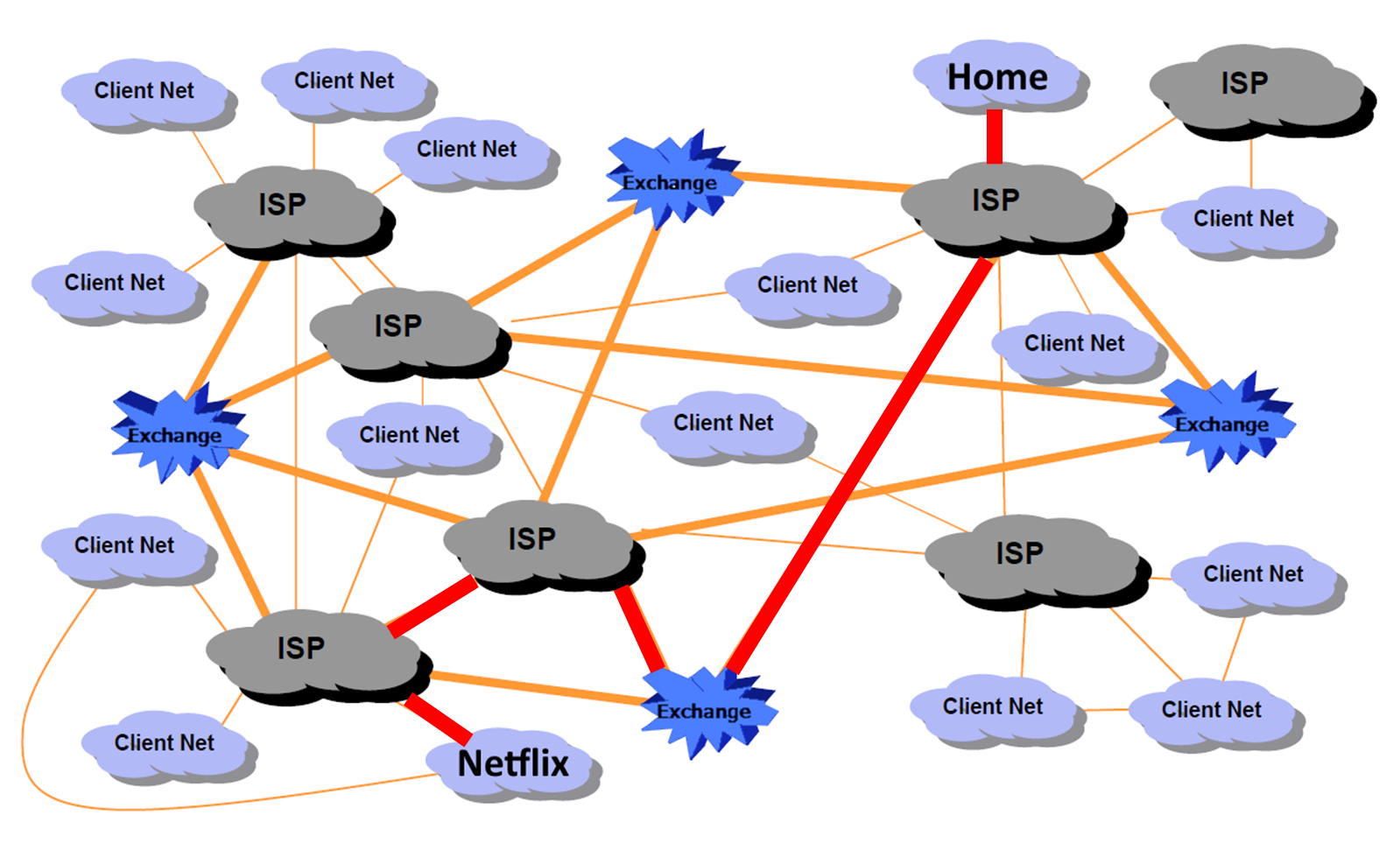
The following images show the route between one's home and Netflix before the agreement with Comcast, the way it is now that the deal has been done and the way it will end up if Comcast has their way.

Before the agreement, transit ISPs connected us to Netflix servers.
Now our ISPs connect us straight to Comcast.
After the merger, Comcast will be my ISP.

Friday, August 24, 2012

FCC approves Verizon + Comcast -- The gentleman's agreement between cable and wireless companies

Verizon Wireless on Thursday won unanimous Federal Communications Commission approval to move forward with its $3.9 billion purchase of 4G LTE spectrum from the country’s largest cable providers. The partnership also enables the cable companies to market Verizon services and in some cases sell their own services inside Verizon stores.

Here is how the industry sees the deal:

Dan Mead, president and chief executive of Verizon Wireless: “This purchase represents a milestone in the industry, and we appreciate the F.C.C.’s diligent work to review and approve the transaction.”

David L. Cohen, executive vice president of Comcast: “a smart and efficient way for Comcast to deliver a broader array of wireless services, and is an efficient deployment of this spectrum.”

And here is the opinion of Gigi B. Sohn, president and co-founder of Public Knowledge, a nonprofit organization based in Washington that promotes an open Internet:

“By allowing Verizon and the cable companies to sell each other’s services, the D.O.J. and the F.C.C. are acknowledging what has been clear for some time — that broadband competition policy in the United States has failed."

I have to agree with Gigi Sohn. The US congress tried to foster competition with the 1996 Telecommunication Act. The idea was that the incumbent telephone companies would allow competitors to use their facilities at wholesale rates to compete as retail level service providers. The telephone companies drug their feet and fought at the state and local level to keep that from happening, and they succeeded.

This is what William Kennard, who, as chairman of the F. C. C. from 1997-2001, was charged with implementing the Telecommunications Act, had to say near the end of his term:

“All too often companies work to change the regulations, instead of working to change the market.”

“[regulation is] too often used as a shield, to protect the status quo from new competition - often in the form of smaller, hungrier competitors -- and too infrequently as a sword -- to cut a pathway for new competitors to compete by creating new networks and services.”

“companies invest in lawyers, lobbyists and politicians, instead of plant, people and customer service.”

Some have argued that wireless connectivity would eventually bring competition to the Internet service industry, but it seems we have instead a gentleman's agreement in which the cable companies will provide land-line connectivity and the cell phone companies will provide wireless connectivity. Furthermore, sometimes they can sell each other's service.

My experience illustrates the gentleman's agreement. I was a Verizon DSL customer for years. I was about to leave them when I started seeing ads and billboards saying I would soon be able to get their fiber service, FIOS. After a couple years wait, they announced they would not be bringing FIOS to my neighborhood after all. Then they cut my DSL speed from 5 to 1.5 mbps! I switched to cable -- my one alternative.

My current slim hope for getting connectivity that close to what is available in Riga Latvia is Google's pilot in Kansas City.

-----
Update 10/5/2014

The FCC okayed Comcast's deal with Verizon, but maybe they are getting tougher now. They've put the Time Warner Cable merger on hold:
In a public letter to Comcast and Time Warner Cable executives, the FCC announced that it is hitting the pause button on its review of the proposed $45 billion merger. Citing inadequate responses by both cable companies to earlier FCC requests for additional information, the agency is stopping the clock on its 180 day review period until late October.

-----
Update 5/10/2015

The end game has been revealed -- Verizon will exit the wireline business within ten years:
A utility company familiar with Verizon's business plans says Verizon has told it the company plans to exit the fixed-line broadband business entirely within the next ten years. Stop The Cap directs our attention to a filing at the FCC made by Florida Power & Light, urging the FCC to reject Verizon's decision to offload its Florida, Texas and California DSL, FiOS and POTS customers to Frontier Communications.
I guess they are counting on 5G cellular, but I hope public WiFi hotspots give them some stiff competition.


-----
Update 11/8/2015

During a recent earnings call, Verizon CFO Fran Shammo said that FiOS will be available to about 70% of their east coast, fixed-line customers once the company finishes the sale of their Texas, Florida and California fixed-line networks to Frontier Communications.

If they stick to their plan of leaving the wireline business, they will have 100% penetration the day before selling off the last customer.

While no further sales are imminent, Shammo stated that all options remain on the table. "As I have always said you never say never," Shammo noted. "We're always open to new options and we always keep our eyes open for that but at this point we're very committed to the wireline business."

Verizon is living up to the aforementioned gentleman's agreement with Comcast. In my personal case, that means Time Warner Cable will remain my only viable Internet service provider until Google or Elon Musk or someone else comes to my rescue.