Showing posts with label election2016. Show all posts

Tuesday, September 19, 2017

Connecting the dots between Cambridge Analytica, The Mercers, Brexit, Russian hackers, WikiLeaks and the US and Kenyan presidential elections

Yesterday Hillary Clinton pointed out that Cambridge Analytica, an ad targeting company financed by billionaires Robert and Rebekah Mercer, worked on the Brexit, US, and Kenyan elections. The Kenyan election was overturned by their Supreme Court and Clinton said she hoped someone would write about the ties between the Mercers, Cambridge Analytica and the Trump Whitehouse.

(While she tentatively connected the dots between the three campaigns, it must be noted that the decision of the Kenyan Supreme Court was not based on the activity of Cambridge Analytica).

The format of this post is unusual. Rather than writing an “article,” I have compiled a short PowerPoint slide deck on the issue. The slides are annotated and have links to sources that would usually have been found in an article or blog post so you can read and study them as you would an article or use them in a presentation. (The slides are a subset of the slides used for a longer presentation, which in turn are a subset of the slides I used in class during the campaign).

The Kenyan Supreme Court, ruled 4-2 to nullify their presidential election.

Links between the Merciers, Cambridge Analytica and Trump

-----
Update 9/21/2017

Mari Christian pointed out that Brexit leader Nigel Farage, who is a person of interest in the FBI investigation into Trump and Russia, met with Wikileaks founder Julian Assange at the Ecuadorian embassy March 9, 2017. Farage said he visited Assange at the behest of LBC Radio “with a view to conducting an interview” and that he had never even been to Russia.

With this in mind, let's modify the above figure as follows:


-----
Update 9/23/2017

There is ample evidence that Russian Hackers acquired the data that was published by WikiLeaks. It remains to be seen whether the Trump campaign and/or Vladimir Putin were co-conspirators. Robert Mueller and congressional committees are investigating that allegation.

Several readers commented on this, so I added a slide on Russian hacking with links to relevant articles.

The final PowerPoint presentation consists of nine slides:


-----
4/13/2018

In an informative timeline on the data hacking scandal, CNBC reports that the originally reported figure of 50 million hacked profiles, has been revised to 87 nmillion.

Tuesday, May 23, 2017

The political implications of the Internet, with an emphasis on the last election

I teach a class on Internet applications, implications, and technology and last semester one of our foci was the impact of the Internet on the election. I recently gave a two-hour lecture on the topic, pulling together material we had covered chronologically during the semester. These are the topics covered in the lecture:

  • Historical context
  • Lying
  • Fact checking
  • Fake news for money
  • Fake news for politics
  • Fake images
  • Trump dominated social media
  • More historical context - disillusion
  • Non-political consequences
  • Hacking USA
  • The Internet is ephemeral
  • Breitbart – “alt right” press
  • Money behind the scenes
  • Europe
  • (Imperfect) fixes
  • Future fake media
I created a PowerPoint deck for the lecture. The slides are fairly simple -- typically a mnemonic image, a few words and perhaps a food-for-thought question (as illustrated below) -- but they also have notes and links to sources for those wishing to study the material further.

Thursday, April 13, 2017

Presentation on the implications of the Internet for politics

I teach a class on the applications, implications and technology of the Internet and we look at relevant current events each week. Last semester there were many current events dealing with the election and I accumulated a large, chronologically ordered, PowerPoint slide deck on the political implications of the Internet.

Last week I substituted for a faculty colleague and gave two 75-minute lectures on the topic, using selected slides from the full deck. The selected slides are not chronological, but organized as follows:

  • Historical context
  • Lying
  • Fact checking
  • Fake news for money
  • Fake news for politics
  • Fake images
  • Trump dominated social media
  • More historical context - disillusion
  • Real world consequences
  • Hacking
  • The Internet is ephemeral
  • Breitbart – “alt right” press
  • Money behind the scenes
  • (Imperfect) fixes
  • Future fake media
There are over 100 selected slides with mnemonic images, few words, links to supporting material and notes. (I use annotated slides in lieu of a textbook). Here are thumbnails of a few of them:


Tuesday, December 06, 2016

I hope Trump keeps tweeting

I hope Trump keeps up his tweeting. They say our eyes are windows to our souls, his late-night tweets are a window to his.

Since I have a blog on the Internet in Cuba, I took a look at Trump's tweets, hoping to learn something about his likely Cuba policy. I searched his Twitter stream for tweets with the words Cuba or Cuban and Twitter returned 27 results, but only three were what I was looking for.

I was surprised to see that 20 of the tweets were about Mark Cuban, an entrepreneur, business man and outspoken Trump critic and four related to President Obama. What do those tweets reveal about Trump?

Two of the tweets illustrate his competitive nature.

In this tweet, he brags (with reason) that his reality TV show, The Apprentice, was a bigger hit than one Cuban was on, The Shark Tank.


(NBC later severed relations with Trump because of his remarks during the campaign).

This tweet refers to the Dallas Mavericks, a professional basketball team owned by Cuban:


The next tweet illustrates Trump's proclivity for personal, ad hominem attacks:


(Trump's physique has also been ridiculed).

Three of trump's Cuba tweets were shots taken at President Obama during the campaign, for example these:


An earlier tweet about President Obama was as goofy as Trump's "birther" campaign:


It turned out that only three of the tweets pertained to my initial question:


They give us a clue as to his posture on Cuba during and after the campaign, but I suspect his hard line will be tempered by practical economic and political factors. Regardless, Trump's tweets reveal more about him than about his Cuba policy.

I plan to repeat my Twitter search "Cuba from:realdonaldtrump" from time to time to see how his views evolve. I hope Trump keeps up his tweeting. They say our eyes are windows to our souls, his late-night tweets are a window to his.

Friday, November 25, 2016

Is the Internet becoming a vast wasteland?

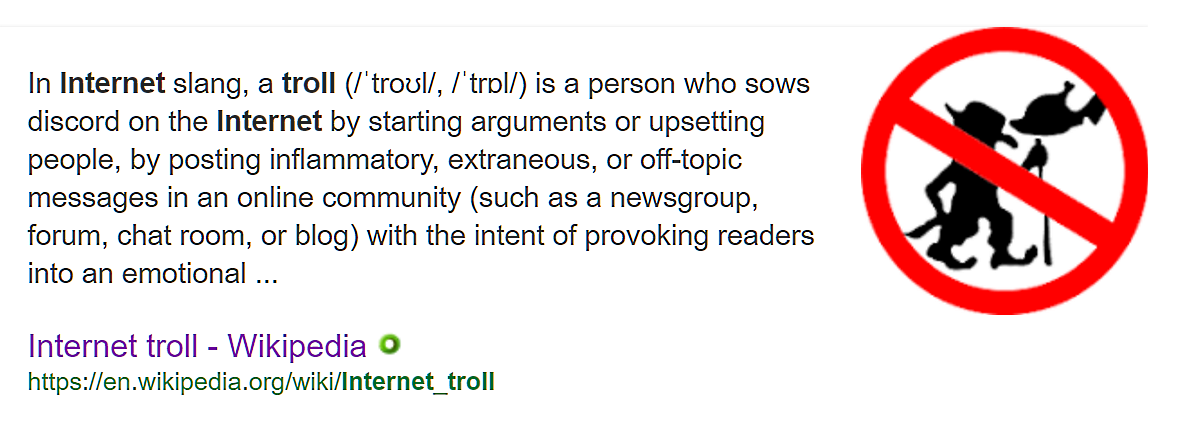
I've written posts about trolls in Cuba, where Operation Truth is said to use a thousand university-student trolls and trolls in China where government workers fabricate an estimated 488 million social media posts annually.

Now we are reading about Russian government trolls. Just before the election, this post documented Russian trolling and warned that "Trump isn’t the end of Russia’s information war against America. They are just getting started."

After the election a new site, PropOrNot.com (propaganda or not) came online. Their mission is outing Russian propaganda using a combination of forensic online sleuthing and crowdsource reporting and they have compiled a list of 200 sites that rapidly spread stories written by Russian trolls. (More about PropOrNot here).

But, is PropOrNot what it claims to be? The people behind the site remain anonymous (for understandable reasons) and their domain name registration is private. How do they determine that a site is home for Russian content? Is there a chance that they are pro-Clinton, sour-grapes trolls? Might trolls and hackers figure out ways to game ProOrNot and get sites they oppose blacklisted?

Hmmm -- I wonder if the US government hires trolls and, if not, should they? How about Canada? Chile? Zambia? How about Exxon Mobile trolls or McDonalds trolls? Is it trolls all the way down?

The fake news and trolling revealed during the last few months of the US political campaign has sowed doubts about everything we see and read online. We're beginning the transition from "critical thinking" to "paranoid thinking."

Newton Minow
In 1961, Newton N. Minow gave a talk to the National Association of Broadcasters in which he worried that television was becoming a "vast wasteland:"
But when television is bad, nothing is worse. I invite each of you to sit down in front of your television set when your station goes on the air and stay there, for a day, without a book, without a magazine, without a newspaper, without a profit and loss sheet or a rating book to distract you. Keep your eyes glued to that set until the station signs off. I can assure you that what you will observe is a vast wasteland.
Will the Internet become a vast wasteland? Newton Minnow was correct, but there were and still are oases in the television wasteland. In spite of the trolls, fake news sites, troll-bots, etc. the Internet is and will remain replete with oases, but we cannot ignore the wasteland.

-----
Update 11/28/2016

I reached out to PropOrNot, pointing out that they do not identify themselves and their domain registration is private and asking how I could know they were not posting false claims themselves. They replied that "We sometimes provide much more background information about ourselves to professional journalists."

They have now posted a document on their methodology, showing how they select sites for their list. They are not saying the sites are paid trolls, but that they publish information that originates on Russian government sites -- that they disseminate Russian propaganda.

At least one of the sites on their list, The Corbett Report, has refuted the claim that they are pro-Russian, but they do not address the question of their distributing material that originated on Russian sites.


Monday, November 21, 2016

Teaching slides on the political impact of the Internet

I teach a class on the applications, technology and implications of the Internet and we begin each week with a discussion of current events relevant to the class. This semester many of those discussions have included material on the implications of the Internet for politics.

I've gone through my discussion slides for this term and put those that deal with the political impact of the Internet in a single, annotated PowerPoint file.

The slides focus on the current election, but also establish context by covering the use of then-new media in earlier elections, starting with radio, and other disappointing political uses of the Internet.

The slides are in chronological order as we have gone through the semester. If you are teaching a related class -- perhaps in political science -- you might find something useful. (I will continue adding new material -- suggestions welcome).


-----
Update 12/1/2016

I've added new slides dealing with the outing of fake news purveyors, truth versus freedom of speech, risk-limiting audits, a Stanford study of junior high, high school and college students reading of Internet news and the possibility that the Internet might become a "vast wasteland."

-----
Update 12/14/2016

I've added new slides dealing with National Security Advisor nominee General Mike Flynn's tweets concerning fake news. He later deleted one of the embarrassing tweets, but it had already been cached by the Internet archive.


-----
Update 12/17/2016

I've added slides dealing with General Flynn, European fake news, Tiananmen Square, the consequences of fake news, good journalism, Trump's continuing post-election lies and Facebook's effort to identify fake news.


-----
Update 12/20/2016

I've added slides on "Alt Right" gaming of Google search and Google's effort to thwart them.


-----
Update 12/21/2016

I've added new slides on "Alt Right" gaming of Google (and Bing) search, Google's effort to thwart them and a Pew Research survey on the public's view of fake news.


-----
Update 12/23/2016

I've added new slides on fantasy versus reality (examples from Trump and Bill Clinton) and whether they matter and Facebook's moves to combat fake news after first dismissing their role.


Update 12/27/2016

I've added new slides on the possibility of real-world consequences to fake news and Russian political hacking in Germany, Italy and the US.


-----
Update 1/6/2017

I've added new slides about the Panama Papers and what they reveal about Secretary of State nominee Rex Tillerson. (Collaborative analysis of the Panama Papers by journalists is a positive application of the Internet in politics).

The new slides are located here.

The cumulative slide deck is located here.


-----
Update 1/9/2017

I've added new slides tracing the impact of a single fake story on the Breitbart News Web site along with some background on Breitbart's Steve Bannon.

The new slides are located here.

The cumulative slide deck is located here.


-----
Update 1/16/2017

I've added new slides dealing with Trump's writing style on Twitter and his reaction to his briefing on Russian hacking by intelligence agencies. (His response also provides an illustration of his Twitter writing style.

The new slides are located here.

The cumulative slide deck is located here.


-----
Update 1/17/2017

I've added new slides dealing with Facebook's efforts to flag fake news in the US and Germany and possible fact-checking collaboration.

The new slides are located here.

The cumulative slide deck is located here.


-----
Update 1/19/2017

I've added new slides dealing with the Internet Archive and others in archiving Internet content that might be deleted or altered for political purposes.

The new slides are located here.

The cumulative slide deck is located here.


-----
Update 9/15/2017

The campaign is over and Trump is president, but I've gone back and added a couple of new slides -- one on Trump's continued lying and another on recent revelations about Facebook. They are part of a collection of lecture slides I used during the campaign. A subset used in another lecture may be found here. I've added the new slides to both decks.


Tuesday, November 15, 2016

A real-names domain-registration policy would discourage political lying.

I've discussed the role of the Internet in creating and propagating lies in a previous post, noting that Donald Trump lied more frequently than Hillary Clinton or Bernie Sanders during the campaign.

Now let's look at fake news like the claim that Pope Francis had endorsed Trump. The fake post features the following image and includes a "statement" by the Pope in which he explains his decision.


The post evidently origniated on the Web site of a fake news station, WTOE 5. Avarice, not politics, seems to be the motivation for the site since it is covered with ads and links to other “stories” that attack both Clinton and Trump.

WTOE 5 states that it is a satirical site on their about page, but how many readers see that? Other sites do not claim satire. For example, the Christian Times about page says nothing about satire, but does assert that they are not responsible for any action taken by a reader:
Christian Times Newspaper is your premier online source for news, commentary, opinion, and theories. Christian Times Newspaper does not take responsibility for any of our readers' actions that may result from reading our stories. We do our best to provide accurate, updated news and information
The Christian Times "editorial" policy is similar to that of WTOE 5 -- they published pre-election news stories on thousands of dead people voting in Florida, hacking of voter systems by the Clinton campaign, Black Panthers patrolling election sites, etc. As soon as the election was over, they informed us that Hillary Clinton had filed for divorce. Don't believe it? Here is their evidence:

Given the WTOE 5 claim to be satire or the Christian Times eschewing responsibilty for actions taken by readers, I suspect that unliess Pope Francis or Hillary Clinton sues, there is no legal recourse.

The dirty tricks during this election remind me of the Watergate burglary, but, unlike Watergate, it is not clear that a law has been broken. In the Watergate case, a crime was committed and the burglars were convicted and sent to prison in 1973. In 1974 investigators were able to establish a White House connection to the burglary and, under threat of impeachment, President Nixon resigned.


Would it be possible to establish a connection between a Web site like "WTOE 5 News" and the Trump campaign?

A Whois query shows us that the domain name Wto5news.com was registered by DomainsByProxy.com. We can see the address, contact information and names of people at DomainsByProxy.com, but the identity of the person or organization registering the domain name is private.


I also checked the Whois record for the Christian Times. It turns out that DomainsByProxy.com is also the registrar for Christiantimesnewspaper.com and the registration is also private.

I am not a lawyer, but I suspect that a request for a subpoena to get the contact information of a long list of people registering domain names for misleading Web sites would be seen as a "fishing expedition" by the courts.

I understand the wish to protect the privacy of a person or organization registering a domain name, but there is also a public interest in discouraging sites like Wto5news.com. A verifiable, real-names policy for domain registration would discourage this sort of thing. The WELL, an early community bulletin board system, adopted such a policy years ago. Their slogan is "own your own words" and it serves to keep discussion civil, stop bullying and lying, etc.

Trump supporters seem to worry a lot about voter fraud. They advocate easing mechanisms for challenging a voter's registration and encourage strict requirements for proof of identity and residence. There is more evidence of demonstrably fraudulent political information on the Internet than fraudulent voting. If their concern is genuine, they should support a real-names policy for domain registration.

If warrants will not pass legal muster and a real-names policy is unrealistic, someone might be tempted to follow the example of the Trump supporters who hacked the Democratic National Committee and resort to hacking registrars to get contact information of their private clients. Maybe Julian Assange could distribute what they find on WikiLeaks.


-----
Update 11/17/2016

I received some comments on this post from an attorney.

For a start, he said labeling something as "satire" was irrelevant because the defense would be 1st amendment free speech. He said there might be a slight chance for the "shouting fire in a crowded theater" argument, but he and this Atlantic Monthly article agree that that is a long shot. He also said there might be a remote chance of a false advertising claim succeeding, especially if it were against a person working on the Turmp campaign like Steve Bannon of Breitbart or Sean Hannity with his popular radio and TV shows. Regardless, it would be necessary to show that their behavior had altered the election result (for president or "down ballot" contests).

I agree that it would be nearly impossible to show that a single site or lie had provided the margin for Trump's victory, but I do believe that rigorous survey research by a reputable organization could demonstrate that the marginal impact of fake sites and posts in the aggregate was sufficient to elect Trump and I hope that such research is conducted.

Regardless, a true-names policy would help investigators looking for possible connections between the Trump campaign and intentional, systematic Internet misinformation. The revelation of the White House role in Nixon's "dirty tricks' was what mattered, not the conviction of the burglars.

-----
Update 11/18/2016

The attorney who commented on this post (above) suggested that it would be relevant if Breitbart published a lying article.

After Khizr Khan spoke at the Democratic convention, Breitbart published a story saying he had deep ties to the government of Saudi Arabia, international Islamist investors, controversial immigration programs that wealthy foreigners can use to essentially buy their way into the United States and the “Clinton Cash” narrative through the Clinton Foundation.


That is a lot of deep ties, but it turns out the post was false.

The Breitbart story has had 167,000 Facebook engagements and the refutation has been shared 32,600 times on Facebook, Twitter, Google Plus, Reddit, by email and shared links combined.

A real-names domain-registration policy would discourage political lying.

I've discussed the role of the Internet in creating and propagating lies in a previous post, noting that Donald Trump lied more frequently than Hillary Clinton or Bernie Sanders during the campaign.

Now let's look at fake news like the claim that Pope Francis had endorsed Trump. The fake post features the following image and includes a "statement" by the Pope in which he explains his decision.


The post evidently origniated on the Web site of a fake news station, WTOE 5. Avarice, not politics, seems to be the motivation for the site since it is covered with ads and links to other “stories” that attack both Clinton and Trump.

WTOE 5 states that it is a satirical site on their about page, but how many readers see that? Other sites do not claim satire. For example, the Christian Times about page says nothing about satire, but does assert that they are not responsible for any action taken by a reader:
Christian Times Newspaper is your premier online source for news, commentary, opinion, and theories. Christian Times Newspaper does not take responsibility for any of our readers' actions that may result from reading our stories. We do our best to provide accurate, updated news and information
The Christian Times "editorial" policy is similar to that of WTOE 5 -- they published pre-election news stories on thousands of dead people voting in Florida, hacking of voter systems by the Clinton campaign, Black Panthers patrolling election sites, etc. As soon as the election was over, they informed us that Hillary Clinton had filed for divorce. Don't believe it? Here is their evidence:

Given the WTOE 5 claim to be satire or the Christian Times eschewing responsibilty for actions taken by readers, I suspect that unliess Pope Francis or Hillary Clinton sues, there is no legal recourse.

The dirty tricks during this election remind me of the Watergate burglary, but, unlike Watergate, it is not clear that a law has been broken. In the Watergate case, a crime was committed and the burglars were convicted and sent to prison in 1973. In 1974 investigators were able to establish a White House connection to the burglary and, under threat of impeachment, President Nixon resigned.


Would it be possible to establish a connection between a Web site like "WTOE 5 News" and the Trump campaign?

A Whois query shows us that the domain name Wto5news.com was registered by DomainsByProxy.com. We can see the address, contact information and names of people at DomainsByProxy.com, but the identity of the person or organization registering the domain name is private.


I also checked the Whois record for the Christian Times. It turns out that DomainsByProxy.com is also the registrar for Christiantimesnewspaper.com and the registration is also private.

I am not a lawyer, but I suspect that a request for a subpoena to get the contact information of a long list of people registering domain names for misleading Web sites would be seen as a "fishing expedition" by the courts.

I understand the wish to protect the privacy of a person or organization registering a domain name, but there is also a public interest in discouraging sites like Wto5news.com. A verifiable, real-names policy for domain registration would discourage this sort of thing. The WELL, an early community bulletin board system, adopted such a policy years ago. Their slogan is "own your own words" and it serves to keep discussion civil, stop bullying and lying, etc.

Trump supporters seem to worry a lot about voter fraud. They advocate easing mechanisms for challenging a voter's registration and encourage strict requirements for proof of identity and residence. There is more evidence of demonstrably fraudulent political information on the Internet than fraudulent voting. If their concern is genuine, they should support a real-names policy for domain registration.

If warrants will not pass legal muster and a real-names policy is unrealistic, someone might be tempted to follow the example of the Trump supporters who hacked the Democratic National Committee and resort to hacking registrars to get contact information of their private clients. Maybe Julian Assange could distribute what they find on WikiLeaks.


-----
Update 11/17/2016

I received some comments on this post from an attorney.

For a start, he said labeling something as "satire" was irrelevant because the defense would be 1st amendment free speech. He said there might be a slight chance for the "shouting fire in a crowded theater" argument, but he and this Atlantic Monthly article agree that that is a long shot. He also said there might be a remote chance of a false advertising claim succeeding, especially if it were against a person working on the Turmp campaign like Steve Bannon of Breitbart or Sean Hannity with his popular radio and TV shows. Regardless, it would be necessary to show that their behavior had altered the election result (for president or "down ballot" contests).

I agree that it would be nearly impossible to show that a single site or lie had provided the margin for Trump's victory, but I do believe that rigorous survey research by a reputable organization could demonstrate that the marginal impact of fake sites and posts in the aggregate was sufficient to elect Trump and I hope that such research is conducted.

Regardless, a true-names policy would help investigators looking for possible connections between the Trump campaign and intentional, systematic Internet misinformation. The revelation of the White House role in Nixon's "dirty tricks' was what mattered, not the conviction of the burglars.

-----
Update 11/18/2016

The attorney who commented on this post (above) suggested that it would be relevant if Breitbart published a lying article.

After Khizr Khan spoke at the Democratic convention, Breitbart published a story saying he had deep ties to the government of Saudi Arabia, international Islamist investors, controversial immigration programs that wealthy foreigners can use to essentially buy their way into the United States and the “Clinton Cash” narrative through the Clinton Foundation.


That is a lot of deep ties, but it turns out the post was false.

The Breitbart story has had 167,000 Facebook engagements and the refutation has been shared 32,600 times on Facebook, Twitter, Google Plus, Reddit, by email and shared links combined.