Showing posts with label satellite Internet. Show all posts

Monday, December 28, 2020

Telesat update -- proposal for a larger constellation, Canadian and DARPA contracts, a planned IPO and more

Telesat has a number of unique advantages and, if LEO broadband truly is a half a trillion-dollar addressable market, there will be room for multiple providers.

Blue satellites are in polar orbits and
red satellites are in inclined orbits.
Click here for animation.

I've discussed Telesat's LEO broadband project in earlier posts, but the project has progressed, so an update is needed.

The original plan was to launch 117 satellites but that has changed. The phase 1 constellation will now have 298 satellites and the second phase will add 1,373 for a total of 1,671. The revised plan has been submitted to the FCC, and they expect it to be approved next year.

While Telesat applied to increase the number of satellites, the macro architecture remains the same as originally planned. There will be two sub-constellations, one with 351 satellites in polar orbits (98.98 degrees/1,015 km) and another with 1,320 in inclined orbits (50.88 degrees/1,325 km). This patented architecture will enable them to serve the entire globe. (I am not a lawyer, but I wonder whether that is something that can be patented).

The sub-constellation architecture will enable global coverage and low latency but will require sophisticated inter-satellite laser links (ISLLs). It turns out that DARPA is also developing Blackjack, a military LEO communication constellation, and since the military requires low-latency and the ability to quickly establish connectivity at arbitrary, perhaps remote locations, they require ISLLs. Telesat received a $2.8 million study contract for the design of the Blackjack bus in 2018 and was awarded $18.3 million to develop and test Blackjack last October. In that role, Telesat selected Mynaric to supply ISLLs and may use them in their satellites as well.

The Canadian government has granted Telesat C$85 million to support research and development and another C$600 million to subsidize Internet connectivity in rural Canada. The R&D funds will go to early satellite tests and will support approximately 500 professional jobs and the rural connectivity funds are like those in the US where SpaceX was awarded $885 million.

While Telesat will have global coverage, they will focus on Canada and the north at first and that will put them in competition with OneWeb which plans to do the same. OneWeb will have a head start since it already has a distribution partner and plans to begin service in the north next fall, but Telesat will need fewer ground stations because of it's ISLLs and it already has 10 GEO teleports in North America and two others in Hawaii and Austria.

Telesat has run tests and done demonstrations of many potential applications since launching a test satellite in 2018 and Lynette Simmons, Director of Marketing and Communication, says the system design is complete and they expect to announce the prime contractor very soon. They will finance the constellation by restructuring and a public stock offering. President and CEO Dan Goldberg is confident that they will be able to raise sufficient capital based on their track record. The company is over 50 years old and is a large, global GEO satellite operator that has been broadcasting televiion since 1978, providing Internet connectivity since 1996 and they have been doing advanced research for both the US and Canadian governments. Goldberg thinks LEO broadband is a half a trillion-dollar market and you can see his pitch in the following video.


Let me add a little speculation. Nearly two years ago, Telesat signed an agreement to use the software defined network (SDN) platform Google had developed for Project Loon, which provides connectivity using baloons in the stratosphere. If Telesat's system design includes Google's SDN, Telesat LEO satellites may be able to interoperate with Google's baloons. Going a step further, they may one day interoperate with Telesat's GEO satellites, creating an integrated three-layer network routing packets between as well as within layers depending upon the service level required by a customer or application. An integrated network could also provide fallback in the case of equipment failure.

A reader recently commented on my Twitter feed that Telesat was "moot," because SpaceX has superior launch capability and a head start, and OneWeb, which, like Telesat, is forsaking the consumer market for commercial applications like 5G backhaul, is a direct competitor. He was wrong. Telesat has a number of unique advantages and, if LEO broadband turns out to be anywhere near the half-trillion-dollar addressable market Goldberg expects, there will be room for multiple providers.

Updates 12/28/2020

A reader pointed out that Telesate has also committed to investing the revenue from their sale of C-band spectrum in the LEO constellation. That spectrum will be used for 5G mobile connectivity and will enlarge the prospective mobile-backhaul market.

Speading at a webinar on "Building NewSpace," Michel Forest, Telsat Director of LEO Systems Engineering says there is significant demand for LEO among their current GEO customers who want low latency and more capacity in specific places like airline hubs and ports. (33:37)

For a threaded discussion of this post on Reddit, click here.

Update 2/23/2021

Telesat received $344 million for their share of the C-band auction and C$400 million from Quebec (C$200 grant and C$200 loan) for economic development.

Wednesday, November 25, 2020

OneWeb is out of bankruptcy, but not out of the woods.

OneWeb, which declared bankruptcy in May, has reorganized and emerged from bankruptcy. Bharti Global, an Indian telecommunication conglomerate, and the British government each own 42.2% of the new company, and most of the rest is owned by previous investors SoftBank and Hughes Network Systems.

Hughes will continue work on ground infrastructure and marketing and the original joint venture with Airbus, which designs and manufactures OneWeb satellites, was re-activated and the production lines brought back into service.

The company has new top management. Neil Masterson, who was COO at Thomson Reuters, will be the new CEO at OneWeb and Sunil Bharti Mittal, Founder and Chairman of Bharti, will be the Executive Chairman. The previous CEO, Adrian Steckel, has been appointed Adviser to the Board. Notably, OneWeb founder and previous Executive Chairman Greg Wyler was not mentioned so may not be involved -- perhaps that is related to the shift from the end-user market to government, enterprise, maritime, aviation and other markets that may be less price-sensitive and not require low-cost terminals. (The first million terminals may be costing SpaceX as much as $2,400 each).

OneWeb has permission from the FCC to operate 2,000 satellites -- 720 in low-Earth orbit (LEO) at 1,200 km and 1,280 in medium-Earth orbits at 8,500 km and a 45° inclination. They currently have 74 LEO satellites in near-polar orbit and recently shipped 36 to Russia's Vostochny Cosmodrome for a December 17th launch on a Soyuz rocket. (While they have permission to launch 720 LEO satellites, they seem to be only planning to launch 648).

OneWeb's first priority is building out its first-generation broadband network and providing coverage down to about 50 degrees latitude next year and to complete the full constellation the following year. The plan is to begin commercial services starting at the end of 2021 to the UK, Alaska, Canada, Northern Europe, Greenland, Iceland, and the Arctic Seas.

The company is seeking landing rights in India and Mittal said they plan to begin testing Internet service there in 6-8 months. (Those will be test satellites with intermittent connectivity). The plan is to offer service in India in May/June 2022.

OneWeb is starting over with new partners, assets that had cost the previous company $3.3 billion, and priority spectrum rights, but they are not yet out of the woods.

For a start, they've booked sixteen launches with Arianespace but will need about $2-2.5 billion to complete the constellation.

They have also lost time. They had initially hoped to begin Alaskan service in 2019 and serve the entire state by the end of 2020, and are now far behind that schedule. In the meantime, Telesat, their stiffest competitor for Alaska and the polar region, has made steady progress.

Whiile Bharti's participation gives OneWeb an advantage in terms of distribution and business and government relationships in developing nations in Asia and Africa, they will face stiff Chinese competition in the "Digital Silk Road" nations.

They are also under time pressure to manufacture and launch satellites in order to retain their ITU spectrum rights -- 360 satellites by June 2023 and 720 by June 226. While OneWeb has maintained it's manufacturing joint venture with Airbus, the BBC reports that "components exist for a further three batches of satellites, and the new owners have been busy in recent weeks re-establishing old supply chains to fully ramp up production to pre-bankruptcy levels."

Other than Hughes and Airbus, I don't know which of their prior contracts, MOUs, and relationships are still in force. For example, they had agreements for distribution and cooperation in Alaska, Hawaii, Russia, Armenia, Georgia, Kazakhstan, and surely others I am unaware of.

Finally, there has been discussion of the possibility of OneWeb generating revenue by modifying their satellites to double as a high-precision global navigation satellite system (GNSS) that is difficult to jam or spoof. Mittal told BBC News: "For Generation 2, we will of course have full-scale precise, navigation and timing. And if the UK government wants some other payloads critical to the needs of security, we will do whatever is required." By the time they are ready to launch the next-generation satellites, they may face competition from Xona Space Systems's forthcoming 300-satellite GNSS as well as the possibility of similar offerings by SpaceX.

I hope OneWeb survives and thrives -- billions of people live in unserved areas and competition is good for all.

Saturday, June 13, 2020

Rural broadband subsidy -- what's the rush?

We are poised to give out $16 billion less than a week before election day ... This approach is not thoughtful policy, it’s rush-it-out-the-door electioneering.
FCC Commissioner Jessica Rosenworcel

x
The Federal Communications Commission (FCC) has adopted procedures for Phase I of the Rural Digital Opportunity Fund (RDOF) auction, which will award up to $16 billion in support over 10 years for the deployment of fixed broadband networks to homes and businesses in census tracks that are unserved by voice and broadband with download speeds of at least 25 Mbps. Successful bidders in the October reverse auction will have to provide a minimum of 25/3 Mbps up/download speed and the FCC will prioritize low-latency (sub-100 ms) networks when awarding funding. They are prioritizing high speeds and low latency so users will "be able to use tomorrow’s Internet applications as well as today’s."

The FCC considers geostationary satellite providers as high-latency and conventional terrestrial providers as low-latency and last month Ars Technica reported that the FCC planned to classify SpaceX and other low-Earth orbit (LEO) satellite operators as high-latency, saying "the providers haven't proven they can deliver low-latency broadband." However, the FCC order issued on June 11 equivocated a bit, saying the FCC has"serious doubts that any LEO networks will be able to meet the short-form application requirements for bidding in the low-latency tier." (The short-form applications are due by July 15, 2020).

If the goal is to support applications that are in use ten years from now, it seems they should consider technologies that will be available ten years from now and the FCC is well aware of the LEO broadband projects of SpaceX, Amazon, Telesat, and several Chinese companies and the possibility that OneWeb will be resurrected. These efforts may turn out to be market failures, but we have both theoretical and experimental evidence to expect that, if successful, they will be able to deliver sub-100 ms latency.

For example, this simulation predicts latencies well under 100 ms even without the inter-satellite laser links that SpaceX plans to introduce in the future and Elon Musk has also reported low latencies with their initial test satellites.

More recently, Telefónica, a major Internet service provider in Latin America and Europe has completed tests with Telesat. (Telefonica owns the Movistar, O2 and Vivo brands). The test scenarios included high-definition video streaming, video conferencing with teams, remote desktop connection to seamlessly manage a remote computer, a VPN connection without any delay or outages, FTP-encrypted file transfers of 2 GB in both directions, and IPSec tunnel encryption with no reduction in the performance of the link. This was done without TCP acceleration or data compression and hey achieved round-trip latencies of 30-60ms with no packet loss.

What's the rush?

Why not allocate $1.6 billion of the ten-year fund this year and the remainder a year or two later when we will have operational data from one or more LEO satellite ISPs? Doing so might require some bureaucratic adjustment and would complicate the planning and bidding process for potential ISPs, but if we are thinking ten-years in the future, why not consider technology that will quite possibly be important in ten years?

Sadly, the rush is political.


For a start, the FCC Chairman came from Verizon and I bet the terrestrial Internet service providers have contributed to Trump and their senators and lobbied the FCC to classify LEO satellites as high-latency.

Furthermore, three of the five FCC commissioners are Republicans and you can read their statements on the RDOF bidding process here. It turns out that the two Democrats were able to convince one of the Republicans to change the draft ruling to allow for the unlikely possibility that LEO satellites might qualify as low-latency providers as noted above.

However, the Democrats were unable to convince any Republican colleagues to postpone the funding until accurate coverage data could be collected and wrote "dissents in part." Commissioner Geoffrey Starks expressed concern over the decision "to spend such a large portion of the budget -- over such a long term of support -- based on broadband maps that are not accurate" and Commissioner Jessica Rosenworcel wrote a stronger dissent including suggestions for addressing the urban and rural digital divides and pointing out that "We are poised to give out $16 billion less than a week before election day ... This approach is not thoughtful policy, it’s rush-it-out-the-door electioneering."

Republican candidates will rush to take credit for bringing the Internet to millions of their rural constituents. Cunning.

Tuesday, March 31, 2020

OneWeb is bankrupt -- who will buy their assets?

One could argue that a global ISP should not be owned by a single nation or a corporation.

OneWeb has filed for Chapter 11 bankruptcy. OneWeb CEO Adrian Steckel stated that they were "close to obtaining financing" but failed as a "consequence of the economic impact of the COVID-19 crisis." That is plausible, but they were also far behind SpaceX Starlink in launch cost and capacity. (SpaceX, remains open as an essential industry working on defense contracts, but two employees have tested positive for COVID-19) and financial analyst Tim Farrar said SpaceX faced a "near-term cash problem" even before the pandemic).

OneWeb has valuable assets -- satellites in orbit, ground stations, flat panel antenna, progressive pitch, debris mitigation and other technologies, engineering and manufacturing experience, patents, a satellite factory, supply chains, memoranda of understanding with nations, spectrum, marketing deals, and other partnerships, etc. Who will acquire those assets?

Amazon comes immediately to mind as a potential buyer. Amazon is a relatively recent entry in the LEO constellation broadband race, which leaves it far behind SpaceX, and it is first and foremost an an infrastructure company. CEO Jeff Bezos has a lifelong interest in space and owns satellite-launch and ground-station service companies. He could also fund the purchase himself.

While Amazon is perhaps most likely to acquire the OneWeb's assets, there are others. China is home to three LEO broadband startups that are also late to the LEO broadband race and have a ready funding source. Facebook might also be interested if they are seriously considering satellite broadband, .

Twitter user @megaconstellati has suggested that a government -- the US, UK or France -- might take over OneWeb. With its new Space Force and interest in lEO constellations, the US could consider taking over OneWeb, but that would not seem likely to appeal to a relatively anti-government administration. The same goes for the UK.

Not that it's likely to happen, but one could argue that a global ISP should not be owned by a single nation or corporation -- it should be a global asset -- just as coronavirus and climate change are global liabilities. Those liabilities remind us that we live on a "pale blue dot.


Update 6/16/2020

If no company buys OneWeb by June 26th, their assets will be auctioned off on July 2nd. Last month Chris Forrester wrote that two Chinese companies were considering bids. He's updated that saying four Chinese companies are now interested and the Amazon, SpaceX and Eutelsat bids are less likely. We'll know how it turns out soon.

Update July 4, 2020

A consortium of the British government and Bharti Global limited was the winning bidder in the OneWeb auction. They bid over $1 billion to fund the full restart of OneWeb's business. The agreement remains subject to approval by OneWeb’s creditors, the Bankruptcy Court, and applicable regulators, with completion expected by the fourth quarter of 2020.

Bharti, through Bharti Airtel, is the third-largest mobile operator in the world, with over 425 million customers and a strong presence across South Asia and Sub-Saharan Africa. If successful, the project will bring fixed broadband to those and other customers. The British government hopes it can use the constellation for global positioning and timing since it lost access to the European Union global navigation satellite system as a result of Brexit and it will provide connectivity in rural areas and a presence in the space industry.

The U. S. government could possibly challenge the sale since OneWeb has significant manufacturing assets in Florida and the Treasury Department Committee on Foreign Investment in the United States is authorized "to review transactions that could result in control of a U.S. business by a foreign person (“covered transactions”), in order to determine the effect of such transactions on the national security of the United States." I'd like to listen in on the call when Trump and Boris Johnson discuss that possibility!


Tuesday, January 28, 2020

China will be a formidable satellite Internet service competitor

In a study of the Internet in China in the late 1990s, my colleagues and I observed that "China has been able to execute plans effectively by allocating resources to competing, government-owned enterprises," and Kai-Fu Lee shows that they have pursued a similar strategy with respect to AI. Now they are doing the same with low-Earth orbit (LEO) broadband satellite constellations.

Characteristics of the Hongyun and Hongyan test satellites
Last December, state-owned China Aerospace Science and Industry Corporation (CASIC) launched their first experimental Hongyun (rainbow cloud) Project satellite and a week later China Aerospace Science and Technology Corporation (CASC) launched their first experimental Hongyan (wild goose) Project satellite. (Both CASIC and CASC have Wikipeida pages and their Fortune Global 500 ranks are 322 and 323).

As shown here, Hongyun launched a test satellite in December 2018 and said they planned four more during 2019, but there is no record of those having been launched as of today. They have, however, completed tests of Web browsing, video chat, and high-resolution streaming and said users across China would be able to access the demonstration system. (I assume that refers to test users).

They initially planned to begin operating with 156 satellites by the middle of the 14th Five-Year Plan (2021-25), emphasizing service in China's remote regions. Late last year, they expanded the constellation plan from 156 to 864 satellites orbiting at 1,175 km with an 8 Terabytes per second capacity. They hope to serve 2 million 5G users through direct connections to base stations, 200,000 broadband users and 10 million Internet of things (IoT) users. The focus will be on China and Belt and Road nations.

CASIC has also established two satellite factories in Hubei and Hunan provinces. This may have been necessitated by the increase in the number of planned Hongyun satellites or it may be another application of the strategy of creating competing state-owned enterprises.

Hongyan applications (source)
CASC's Hongyan project plans a constellation of around 320 LEO satellites. They have launched one test satellite so far and had hoped to launch 8 more by 2020, but did not make that deadline. They expect to have 60 operating satellites "around" 2023 and to be able to provide global coverage with the full constellation by 2025.

As shown in this illustration, they plan to connect buildings, ships, trains, and planes and to provide mobile backhaul and, most interestingly, direct service to mobile phones. He Mu, Hongyan Application Director, promised the development of a "chip [that] can be integrated into the mobile phone so that everyone holding an ordinary mobile phone will have access to seamless satellite telecommunication with global coverage." That does not sound like a mobile connection to a base station with satellite backhaul, but neither does it sound possible.

Earlier this month a third competitor, GalaxySpace, launched Yinhe-1, which is expected to test Q/V and Ka-band communications at up to 10 Gbps. They refer to Yinhe-1 as a "5G satellite." I'm not sure what a "5G" satellite is, but note again that the above diagram shows a satellite communicating directly with a mobile phone, as opposed to a mobile tower. Check out this short video on the satellite and launch:


CASIC has four other "five clouds" projects underway in addition to Hongyun: Feiyun, using solar-powered drones, Kuaiyun, using near-space airships (dirigibles?), Tengyun, a project to develop a reusable space plane, and Xingyun, an 80-LEO narrowband IoT constellation using cubsats, the first of which is to be launched soon.

As noted above, Chinese state-owned enterprises often compete with each other, but they also cooperate. For example, CASIC's Hongun-1 was launched on a CASC rocket. (I wonder how they arrived at the launch price). Will Hongyun and Hongan exchange traffic at shared ground stations? Will their satellites one day intercommunicate in order to optimize a joint constellation with different orbits? Will they intercommunicate with China's geostationary satellites and other space assets?

It is often argued that government ownership and subsidy are unfair to competitors and lead to a suboptimal allocation of resources. I assume this sort of government-brokered "coordinated competition" is more common in China than in the US, but even here, the lines between government-sponsored research and development, government procurement and industrial subsidy are a bit vague as are the criteria for anti-trust enforcement. People and organizations will learn to game either system, so both must be dynamic.

Hongyun, Hongyan and GalaxySpace are late to the game. OneWeb, SpaceX, and Telesat are beginning to sign up customers and will launch a lot of satellites this year. Amazon is also a late-comer, but they have a lot of money and complementary infrastructure. Like Amazon, China has funds for the long run, domestic infrastructure which can be shared by the three LEO projects and they are working on reusability. Furthermore, they have a political advantage in the "Digital Silk Road" nations of our increasingly divided world and divided Internet. China will be a formidable satellite Internet service competitor.

Update 4/26/2020

The US military has tracked the Galaxy satellite launched in January in a 637 by 621-kilometer altitude orbit inclined at 86 degrees. On April 23, Galaxy engineers conducted a three-minute video call via a WiFi hotspot that used the satellite for backhaul.

As noted above, Galaxy has referred to this as a "5G" satellite constellation and we speculated that they may have been implying direct connections from cell phones to orbiting 5G base stations, but these test results confirm and @Megaconstelai points out, they are using the satellite for backhaul from terrestrial 5G cells.

Update 5/26/2020

A few Hongyun test results are in. The brief note speaks of spectral thermometer tests and image data. There was no mention of broadband Internet tests.

Update 9/8/2020
A Galaxy Space test achieved 1 gigabit per second for each of its 16 Ka-band user beams and Blaine Curcio says 2020 is a turning point for Chinese commercial space. SpaceX and others are racing ahead and China has a strategic -- military, political, and commercial -- interest in keeping up with the West/US in space. The Digital Silk Road runs through space.
Update 9/20/2020 
GalaxySpace is building a factory to mass-produce low-cost satellites in East China. They will manufacture "more than one" satellite per day, joining SpaceX (four per day) and OneWeb (three per day) as mass-production LEO broadband satellite manufacturers.

Their current test satellite has verified high-frequency Q/V/Ka and other frequency band communications and they have achieved 10 Gps speed within a 300,000 Km^2 footprint. They also succeeded in a 5G wireless test, which I assume means they communicated through a 5G base station.

In a related development, China's National Development and Reform Commission added satellite broadband, 5G, and the Internet of Things to it's “New Infrastructures” list. That means more money will be invested in these technologies.

Consultant Blaine Curcio speculates that the Chinese government assumes increased importance of the Internet in a post-COVID world and rather than limiting the investment effort to the state-owned enterprises, the government has opened the doors to the private sector as well.

Update 1/19/2021

Construction of China's first smart manufacturing plant for satellites has been completed. Production will begin in March and the first product will be Hongyun broadband Internet satellites. The factory will be capable of making 240 small satellites a year and it sounds like it can be repurposed to build satellites for other constellations. SpaceX and OneWeb both claim to be able to produce satellites faster, but their factories may not be as easily reconfigured. Regardless, the Chinese space industry is progressing rapidly.

Monday, December 30, 2019

Starlink simulation shows low latency without inter-satellite laser links

Handley's simulation shows that, while not as fast as an equivalent ISLL path, long bent-pipe paths would typically have lower latency than terrestrial fiber routes between the same two points.

Mark Handley, a professor at University College London, has made two terrific videos based on runs of his simulation of the first -- 1,584 satellite -- phase of SpaceX's Starlink Internet-service constellation. I discussed the first video, which assumes that the satellites have inter-satellite laser links (ISLLs), in recent post.

While SpaceX plans to deploy ISLLs in the future, their early satellites do not have them since at 27,000 km/hr they are state-of-the-art technology and may also encounter political problems in some nations. Since it could be a year or so before SpaceX begins launching ISLL-equipped satellites, Handley has made a second video that assumes the phase one satellites do not have ISLLs. This post discusses that video.

Satellite footprint (source)
Each satellite has four phased-array antennas that can rapidly switch narrowly focused connections to terrestrial antennas falling within a large "footprint" area. The terrestrial antennas might be Internet-connected ground stations or end-user terminals. If there were no ISLLs, long-distance traffic would have to be relayed by bouncing packets up and down between satellites and the ground.

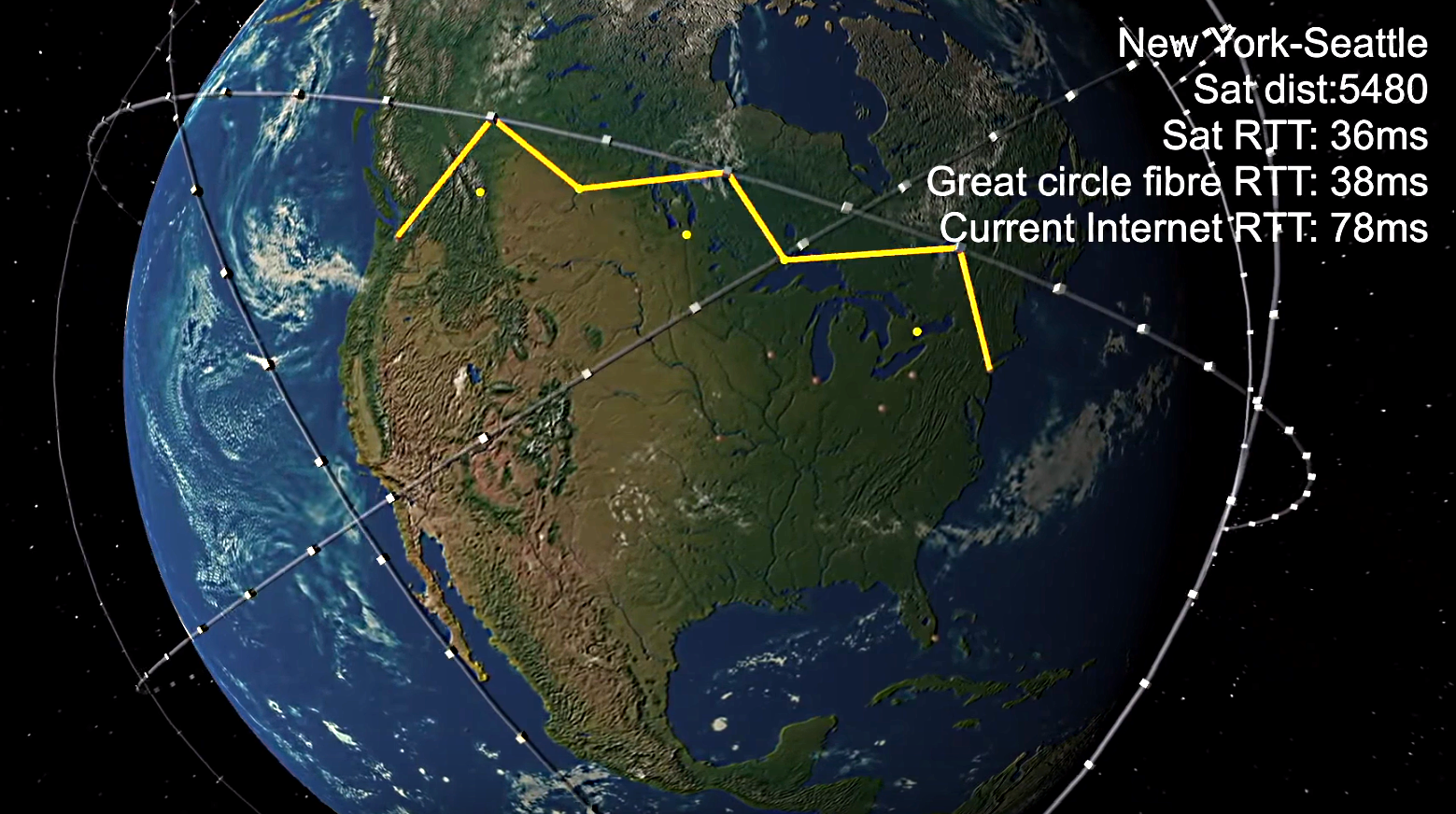
Many people -- me included -- have assumed that these "bent pipe" hops would significantly increase latency on long-distance paths, but Handley's simulation shows that, while not as fast as an equivalent ISLL path, long bent-pipe paths would typically have lower latency than terrestrial fiber routes between the same two points.

Sample Seattle-New York path
Consider, for example, this six-hop route between Seattle and New York. The bent-pipe route has a round-trip time of 36ms versus 78ms for the current Internet and 38ms for an hypothetical great circle fiber route, which would be impossible because of mountains and other obstructions.

That example was taken from a run in which only six orbital planes had been populated and it assumed ground stations at popular SpaceX locations plus a few others that Handley assumed would be added at strategic points. With only six orbital planes, global coverage is spotty but it is solid around 53 degrees north (and south). As more satellites are added, coverage becomes wider and latency improves. By the time all 1,584 satellites are in operation, there is global coverage and latency is consistently better than today's terrestrial Internet.

User terminals as relays
While adding satellites improves performance, adding additional ground stations has an even greater impact. That suggests the possibility of relaying traffic through idle end-user terminals, which also have phased array antennas. Handley ran a simulation assuming relays every 100 km and found that latency across the US was roughly cut in half and jitter (latency variance) also declined, but the number of route changes increased to about one every five seconds. That sounds like a lot of overhead but Handley feels that it is feasible to handle. It would also require a more expensive user terminal, a little power and the permission of the user so SpaceX might subsidize the terminals or charge less for service.

Handley also considered inter-continental relaying, which would require relay stations on strategically placed ships at sea. (It turns out that no ships would be needed to cross the Northern Pacific, but that would require a relay station in Russia, which might be a political problem). He doesn't mention the possibility, but couldn't cargo and cruise ships act as slowly moving relay stations? (They will certainly want to be terminal-users).

The example shown above is for an east-west link but Handley also looked at long north-south links and found that ground relays actually beat ISLLs in some cases and were always better than fiber, but the best results are achieved by a combination of ISLL and terrestrial links, which we can look forward to once SpaceX and others begin deploying satellites with ISLLs.

Handley concludes by pointing out that since he started making the video, SpaceX had revised their constellation configuration from 24 66-satellite planes to 72 22-satellite planes. It turns out that once the first 1,584-satellite phase is complete, there is pretty much no difference between the new and old configurations, but it does require a few more satellites to be deployed before the trans-Atlantic and Pacific relays will work continuously. Note that SpaceX hopes to complete the first phase by early 2021.

I can't conclude this post without mentioning Handley's charming disclaimer that he has no inside information, but, based on public statements, has made reasonable assumptions about "what they could do if they wanted to, but probably isn't what they will actually do."

Watch the video:


Update 1/1/2020

Handley presented a paper on this research at the 2019 ACM HotNets Conference. You can see a video of his presentation and download a copy of his paper here. (The video of his talk is free, but the paper is behind a paywall).

Update 1/13/2020

There has been further discussion of this topic in the Reddit Starlink Community. Commenters have pointed out that ISLLs are cutting edge technology and the current cost of Mynaric's 10 Gbps terminals is prohibitive, though it will doubtless drop with mass production (and Mynaric has hired an ex-SpaceX executive). While SpaceX has announced plans to launch satellites with ISLLs by the end of 2020, those may just be for testing. Furthermore, they will have many legacy satellites in orbit by then and those will not be replaced for around five years. SpaceX will not have a 100% ISLL constellation until 2026. Perhaps OneWeb made a wise decision in postponing ISLLs and Wall Street arbitrage traders will have to wait a few years for ultra-low latencies.

Sunday, November 03, 2019

What to expect from SpaceX Starlink broadband service next year and beyond

Last May, SpaceX founder Elon Musk tweeted "6 more launches of 60 sats needed for minor coverage, 12 for moderate" and SpaceX President and CEO Gwynne Shotwell recently said they planned to be offering service in parts of the US in mid-2020, which would require six to eight 60-satellite launches. The first of those launches will be in the middle of this month on a thrice-flown Falcon 9 booster. (They will also need customer terminals and Elon Musk has used a prototype to post a tweet from his home).

Six to eight launches would bring them up to Musk's "minor" coverage by mid-2020 and, if they maintain the same launch rate, they would achieve "moderate" coverage around the end of the year. But, what is meant by "minor" and "moderate" coverage? A simulation by Mark Handley, a professor at University College London, provides an approximation of the answer.

The first Starlink "shell" will have 24 orbital planes. Each orbital plane will have 66 satellites at an inclination of 53 degrees and an altitude of 550 km. Handley ran simulations of the first 6 and first 12 orbital planes -- corresponding roughly to the SpaceX plan for 2020. Snapshots of the coverage area "footprints" from the two simulations are shown below:

Coverage with six and twelve 66-satellite orbital planes

The blue areas -- around 50 degrees north and south latitude -- are regions with continuous 24-hour coverage by at least one satellite. With six orbital planes, there will be continuous connectivity in the northern US and Canada and much of western Europe and Russia, but only southern Patagonia and the South Island of New Zealand in the sparsely populated south. Note that the financial centers of London and (just barely) New York will have continuous coverage, but, since these early satellites will not have inter-satellite laser links (ISLLs), SpaceX would have to route traffic between them through an undersea cable.

Coverage is continuous around 50 degrees north and south.

(At this point, you should stop reading and watch the video (6m 36s) of the simulation which shows the footprints moving across the surface of the planet as it rotates).

With 12 orbital planes, all of the continental US and most of Europe, the Middle East, China, Japan, and Korea will be covered. Shotwell says that once they have 1,200 satellites in orbit, they will have global coverage (with the exception of the polar regions) and capacity will be added as they complete the 550 km shell with 1,584 satellites. That should occur well before the end of 2021 since she expects to achieve a launch cadence of 60 satellites every other week.

Shotwell also said they planned to include ISLLs by late 2020, implying that less than half of the satellites in this first shell will have them. Those ISSLs will give SpaceX an advantage over terrestrial carriers for low-latency long-distance links, a market Musk hopes to dominate. ISLLs will also reduce the need for ground stations. (Maybe they can lease ground-station service from SpaceX competitor Amazon in the interim)

All of this is cool, but what will it cost the user?

it sounds like SpaceX is serious about pursuing the consumer market from the start. When asked about price recently, Shotwell said millions of people in the U. S. pay $80 per month to get “crappy service.” She did not commit to a price, but homes, schools, community centers, etc. with crappy service would pay that for good service, not to mention those with no service. Some customers may pay around $80 per month, but the price at a given location will be a function of SpaceX capacity, the price/demand curve for Intenet service and competition from terrestrial and other satellite service providers, so prices will vary within the U. S. and globally. In nations where Starlink service is sold by partner Internet service providers, they will share in pricing decisions.

Since the marginal cost of serving a customer is near zero as long as there is sufficient capacity, we can expect lower prices in a poor, sparsely-populated region than in an affluent, densely-populated region. Dynamic pricing is also a possibility since SpaceX will have real-time demand data for every location. "Dynamic pricing of a zero marginal cost, variable-demand service" sounds like a good thesis topic. It will be interesting to see their pricing policy.

National governments will also have a say on pricing and service. While the U. S. will allow SpaceX to serve customers directly, other nations may require that they sell through Internet service providers and some -- maybe Russia -- may ban Starlink service altogether.

The price and quality of service also impact long-run usage patterns and applications. Today, the majority of users in developing nations access the Internet using mobile phones, which limits the power and range of applications they can use. Affordable satellite broadband would lead to more computers in homes, schools, and businesses and reduce the cost of offering new Internet services, impacting the economy and culture and leading to more content and application creation, as opposed to content consumption.

Looking further into the future, SpaceX has FCC approval for around 12,000 satellites and they recently requested spectrum for an additional 30,000 from the International Telecommunication Union. Their next-generation reusable Starship will be capable of launching 400 satellites at a time and they will have to run a regular shuttle service to launch 42,000 satellites as well as replacements since the satellites are only expected to have a five-year lifespan. (One can imagine Starships dropping off new satellites then picking up obsolete satellites and returning them to Earth).

This sounds rosy. As we said in the NSFNet days, what could possibly go wrong? SpaceX seems to have a commanding lead over its would-be competitors. Might they one day become a dominant Internet service provider in a nation or region and abuse that position? Also, before they launch 42,000 satellites -- or even 12,000 -- SpaceX better come up with a foolproof plan for debris avoidance and mitigation. I hope they have a vice-president in charge of unanticipated side-effects.

Update 11/5/2019

Speaking at an investment conference, Shotwell said that a single Starship-Super Heavy launch should be able to place at least 400 Starlink satellites in orbit. Doing so would reduce the per-satellite cost to 20% of today's 60-satellite launches.


Update 11/6/2019

Serge Eagleson informed me that since Mark Handley ran his simulations, SpaceX modified the configuration of the 550 km shell in order to sooner serve the southern U. S. The new configuration will have 72 orbital planes of 22 satellites rather than 24 orbital planes of 66 satellites -- 1,584 sats either way. The change will broaden coverage in the southern U. S., but thin overall capacity. Serge ran a simulation of the tentative configuration by around the middle of next year, 18 planes of 20 satellites:

U. S. overage with 18 20-satellite planes

The following shows global coverage with 18 and 36 planes of satellites:

Global coverage with 18 and 36 20-satellite planes

At 18 planes, the Earth outside of the polar regions is nearly covered. With 36 planes, it is fully covered and there is more capacity (deeper blue shading). The remaining 36 planes of the shell will further increase capacity.

Update 1/16/2020

Gwynne Shotwell predicted a Starlink launch every two weeks, and they seem to be achieving that cadence. The next Starlink launch will be as soon as January 20 -- two weeks after the last one. That works out to about 1,500 launched by the end of this year. If they can maintain that rate, they will have completed their first 550-km shell around February 2021. (There will be some satellite failures, so that may take till March). At that point, they will have continuous coverage between about 53 degrees north and south latitude.

The financing also seems to be working out. Last May, Elon Musk said their recent fundraising rounds “have been oversubscribed” and “At this point, it looks like we have sufficient capital to get [Starship] to an operational level.” I don't know what an operational level means, but if it means 400 satellites per launch, we are going to be seeing a lot of Starlink satellites in the next few years.


Friday, September 06, 2019

Inter-satellite laser link update

SpaceX satellite mesh with four
laser terminals on each satellite
Inter-satellite laser links (ISLLs) and electronically steerable flat panel antennas are critical technologies for constellations of low-Earth orbit (LEO) Internet-service satellites. Low-cost antennas are critical for the mass consumer market and ISLLs are required for an effective Internet backbone in space. In an earlier post, we saw that progress is being made on antennas, this one looks at ISLLs.

The figure to the right is taken from a simulation of the first phase of SpaceX's planned broadband Internet service, Starlink. It shows 66 satellites in each of 24 53-degree orbital planes -- a total of 1,584 satellites at an altitude of 550 km. Each satellite has four laser-communication terminals. Two on the front and back and two on the sides. Since the front and back lasers link to satellites in the same orbital plane, they remain at the same place in the sky relative to each other while the side lasers must move to track one another. (To visualize the dynamic nature of the links between the constantly moving satellites, check this clip from the animated simulation).

When Elon Musk introduced his Starlink plan to prospective employees in 2015, he said his goal was to transport "a majority of long-distance Internet traffic" and "about 10 percent of local consumer and business traffic." He pointed out that satellites would have an advantage over terrestrial links since the speed of light is faster in space than through optical fiber and fewer router hops would be needed to reach a distant location.

In addition to mitigating the digital divide by serving rural areas and small organizations, Musk and his competitors at OneWeb, Telesat, Amazon, and Leosat hope to service high-end, high-margin customers like enterprises, governments and maritime, airline and mobile phone companies. ISLLs are necessary for serving those lucrative high-end markets.

Initially, SpaceX proposed five ISLLs for each satellite -- the fifth would have been a link to a satellite in the crossing plane, but last November they cut back to four. The fifth terminal would have been difficult to engineer because while the front, back and side-mounted terminals move slowly relative to each other, this simulation shows that satellites in crossing planes would have been traveling at 7.3 km/second relative to each other. Furthermore, links between satellites in crossing planes would be of short duration. Designing and manufacturing them would have taken time and money.

Furthermore, because of the 53-degree orbit inclination, about half the satellites are moving northeast and half are moving southeast at any time and place. That favors east-west links over north-south links and since most of the lucrative low-latency, long-link traffic is in the northern hemisphere, they could not justify the cost or possible deployment delay. That is not to say they will not deploy them in the future. (Note that the initial five-link constellation was to orbit at an altitude of 1,100, not 550 km. Future plans call for constellations at 1,100 and 335-345 km and there may be ISLLs between all of them).

Tesat laser communication roadmap
But even with 4-links, the terminals are still under development and will be expensive. At least two companies are working on ISLLs, Mynaric and Tesat.

Tesat already markets a laser communication terminal for LEO to ground transmission from CubeSats. Their CubeLCT is 9 x 9.5 x 3.5 cm, has a mass of 360 grams, consumes 8 Watts of power and communicates through the atmosphere to the Earth at 100 Mbps, with a 1 Mbps channel from the ground to LEO. They are developing an ISLL terminal based on that experience and, judging from the diagram shown here, they are pursuing laser communication between the ground, LEO and geostationary satellites.

Mynarc has announced that their ISLL terminal, the MLT-80, will be available in high-volume production this year and both companies are working on faster terminals. A while ago, I suggested that SpaceX would probably develop their own ISLL, but last March, Bulent Altan, a former SpaceX Vice President, joined Mynarc as co-CEO and a few days later Mynaric announced that they had raised $12.5 million from mystery constellation customer. Might the mystery company be SpaceX? Might it be Amazon, which entered the race late and has enough money to pay for terminals or even buy a stake in Mynaric or Tesat? We will know soon because test satellites equipped with Mynaric’s terminals should be launched in late-2019.

The following are selected characteristics of their forthcoming ISSLs:

Mynaric Tesat
Link distance 4,500 km 6,000 km
Data rate (full duplex) 10 Gbps 10 Gbps
Target mass <20 kg <15 kg
Power consumption <60 W 80 W
Sources Tesat, Myarnic

The SpaceX simulation shown above was for satellites with 4 ISLLs, but SpaceX launched their first 60 satellites without the ISLLs and, as far as I know, has not said if forthcoming satellites will have them or not. Arthur Sauzay, a French environment and space lawyer has pointed out that SpaceX argued for the allocation of radio frequencies for ISLs in a comment to a recent Whitehouse report on the impact of emerging technologies and their impact on non-federal spectrum demand, but they seem too large, heavy and slow to support a LEO network with long-distance, low-latency links.

OneWeb has decided not to use ISLs in their first constellation and will route traffic through terrestrial gateways. This decision seems to have been at least partially motivated by Russian insistence that satellite traffic passes through gateways within their borders. I imagine China and other nations will impose the same restriction.

Telesat remains committed to ISSLs, but say they will have the flexibility in their network-control system to route traffic coming to a country over satellite or terrestrial links. Erwin Hudson, vice president of Telesat LEO is confident that ISLs will be cheap enough to allow them to compete successfully with terrestrial fiber and 5G, offering fast, 30 ms latency broadband. They also have a $2.8 million contract to study inter-satellite laser links between their constellation and Blackjack, DARPA's 20 LEO satellite constellation and they are collaborating with Google on software, so we might see laser links between Telesat satellites and Google's balloons.

LeoSat is unique in that they are not pursuing the consumer and small organization markets, but are focused exclusively on large, high-end customers. They will provide fast, low latency, encrypted, reliable point-to-point connections to governments at up to 1.2 Gbps with latency under 50 ms and they have over $1 billion in pre-launch customer agreements. ISLLs are mandatory for the markets they are pursuing and since two geostationary satellite operators, Jsat and Hispasat, are investors in LeoSat, they may very well link to them in the future to offer a service similar to the SpaceDataHighway of Airbus and the European Space Agency.

China's Hongyun LEO broadband project is an ISLL unknown. China is doubtless working on laser communication in space, but I have no idea whether or not they will use it in their broadband constellation. Since they say the goal of the project is to serve rural China and they regulate Internet links to the outside world, Hongyun satellites may serve exclusively as "bent pipe" relays between rural locations and China's terrestrial network.

ISLLs will be needed if the Internet backbone in space is to compete with the terrestrial backbone and serve high-value applications. It seems that making cost-effective ISLLs for LEO constellations was harder than Elon Musk and others anticipated, but first production models are now on the horizon and they will improve over time.

For a copy of the PowerPoint presentation I use for teaching this topic click here.


Friday, July 19, 2019

Latecomer Amazon will be a formidable satellite ISP competitor

Amazon CEO Jeff Bezos
In spite of being a latecomer to the race to deploy a constellation of low-Earth orbit (LEO) broadband Internet satellites, Amazon's Project Kuiper will be a formidable competitor. SpaceX, OneWeb and Telesat already have test satellites in orbit, but Amazon has several strategic advantages.

For a start, each of the LEO broadband competitors plans to end the digital divide by providing global connectivity to end-users and small organizations in underserved areas, but they are also counting on high-margin customers -- governments, enterprises, financial institutions, telephone companies, airlines, maritime companies and luxury yacht owners for early revenue. (A fifth company, LEOSAT, will focus exclusively on these commercial markets). Amazon's complementary infrastructure will give them a strategic advantage with these early customers. They will be able to leverage Amazon's established global Web and database services as well as their newly launched satellite ground-station service all of which will be integrated with the Project Kuiper constellation. Furthermore, when new end-users come online, they will be potential Amazon retail customers regardless of their satellite ISP.

The high-margin applications require inter-satellite laser links (ISLLs) for fast, secure long-distance communication and that technology is still under development. OneWeb has decided to forego ISLLs for their first constellation and SpaceX launched their first 60 satellites without them and, as far as I know, has not said when they will be deploying satellites with ISLLs. Amazon may be working on their own ISLL technology or planning to partner with (or buy) Mynaric or one of the partners in the European project ORIONAS (Lasercom-on-chip for next-generation, high-speed satellite constellation interconnectivity). Note that there are political as well as technical barriers to ISSL deployment.

SpaceX and OneWeb have talked of consumer ground stations costing as little as $200, but that will require another critical technology that is still under development -- cheap, mass-produced, electronically-steerable antennas the size of a "pizza box". Telesat says they will concentrate on the maritime, aviation and cellular-backhaul markets until the cost of end-user antennas comes down. SpaceX is developing their own antenna and has filed for permission to deploy a million end-user ground stations but an engineer working on the project told me they do not yet have an antenna that is cheap enough for the consumer market. OneWeb CEO Greg Wyler claims to have a self-funded side project that has developed a suitable fifteen dollar antenna and they may be ready to deploy. I don't know whether Amazon has been working on small electronically-steerable antennas internally, but even if they have not, as with ISSLs, they have the funds to either partner with or purchase a company that is working on them.

Debris mitigation is another technology for which no one has a proven lead over Amazon at this time.

Amazon also gained ground on the others when Elon Musk reportedly became frustrated with the pace of development at Starlink and fired the vice president in charge of the satellite program, Rajeev Badyal, a veteran of Microsoft and Hewlett Packard and satellite designer Mark Krebs, who led Google’s aircraft and spacecraft teams before coming to SpaceX and playing a key role in developing their first two test satellites. Amazon subsequently hired Baydal, Krebs and other ex-SpaceX engineers. I wonder if they influenced Bezos' decision to proceed with Project Kuiper.

Amazon has its own launch capability, but SpaceX has a clear lead in launch technology and capacity. Still, OneWeb has contracted with Amazon for five launches of perhaps 400 satellites starting in 2021 and one could imagine SpaceX serving their competitors as well. (I wonder if anti-trust law would require some sort of arm's length pricing).

Amazon CEO Jeff Bezos has deep pockets so will not have to worry about raising money and, perhaps more important, he will have complete control over the project. SpaceX has had to go to the capital markets several times, OneWeb is working with a group of investors and collaborator/investors and Telesat has income from its established geostationary satellite business, but is owned by a somewhat contentious combination of Loral Space and Communications and a Canadian pension fund.

Finally, Bezos has had the skill and vision to build an array of highly successful, complementary companies from online retail to fulfillment infrastructure to Internet services to space. That is not to take anything away from the others -- I suspect they were less surprised than I by the announcement of Project Kuiper. Whatever led to Amazon's decision, it is good to see them involved in a competitive battle among would-be global Internet service providers.

Update 7/22/2019

Megaconstellations points out that as a smart follower Amazon will also benefit from a matured ecosystem of suppliers and service providers facilitating mass production created and paid for by the first movers, OneWeb, Telesat and SpaceX.

Update 7/13/2020

Amazon had applied for Ka-band frequencies between 17.7-20.2 GHz for various types of customer terminals and gateways and 27.5-28.5 GHz for higher frequency gateways and FCC Chairman Ajit Pai has recommended approval of the request. Since he is one of three Republican appointees on the five-person Commission, I guess it is nearly certain the request will be granted. (That is not to say the Democrats will not also favor it as well).


Saturday, June 01, 2019

Hongyun Project -- China's low-earth orbit broadband Internet project

It might be tempting to dismiss this effort as small and behind the broadband satellite projects of companies like SpaceX, OneWeb and Telesat, but that would be a mistake.

Long March 11 rocket and Hongyun-1
satellite (source).
Last December, State-owned China Aerospace Science and Industry Corporation (CASIC) launched the first experimental Hongyun (rainbow cloud) Project satellite and they began testing it in March.

The 247 kg test satellite is in orbit at an altitude of around 1,100 km and they plan to launch four more test satellites this year and begin operating with a 156-satellite constellation in 2022. I don't know anything more about their plans, but with only 156 satellites I suspect they will focus on unserved regions in rural China and perhaps Latin America at first.

It might be tempting to dismiss this effort as small and behind the broadband satellite projects of companies like SpaceX, OneWeb and Telesat, but that would be a mistake. China has an ambitious, global Internet infrastructure and application program called the Digital Silk Road and the "road" is terrestrial with highways, ports, pipelines, and railways, undersea with cables and in space with the Hongyun Project, their Beidou satellite navigation system, which will be global next year, and the Digital Belt and Road Earth observation program. Our withdrawal from the Trans-Pacific Partnership and the current trade war were gifts to the Chinese.

(Other early short articles on the LEO project here and here).

Update 6/4/2019

CASIC broke ground on April 24 for a satellite industry park in Wuhan, Central China's Hubei Province, where they will produce satellites for the Hongyun project.

In keeping with China's policy of funding competitors, another production line operated by a satellite start-up, Spacety, based in Changsha, Central China's Hunan Province, began construction in January. Each facility is expected to produce 100 satellites per year. (China has historically funded Internet service competition).

Update 6/18/2019

U.S. military tracking data shows the satellite is in a nearly circular orbit averaging 1,067 km altitude at an inclination of 99.9 degrees and CASIC confirmed that Hongyun would emphasize service in China's remote regions.

Update 11/26/2019

Speaking at a conference last week, CASIC general manager Zou Guangbao confirmed their planned schedule and said they would serve the broadband communication, navigation & remote sensing markets in China and elsewhere. They are also developing a separate constellation of 80 Internet of things satellites

Update 12/14/2019

GalaxySpace is a second Chinese company working on a LEO broadband constellation. Their first satellite is under construction. The 200 kg satellite will have 10 Gbps capacity, orbit at 1,200 km with a 300,000 square km footprint and use high-frequency Q/V band radio.


Update 12/18/2019


Hongyun has expanded its broadband satellite plan. They are now working toward 864 satellites orbiting at 1,175 km with an 8 Terabytes per second capacity. They hope to serve 2 million 5G users through direct connections to base stations, 200,000 broadband users and 10 million Internet of things users. The focus will be on China and Belt and Road nations.

Update 12/21/2019

Liu Shiquan, Deputy General Manager of CASIC Hongyun satellite reported that Hongyun performance and function tests have been completed. He did not give details but said the tests included Web browsing, video chat, and high-resolution streaming.

Liu also gave a few schedule hints. The post quotes him as saying they would launch four more test satellites "by 2020" but I assume that meant "during 2020." He also said that by the beginning of 2020, users across China will be able to access the demonstration system. There was no elaboration on this, but I assume he is referring to a few test users. He also said they plan to have 156 satellites in operation by the middle of the 14th Five-Year Plan (2021-25).

I wonder if more detailed information is available on the Web in China.

Update 1/6/2020

The Hongyan (Wild Goose) project plans a constellation of around 320 LEO satellites. They have launched one test satellite so far and had hoped to launch 8 more by 2020, but did not make that deadline. They expect to have 60 satellites in orbit and operating around 2023 will be able to provide global coverage with the full constellation by 2025.

As shown in this illustration, they plan to connect buildings, ships, trains, and planes and to provide mobile backhaul and, most interestingly direct service to mobile phones. He Mu, Hongyan Application Director, promised the development of a "chip [that] can be integrated into the mobile phone so that everyone holding an ordinary mobile phone will have access to seamless satellite telecommunication with global coverage." (If this happens, it will be interesting to see how they differentiate this from terrestrial mobile service).

CASIC's Five Clouds
Hongyan is a project of China Aerospace Science and Technology Corporation (CASC) while Hongyun is a project of the China Aerospace Science and Industry Corporation (CASIC). CASIC has four other "five clouds" projects underway in addition to Hongyun:
  • Feiyun, using solar-powered drones
  • Kuaiyun, using near-space airships (dirigibles?)
  • Tengyun, a project to develop reusable space plane.
  • Xingyun, an 80-LEO narrowband IOT constellation using cubsats, the first of which has been launched.

Characteristics of Hongyun and Hongyan satellites


Update 1/20/2020

GalaxySpace has launched a LEO "5G" satellite, Yinhe-1, which is expected to test Q/V and Ka-band communications at up to 10 Gbps. I'm not sure what a "5G" satellite is, but note that the above diagram shows a satellite communicating directly with a mobile phone, as opposed to a mobile tower. Check out this short video on the satellite and launch:


Update 1/30/2020

See this post for some discussion of Chinese space policy.

Update 2/25/2021

Space Engineering Development (SED), a subsidiary of China Aerospace Science and Industry Corporation (CASIC), has begun testing its satellite manufacturing infrastructure and is expected to begin production in March. The plant will manufacture the Hongyun satellites and will be capable of producing about 240 satellites annually. Hongyun plans a 156-satellites constellation, so they should be ready next year when they plan to begin operation.