Showing posts with label history. Show all posts

Tuesday, July 10, 2018

Telecommunication in ancient Greece

The Greek historian Polybius (c. 200 – c. 118 BC) documented two methods for communication at a distance -- telecommunication.

The first was an analog hydraulic system. The terminals consisted of identical vessels filled with water. The sender signaled the receiver with a torch when he was ready to transmit and they both let water out of their vessels until the end of transmission torch was raised. If the amount of water drained from both vessels was the same, the height of the water in the receiver designated the message.


This method was imprecise and could only transmit one of a number of pre-defined messages. The second, digital method could transmit any written message. It used a 5-bit representation of characters to send messages using torches. Messages were transmitted one character at a time by raising torches in two of five positions.


The operators had identical tablets showing the letters and the torch positions (1-5) designated the column and row of the letter being sent. If this tablet were used:


the message 22, 51, 13, 13, 45 would spell out ΗΕΛΛΩ.

Note that messages could be encrypted by changing the tablets.

(If you find this interesting, check out Claude Chappe's French telecommunication system).

Monday, November 24, 2014

RAND Corporation's contributions to computer science

What comes to mind when you hear the word Rand? Ayn Rand? Rand Paul? For me, it is the RAND Corporation. Project RAND (research and development) was housed at Douglas Aircraft in Santa Monica, California immediately after World War II, and became an independent, nonprofit organization in 1948. Perhaps the first "think tank," they spun off their development work, creating the System Development Corporation (SDC) in 1957.

I don't know how one ranks research institutions, but, for me, RAND ranks right up there with Bell Labs, IBM Research, and newcomers Microsoft and Google Research. The following are summaries of some of the computer science advances made by RAND researchers and consultants.

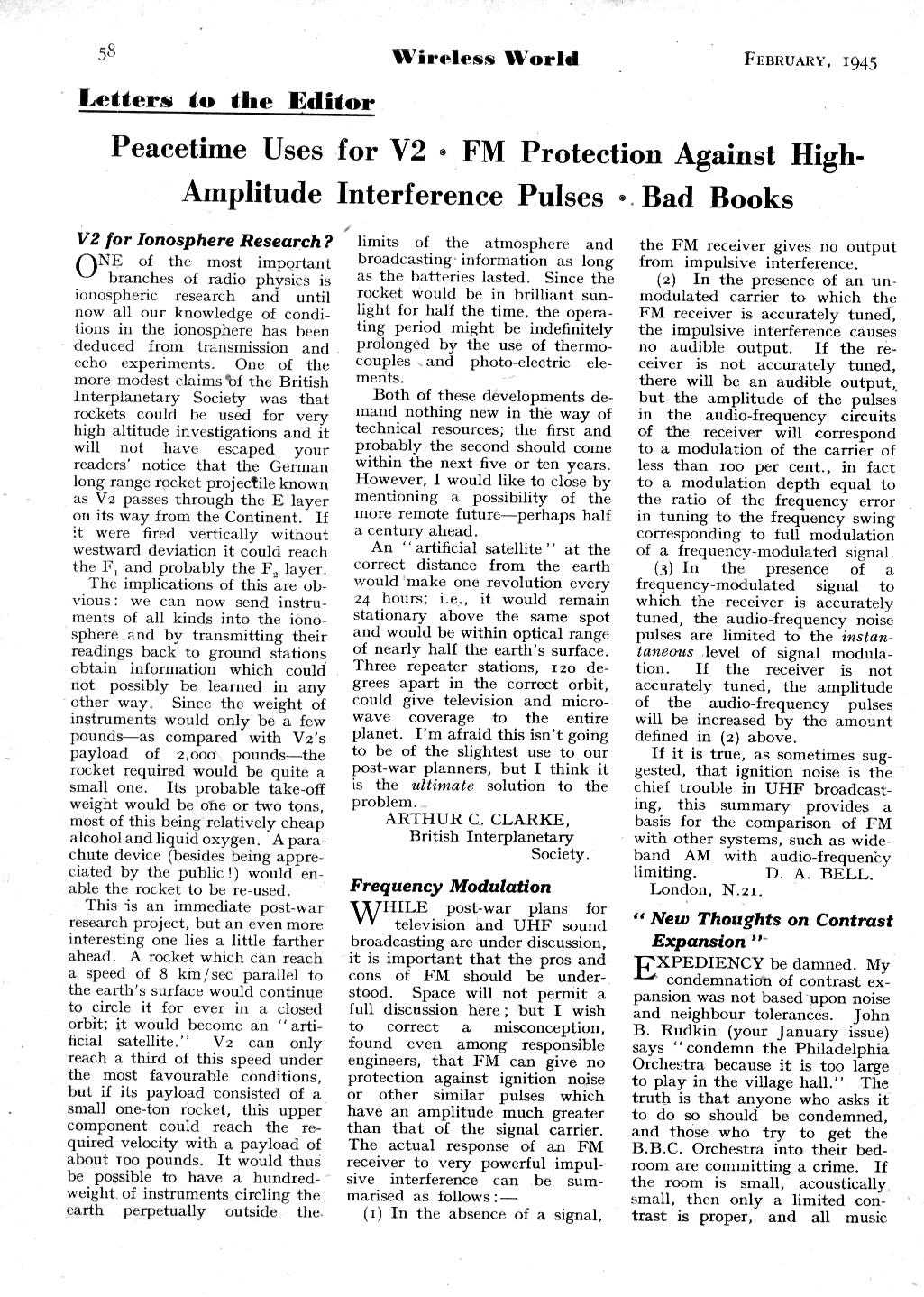
Communication satellites: Science fiction writer Arthur C. Clark outlined the vision of geostationary communication satellites in a short article published in October 1945. Five months later, Frank Collbohm and James Lipp published a comprehensive engineering study on a "Preliminary Design of an Experimental World-Circling Spaceship."

Arthur C. Clarke's vision (left) and RAND's design 

Artificial intelligence: Herbert Simon, Allen Newell, and Cliff Shaw did early work on artificial intelligence at RAND and Carnegie Tech. They asked people to talk out loud while proving theorems and noted that their strategy was to apply operations that reduced the differences between the current state of the proof and the theorem they were trying to prove. Their programs, Logic Theorist and General Problem Solver did the same -- and so does this pigeon:


A pigeon solves Wolfgang Kohler's box-and-banana
problem by applying the Box Move operator.
Operations research: George Dantzig and Richard Bellman invented mathematical techniques for finding optimal or near-optimal solutions to complex, but well-defined problems. This work has applications in network design, and you use Dantzig's simplex algorithm whenever you build an Excel spreadsheet to solve a linear programming problem.


SIMSCRIPT: Harry Markowitz and Bernard Hausner invented the SIMSCRIPT programming language for simulating systems like customers moving through checkout stands at a market. SIMSCRIPT was an early object-oriented language in that it modeled the world as sets of entities and their attributes. Entities could be created and destroyed and their attribute values and set memberships changed when events in simulated time occurred. (SIMSCRIPT is close to my heart because it was the subject of the first class I ever taught. Unfortunately, my wife threw out my SIMSCRIPT t-shirt years ago).

T-shirt -- Entities, Attributes and Sets

An early research computer: Early computers were built as research projects at universities. You can recognize them by their names ending in "AC" for automatic calculator. RAND's JOHNNIAC (named in honor of mathematician and computer architect John von Neumann) was a stored program computer. It was used for applications including the early artificial intelligence research and operations research mentioned above.

JOHNNIAC

Timesharing: Terminals and drum storage were added to the JOHNNIAC, enabling Cliff Shaw to create JOSS (JOHNNIAC Open Shop System), one of the first interactive time-sharing systems. JOSS was an "open shop" in that users interacted directly with the computer rather than dropping off jobs to be run at a later time by a computer operator. I was fortunate to see demonstrations of both JOSS and QUICKTRAN, an interactive FORTRAN interpreter built by John Morrisey of IBM. The advantage of these systems over batch processing was immediately and strikingly apparent. This led me to SDC (mentioned above), which by then had a more advanced time-sharing system that I used for my dissertation research on man-machine data analysis.

Programmer at a JOSS terminal
The RAND tablet: The RAND Tablet, the great grandfather of the iPad, was built by Tom Ellis and his colleagues. Their GRAIL (graphical input language) software featured object-oriented drawing and character recognition. Their publications are some of the earliest work on human-computer interaction -- GRAIL was the great grandfather of Macdraw. (The following video clip is narrated by Alan Kay of Dynabook fame).


Object-oriented drawing and character recognition on the RAND tablet

Large, packet-switching networks: I've saved the best for last. Paul Baran published a series of eleven reports on Distributed Communications Networks in 1964. In Volume 2, he described the network architecture:

Traffic to be transmitted is first chopped into small blocks, called Message Blocks or simply messages. These messages are then relayed from station to station through the network with each station acting as a small "post office" connected to adjacent "post offices."
After simulating this system and considering the technology of the day, Baran concluded in Volume 11 that
It appears theoretically possible to build large networks able to withstand heavy damage whether caused by unreliability of components or by enemy attack.
He was right!
Paul Baran's distributed network architecture

In the following video, Baran reviews RAND's work on distributed networks and packet switching -- from early concern over the possibility of a nuclear attack disrupting military communications through skepticism about packet switching and the creation of the ARPANet. (Since the ARPANet was just a research project, they did not need to bother with security and encryption).


Paul Baran on distributed networks and packet switching (38 minutes plus Q&A)

Two of the people cited here went on to win Nobel prizes. Harry Markowitz received the Nobel Prize in economics for his work on portfolio theory -- perhaps not tied to his work on digital simulation.

Herbert Simon also received the Nobel Prize in economics for his work on decision-making. He noted that we do not make optimal decisions when choosing among alternatives because information about outcomes is incomplete, gathering more information has a cost, and outcomes are multidimensional. In real life we make satisfatory decisions. This realization no doubt guided his studies of the thought processes of chess players and theorem provers and therefore his work on artificial intelligence.

(A personal note: I took a class from Professor Simon as an undergrad. All I recall was that I liked him a lot and he told us about the chess game his "computer" -- whatever that was -- was playing with a computer in Arizona. I also met him much later, and he was modest and helpful -- told me he stored most of what he knew in his friend's heads).

You can learn more about any of this work on Wikipedia or using Google, but -- better yet -- download the historic reports by these researchers from the RAND Web site.

-----
Update 11/29/2014

As noted above, RAND spun off its development work in 1957 when SDC was set up to build the SAGE (Semi-Automatic Ground Environment) air defense system, designed to defend the U.S. against nuclear attack.

SAGE was the first computer network and the project trained most of the computer programmers in the US at the time. The project also produced many innovations in programming and programming project management.

After SAGE, SDC built an advanced general-purpose time-sharing and software development system on an AN/FSQ-32 (Army Navy Fixed Special eQuipment) computer built by IBM. The Q-32 was used for ARPA-sponsored research projects in man-machine interaction -- including my dissertation project. More on SDC in a forthcoming post.

The AN/FSQ-32 supported research on man-machine systems.


Saturday, September 13, 2014

Recommended podcast: the women who programmed the ENIAC

How some math-savvy women helped win World War II and became the first computer programmers

Stephen Cherry of IEEE Spectrum interviews LeAnn Erickson about the women who were hired to program the ENIAC just after World War II. The ENIAC was at the University of Pennsylvania and, during the war, many of the women had been using calculators to compute artillery shell trajectories at the nearby Aberdeen Proving Ground.

These women were "computers" at the Jet Propulsion Lab.

LeAnn Erickson is a professor of film and video production at Temple University and an independent filmmaker. She produced and directed Top Secret Rosies, a documentary on those early ENIAC programmers.

Here is the trailer:


Also, check out this post on the US Army Web site.

-----
Update 10/6/2014

NPR has done a segment (6:46) on The Forgotten Female Programmers who Crated Modern Tech -- the ENIAC programmers, Grace Hopper and Ada, Countess of Lovelace. It is based on a new book, The Innovators, by Steve Jobs biographer Walter Isacsson.


_____
Update 10/22/2014

Jean Jennings Bartik, one of the first seven ENIAC programmers, has written an autobiography. Her son, Timothy Bartick sent me a link to his review of the book, in which he highlights some of the recognition she has received and describes her effort to improve the standing of women in technology.

In the following six minute video, Ms. Bartik tells of her education, early work as a "computer" at the Aberdeen Proving Grounds and later as an ENIAC programmer. The video begins with a short clip showing Ms. Bartik programming the ENIAC. (This was before the stored program computer -- the ENIAC was programmed by setting dials and switches and plugging in switchboard like wires).

_____
Update 10/23/2014

Yesterday I posted links to a short video interview of Jean Bartik and her autobiography.

She was an exceptional woman and had a significant career after her work on the ENIAC. The same can be said of other ENIAC programmers. Read more about each of them on their Wikipedia pages:

-----
Update 11/30/2024

The Computers, another documentary on the women who programmed the ENICAC will be released soon. You can see the trailer here.


-----
Update 5/24/2015

CIO Magazine has a post with links to photos and ancilary material on "Nine programming languages and the women who created them." The title is misleading -- the nine women were significant contribtors, but not the sole "creators" of the languages, but post itself makes that clear, citing other team members.

Grace Hopper, creator of FLOW-MATIC and COBOL contributor

Wednesday, March 12, 2014

Reminiscence -- my early days with the Web

Some have declared this month the 25th birthday of the Web because Tim Berners-Lee submitted a document called Information Management: a Proposal to his bosses at CERN in March 1989.

I am not sure what constitutes the birthday of an application. For example, Request for Comments 1945, defining HTTP/1.0, states that "HTTP has been in use by the World-Wide Web global information initiative since 1990" and the following announcement of availability of running code was posted in August, 1991.


Regardless, by 1992 the Web was well underway and we were surfing using a text-oriented browser called Lynx from the University of Kansas. (Recall that graphic workstations were quite expensive at the time and PC graphics were very crude, so nearly everyone worked with text in those days days, and the first Web release was text only -- no images).

In 1993, I attended a presentation on "The World-Wide Web Initiative" by Tim Berners-Lee at the Internet Society INET Conference. In my usual prescient manner, I found it interesting, but recall dismissing it as "Gopher with pictures." (Gopher was a system for distributed documents, but links were restricted to a table of contents at the start of a document and there were no pictures).

(I was working in developing nations at the time -- my presentation was on "Empowering Low-Bandwidth Users" -- people with no hope of Web access).

My next encounter with the Web was as an instructor in the 1995 Internet Society Developing Nations Workshop. On the last day of the workshop, we installed Mosaic on a Sun Workstation, and showed the students a collection of pictures of dinosaurs at a community college in Hawaii.


That was pretty cool -- I finally got it. I returned to campus and put our university's first Web site online using a PC running Windows 3.1 and an HTTP server written by Bob Denny. It crashed a lot, but my students were able to design, collect data for and publish a Web site with the course catalog and pages for each professor with their photos and interests and the departments and majors. (This was just for the School, not the entire university).

I also got funds from the USC Information Sciences Institute and installed a T1 link to four old NeXT workstations at Crenshaw High School in Los Angeles -- we were off and running.
-----
Update 3/13/2014

You cannot trust reminiscence! In looking back, the last paragraph of this post is totally incorrect. We had eight NeXT machines, not four and they were online before I saw the Web! We used them for surfing Gopher sites and for a telementoring project.
-----

Update 3/22/2014

I just came across an old blog post that sheds further light on the early Internet culture -- a discussion of the choice of the top level domain names like .com and .edu.

Monday, July 29, 2013

The Syncom satellites and Arthur C. Clarke

The LA Times ran a cool article on the development of the Syncomm satellites. Syncom 1 failed, but Syncom 2, which was launched 50 years ago on July 26, 1963, succeded in transmitting voice and image-only TV, and President Kennedy used it for a call to the Prime Minister of Nigeria in August 1963. Syncom 3, which launched August 19, 1964 was used to telecast the 1964 Olympic Games.

The Times article describes the three Syncom engineers, shown below, and their project.


The Times article relates the trouble they had selling the project, but in retrospect, it ended up being a very small investment that launched an industry and re-shaped global culture. (It was similar to the Internet in that respect). The article also contains an interactive graphic showing the satellites currently in orbit.

My only criticism of the article is that it gives the impression that the lead engineer, Harold Rosen, was the first to conceive of a geostationary communication satellite. That concept was suggested by others and fleshed out and popularized as a communication tool by the famous science fiction writer Arthur C. Clarke in a 1945 letter to the editor and subsequent article in Wireless World Magazine. This graph, from Clarke's article, shows the equilibrium altitude for a geosynchronous satellite:


So, in addition to reading the LA Times article, I'd recommend checking these out:

Time flies -- the Earth now has a fiber-optic nervous system that far outstrips communication satellite capacity. That would have been hard to predict in 1963, but if you think Arthur C. Clarke would have been surprised, read his book on the cabling of The Earth, How the World Was One.

Tuesday, July 16, 2013

Vint Cerf -- a concise history of packets, the ARPAnet and the Internet

Conceptual sketch of the ARPAnet by Larry Roberts
If you are interested in the history of the Internet and only have 16 minutes to spare, watch this interview of Vint Cerf, who was one of the handful of people that created the Internet.

Cerf's narrative begins with the idea of packet switched communication and runs through the creation of the ARPAnet, followed by the invention of internetworking protocols to link three disparate networks -- the ARPAnet, a mobile communication network and a satellite communication network.

This short video is like an annotated table of contents of the early history of the Internet. Cerf introduces us to Leonard Kleinrock, Paul Baran, Donald Davies, Larry Roberts, Thomas Marill, J. C. R. Licklider, Doug Engelbart, Norman Abramson, Robert Taylor, Charles Herzfeld, Steve Crocker, Jon Postel, Bob Kahn, David Reed, Danny Cohen and Bill Joy, summarizing the work of each and putting it in context.

Whether this is all you want to know about the history of the Internet or you want to use it as a jumping off place to learn more about the contributions of these people, this is a good place to start.

Cerf also conveys a sense of common purpose among those pioneers. He does not say so, but one can think of them as working together to realize Licklider's vision of a network running Engelbart's applications. Cerf makes it clear that, although they worked for several different organizations and changed jobs from time to time, these people knew each other well and collaborated closely on creating the Internet. (For example, Cerf, Postel and Crocker went to the same high school and studied under Kleinrock as graduate students at UCLA). The group also had an excellent collaboration tool -- they were the first users of the networks they built.

The ARPA/Internet project was a great example of government as a non-equity angel investor -- providing a small bit of seed funding ($124 million) to a group of smart, dedicated people, rather than setting up a department to do the work internally.

Charles Severance of IEEE Computer Magazine conducted the interview of Cerf, and it is one in a series of computing conversations.

Wednesday, January 02, 2013

The 30th anniversary of the transition of the ARPANET to TCP/IP -- the birthday of the Internet?

Pre-network packet switching -- routing
telegrams by tearing paper tape

New Years day marked the 30th anniversary of the transition of the ARPANET to the TCP/IP communication protocols, a day many consider the birthday of the Internet. Let's look back to see why that date was an important milestone.

The ARPANET, the first large, operational, packet-switched network, was funded by The Advanced Research Projects Agency of the Department of Defence (ARPA, later DARPA) and it went online October 29, 1969. The ARPANET, which began as untested research, grew and evolved and was declared "operational" in 1975.

The ARPANET was a success, but all the connected machines used the same communication protocol -- it was like a nationwide LAN. But DOD had other networks using different protocols, so they funded the development of an inter-networking protocol to enable these dissimilar networks to communicate. The design for that protocol, the transmission control program (TCP, later split into two layers, TCP/IP), was published in a paper by Vint Cerf and Robert Kahn in 1974.

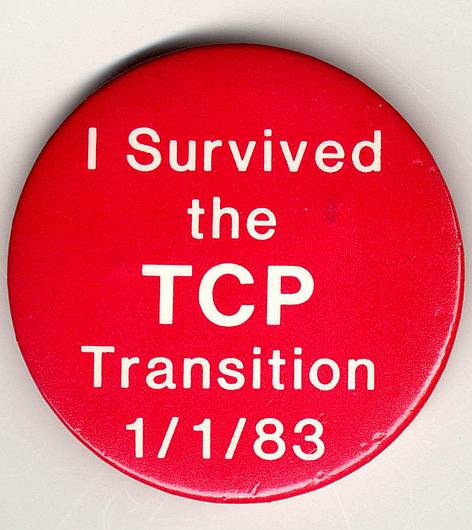
TCP/IP was implemented and tested and, on January 1, 1983, the ARPANET was transitioned to TCP/IP. Was that the birthday of the Internet?
One might argue that the Internet began with the vision of pioneers like Vannevar Bush, JCR Licklider and Doug Engelbart, Paul Baran's RAND reports, early packet switching experiments, the start of the ARPANET, the first tests of TCP/IP, the diffusion of TCP/IP with NSFNet, etc., but the first large scale inter-network began with the deployment of TCP/IP on the ARPANET and TCP/IP (and Ethernet in the LAN) remain the basis of today's Internet.

Here are a few links you might want to follow if you want more on the 30th anniversary:

Sunday, August 05, 2012

Government spending: seeding the Internet cost $124.5 million, Morse's telegraph $30 thousand

On July 22, Wall Street Journal columnist Gordon Crovitz wrote an article giving "full credit" for the invention of the Internet to the Xerox Corporation.  That article was embarrassingly inaccurate in denying the role of the US government, and there have been a spate of rebuttals.

Steve Crocker, Internet pioneer and current chairman of the Internet Corporation for Assigned Names and Numbers, has summed up the roles of government and industry in an excellent article. He explains why the Internet could not have been created by private industry without government’s help and also points out that once the initial infrastructure was in place and its feasibility demonstrated, it was vital for industry to step in and develop products, software and services.

That initial infrastructure began with research and theory leading to the ARPANet, which demonstrated the feasibility of a large scale network. Critical mass and training were achieved when the government funded the spread of networking to universities through CSNET for computer science departments, the National Science Foundation NSFNet for connecting all US colleges and universities and the NSF International Connections program, which brought in university and research networks in 28 nations, most of which were in the developing world.

In a 1996 Communications of the ACM article Seeding Networks: the Federal Role, I documented the cost of that government effort. The ARPAnet cost $25 million, CSNET $5 million, the NSFNET backbone $57.9 million, connecting universities to the backbone $30 million, and the NSF International connections program $6.6 million. The US taxpayer got a pretty good return on an investment of $124.5 million.

The US government investment that led to the Internet paid a handsome return, but it was not the first federal networking investment. As we see here, in 1843, the US Congress appropriated $30,000 for the construction of a line of electro-magnetic telegraphs under the supervision of Professor Samuel F. B. Morse in order "to test the capacity and usefulness" of the system he invented. He used the money to construct a 37 mile telegraph connection between Washington and Baltimore, and, indeed, it turned out to be useful. That was a pretty good investment too.

Of course it is not only the US Government. Donald Davies was at the National Physical Lab in England when he coined the term "packet switching" and built an early test network and Tim Berners Lee was working at CERN, which was funded by 20 European governments and the European Union, when he invented the Web.

-----
Update 4/21/2016

The Internet is one example where Federal funding of research has paid off handsomely. For other examples, see this post on Presidential science initiatives.

Tuesday, July 24, 2012

Obama perpetuates an Internet urban legend ... not

In a recent campaign speech in Roanoke Virginia, President Obama defended government, pointing to its role in projects like building Hoover Dam, putting a man on the moon or creating the Internet. Regarding the Internet, he said:
The Internet didn't get invented on its own. Government research created the Internet so that all the companies could make money off the Internet.
That remark led Wall Street Journal columnist and former publisher Gordon Crovitz to write an opinion article giving "full credit" for the invention of the Internet to the Xerox Corporation.

Crovitz' article ignores so much that it would be hard to know where to start in refuting him, but I don't need to do that. The LA Times, Wired Magazine, arstechnica and countless others have shot the article down. (For an in-depth, nuanced discussion of the invention of computer networks by the people who actually did it, subscribe to the Internet History list).

Let's switch gears and ask what might have motivated Mr. Crovitz to embarrass himself and the Wall Street Journal by writing the article. A cynic might think this was a deliberate attempt by the Wall Street Journal to deceive voters, but, jaded as I am, I can't imagine them explicitly deciding to do that.

I think it is an example of confabulation by Mr. Crovitz and his editors at the Wall Street Journal. We all confabulate to some extent. We are masters of subconscious rebuttal -- quick to explain away new information that undermines our beliefs. Without thinking, "yes, but ..." springs to mind.

I would be willing to bet that Mr. Crovitz is a Republican who opposes President Obama and believes that relative to private business, government is bureaucratic, inefficient, wasteful and perhaps even corrupt.

When The President said "Government research created the Internet," Mr. Crovitz internal confabulator immediately and subconsciously ginned up a response -- Xerox Corporation.

Maybe it is unfair to beat up on Mr. Crovitz. We all confabulate -- that is why newspapers and other news organizations have editors and editorial review. This article sounds more like The Onion than The Wall Street Journal. The editors blew it.

(Still, I would nominate Mr. Crovitz for the 2012 Ted Stevens memorial Internet Pipes Award).

Friday, August 26, 2011

Steve Jobs is an artist

Homebrew Computer Club meeting
I only met Steve Jobs once -- at a Homebrew Computer Club meeting in 1976. Homebrew meetings were held in a stadium style auditorium at the Stanford University linear accelerator lab, and they featured a "random access" time, in which people in the audience stood up and made announcements or asked for help with a problem they were working on.

Steve Wozniak stood up and offered free copies of the schematic for the computer he and his friend had built.

After the random access session, attendees talked with each other and with vendors standing at tables in the back of the auditorium. Jobs was behind a table with a wire wrapped version of the Apple I motherboard, and we talked about the trade-offs in implementing functions in software or hardware.

Wozniak, Jobs and an Apple I
At the time, I was editor of Interface Age, a short-lived magazine with a national circulation, so I asked Jobs if he would write us an article about his ideas on design and his computer. He told me he would not be willing to write an article unless I would devote the entire issue to Apple.

I was pissed by the kid's arrogance, and walked away.

Inside the Apple I
But he was right to be arrogant. He is an artist who works on very large canvases.

Jobs does not create paintings or songs, he creates products and industries. Painters work with paint and brushes, musicians with instruments. Jobs works with organizations and capital. His artistic works include Apple Computer, Apple, Next, Pixar, Apple stores and iTunes and he's sculpted the personal computer, mobile music and phone, movie, TV and music industries. Now he is dabbling in architecture with Apple's proposed office complex.

Check this column by David Pogue for more on the industries and products Jobs imagined and then created.

Apple I

Sunday, January 31, 2010

Who came up with top-level domain names like "com" and "edu," and what was the early Internet culture like?


The Internet was developed by a group of people at various universities and companies with contracts to work on the project. Decisions, policies and technical specifications were worked out informally in conversations, email, and documents called "requests for comment" (RFCs).

Many of the original developers and users of the Internet still contribute to discussions on the Internet History email list. You can gain insight into the history and also the culture of the early Internet by subscribing to the list.

For example, there was a recent discussion of the choice of the original top level domain names like "com" and "net" on the list. I have selected a few messages from that discussion to give you a sense of the way decisions were made. (The messages refer to "Jon" -- Jon Postel, one of the key Internet developers and policy makers).

This question was posted January 20, 2010:

Does anyone know why .com; .edu and .gov were chosen? I know it seems
simple, but why .com instead of something like .biz?
There were many replies, and I selected a few which help capture the process and culture:
I recall seeing those TLD names on Jon's white board at the time. I feel
quite certain that they came out of Jon's head, but were ratified by
discussions with Paul.

Bob Braden


Some years ago, Jake Feinler said that there was a persistent, non-converging
debate in the community about the TLD choices.

She asserted that there was finally some small face-to-face discussion where she
ran out of patience and declared that the choices would be com, net and org.

I have a somewhat more vague recollection of her acknowledging that the
question, then, was whetehr Jon would concur, and that he did.

Dave Crocker


perhaps the point has been made but the motivation for these TLDs was
to parse the responsibility for registration into very distinct
categories so that the work could be delegated without too much
dispute over jurisdiction but still covered the range of then-foreseen
participants in the use of the Internet system.

Vint Cerf


I don't know but it happened between April 1984 and October 1984.

In April 1984 Postel and Reynolds distributed a draft of what became RFC 920.
In that draft they used Grapevine-like naming, so ERNIE.CS.CAL.UC for a
site in the University of California system.

In October 1984, when RFC 920 came out it specified GOV, EDU, COM, MIL and
ORG. NET came later (Dick Edmiston's and my doing).

I wish I had copies of the email discussions between April '84 and October '84
but I don't. My guess is that the discussion was in NAMEDROPPERS but I
only have a very limited archive of old NAMEDROPPERS email.

Craig Partridge

Hi Bob!

I also have the feeling that Jon put the list together, since as I
recall he was the only one of us organized enough to deal with such
things...

As to why that initial list was chosen, my recollection is that it
simply reflected the demographics of the emerging "Internet community"
at the time. There were lots of governmental entities and lots of
schools. The "rest of world" were commercial, or companies.

Plus it was likely that someone from each TLD subgroup would step up and
volunteer to be the coordinator/arbitrator of name etiquette within that
subgroup. You couldn't have a TLD unless there was someone willing to
manage it.

The nascent Internet was very US-centric, again reflecting the
demographics. Gov meant US government. Com was US companies, weighted
toward government contractors such as BBN or Linkabit - I can't recall
any non-US companies being involved until later in the game.

I think .com originally was derived from "company" rather than
"commercial". The .com's weren't thought of as "businesses" in the
sense of places that consumers go to buy things. They were companies
doing government contract work. The Internet was not chartered to
interconnect businesses - it was a military command-and-control
prototype network, being built by educational, governmental, and
contractors. If anybody had suggested that businesses were to be
included, it would have raised flotillas of red flags in the
administrative ranks of government and PTTs. Hence .com -- not .biz.

I don't recall anybody ever thinking we were creating an organizational
structure to encompass hundreds of millions of entities covering the
entire planet in support of all human activities. And it certainly
wasn't supposed to last for 30+ years, even as an experiment. It just
happened to turn out that way.

IIRC, there weren't any major debates or counterproposals or such about
TLDs. The TLD list just wasn't that big a deal (at the time). The
Internet was an experiment which, like all experiments, was supposed
to end. CCITT, ISO, and such organizations were inventing the official
technologies for the future of data communications. We know now how
that turned out Whatever TLD list and such was used in the Internet
wasn't supposed to last long. So a specific logistical decision like
the TLD list wasn't all that important - at the time.

I agree that whatever discussion happened was almost certainly carried
out mostly on the email lists which served as the primary way for
everybody to interact between quarterly meetings, and then Jon and crew
most likely put the initial list together, and there wasn't any real
opposition so it became real.

It's very difficult to identify who "invented" anything in those days.
There was lots of discussions, ideas, and strawmen passed around in
emails and then eventually somebody wrote the document or wrote the code
to capture the "rough consensus" of the discussion.

Jack Haverty
You can find these messages and the others on the thread here. I've also included snapshots of the people participating in this discussion -- they may also help give you a feel for the culture. (Which one is Jon Postel)?

Tuesday, August 19, 2008

Technology transitions -- the early days of the Web

Today's freshman cannot remember a time before the Web, but, at first, HTTP and HTML were just newly proposed protocols without users. In the early 1990s, email, file transfer, network news, and remote login were important Internet applications. We also read documents from Gopher servers, and found them using search services like Veronica, WAIS, and Archie or a directory called "Jerry's Guide to the World Wide Web," which was maintained by two graduate students and later renamed "Yahoo!".

Gopher sites had tables of contents with links to documents, but no links within documents. The text could not be formatted (as we do with HTML today), and there were no images, only text. Web files were larger than Gopher files, but that became less important as communication speed -- faster modems -- improved.

As with all technology transitions, the Web protocols co-existed with Gopher and related search engines for some time. John December, a graduate student at the time, documented this transition period and his outlook for the Web in a book and in this article.

Can you give an example of another emerging application that depends upon increased communication speed? Increased storage capacity? Increased computation speed?

Wednesday, April 30, 2008

Web anniversary -- 15 years in the public domain

We discuss IT history, including that of the Web.

Today is the fifteenth anniversary of the placing of the Web in the public domain -- enabling it to grow to what it is today.

In 1989, Tim Berners-Lee was working at CERN, the European Organization for Nuclear Research. He proposed that CERN develop a hypertext (link) based document management system for the Internet. You can read his proposal here.

The proposal was accepted and work began on what would become the first Web client/server.

On April 30 1993, CERN placed the Web software in the public domain, allowing anyone to build and use Web browsers and servers without paying a royalty. The BBC published several articles commemorating the fifteenth anniversary of that date, including:

What do you think would have happened to the Web if CERN management had decided to copyright the Web protocols and software and charge royalties for those wanting to use them?

Wednesday, December 26, 2007

An excellent computer history course

We cover the history of technology and networks, and the University of Washington, UCSD and UC Berkeley offered an excellent course on the history of computing in fall 2006.

The course material is online, and includes short essays by the faculty, links to original material, and presentations by faculty and prestigious guest speakers, including many computing and networking pioneers.

Many of the presentations include photos of historic equipment and events. For example, the photo shown here was taken behind the scene of Doug Engelbart's historic 1968 demonstration of his work on personal and collaborative computing.

Note that the course material is organized using a wiki. It illustrates the use of a wiki as a simple, flexible platform for creating a Web site to support an ad-hoc project or organization.

Historic prototypes look old fashioned to us, like early cars or the Wright Brother's first plane. How will we see today's technology in the future? Is technology changing as fast today as in the past?