Clear, ambitious objectives drive rapid innovation and his goal it to create a self-sustaining settlement on Mars as soon as possible.
Achieving that goal requires getting a lot of tonnage to Mars, so expendable rockets are a joke, a waste of time. Fairings too.
Scale matters -- large rockets are efficient. Avionics for a large rocket are no larger than for a small rocket and you gain gauge advantages with size -- you can afford thicker, more accurate castings and skins on a large rocket. (The same goes for trucks and ships).
Their current Falcon 9 is close to a local maximum for a kerosene-burning rocket which is limited to a 12-foot diameter because of road transport constraints and its length is constrained by the skin thickness required to avoid bending.
Methane is a better fuel than kerosene -- a rocket goes further if it shoots gas out the end faster and a bigger percentage of its mass is propellant. Furthermore, oxygen is cheap and you can go to a higher oxygen/propellant ratio with methane and you can make both oxygen and methane on Mars.
He gave some timetable guesses with the caveat that they assume exponential innovation:
80-90% confident of reaching orbit with Starship next year.
50-60% confident of ship and booster reuse next year.
Two or three years for a moon ship -- after refueling in orbit.
An un-crewed Mars mission in maybe four years (at the time of the second Mars transfer window from now).
(Note that they might not choose to launch 400 satellites at a time since a loss of 400 satellites or 28 booster rocket engines would be very costly and mixed-purpose launches are also possible).
The above assume a non-linear rate of innovation. When asked what makes SpaceX so innovative, Musk first said "I don't really know," but went on to credit having ambitious sub-goals like:
Full and rapid reuse.
Orbital refueling.
Propellent production on Mars.
He said SpaceX will not have competitors unless someone else is shooting for Mars.
His goal also requires a million people who want to go to Mars and can afford or find funding to do so -- you need the will and the way. He is working on the way.
When asked about SpaceX hiring criteria he said he looks for "evidence of exceptional ability" regardless of certification and worries that if Nikola Tesla applied to work at Tesla they might not even give him an interview.
I really enjoyed the interview. I like Musk's humor and relaxed, off-the-cuff speaking style and admire the breadth of his knowledge, his focus on the very big picture, and his management style. He gets results.
On November 15, the FCC approved a revision to the plan for Starlink, SpaceX's forthcoming broadband satellite service. The new plan reduces the number of satellites from 4,525 to 4,409 and lowers the altitude of the phase-1 satellites from 1,100 to 550 km.
Revised broadband satellite plan (Sources 1, 2 and 3)
Mark Handley, a professor at University College London, has created videos based on simulations he ran of both the original and revised phase 1 plans. You should watch the videos, but it will help to first look over a few images from his simulation of the new plan.
Starlink phase-1 is shown below. Handley assumed a phase offset between adjacent planes that would minimize the chance of a collision. The minimum crossing distance between satellites is a little over 90 km -- an improvement over the previous plan.
Starlink phase 1
Looking up, there are several satellites in view at any one time (but fewer than there would have been with the previous 1,100 km plan):
View from the ground
Radio transmission will be used for links between the satellite constellation and the ground and laser links will be used between satellites. Handley assumed that each satellite links to the one before and after it in its plane and to the second closest in the adjacent planes in order to improve east-west routes. In his simulation of the first plan, he assumed a fifth laser linked to a satellite in the crossing plane, but that would be more difficult at this fast-moving lower altitude. It will be interesting to see how SpaceX uses the inter-satellite links.
Each satellite is linked to four others, forming a mesh network.
A simulated route between San Francisco and London is shown below. Note that latency is about half that of current, terrestrial routes. (The latency advantage of satellite routes over terrestrial is generally greater for long distances).
San Francisco-London -- twelve hops in space
Nine parallel routes between New York and London are shown below -- eight have lower latency than the current, terrestrial route.
Eight New York to London routes are faster than a terrestrial route
The following image shows all three phases -- Handley is not sure if the other two will interact with the phase 1 satellites.
Red: phase 1, white: phase 2, Blue, phase 3
Only Elon Musk knows what motivated this revision in SpaceX's Starlink plan, but we can speculate. They have had two test satellites in orbit at around 550 km altitude for some time, and that experience must have informed the decision. Musk reported that the links between the test satellites and the ground were performing well, but did not mention the laser links between satellites. Perhaps they feared difficulty with the longer laser links at 1,100 km or some other engineering problem. (Musk recently fired several managers in an effort to keep the project on schedule).
Because SpaceX and others are planning to launch thousands of new low-Earth orbit satellites, the FCC is focusing their attention on debris mitigation. The chance of a collision with the new plan is reduced since the minimum distance between satellites increases from over 40 to slightly over 90 km and.
The lower-altitude satellites may require more fuel to overcome a slight increase in atmospheric drag, but they will be easier to de-orbit when their life (around 5 years) is up, further reducing the likelihood of a collision.
Starlink's primary goal is affordable global broadband service to individuals and organizations, but Musk has also predicted that they would carry half of the global long-distance traffic. Handley's simulations predict roughly 2X latency improvement over current terrestrial cables on long routes and he points out that low-latency long-distance service will appeal to financial companies with offices in Europe, North America, and Asia. If capacity turns out to be sufficient, I imagine Starlink will also attract tier 1 ISPs and large companies like Google.
Finally, SpaceX also has approval for a constellation of 7,518 very low-Earth orbit satellites operating at altitudes from 335km to 346km. These will not be launched until SpaceX has satellite engineering, regulatory and market experience and time to assess potential cooperation/competition from 5G terrestrial networks.
I recommend watching the videos of both of Handley's simulations because the narratives are different and both are inciteful. You should also read his paper Delay is Not an Option: Low Latency Routing in Space.
Update 5/27/2019
Mark Handley has created a simulation of all 11,927 planned Starlink satellites.
Red: first phase at 550km.
White and blue: 2nd phase: 1,110 to 1,325km.
Yellow: 7,517 yellow VLEO satellites 335-345km.
Blue: Polar orbit
You can see a short video of this simulation here.
Last week, Elon Musk was asked on Twitter how the Starlink tests were going and he replied that the two test satellites, TinTin A and B, are connecting at "high bandwidth" with 25 ms latency.
That's good news but it leaves a lot unanswered. For example, he did not mention the speed and reliability of the phased-array handoffs between the satellites and ground terminals and he said nothing about tests of the inter-satellite laser links, which OneWeb has abandoned.
While we have experience with radio links between satellites and the ground, inter-satellite laser links are new so I'm more curious about those tests. What sorts of speeds and latencies are they seeing on transmissions between TinTin A and B and how well are they doing at creating and maintaining links between the satellites? Fast inter-satellite switching and transmission speed are critical to overall performance of the constellation grid, particularly on long-distance links.
Click here for a survey and updated progress report on SpaceX Starlink and other potential LEO-satellite based Internet service providers.
SpaceX President and COO Gwynne Shotwell gave a recent interview in which she said that SpaceX is profitable, but she predicts a much larger market for the Starlink Internet service. (As we see here, a January 2017 Wall Street Journal article made the same point).
Shotwell also spoke of synergies among Elon Musk's companies: Tesla cars will be online via the Starlink Internet service; Tesla battery technology has been leveraged for the Falcon 9 rocket and Dragon spacecraft and Boring Company technology will be used in housing construction on Mars. They have also learned manufacturing techniques from Tesla and will be able to produce one rocket engine per day and two complete Falcon 9 rockets per month.
She also said they remain on schedule to take people to Mars in 2024, and, when asked about Elon Musk, she said he spends about half his time on SpaceX and half on Tesla and that he is an inspirational leader.
Click here for a survey and updated progress report on SpaceX Starlink and other potential LEO-satellite based Internet service providers.
The ability to launch 30 Falcon 9s per year at a cost of $5-6 million per launch, would be a big plus for SpaceX's Starlink Internet service.
On May 11, SpaceX launched a Bangladeshi satellite using their Falcon 9, Block 5 rocket. This was the first production flight for the Block 5. The day before the launch, Elon Musk participated in a call with reporters and the following are some of the points he made. (You can read more analysis and read a full transcript of the call here)
SpaceX accounted for over half of US launches in
2017 and expects to double their launch rate.
In 2017, SpaceX had 18 successful launches and Musk stated that they were on track to double their launch rate this year, implying a rate of 3 launches per month. He said that "if things go well, which is a caveat, then SpaceX will launch more rockets than any other country in 2018."
There will not be a Block 6. Musk said that after 8 years of upgrades, the Block 5 will be the last major version of the Falcon 9 before their next rocket, the BFR.
Musk expects the Block 5 "to be a mainstay of SpaceX business," and there will be 300 or more Block 5 flights before it is retired in favor of the BFR.
The Block 5 is designed for rapid-turnaround reusability. It is "designed to do 10 or more flights with no refurbishment between each flight — or at least not scheduled refurbishment between each flight. The only thing that needs to change is you reload propellant and fly again." He also said that "the Block 5 boosters are capable of on the order of at least 100 flights before being retired."
Musk has set a goal of demonstrating "two orbital launches of the same Block 5 vehicle within 24 hours, no later than next year."
The Block 5 was designed "to be the most reliable rocket ever built." They have exceeded all of NASA's human-rating requirements and have met "all of the Air Force requirements for extreme reliability."
Reliable reusability will cut cost dramatically. Musk broke down launch cost as follows: booster about 60 percent, upper stage 20 percent, fairing 10% and the launch cost 10%. If they are able to reuse all three rocket elements, they would be able to "reduce the cost for launch by an order of magnitude ... to $5-6 million per launch." Musk pointed out that getting to this point had taken "16 years of extreme effort" (and a lot of learning from failures).
The ability to launch 30 Falcon 9s per year at a cost of $5-6 million per launch, would be a big plus for SpaceX's Starlink Internet service.
SpaceX started with their Falcon 1 booster followed by several versions of the Falcon 9. The Falcon Heavy will fly later this year and the rocket that will take the first person to Mars is called, for now, the Big F***ing Rocket or BFR.
The Falcon1, Falcon 9, Falcon heavy and the BFR (source)
The 150-ton BFR payload will be 10 times that of the Falcon 9. It will have an have an extra landing-guidance engine for reliable reusability and SpaceX also expects to be able to soft-land and reuse the second-stage payload rocket as well as its protective nose cone, substantially reducing cost per launch. (Note that Boeing is also planning a Mars mission so they may be planning their own BFR).
SpaceX applied to launch their 4,425 satellites in two phases -- an initial deployment of 1,600 satellites and a final deployment of 2,825. That is a lot of satellites and the FCC has required licensees to deploy their full constellations within six years of their grant, but last month they relaxed that constraint, establishing milestones of launching 50% of a constellation within six years and allowing another three years to complete the constellation. The FCC has delayed licensing SpaceX's plan until spectrum sharing agreements are reached by satellite operators, so the clock has not yet started running on their six and nine-year milestones.
SpaceX plans to send a BFR to Mars in December 2022, and they won't give me any details, but they will surely be used "locally" before that. They plan to begin launching operating Internet satellites in 2019 and those will be launched by Falcon 9 or Falcon Heavy rockets, but the BFR should be available to launch many of the planned 4,425 satellites before the FCC deadline and it will be used for replacement satellites when they are eventually required.
SpaceX estimates the satellite mass as 386 kg and the BFR can carry a 150-ton payload so, if they fit perfectly, a BFR could launch about 350 satellites at a time, but they won't fit perfectly, so let's say 300 per launch. SpaceX Senior Director Tom Ochinero says they will be capable of up to six launches per month. Using the BFR, 4,425 satellites in nine years sounds feasible and relatively cheap. (Elon Musk has estimated that future versions of the BFR may carry up to 1,000 tons).
The BFR may also play a role in debris mitigation. When they are taken out of operation, satellites are de-orbited and they burn up in the atmosphere, but there is some risk of debris hitting the Earth. Bloomberg reported that the FCC had challenged SpaceX's assessment of risk of human casualty from falling debris and SpaceX responded the following month. Recently two Senators have also asked the FCC to investigate the risk of collisions and debris.
The BFR may render the debate moot. In a recent presentation, Elon Musk speculated that the BFR might be used to capture orbiting satellites and return them to Earth, as illustrated here:
SpaceX hopes to recapture satellites in the future (source)
I will conclude with the following image that illustrates how the BFR got its name -- it is a BFR. If you are interested in the BFR and its role in Elon Musk's plan to colonize Mars, you should definitely read the post this illustration is taken from.
Still not sure how big it is? Check out this view of a BFR in Boston:
=====
Update 10/20/2017
In a talk at the 2017 International Astronautical Congress in Australia last month, Elon Musk summarized SpaceX's technology progress, including 18 successful booster landings, and described the BFR design and economics and its applications -- launching satellites, shuttling to the International Space Station and travel to the Moon, Mars and between distant cities on Earth. It is a terrific talk, well worth watching:
On October 15, Musk followed up his talk with an “Ask Me Anything" (AMA) discussion about the BFR on Reddit. You can read a good summary of the AMA discussion, which includes video excerpts from the IAC talk and a concept video on terrestrial travel here. if you have time on your hands to geek out, you can see the entire AMA session here.
Last, but not least, SpaceX has posted a terrific 39-slide presentation on the project. It's a "Steve Jobs" kind of presentation -- long on images illustrating a concept and short on words. (I'm a big fan of that presentation style and try to force it on my beleaguered students). The presentation also includes links to a couple of animations and a video illustrating a hypothetical terrestrial travel scenario. Here are four of the slides to whet your appetite:
=====
Update 12/9/2017
The much-delayed test launch of the Falcon Heavy rocket is scheduled for January 2018. The payload capability of the Falcon Heavy is about 2.5 times that of the Falcon 9 and around one-third of that of the BFR -- "well over 100,000 pounds to low-Earth orbit" according to Elon Musk.
(The Falcon Heavy test payload will be a Tesla Roadster destined for solar orbit -- a good publicity stunt and a near-permanent symbol of our transition to alternative energy sources).
The Falcon 9 will be used to launch SpaceX's first two prototype satellites next year, but in 2019, when SpaceX will begin launching operational Internet-service satellites, the Falcon Heavy will be available. The BFR will be available before the first Internet constellation is complete in 2024.
=====
Update 12/20/2017
SpaceX has released photos of the first Falcon Heavy rocket. It is expected to launch next month, putting a Tesla Roadster in solar orbit. When asked why he wanted to put the car in orbit, Musk said he loves "the thought of a car drifting apparently endlessly through space and perhaps being discovered by an alien race millions of years in the future," and so do I. That reply is even cooler than Mallory saying he climbed Mount Everest "because it's there."
They hope to retrieve and reuse the three booster rockets.
=====
Update 9/23/2018
Elon Musk announced changes to the evolving BFR design and introduced their first moon passenger in a presentation at SpaceX headquarters. During the first portion of the talk, Musk outlined 18 changes to the BFR design. For example, as shown below, the payload capacity has been revised at least twice since the initial BFR announcement, the second-stage spaceship is larger and it has fins for landing and deceleration during reentry.
The specific changes are each of interest, but the transparency of the engineering process is unique. Can you imagine Apple giving periodic public presentations on the evolving design of the 2022 iPhone and it's target applications every few months?
Another insight into Musk's thinking was illustrated by a question from the audience near the end of the presentation. He was asked what he thought about the Boeing CEO's prediction that they would build the first rocket to take a human to Mars and his answer was
Game on ... I'm glad he said that. that's great. I hope Boeing really goes, like, hard-core for Moon and Mars missions ... that would be really great.
Musk's goal is for us to become a multi-planet species and he welcomes Boeing as a competitor and a collaborator. Similarly, he wants us to transition to renewable energy and sees Tesla as accelerating the renewable-energy plans of other automakers. His open-patent policy is further evidence of his working toward goals that transcend corporate growth and profit.
Musk also introduced Japanese billionaire Yusaku Maezawa who has paid to be the first passenger on a BFR Moon trip. Maezawa also paid the fare for eight artists -- he and Musk are clearly kindred spirits.
Four companies, SpaceX, OneWeb, Boeing and Leosat are working on constellations of low-Earth orbiting satellites to provide Internet connectivity. While all four may be thinking of competing with long, terrestrial cables, SpaceX CEO Elon Musk said "the goal will be to have the majority of long-distance traffic go over this (satellite) network" at the opening of SpaceX's Seattle office in 2015 (video below) and Leosat is focusing on high-end fast, point-point links.
Can he pull that off?
Their first constellation will consist of 4,425 satellites operating in 83 orbital planes at altitudes ranging from 1,110 to 1,325 km. They plan to launch a prototype satellite before the end of this year and a second one during the early months of 2018. They will start launching operational satellites in 2019 and will complete the first constellation by 2024.
The satellites will use radios to communicate with ground stations, but links between the satellites will be optical.
At an altitude of 1,110 kilometers, the distance to the horizon is 3,923 kilometers. That says each satellite will have a line-of-sight view of all other satellites that are within 7,846 kilometers, forming an immense mesh network. Terrestrial networks are not so richly interconnected and cables must zig-zag around continents and islands if undersea and other obstructions if under ground.
Latency in a super-mesh of long, straight-line links should be much lower than with terrestrial cable. Additionally, Musk says the speed of light in a vacuum is 40-50 percent faster than in a cable, cutting latency further.
Let's look at an example. I traced the route from my home in Los Angeles to the University of Magallanes in Punta Arenas at the southern tip of Chile. As shown here, the terrestrial route was 14 hops and the theoretical satellite link only five hops. (The figure is drawn roughly to scale).
So, we have 5 low-latency links versus 14 higher-latency links. The gap may close somewhat as cable technology improves, but it seems that Musk may be onto something.
Check out the following video of the speech Musk gave at the opening of SpaceX's Seattle office. His comments about the long-distance connections discussed here come at the three-minute mark, but I'd advise you to watch the entire 26-minute speech:
Update 10/30/2017
Elon Musk has set a goal of having the majority of long-distance Internet traffic go over the SpaceX satellite network. The key to that is a richly connected, optical mesh linking their fast-moving satellites.
SpaceX is building a vertically-integrated organization -- rockets, satellites, ground stations, etc. are all being designed and manufactured in-house as opposed to OneWeb, which is working with strategic investors and partners. Based on this, I suspect that SpaceX is designing their own optical mesh network for inter-satellite communication.
I've not heard OneWeb talking about optical links between their satellites but, if they are planning for that, they might be seeking a partner and Mynaric may be a likely candidate. Mynaric says they have solved the problem of steering a narrow laser beam sufficiently accurately to keep it locked on a target only centimeters in diameter on a moving platform hundreds of kilometers away. OneWeb might satisfy their inter-satellite communication requirement by partnering with Mynaric.
Mynaric technology might be a good fit for OneWeb and other airborne platforms.
=====
Update 12/21/2017
As stated above, Elon Musk set a goal of having the majority of long-distance Internet traffic traverse the SpaceX satellite network. He based that goal on an inaccurate assumption about terrestrial networks and said nothing about competition from other LEO satellite networks. Let's look at both factors.
In his talk, Musk claimed that a route from Seattle to South Africa would involve 200 router hops. That is a major overstatement. I just ran a trace from my home to Durbin Technical University in South Africa and it was only 16 hops with an average latency of 350 ms. Musk also asserted that it would take only 2 or 3, perhaps four hops via satellite. My estimate to Chile, shown above, was 5 hops so that claim may have been a little optimistic. Regardless, it is far fewer than 200 hops.
Second -- Musk drew a comparison to terrestrial cables, pointing out that transmission is slower through a cable than in space and cables had to weave around geographic obstacles. That is true, but it seems that SpaceX will have at least one strong, satellite-based long-link competitor, Leosat. Leosat is focusing on the market for low-latency, secure, point-point links.
I can't believe I am contradicting Elon Musk (I am a big fan), but he may not reach his goal in the long-distance Internet service market.
I've been following the efforts of SpaceX and OneWeb to become global Internet service providers using constellations of low-Earth orbit (LEO) satellites for some time. Launch times are getting close, so I'm posting a status update on SpaceX's project. (I'll do the same for OneWeb in a subsequent post).
The Senate Committee on Commerce, Science, and Transportation held a hearing titled “Investing in America’s Broadband Infrastructure: Exploring Ways to Reduce Barriers to Deployment” on May 3, 2017, and one of the expert witnesses was Patricia Cooper, SpaceX Vice President, Satellite Government Affairs.
She began her oral testimony with a description of SpaceX and its capability and went on to outline the disparities in broadband availability and quality and the domestic and global broadband market opportunities.
Next she presented their two-stage plan. The first, LEO, satellite constellation will consist of 4,425 satellites operating in 83 orbital planes at altitudes ranging from 1,110 to 1,325 km. They plan to launch a prototype satellite before the end of this year and a second one during the early months of 2018. They will start launching operational satellites in 2019, will begin offering commercial service in the 2020-21 time frame and will complete the first constellation by 2024.
The LEO satellites launched in the first phase of the project will enable SpaceX to bring the Internet to all underserved and rural areas of the Earth. If all goes according to plan, SpaceX will be offering global Internet connectivity by 2024. These satellites may also have an advantage over terrestrial networks for long-range backhaul links since they will require fewer router hops, as shown in the following illustration comparing a terrestrial route (14 hops) with a satellite route (5 hops) between Los Angeles and a University in Punta Arenas, Chile (The figure is drawn to scale).
Ms. Cooper also said they had filed for authority to launch a second constellation of 7,500 satellites operating closer to the Earth -- in very low Earth orbit (VLEO). A 2016 patent by Mark Krebs, then at Google, now at SpaceX, describes the relationship between the two constellations.
I don't have dates for the second constellation, but the satellite altitudes will range from 335.9 to 345.6 km. (The International Space Station orbits at 400 km). These satellites will be able to provide high-speed, low-latency connectivity because of their low-altitude orbits. Coverage of the two constellations will overlap, allowing for dynamic handoffs between them when desirable. When this second constellation is complete, SpaceX might be able to compete with terrestrial networks in densely populated urban areas.
Very low Earth orbit (VLEO) satellites have smaller footprints,
but are faster and have lower latency times than higher
altitude satellites. Image Source
Ms. Cooper concluded her testimony with a discussion of administrative barriers they were encountering and listed six specific policy recommendation. You can see her full written testimony here. The entire hearing is shown below and Ms. Cooper's testimony begins at 13:54.
I will follow this post with a similar update on OneWeb, SpaceX's formidable competitor in the race to become a global Internet service provider using satellites.
Global connectivity is a rosy prospect, but we must ask one more question. Success by either or both of these companies could, like the shift from dial-up to broadband, disrupt the Internet service industry. As of July/August, 1997, there were 4,009 ISPs in North America and today few people in the United States have more than two ISP choices. Might we end up with only one or two global Internet service providers and, if so, what sort of regulation, if any, would be beneficial?
Update 9/21/2017
Evidently SpaceX will name their satellite Internet service Starlink. They applied to trademark the name last month and described the service as follows:
Update 9/27/2017
The SpaceX Internet service project hit a roadblock yesterday when the FCC voted to delay it due to fear of radio interference with OneWeb and Telesat satellites. Like SpaceX, OneWeb is planning to provide Internet service with a constellation of low-Earth orbiting satellites and they and Telesat have reserved International Telecommunication Union (ITU) priority rights to spectrum SpaceX plans to use.
OneWeb technique to avoid inference
with geostationary satellites (source)
ITU priority does not mean they have exclusive use of their frequencies and it is not a permanent designation, but SpaceX will have to work out a spectrum-sharing scheme that OneWeb and Telesat agree to. OneWeb has already patented a technique they say will avoid interference with Telesat's geostationary satellites, which orbit at much higher altitudes around the equator.
I am not an expert in such matters, but it seems that we are at the start of a transition from exclusive spectrum rights to an era of unlicensed spectrum (like WiFi) and spectrum sharing. This fundamental shift will enable efficient use of spectrum (on Earth and in space). It is reminiscent of the shift from circuit-switching to packet-switching and will take years to complete.
I understand OneWeb's desire to delay the SpaceX project for business reasons, but they seem to be on the wrong side of the technology trend in this case and delaying SpaceX is not in the best interest of society.
For more on this ruling and its implications, click here.
Update 9/29/2017
Elon Musk gave a terrific talk on SpaceX's
Reliable reusability makes BFR launches cheaper than others.
The key to reducing cost is their shift to a new rocket, called, for now, the Big F***ing Rocket or BFR. The BFR will carry a 150-ton payload (10 times that of their current Falcon 9) and have an extra landing-guidance engine for reliable reusability. (They have now successfully landed 16 straight boosters with only one engine). As shown here, marginal cost per BFR launch will be the lowest of all SpaceX rockets, which are cheaper than any others.
Musk said they would soon begin soft-landing and reusing second stage rockets as well as boosters and he suggested that the BFR and its reusable second stage may be able to retrieve spent satellites in the future.
I don't know how many Internet satellites will fit in a BFR 150-ton payload module, but the BFR may give SpaceX a cost advantage over competitors OneWeb and Boeing. (Note that Boeing is also planning a Mars mission, so they may have something novel up their sleeve).
For more on the BFR and it's role in the satellite Internet project see this post.
You can see a number of the slides from Musk's talk here and I heartily recommend watching the talk:
Update 10/17/2017
SpaceX has applied for FCC approval to test satellite communication using radios on two buildings in Redmond Washington. The ground station equipment will be mounted on the SpaceX satellite research and development building shown here and the communications equipment that will eventually be in test satellites will be on top of a tall building about 6 km away. You can read more on the application and test on Reddit.
SpaceX satellite research and development building
She said they would launch two prototype satellites within the next few months and would begin operation in 2019. Launching the full 4,425 LEO satellite constellation will take about five years and commercial service will begin with 800 satellites in the 2020-1 time frame. At that time, they will cover the entire US. (OneWeb will also cover the US first for political reasons and because we have a high-margin Internet market due to our GDP and lack of terrestrial ISP competition).
Ms. Cooper said their emphasis was on building constellation capacity by increasing the throughput of each satellite and increasing the number of satellites in orbit as quickly as possible. When the constellation is fully deployed, they will have "over 20 satellites in view from any spot in the US." She also said that if operators cannot agree on techniques to share spectrum, the FCC (and ITU) will divide and allocate fixed spectrum blocks and no one wants that so they are motivated to rapidly develop spectrum-sharing techniques.
Ms. Cooper did not give a timeline for the second constellation of 7,500 VLEO satellites mentioned above, but it sounds like they expect this constellation to enable them to eventually compete in urban areas and it will be interesting to see how well they can compete with terrestrial ISPs at that time.
You can read her written testimony describing their plans, expected benefits and policy recommendations here or watch her oral testimony, beginning 45:50 of the archived video of the hearing. Representatives of OneWeb, Intelsat and ViaSat also testified, but, Boeing was noticeably absent. Ms. Cooper and the others answered questions after their introductory oral testimony.
Musk has a sense of humor (the payload of their first Dragon booster flight was a giant wheel of cheese) but this is also a publicity stunt with symbolic value. If the flight is a success, it will be widely publicized and serve as near-permanent marker of the beginning of our transition from fossil fuels to renewable energy. As a final touch, the car radio will be playing David Bowie's song, Space Oddity.
The Falcon Heavy will also be available for launches of Internet service satellites.
Update 12/20/2017
SpaceX has released photos of the first Falcon Heavy rocket. It is expected to launch next month, putting a Tesla Roadster in solar orbit. When asked why he wanted to put the car in orbit, Musk said he loves "the thought of a car drifting apparently endlessly through space and perhaps being discovered by an alien race millions of years in the future," and so do I. That reply is even cooler than Mallory saying he climbed Mount Everest "because it's there."
They hope to retrieve and reuse the three booster rockets.
Update 1/8/2018
The SpaceX Zuma launch was a success. You can see a video of the launch here, but it ends just after the recovery of the booster because the purpose of the mission is secret. The recovery footage, near the end of the video, shows the controlled descent of the booster -- X marks the spot:
SpaceX has made booster recovery routine. Their next launch will the first for the new Falcon
(It has been rumored that the Zuma mission failed, but SpaceX will not comment because the mission was classified).
Update 1/23/2018
It looks like SpaceX will launch it's two Internet-service test satellites, Microsat-2a and 2b, on February 10th. They will be "ridesharing" with Paz, a Spanish Earth-observation satellite. Here is summary of what is known (and unknown) about the launch plan:
The satellites will measure 1.1m x 0.7m x 0.7m and, with their two 2x8 meter solar panels, will each have a mass of approximately 400kg. Satellite geeks can read the purpose of the test, test procedures and the specifications of the satellites, radios, and orbits here.
This will be a significant milestone in the race with OneWeb and others -- let's hope all goes well on February 10th.
Update 1/30/2018
Correction:
I blew it -- I said it was Mars orbit because, as you see above, Elon Musk tweeted that the "destination is Mars orbit," but he misspoke.
He later corrected himself, as outlined in this post.
It turns out to be a solar orbit -- "an orbit around the Sun that takes it as close to the Sun as Earth and as far out as Mars".
Update 2/6/2018
The Falcon Heavy launch was a success! The roadster is on the way to orbit and the three side booster rockets were recovered. The center booster ran out of propellant and crashed into the ocean while trying to land on a drone ship. This was not a great loss since it was an older version 4 Falcon rocket and they had not planned to re-use it. The side rockets will also be retired since SpaceX only plans to fly version 5 Falcons in the future.
The Falcon heavy can lift a payload of 63,800 kilograms to low-Earth orbit and the Starlink Internet satellites weigh 386 kilograms. If they fit perfectly, a launch could insert about 160 satellites in orbit. The actual number will clearly be less than 160, but since I don't know about the geometric constraints and solar panel sizes, I can't estimate it reliably.
Regardless, the Falcon Heavy will play a stratgeic role in launching the constellation. Fewer launches will be needed, which will speed deployment and, if they are able to continue re-using boosters, launch cost per satellite will be reduced. (The two side boosters used in this launch had been flown previously).
Here are some launch photos:
Ready to go
Ascending
Three bosters burning
View of the three boosters from onboard
Side boosters descending
Synchronized landing
They did it!
The roadster and dummy in orbit -- for a billion years
Update 12/14/2018
MicroSat 1a and 1b, identical test satellites for SpaceX's Starlink constellation, will launch Feb 17 at 6:17 Pacific time. The Starlink test satellites will be "ridesharing" on the launch of Paz, a Spanish Earth observation satellite. Ridesharing with commercial launches lowers SpaceX's cost relative to competitors.
Update 2/17/2018
Federal Communications Commission Chairman Ajit Pai gave SpaceX a Valentine day present when he proposed that the FCC grant SpaceX's request to offer its Starlink LEO satellite Internet service in the US and globally. A formal vote by the Commission may be needed, but that would be a mere formality given Pai's approval.
Telesat, OneWeb and Space Norway had previously been granted permission to offer Internet service using LEO satellites. I've been following OneWeb and Telesat, but am not familiar with Space Norway's plans. They've proposed using only two satellites and it seems they may be focusing on serving the northern seas.
Update 2/22/2018
On October 29, 1969, UCLA student Charles Kline sent the first test message over the ARPANET. He was trying to log in to a computer at the Stanford Research Institute (SRI), but the system crashed after he had typed only the first two letters of the word LOGIN. (Terminals were typically upper case only in those days).
By December, the ARPANET had expanded to 4 nodes – one at SRI and three at universities, as shown in this sketch which was made at that time.
Early this morning, SpaceX launched the first two test satellites for their planned Starlink Internet-service. Will we look back on February 22, 2018 as the day we took the first step toward a truly global Internet?
Update 2/22/2018
SpaceX succeeded in launching two Starlink test satellites today, but the subsequent attempt to catch and reuse the fairing (nose-cone) failed. The plan was to have the fairing fire small retro-rocket to slow it as it fell back to Earth then catch it in a large net attached to a ship called "Mr. Steven."
This attempt failed, but, as with booster recovery, they will learn from this and any future failures and eventually succeed in recovering fairings, which cost over five million dollars. (SpaceX failed at many attempts to safely land booster rockets, but they learned from each failure and now booster recovery is fairly routine).
Mr. Steven with large "catcher's mitt"
Fairing floating in the ocean near Mr. Steven
Update 3/30/2018
On February 18, 2018, FCC Chairman Ajit Pai endorsed the SpaceX application for a constellation of low-Earth orbit (LEO) Internet service satellites and on March 29, the FCC approved their application to "construct, deploy, and operate a proposed non-geostationary orbit (NGSO) satellite system comprising 4,425 satellites for the provision of fixed-satellite service (FSS) around the world."
That makes SpaceX the fourth company with permission to operate an LEO Internet service constellation in the U. S.
The first was OneWeb on June 22, 2017. OneWeb received permission to deploy 720 LEO Internet-service satellites, subject to an important constraint that they "need to accommodate in-line interference avoidance and spectrum sharing with other NGSOs in the future." That cleared the way for spectrum sharing among all operators.
The applications of Telesat and Space Norway were both approved on November 2, 2017. Telesat was granted permission "to access the U.S. market to provide FSS using a proposed constellation of 117 NGSO satellites" and Space Norway was granted permission to "to access the U.S. market to provide FSS using a proposed constellation of two NGSO satellites." (Space Norway is planning coverage in the area north of 65 degrees N latitude, which includes northern Alaska).
Update 4/11/2018
The final version of the Falcon 9 series, the "Block 5" Falcon 9, was designed for extreme reuse because it will be used to take astronauts to the Space Station and NASA requires seven flights without making any changes in order to qualify for human flight.
Previous Falcon 9 versions were designed to be reused only two or three times, but SpaceX expects Block 5 rockets to have a 100-flight lifespan and only require refurbishing every tenth flight. This will save money and reduce recycle time and the overall time to launch the Starlink constellation. (The FCC's approval of Starlink requires that they launch at least 2,213 satellites within six years).
For a description of previous Falcon 9 version changes and the Block 5, watch this video (17:38):
Update 5/21/2018
On May 11, SpaceX launched a Bangladeshi satellite using their Falcon 9, Block 5 rocket. This was the first production flight for the Block 5. The day before the launch, Elon Musk participated in a call with reporters and the following are some of the points he made. (You can read more analysis and read a full transcript of the call here)
SpaceX accounted for over half of US
launches in 2017 and expects to
double their launch rate.
In 2017, SpaceX had 18 successful launches and Musk stated that they were on track to double their launch rate this year, implying a rate of 3 launches per month. He said that "if things go well, which is a caveat, then SpaceX will launch more rockets than any other country in 2018."
There will not be a Block 6. Musk said that after 8 years of upgrades, the Block 5 will be the last major version of the Falcon 9 before their next rocket, the BFR.
Musk expects the Block 5 "to be a mainstay of SpaceX business," and there will be 300 or more Block 5 flights before it is retired in favor of the BFR.
The Block 5 is designed for rapid-turnaround reusability. It is "designed to do 10 or more flights with no refurbishment between each flight — or at least not scheduled refurbishment between each flight. The only thing that needs to change is you reload propellant and fly again." He also said that "the Block 5 boosters are capable of on the order of at least 100 flights before being retired."
Musk has set a goal of demonstrating "two orbital launches of the same Block 5 vehicle within 24 hours, no later than next year."
The Block 5 was designed "to be the most reliable rocket ever built." They have exceeded all of NASA's human-rating requirements and have met "all of the Air Force requirements for extreme reliability."
Reliable reusability will cut cost dramatically. Musk broke down launch cost as follows: booster about 60 percent, upper stage 20 percent, fairing 10% and the launch cost 10%. If they are able to reuse all three rocket elements, they would be able to "reduce the cost for launch by an order of magnitude ... to $5-6 million per launch." Musk pointed out that getting to this point had taken "16 years of extreme effort" (and a lot of learning from failures).
The ability to launch 30 Falcon 9s per year at a cost of $5-6 million per launch, would be a big plus for SpaceX's Starlink Internet service.
SpaceX President and COO Gwynne Shotwell gave a recent interview in which she said that SpaceX is profitable, but she predicts a much larger market for the Starlink Internet service. (As we see here, a January 2017 Wall Street Journal article made the same point).
Shotwell also spoke of synergies among Elon Musk's companies: Tesla cars will be online via the Starlink Internet service; Tesla battery technology has been leveraged for the Falcon 9 rocket and Dragon spacecraft and Boring Company technology will be used in housing construction on Mars. They have also learned manufacturing techniques from Tesla and will be able to produce one rocket engine per day and two complete Falcon 9 rockets per month.
She also said they remain on schedule to take people to Mars in 2024, and, when asked about Elon Musk, she said he spends about half his time on SpaceX and half on Tesla and that he is an inspirational leader.
Click here for a survey and updated progress report on SpaceX Starlink and other potential LEO-satellite based Internet service providers.
Update 6/5/2018
Last week, Elon Musk was asked on Twitter how the Starlink tests were going and he replied that the two test satellites, TinTin A and B, are connecting at "high bandwidth" with 25 ms latency.
That's good news but it leaves a lot unanswered. For example, he did not mention the speed and reliability of the phased-array handoffs between the satellites and ground terminals and he said nothing about tests of the inter-satellite laser links.
While we have experience with radio links between satellites and the ground, inter-satellite laser links are new so I'm more curious about those tests. What sorts of speeds and latencies are they seeing on transmissions between TinTin A and B and how well are they doing at creating and maintaining links between the satellites? Fast inter-satellite switching and transmission speed are critical to overall performance of the constellation grid, particularly on long-distance links.
Update 11/26/2018
The FCC approved a revision to the plan for Starlink, SpaceX's forthcoming broadband satellite service. The new plan reduces the number of satellites from 4,525 to 4,409 and lowers the altitude of the phase-1 satellites from 1,100 to 550 km and authorizes the use of V-band frequencies. The FCC has also approved the use of V-band spectrum by SpaceX, but I am not sure whether they plan to use it for their LEO or VLEO satellites. Click here for a cool, inciteful simulation of the revised plan.
Update 12/21/2018
Financial analyst Brian Wang predicts that Elon Musk's Mars plan will be financially unstoppable in four years because of the early success of his Starlink Internet service satellite constellation. Wang assumes that two critical technologies -- free-space laser & phased-array links will be working in 2019 and financial traders will pay big bucks for low latency links. He expects it will be easy for SpaceX to raise capital after 2022, enabling them to self-fund the Mars plan. (It is unsettling to think that shaving milliseconds off of financial trades is a critical link in establishing global Internet service or Mars exploration).
SpaceX is set to raise $500 million at a $30.5 billion valuation -- will that suffice to fund them through the point where Mars is unstoppable?
SpaceX has formed a sister company, SpaceX Services, to market connectivity. SpaceX Services filed an FCC application to operate up to 1 million Earth stations for end-user customers -- presumably homes and organizations like schools or community centers.
The SpaceX Services application repeats their plan to begin launching satellites to populate its LEO constellation in 2019, so SpaceX must have or be acquiring a low-cost phased array antenna.
Reading the tea leaves in SpaceX's forthcoming launch manifest, Michael Baylor concludes that the second of two upcoming Falcon Heavy missions, sometime after mid-May, will be dedicated to launching several operational Starlink Internet-service satellites.
For more on the upcoming first operational launch click here.
Starlink becoming operational this summer, would give SpaceX a publicity jump on OneWeb and Telesat and, more important, the experience would guide subsequent refinement of technology and operations.
Update 4/24/2019
The first tranche of SpaceX's Starlink Internet-service satellites is scheduled to be launched in early May and they have applied for temporary permission for them to communicate with six ground stations immediately after launch rather than waiting until they are at their final approved operational orbit altitude. That will enable early testing and correction of any problems and get them a few extra days head-start over the competition.
I wonder how many satellites will be in that first tranche.
That being said, an investment of $500 is a relatively small part of the cost of ongoing broadband Internet service to a home or a school or other organization.
Update 5/12/2019
In a talk last week, SpaceX CEO Gwynne Shotwell said they planned to launch "dozens" of Starlink Internet-service satellites on May 15th and that there could be two-six more launches during the year. She said the first batch would not have inter-satellite links and declined to say how many would be launched on the 15th.
Elon Musk has elaborated in a tweet saying they would launch a surprising 60 satellites. (For comparison, OneWeb has launched six and Telesat 2). Musk acknowledged that this would be a risky launch, saying "Much will likely go wrong on 1st mission." They will be using an untested method for packing so many satellites inside the rocket fairing and imagine the cost of losing 60 satellites in case of a failure.
He also said they would need six more launches of 60 satellites for "minor" coverage and 12 for "moderate" coverage. SpaceX has said they would begin offering broadband service when there were 800 satellites in orbit. If all goes well, we might see commercial service beginning sometime next year.
In her talk, Shotwell referred to these as "demonstration" satellites, but I imagine they will be used for production once service begins. In the meantime, they will probably be used in marketing and also help SpaceX raise capital, which they have had difficulty doing recently.
One question remains -- when will they begin launching satellites with inter-satellite links?
Update 5/23/2019
SpaceX's launch of 60 Starlink Internet-service satellites was a success! Here you see the satellite cluster before launch, the deployment of the cluster at an altitude of 440 km, the beginning of their separation, and the recoverd booster rocket on a SpaceX barge at sea.
The satellites separated because the cluster was slowly rotating, then thrusters fired raising them to an operational altitude of 550km. Recovery of expensive boosters is becoming commonplace for SpaceX.
Update 5/27/2019
Video of the entire launch and deployment:
Video of the train of Starlink satellites passing over Leiden, the Netherlands, about 22.5 hours after launch.
Video with WATEC 902H + Canon FD 1.8/50 mm lens, GPS time inserter:
Miscellaneous Updates 11/7/2019
SpaceX has succeeded in catching half of a $6 million fairing before it hit the water. You can see a video of the catch here. Since they have apparently learned from their failures and are planning a lot of launches, they have also outfitted a second fairing-catching ship. The ships are named Ms. Chief and Ms. Tree.
SpaceX has asked the International Telecommunication Union to allocate spectrum for 30,000 Starlink satellites in addition to the 12,000 that have already been authorized by the US Federal Communication Commission. This is long-range planning -- they will be replacing retired satellites before they start launching the 30,000 new ones.
The US Air Force is Starlink's first paying customer. They signed a $28 million contract last year and have communicated with a C-12 military transport plane in flight at 610 Mbps using SpaceX's two test satellites, TinTin A and B.
This post presents the results of simulations of the first year of Starlink coverage and speculates on long run pricing and potential roadblocks.
Update 2/19/2020
Elon Musk tweeted that the anti-glare coating on their test "dark" satellite is performing well.
That being said, the International Astronomical Union reports continued concern that "Apart from their naked-eye visibility, it is estimated that the trails of the constellation satellites will be bright enough to saturate modern detectors on large telescopes. Wide-field scientific astronomical observations will therefore be severely affected." They also note that "The focus of this Statement has been on the optical wavelengths. This is not to underplay the effect on the radio and submillimetre wavelength ranges, which is still under investigation."
SpaceX has launched another 60 satellites, bringing their total to 300. Unfortunately, they failed to save the booster rocket and fairings for reuse.
The US Airforce is the first Starlink customer. As noted above, the Block 5 booster has met all of the Air Force requirements for extreme reliability and last year SpaceX demonstrated communication between a C-12 military transport plane in flight at 610 Mbps their two test satellites, TinTin A and B.
SpaceX CEO Gwynne Shotwell has confirmed that they will be testing Starlink with “a number” of additional military aircraft types. The contract also includes testing of communications between satellites in orbit and Dr. Will Roper, the head of Air Force acquisitions, says the branch will have a “massive” demonstration event on April 8 that will include testing applications of SpaceX’s Starlink satellites to “a greater degree,” connecting to platforms both in the air and on land.
We are moving toward a multi-layer Internet -- from terrestrial to deep space.
Update 7/15/2020
Raymond Li looked through the Javascript of the Starlink beta test agreement and discovered that it was limited to users between the 44th and 52nd parallels north.
The JS also states the financial terms of the beta test:
"These charges are not a fee for the Starlink hardware or services but are being requested exclusively to allow for the testing of our ordering and billing systems as part of this beta program. SpaceX is temporarily loaning you the hardware and providing the internet services free of charge. The $1 will be charged 30 days after your hardware is shipped. This invitation is not transferable to any other address."
Update 10/1/2020
After receiving over 700,000 expressions of interest from all 50 states, SpaceX requested an increase in the number of authorized user terminals from one million to five million. They also announced that they are able to manufacture 200 satellites per month, keeping up with their target launch rate.
Update 10/11/2020
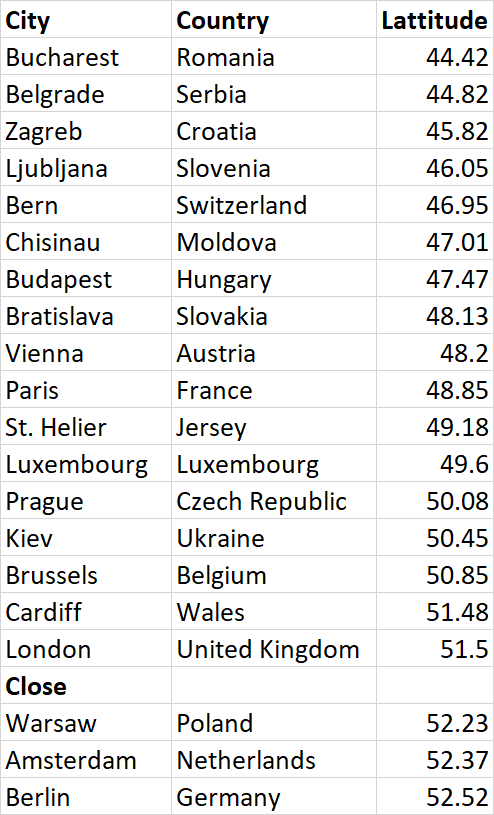
The Starlink beta test is avaialble between 44 and 52 degrees north lattitude, which includes relatively prosperous parts of North America and Europe. A close observer of Starlink reports that SpaceX is said to be trying to secure roof space on data centers in Europe. They already have many US groundstations covering the area beetween 44 and 52 degrees in North America and they have applied for a ground station in Cromwell New Zealand, which is 45.06 degrees south.
The following is a list of European capital cities falling within the 44-52 degree north beta test area. (Let me know if I missed any).
Update 1/7/2021
The Starlink beta rollout is under way. The beta is available in the northern US, southern Canada and parts of the UK. A beta tester has even been spotted in the Czech Republic. Beta prices are affordable for many connectivity-deprived rural users in relatively affluent nations, but may be lower in poorer nations. Affiliate companines have also been established in several nations and ground stations are being built.