Showing posts with label copyright. Show all posts

Friday, February 12, 2016

Sci-Hub, a site with open and pirated scientific papers


Sci-Hub is a Russian site that seeks to remove barriers to science by providing access to pirated copies of scientific papers. It was established in 2011 by Russian neuroscientist Alexandra Elbakyan, who could not afford papers she needed for her research. She was sued by Elsevier, a science publisher, and enjoined to shut the site down, but she has refused to do so.

The site claims links to over 48 million journal articles, so I decided to try it out by searching for the title of an article I had just read: "A technological overview of the guifi.net community network." The paper was published by Elsevier and costs $35.95 to download if you are not from an organization with an Elsevier account.

My search generated an indirect referral to Google Scholar, which returned the following error message:


The request had timed out, probably due to latency in the Google search plus transit time to Russia. It returned an error message with a link (arrow) and the suggestion that I try again, so I did. This time, it returned a captcha screen:


After the captcha, it retrieved a PDF file with the full article as it had been published.

The site is inconsistent. I tried it for a couple of the articles I have published in the Communications of the Association for Computing Machinery (ACM), which are online behind a paywall. It found the Google Scholar references, but was not able to retrieve the articles.

However, it was able to retrieve some of my ACM articles that other people had managed to liberate and post on their own Web sites and it found drafts that are on my Web site. It must do a Google Web search as well as call on Google Scholar.

The best way to use Sci-Hub is to find the Digital Object Identifier (DOI) of the publication you are looking for before you go to Sci-Hub. The DOI is a standard, persistent identifier of scientific paper or other digital object and, if you have it for the paper you are seeking, you can simply enter it into the search box on the Sci-Hub home page.

Many publishers and organizations assign DOIs to their material and you can often find them in databases like PubMed or on the Web sites of the publisher, like the ACM Digital Library.

Sci-Hub openly violates copyright law, is slow and clumsy to use and the access is inconsistent, but what alternative does a researcher in a developing nation or at a relatively poor university or other organization in a developed nation have? There are a number of open scientific publication sites, and my guess is that they will prevail in the long run, leading publishers like ACM and Elsevier to change their business models. But that is just a guess.

One can also imagine a world in which copyright law makes fair use exceptions for scientific research, as opposed to entertainment. I don't feel guilty about pirating a scientific paper, but am happy to pay to see Star Wars.

Finally, after visiting this site, one cannot help thinking of the case of Aaron Swartz, who committed suicide as a result of prosecution for his attempt to free scientific literature.

Thursday, May 30, 2013

Authorizer -- a breach in the ACM Digital Library paywall

The Association for Computing Machinery (ACM), the leading computer science professional society, publishes many technical journals. The articles are online in the ACM Digital Library, but one must either be a member or pay to access them.

I am nearly two years behind the times, but I just learned that, in fall 2011, ACM decided to allow authors to publish links to their Digital Library articles on their own Web sites.

ACM calls the service "Authorizer," and it enables an ACM author to publish links to their articles on their Web sites. Users who follow those links will get free copies of the articles.

The decision to make the articles available is left up to the author, but doing so is very simple. The author merely registers a free Digital Library site and completes a form giving the URL of his or her Web site. A single click generates an HTML document with links to the articles in the Digital Library. The author can put that document on their Web site as is or edit as they wish.

I asked Bernard Rous, Director of publications at ACM, how many authors had signed up reported that 1,850 authors had created 14,000 links resulting in 44,000 downloads.  That is a small percentage of the Digital Library and its authors, and ACM is going to contact authors and publicize the opportunity.

If an ACM author does not bother to Authorize their articles, they will remain behind the ACM paywall, but Authorizing access takes just a few minutes and I would think most authors would jump at the chance.  I Authorized my ACM articles in about in about five minutes and they are now available online.  I can spend a little more time, and add an abstract to each when I find the time.

I understand that that the Authorizer services is not enough to satisfy open access purists, who would prefer that the copyright remains with authors, leaving them free to place their work in the public domain or use a Creative Commons license, but it is a big step in the right direction.

Sunday, November 18, 2012

Republican critique of copyright and patent system withdrawn

The Well, an early online community, had a saying “you own your own words.”

What you say online may come back to haunt you, so think twice before posting something controversial.


Representative Jim Jordan of Ohio learned that lesson on November 16, when the Republican Study Committee (RSC), which he chairs, published “The Three Myths of Copyright,” a well reasoned critique of the copyright and patent systems and their impact on the economy.

The critique was consistent with Jordan’s view of the government and free enterprise, but it disappeared from his Web site soon after it was published.

But, Lauren Weinstein had made a copy of the RSC document and published it on his excellent blog. Note that he has marked it as “withdrawn,” since it is no longer on Jordan’s Web site.


Jordan has learned a lesson about Internet publication – you own your own words and they are difficult to erase.

And we citizens have gotten another look at the morality of politics and the rapidity with which principle and reason can be set aside.

PowerPoint presentation for teaching


Addenda

12/7/2012
The Republican Study Committee, a caucus of Republicans in the House of Representatives, has told staffer Derek Khanna that he will be out of a job when Congress re-convenes in January. The incoming chairman of the RSC, Steve Scalise (R-LA) was approached by several Republican members of Congress who were upset about a memo Khanna wrote advocating reform of copyright law. They asked that Khanna not be retained, and Scalise agreed to their request.

1/11/2013
ARS Technica interview of Derek Khanna, who was fired.

Thursday, July 05, 2012

Is the intellectual property situation improving?

Computing device: US patent D558,753
Common sense has prevailed in three recent intellectual property rulings, and the judges are being blunt.

Last month, in a case where Oracle was suing Google, U.S. District Judge William Alsup, who has a degree in math, ruled that application programming interfaces cannot be copyrighted, stating that "So long as the specific code used to implement a method is different, anyone is free under the Copyright Act to write his or her own code to carry out exactly the same function or specification of any methods used in the Java API."

One of Oracle's claims was that Google had used a nine-line range checking function in order to bring Android phones to the market faster. In court, Alsup said he had written blocks of code like rangeCheck a hundred times befor and there was no way that was "speeding them along to the marketplace." Speaking to Oracle's lawyer, he said "You're one of the best lawyers in America, how could you even make that kind of argument?"

In another case, highly respected US appeal court judge Richard Posner has finally said the unsayable: that Apple's and other tech firms' patent battles are a ridiculous abuse of intellectual property law.  Posner referred to Apple's patent on unlocking a phone by swiping the screen as "silly."

And yesterday, a high court judge in London said Apple's slide-to-unlock feature was an "obvious" development in the light of a similar function on an earlier Swedish handset.

Every company does it, but it seems Apple files a lot of silly and obvious patents.  Did you know that Steve Jobs held 313 patents? (Most of them are design patents that cover the look and feel of a product rather than utility patents, which may cover a technical innovation). Check the interactive graphic accompanying the article and see which ones you consider to be unique designs.  (The ornamental design illustrated above was patented on January 1, 2008).

Sunday, February 05, 2012

Webcam monologues from Amanda Congdon to Felicia Day

New media lead to new art forms, and the Webcam monologue is well suited to the mobile Internet.

The first memorable Webcam monologue I recall seeing was Amanda Congdon's dramatic piece on Hurricane Katrina, in which she intersperses still images and moves the camera a few times:


YouTube is filled with Webcam rants and rambling, but Congdon's monologue was original and moving art.

Here's another example. I just stumbled upon a Web series called The Guild, and saw this clip of Felicia Day talking to a Webcam.

The clip is taken out of context, but she's a funny lady and a master of the Webcam monologue. She's expressive, over-the-top and at the same time, subtle.

These are are well above your typical YouTube videos and I can imagine many others. Have you seen any noteworthy Webcam monologues?

-----

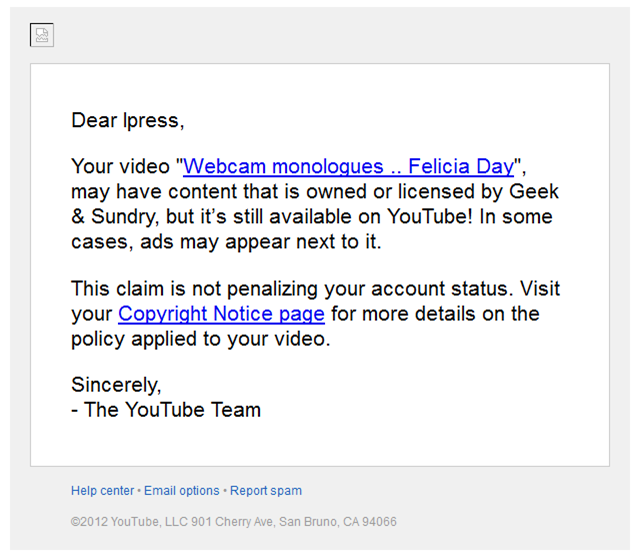
The Felicia Day clip shown above was flagged as possibly infringing on copyright by Google. Rather than take it down, they added ads. Did you see an ad with this post? If so, what was it for? Do you think my including the clip was fair use? Why did I do it? Did I harm Felicia Day? Did I use a substantial portion of the original video?

I wonder if Google or the copyright holder gets the revenue from the ad or they split it. Was the suspected infringement discovered by a Google algorithm or one run by the copyright holder? If Google discovered it, did they ask the copyright holder whether they wanted to take it down or place ads on it?

Thursday, December 29, 2011

Is fair use moot in the Internet era?

Today's New York Times has an excellent article on a case in which the court ruled that artist Richard Prince had broken the law by using photographs from a book about Rastafarians in a collage without permission.

The article (and its enlightening comments) goes well beyond this case. It examines the notion of "fair use" of copyrighted material, in which the result transforms the thing used, adding value to the original and culturally enriching society.

But, cultural enrichment is in the eye of the beholder.

Do you think Stephanie Lenz should pay the musician Prince a royalty because his song "Let's Go Crazy" is playing in the background of this video of her baby?

U.S. Federal District Court Judge Jeremy Fogel answered "no" and the video was restored to YouTube.

That case is pretty blatant -- it did not cost Prince sales and was not intended for the same audience as his recording. But, how about this case -- do you think 2 Live Crew should reimburse Roy Orbison for their sampling of his song "Oh Pretty Woman?"

The Supreme Court decided in favor of 2 Live Crew, ruling that their recording was a parody of Orbison's and was aimed at a different audience.

Regardless of your viewpoint on any of these cases, it is clear that there can be no definition of "fair use" that will satisfy everyone. Indeed, the whole thing may be moot in the Internet era. Do you really expect me to contact the copyright holder and get permission before I use an image I find using Bing or Google to illustrate a blog post?