Thursday, November 22, 2012

Dish TV wants to become Dish TV and Mobile

The Financial Times reports that Dish has won FCC approval to use spectrum they already own for LTE cellular communication rather than TV broadcast.

The approval came with a caveat regarding power limitations so as to avoid interference with adjacent spectrum that the FCC plans to auction next year. (That spectrum will also be used for LTE).

Dish said it was not all good news since the power restrictions could "cripple our ability to enter the business." Perhaps they are hoping to negotiate with the FCC over those restrictions.

The Wall Street Journal has speculated that Dish might partner with Google in forming a mobile communication company. Or perhaps Dish will sell the spectrum, which is now worth more than it was before the FCC approval.

Dish's move is reminiscent of the recent case in which the FCC turned down LightSquared, a startup seeking to offer LTE service using spectrum adjacent to GPS frequencies. LightSquared has a new proposal before the FCC, asking permission to share frequencies that are used by weather balloons.

Dish might provide some competition for the mobile cartel, but, then again, they have not exactly driven the price of broadcast TV down. But there are others as well. Google may join in with or without Dish, LightSquared may get a second chance, T-Mobile and Metro PCS want to compete and virtual mobile operators like Virgin and Ting are offering cut-rate prices. The cartel may be weakened.

Sunday, November 18, 2012

Republican critique of copyright and patent system withdrawn

The Well, an early online community, had a saying “you own your own words.”

What you say online may come back to haunt you, so think twice before posting something controversial.


Representative Jim Jordan of Ohio learned that lesson on November 16, when the Republican Study Committee (RSC), which he chairs, published “The Three Myths of Copyright,” a well reasoned critique of the copyright and patent systems and their impact on the economy.

The critique was consistent with Jordan’s view of the government and free enterprise, but it disappeared from his Web site soon after it was published.

But, Lauren Weinstein had made a copy of the RSC document and published it on his excellent blog. Note that he has marked it as “withdrawn,” since it is no longer on Jordan’s Web site.


Jordan has learned a lesson about Internet publication – you own your own words and they are difficult to erase.

And we citizens have gotten another look at the morality of politics and the rapidity with which principle and reason can be set aside.

PowerPoint presentation for teaching


Addenda

12/7/2012
The Republican Study Committee, a caucus of Republicans in the House of Representatives, has told staffer Derek Khanna that he will be out of a job when Congress re-convenes in January. The incoming chairman of the RSC, Steve Scalise (R-LA) was approached by several Republican members of Congress who were upset about a memo Khanna wrote advocating reform of copyright law. They asked that Khanna not be retained, and Scalise agreed to their request.

1/11/2013
ARS Technica interview of Derek Khanna, who was fired.

Friday, November 16, 2012

I blew it -- Twitter was cool on election night


In a recent post, I argued that The AP's interactive results map was better than Twitter, hangouts or a TV stream for watching the election returns online because the map was interactive, putting the user in charge.  I still like the map a lot and have not changed my mind about TV or the hangouts, but I sold Twitter short.

The problem was that I only followed one person's Twitter feed -- Andy Carvin.  I picked Andy because he practically invented the notion of reporting events via a live Twitter stream during the Arab Spring.

I said I found Andy's election coverage boring and often uninteresting to me, but I overlooked the fact that Twitter is social.  I should have followed many feeds, not just Andy's.  For example, if I had been following the candidate's feeds, I would have seen President Obama's victory tweet, the most re-tweeted post ever.

Twitter has published other statistics and memorable tweets.  It turns out they hit a rate of 327,452 tweets per minute, and did not crash.  (They were known for crashing under load in the past).

A terrorist could jam an LTE base station for $650

Click to enlarge and read
Virginia Tech professor Jeffrey H. Reed and Marc Lichtman, a graduate student, filed a comment with the National Telecommunications and Information Administration showing that a terrorist could crash an LTE base station serving thousands of people by jamming control signals using a software defined radio and laptop.

They were commenting because there is a plan for a nationwide public safety broadband network that would use LTE wireless technology.

A Technology Review article on the filing estimates the cost of the jamming equipment at $650 and points out that 2G and 3G wireless would continue to work -- but 2 and 3G wireless are relatively will be phased out.

Reed and Lichtman do not offer a solution -- they merely point out the vulnerability.

Monday, November 12, 2012

A quick look at the use of the Internet in the 2012 election

In an earlier post, we looked at the election coverage on the Internet. Now, we take a quick look at the way the campaigns used he Net.

As in the last election, both campaigns used Facebook, Twitter and other social networks, but this time they moved on to the targeted advertising we are now used to on the Internet -- white males saw different campaign ads than their wives. (See articles in both The Economist and The New York Times.

Perhaps Obama was a more aggressive in tracking clicks than Romney.  The Times checked Obama and Romney's Web sites during the campaign, and found that Obama was using 76 click tracking services and Romney 40.  I checked yesterday and found that Obama was down to 32 and Romney only one (click on the image to the right to see which ones).
In another article on the use of the Internet in the election, The New York Times gave the Obama campaign the edge in their use of the Net in organizing volunteers for door to door canvasing, phone calls and fund raising. They did that using a Web site called Dashboard and mobile apps that could access it.

A couple of factoids to establish context: The Economist quotes Borrell Associates as estimating online ad spending in 2012 at $160 million, six times what it was in 2008, but it remains a small percent of the estimated $6 billion spent on the election. This understates the impact of online campaigning, because it costs very little -- the Obama campaign built about 200 different programs that ran on Amazon's cloud services.

Wednesday, November 07, 2012

NPR's interactive map tops election night coverage on the Internet

How did you watch the 2012 election results? I watched on my laptop. As shown below, there were several approaches to the coverage -- local TV stations holding hangouts, streaming TV coverage from ABC News, live tweeting by Andy Carvin (@acarvin) and an interactive map on the NPR Web site.

Which to watch? I tried them all and frankly found three to be boring.

ABC's coverage consisted of periodic local and national vote updates with "pundits" talking about what all meant.  I found it slow and much of it was irrelevant to me. Streaming linear TV online is liking making a movie by setting camera on a tripod and recording a stage play.  Old wine in a new bottle.

I found that Andy Carvin's tweets came in too slowly and, like ABC's stream, often concerned things I was not interested in. Carvin has been live tweeting events in the Middle East for a couple of years and is probably our best, most experienced live tweeter. (See his book Distant Witness). If he can't make live tweeting of election results work, the medium is probably not a good fit.

(Correction after posting -- I blew it -- Twitter was cool -- I should have followed more than Andy Carvin).

I found several hangouts in which a local TV reporter discussed the election with the public and found them boring and uninformative. I'd rather listen to pundits.

For me, the clear winner was NPR's interactive map. In retrospect, that is no surprise. The key is that it is interactive. Unlike the others, it let me be active, determining what I would see.

As shown below, the map page is divided into three sections. The largest is a map of the US. Above that is a graphic summary of the current state of the presidential, senate, house and gubernatorial races. Interactive results were displayed to the left of the map.

The summary at the top has small red, blue and gray spots -- red signifying a decided Republican victory, blue a decided Democratic victory and gray undecided. The bar below that summarized the state of the presidential election at that time.

The dark red and blue areas signify electoral votes won by the two candidates. The light red and blue areas signify likely electoral votes and the gray area in the middle votes that were too close to call. The image shown above was snapped Tuesday evening, when the race was close. By Wednesday morning, the summary showed that Obama had won the presidency, the Democrats controlled the Senate and the Republicans had retained control of the House and won a majority of the gubernatorial elections.

You could drill down by clicking on a state.  Below I clicked on California and the current vote counts in presidential, senate, house and gubernatorial elections were for the state were displayed to the left of the map.

One could drill down further. The results as of Wednesday morning for the House race in California's 30th District are shown below.

You could also check the tally of ballot initiatives for each state. California's are shown below.

I don't want to leave the impression that NPR was perfect.  The maps were poorly rendered and I had some quibbles with the user interface, but, for me, NPR's interactive map was the election coverage winner.  This reminded me of my comparison between the BBC and NBC coverage of the 2012 Olympic Games. BBC's coverage was more interactive than NBC's. NBC's was more like watching television. There is a general lesson here -- the Internet is an interactive medium. 

------


Added after posting

The NPR site is displaying data from the Associated Press.  I turns out that Google also presented the same data (http://bit.ly/Up9c0D) and it was also posted on the C-SPAN Web site (http://cs.pn/XnY58x).

Monday, November 05, 2012

Pearson announces Operation Blue Sky, a discovery service for open educational resources

There are tons of useful, open educational resources(OER) -- ranging from Creative Commons textbooks to narrowly focused videos, images, presentations and other material. The problem is that it is difficult for a teacher to discover these free jewels.

Pearson hopes that their newly announced Operation Blue Sky will fill that role. The site is not yet live, but the image shown below illustrates its user interface.


OER discovery is a tough nut to crack. Services like MERLOT have tried for years, but what percent of your teaching material did you find on MERLOT?

I personally am looking for much finer grained OER than an open textbook or video. How about a cool image, quote or anecdote to illustrate a point I am trying to make in class?

Pearson says Project Blue Sky will allow instructors "to search, select, and seamlessly integrate Open Educational Resources with Pearson learning materials." The last part about seamless integration indicates their motivation, and, if they are not careful, their Achilles heel. I am not interested in closed silos.

That being said, I am hoping that Pearson will be able to crack the OER discovery nut and will be keeping an eye on the effort.

#digilit #jiscdiglit #highered #edreform #MOOC #pedagogy #EDUCAUSE #bonkopen #merlot #Pearson

-----

Pearson Project Will Let Professors Mix Free and Paid Content in E-Textbooks - Wired Campus - The Chronicle of Higher Education.

Fostering interaction and spontaneity in a MOOC -- in-class students as co-stars

MOOCs have shown that the presentation of material scales dramatically -- thousands of people are willing to watch interactive video presentations -- but we have not demonstrated the ability to scale interaction.

One approach is to encourage peer interaction using threaded discussion, peer grading, social media and face-face meetings in study groups.

But, can we also find ways to scale the sort of spontaneity and interaction that takes place in a face-face (FF) classroom? I doubt that we can ever achieve the level of exchange and enthusiasm in an outstanding classroom session, but those are atypical. A more realistic goal would be to scale interaction to the level that occurs in an average FF class session. I think (hypothesize) that is achievable. Let me give a couple of examples of attempts at using classroom interaction in a MOOC -- one that worked and one that did not.

I am currently dropping in on, though not taking with any discipline, "A History of the World since 1300" offered through Coursera by Princeton professor Jeremy Adelman.

In addition to typical video lectures with breaks for quizzes, they have tried to bring in some classroom interaction using "global dialogs," in which Professor Adelman and a guest scholar hold a conversation in front of a FF class. I've only watched one of these conversations from start to finish (45 minutes), but it did not work. The class observed, but did not participate.

The camera was focused on the professor nearly all the time. About half a dozen times it cut to the audience, which was motionless. (The image shown below was just after Professor Adelman tried to lighten the atmosphere with a quip). The fact that the speakers, not the class, are the stars of the show is emphasized by the class shots being badly out of focus.


This is not to beat up on Professor Adelman or Coursera -- we are all experimenting at this stage of the game.

Now for an example that worked well. My first MOOC experience was in 2006 when I "took" Professor Charles Nesson's Harvard Law School course "CyberOne: Law in the Court of Public Opinion." There were three groups of students -- Harvard law students who attended in a traditional lecture hall and received course credit, extension students who met in Second Life and received extension credit and the general public which followed via weekly podcasts without credit. The course wiki, student notes, lecture videos, and student projects were all online under Creative Commons license and we podcast lurkers were encouraged to participate.


I did not watch the class videos, but listened to audio recordings of the class sessions. I heard professor Nesson lecturing and leading discussions with the students in the room. He was informal and encouraged participation. In spite of the fact that I was only listening to audio recordings while working out in the gym, I became quite involved in the class. I looked forward to the podcasts, read the online material and corresponded a bit with Professor Nesson and the TA (his daughter) via email. I remember the class fondly and would say that the interaction scaled quite well.

The global dialog discussions in the history class are interesting and the participants have deep knowledge of the subject matter, but they are presentations by experts which are passively observed by an audience.

What would I do if I were teaching a MOOC?

I teach a digital literacy course, and I would run the MOOC in lockstep with an on-campus section. Like professor Nesson, I would have our instructional technology staff record every FF class session and edit and post those weekly. The FF students would be co-stars of the videos.

As I do today, I would divide FF class time between lectures based on prepared teaching modules and topical material. Let's take a quick look at both the lectures and topical material.

The lectures are based on teaching modules consisting of pre-recorded lectures (5-10 minutes plus breaks for interaction), transcripts of those lectures, and the lecture slides. I present about half of the lectures in class and assign the others for self-study.

The MOOC students could watch the in-class videos of the lectures as well as the pre-recorded videos. While the live lectures are based on the same material as the pre-recorded videos, they are not scripted. I choose different words and speak differently. Unscripted examples or ways of saying things occur to me. I respond to student questions and stop to ask questions, which the students either answer or discuss with their neighbors. The goal of the in-class recording would be to capture as much of this interaction as possible.

In addition to lecturing, I devote in-class time to topical material. I prepare weekly discussion presentations in the same format as my pre-recorded lectures. A portion of the topical material is class feedback -- common misconceptions I find while grading their weekly quizzes and assignments and the results of anonymous study-habit polls with questions like "did you review presentation X before coming to class?" I also present things that occurred to me after class during the previous week.

While some of the topical material is based on our class, most of it is triggered by current events that are relevant to the class. For example, this week (tomorrow) we will talk about the damage to the Internet due to Hurricane Sandy, the concept of fair use in copyright, triggered by a warning I just got for a YouTube video I posted, Google image search, which has been around for some time, but I had not tried until this week, the use of new media (radio, TV, the Internet) in political campaigns triggered by President Obama's holding Google Hangout and Reddit "ask me anything" sessions and the global diffusion of fourth generation cell technology triggered by a trade association report.

Could we capture the spontaneity and interaction of an excellent FF class using video recording and presentation of topical material? Probably not, but my hypothesis is that we could capture some of it -- perhaps as much as goes on in an average FF class.

Teaching assistants and I would also hold online office hours (Google hangouts) discussing topics and questions submitted by students during the hangout or before. (These office hangouts might run considerably longer than typical course office hours). Videos of the hangouts would be posted online.

There is a question of motivation in the FF class. We all know that some classes are more engaged and lively than others. If the class is to be the MOOC co-star, I would explicitly try to involve and motivate them -- to build esprit de corp and encourage active participation. I am not sure how to do that, but I would let them know they had a responsibility to speak for the MOOC students. I would also encourage communication between MOOC and FF students. I would try bribery with refreshments served during class. I would try negative reinforcement like taking class participation, attendance and participation in office hour hangouts into account in their grades. What else?

#digilit #jiscdiglit #highered #edreform #MOOC #pedagogy #EDUCAUSE #bonkopen #coursera

Friday, November 02, 2012

Internet damage from Hurricane Sandy -- the Internet senses its own failures

Still from Renesys animation
This is a follow up on yesterday's post on the Internet damage done by Hurricane Sandy. That post described data center outages and Paul Baran's 1964 RAND reports spelling out the rationale for and design of a packet switched network. It also includes a link to a terrific interview of a data center CEO who struggled to stay on-line during and after Hurricane Katrina in New Orleans.

The Internet senses its own failures in two ways, automatically and in cooperation with humans.

A network is removed from the global routing table a few seconds after it goes down. Renesys tracks the dynamic state of the Internet by monitoring that table.

This animation shows the percent of networks that are down in small geographic areas hit by the storm. Dark green indicates that at least 99.95% of the networks are up and the dark red indicates that more than 5% are unreachable.

They report that in Manhattan the typical outage rate is around 10% and point out that "silencing ten percent of the networks in the New York area is like taking out an entire country the size of Austria, in terms of impact on the global routing table." That is the bad news. The surprisingly good news is that 90% of the data centers are still up -- running on backup diesel power and caffeine.

On the right, we see another Renesys view showing network outage by state over time. As we see, New York was the hardest hit with around 1,200 networks off line at the peak, but some have come back on-line.

Renesys monitoring is automatic, but people are also monitoring the network with the aid of tools like Twitter. Andy Carvin is known for his use of Twitter and other Internet tools in producing real time news reporting (see the presentation at this location) and the same approach has been used in disaster reporting.


Using Twitter and other sources, Rich Miller of the Data Center Knowledge blog has been reporting on data center outages

J.C.R. Licklider
Internet damage is caused by flooding and power outages and the Internet is also used (by people) to report power outages. Those reports are aggregated and mapped in real time at Web sites run by companies like Con Edison, which serves Manhattan and the Long Island Power Authority. (Note the overlap between the power-outage and Internet outage maps).

Finally, let's note that the human-Internet collaboration on disaster reporting or any other task was anticipated long ago by J. C. R. Licklider who, in the 1960s, wrote of man-computer symbiosis, envisioned the Internet and was instrumental in funding much of the research that led to the Internet and modern personal computers.  (Read two of his highly influential papers here).


Wednesday, October 31, 2012

The Internet damage caused by hurricane Sandy

As GigaOm points out, many data centers are flooded and are running backup generators for power. There has also been some damage to transatlantic cables.

This is reminiscent of the Internet damage caused by Hurricane Katrina in New Orleans. Only one New Orleans Internet service provider, DirectNIC, remained online during and after the hurricane. Shortly after the hurricane, Doc Searles conducted a 40-minute interview of DirectNIC CEO Sigmund Solares. Solares tells a fascinating story of the effort it took to find deisel fuel for their standby generators and keep the data center running. If you are a data center geek -- even a little bit -- you will enjoy the interview.

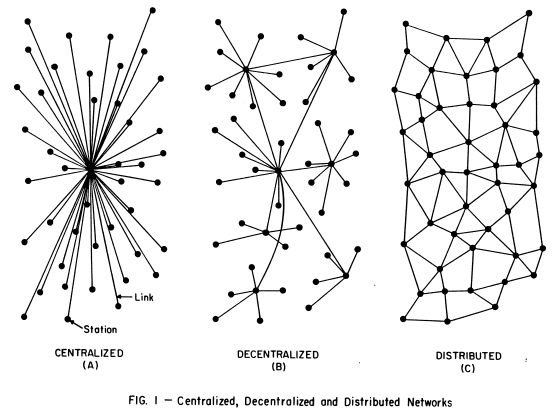
It also reminds me of one of the initial motivations for the invention of packet switched networks -- that they would be able to route around damaged equipment and continue to function in case of a disaster. The figure below is from one of Paul Baran's 1964 RAND reports outlining the rationale and design for a distributed packet switching network.


The problem here is that too much equipment was located in a small area. You can understand why -- there are many large businesses in lower Manhattan and a lot of cable landing points near New York City.


-----

I've added a second post on the damage caused by the hurricane. It talks about ways the Internet senses and reports its own state.

The times they are a changing -- HTwins "Scale of the Universe" updates Eames' "Powers of Ten"

In 1977 the designers Charles and Ray Eames made a film called Powers of Ten, "dealing with the relative size of things in the universe and the effect of adding another zero." It begins with a picnic scene then zooms out to 100 million light years (10^24 meters) and back in to .000001 angstroms (10^-16 meters).


The film was very popular at the time and it has been viewed over 1,728,000 times on Youtube. In 2010 the Eames Studio created a Web site based on it. The Web site adds a bit of interactivity and sharp still images like the one shown here, which depicts a view of the picnic from 10^26 meters.


But, it is re-purposing of old material and it shows.

Contrast that with HTwins' interactive site "Scale of the Universe 2" (Scale2), which was born digital. Here we see some objects that are around 1 meter in diameter.


Instead of watching a video, the user zooms in and out using a slider that ranges from the size of the strings of string theory (10^-35 meters) to the observable universe (10^27 meters). The user can also click on an image to open a small text window describing the object. The text is at least partially available in 20 languages.

Unlike Powers of Ten, Scale 2 is extensible. The translations are provided by volunteers and new images and text descriptions can be added. Powers of Ten has not changed since it was filmed.

While I like the interactivity and extensibility of Scale2, it lacks the interesting and compelling narration that accompanies the Eames film and provides for transitions between the images. The two have their place, and if I were teaching the topic, I would have the students watch Powers of Ten then play with Scale2.

There are two other notable differences between Powers of Ten and Scale2.

Powers of Ten was sponsored by a major corporation, IBM, and Scale2 is sponsored by Google Ad Sense ads. One big client versus a lot of minuscule clients.

Another difference is in the project organization and cost. Powers of Ten was produced by what was arguably the most famous design firm in the world. They had a large studio with many employees and were known for projects like the Eames chair, IBM's World Fair pavilion and the design and colors of IBM's "big blue" mainframe computers. Scale2 was created by Cary Huang, a 14-year-old ninth grader with technical help from his twin brother Michael. (I wonder if their parents helped). Here are the Htwins:

Tuesday, October 09, 2012

News 2.0? Reporting with Google hangouts.

California gasoline prices jumped to record highs this week, and the Los Angeles Times covered the story in their print edition. But, when I asked a class of 25 students how many read the LA Times, only three said they did.

I can also imagine this being covered on TV news -- a reporter standing in front of a gas station ... the camera pans from her to the price sign and back ... she comments that prices have risen by a dollar a gallon in a short period of time ... she interviews a customer who complains about the price hike ... It ends up being a 60-second spot, then on to the next story or a commercial.

I also asked my students how many watched TV news regularly. Again three said yes.

It turns out that the LA Times also covered the story in the following 8-minute Google hangout between two Times writers and an expert on energy and gasoline prices.


During this interview/discussion we heard why the prices shot up, how high they might get, when we might expect to see them come back down, why gas does not come in from out of state, tactics of the gasoline station owners, the global determinants of oil prices, etc.

Is there a demand for this sort of relatively in-depth reporting? Will this sort of coverage become common in the future? If so, how will people discover the stories they want to focus their attention on?

And, what about the business model? How much did this hangout cost to produce? Perhaps the two Times writers spent half an hour planning the interview and getting in touch with the expert. The participants all stayed in their offices and the call itself took no more than 15 minutes. When the hangout ended, it was automatically posted on YouTube. That is the good news. The bad news is that the three people were well-paid, articulate professionals so their time is valuable.

Can we find a viable business model with revenue from ads, subscription fees, pay-per-view fees, etc. to cover the cost?

Inverting classes and outsourcing teaching material

Last week, I sent my class a copy of the announcement of Stanford's forthcoming MOOC An Introduction to Computer Networks.

One of the better students replied immediately, thanking me and saying it was just what he had been looking for. Since our on-campus introduction to networking involves some lab work, the two classes will not be identical, but could they be complementary?

This morning I read that NYU will run an inverted class in programming. The students will work through online teaching material at Codeacademy.com, then come to class to address problems and ask questions. The weekly class will also have guest lectures from technology industry leaders.
I find myself running an increasingly inverted class, expecting students to study my online modules on their own, freeing up class time for questions over the material and feedback based on their weekly assignments and quizzes. We also discuss current events that are pertinent to the class, which I describe in blog posts and Google Plus posts during the week.

Are you using any "outsourced" teaching material? Inverting your classes?

=====

San Jose State has reported improved test scores in a pilot comparison of an inverted class section using MIT material. It was just a midterm result from one section, so is far from conclusive, but we will keep an eye on the project and hope others do similar comparisons.

#digilit #jiscdiglit #highered #edreform #MOOC #pedagogy #EDUCAUSE #bonkopen
Collapse this post

Monday, October 08, 2012

Software and plumbing patents

Gary S. Becker,a Nobel laureate in economics, and Richard A. Posner, a prolific and renowned Federal Judge, are co-authors of a blog, in which they discuss a wide variety of topics.

The patent and copyright systems was a recent topic, and both men commented on software patents.

Posner wrote "pharmaceutical drugs are the poster child for patent protection" -- expensive to develop and cheap to copy -- and the "problem of excessive patent protection is at present best illustrated by the software industry."

Becker agreed, writing "I admit it is not clear where to draw the line between what should and should not be patentable. However, one can start by eliminating the ability to patent software."

I recommend their posts on patent and copyright as well as the comments that accompany them.

Professor Becker says it is not clear where to draw the line as to what should be patentable, but you know innovation when you see it.

Here are two examples. I agree with judge Posner that issuing a patent on the idea of swiping the screen to turn your phone on is "silly" -- incremental and obvious. Contrast that with the LDR 506 7041BK sink trap.

I've used a pipe wrench and plumber's tape to install and adjust a lot of sink traps over the years, but this morning I installed an LDR trap with no tools, no plumber's tape and little effort. You assemble the trap and snap the parts together with a twist. They click into place, there are no leaks and the assembly costs only $4.95. That is a patent-worthy invention.

Saturday, October 06, 2012

Yet another way to cover live events


Louis CK made a lot of money and made a lot of fans happy by producing his own video of a recent comedy show and distributing it on the Internet.

This evening, Bill O'Reilly vs Jon Stewart will be on stage at George Washington University for a political/comedy show.  If you can't or don't want to be there, you can still watch it on the Internet.

Nox Solutions will stream the event on the Internet, and for $4.95 this is what you get:
  • You can stream the event up to three times, including the live stream
  • After that, you can watch it on demand (for a limited time)
  • You get a downloadable audio (mp3) file or downloadable high-definition video file (H.264 encoded in an MP4 container), which will be available at a later date. 
  • You can watch it on any phone, tablet or computer and on your TV if you have a Roku, Google TV, Apple TV, etc.
They ask that you not redistribute and half the profit goes to charity.

You see the event where and when ever you want for $4.95.  Does that sound good to you? What other events would you like to see given similar terms?

-----

More versions are now available for download or streaming -- 240p, 360p, 540p, 720p and 1080p. The file sizes are 238 MB, 548 MB, 882 MB, 1.8 GB and 3.4 GB respectively. It seems like they could have produced the hi-def version faster, but in the case of an entertainment event like this, waiting a few days is not a problem. (They will improve their work flow and get hi-def versions out faster in the future).

Friday, October 05, 2012

Improving African infrastructure -- Internet exchange points come online

Russell Southwood of Balancing Act, who has been tracking and encouraging the growth of the Internet in Africa since the 1990s, reports that Africa’s future data architecture is beginning to fall into place. In recent years, several undersea cables have gone online, linking Africa to the rest of the world, and now Africans are beginning to deploy Internet exchange points.

Undersea cable that are online or soon will be
In the very early days of the Internet, virtually all international traffic was routed through the National Science Foundation backbone in the United States. An email from the University of Chile in Santiago to Catholic University in Santiago, was routed to Florida then back to Santiago. The US National Science Foundation gave free service and even offered connectivity subsidies to foreign research and education networks. (There was no commercial traffic -- it was all for research and education).

As usage expanded, ISPs in Europe, Asia and South America cut costs by creating domestic Internet exchange points. Traffic remained local -- it was no longer routed through the United States.

As you see on this map of Internet exchange points, Africa is now starting down that path. An interactive version of the map is online at the University of Oregon Network Startup Resources Center which has been tracking and encouraging the spread of the Internet in developing nations since the late 1980s.

Internet exchange points in Africa
Southwood points out that Africa still has a long way to go, stating that "on a recent visit to a Central African country, I discovered that an mbps of international bandwidth still costs over US$1,500 compared to the low hundreds or lower in more competitive countries." (And that is still around 10 times the cost in developed nations).

African connectivity trains the rest of the world, but is improving
Indeed, Africa lags far behind other continents in Internet connectivity and utilization, and the relative gap continues to grow, but the absolute level of service is improving. That will benefit Africa and the rest of the world as well.


Monday, October 01, 2012

Governor Brown signs California open source textbook bills

Spurred by the rapidly rising cost of textbooks, California Governor Jerry Brown signed two bills designed to provide Creative Commons textbooks and other teaching material to students in large-enrollment lower division courses. Senate Bill 1053 establishes the California Digital Open Source Library and Senate Bill 1052 establishes the California Open Education Resources Council to oversee and acquire material for the library.

As I read it, the nine member Council will be composed of three faculty members from University of California, the California State University and the California Community Colleges and this is what they will do:
  • Determine a list of 50 lower division courses in the public post secondary
    segments for which high-quality, affordable, digital open source textbooks
    and related materials would be developed or acquired
  • Review and approve developed open source materials and to promote strategies for production, access, and use of open source textbooks to be placed on reserve at campus libraries in accordance with this section
  • Regularly solicit and consider, from each of the statewide student associations of the University of California, the California State University, and the California Community Colleges, advice and guidance on open source education textbooks and related materials, as specified
  • Establish a competitive request-for-proposal process in which faculty members, publishers, and other interested parties would apply for funds to produce, in 2013, 50 high-quality, affordable, digital open source textbooks and related materials, meeting specified requirements
  • Submit a report to the Legislature and the Governor on the progress of the implementation of these provisions by no later than 6 months after the bill becomes operative and to submit a final report by January 1, 2016

This sounds good, and I am optimistic, but have a couple of questions:

Is the bill funded? The act states that all of this is conditional upon funding with State, Federal or Private funds.

At first, publishing companies opposed the bills, then removed their opposition. I wonder what they are thinking. Will they be applying for funds to produce these textbooks? How big a business might that end up being?

Finally, will these end up re-purposed versions of traditional textbooks, or will the library also acquire born digital teaching and learning materials?

It will be interesting to see how the funding goes, who ends up providing the textbooks in 2013 and how much it costs the tax payers.

#digilit #jiscdiglit #highered #edreform #MOOC #pedagogy #EDUCAUSE #bonkop

Wednesday, September 26, 2012

First shot at characterizing MOOCs -- what are the relevant attributes? (Using a Coursera history course as an example)

Last month I watched portions of Google's Inside Search MOOC and posted a short description of its structure.

Now I am watching Coursera's History of the World since 1300, taught by Princeton history professor Jeremy Adelman.

I am not trying to evaluate the course in this post, but to use it as an example in an effort to develop a set of characteristics or dimensions we can use in describing online courses. (We also need classification schemes for course levels, student goals, etc.). I've also compiled a set of screen images illustrating various characteristics of the course.

Course attributes or dimensions

  • Synchronization: This is a lockstep class in which a cohort is synchronized over twelve weeks as opposed to self study. I do not know whether or not the lectures and other material will be archived for self study after the class ends.
  • Ordering: Ordering of this course is strong since all students follow the same path throught the weekly modules as opposed to students selecting arbitrary modules or following suggested paths through the course material.
  • Presentation style: The presentations are lecture style as opposed to the over-the-shoulder conversation style of the Khan Academy or Udacity.
  • Lecture format: There are two one hour lectures per week. They are broken into four or five segments running from around 6 to 20 minutes.
  • Video presentation modes: There have been five video presentation modes -- (a) image of the professor superimposed next to a slide on a large simulated display screen, (b) full screen image of the professor speaking, (c) full screen image of a slide with the professor narrating, (d) full screen image of the TA speaking in a control room, (e) simulated conversation between the TA and the professor. Mode a is by far the most common. Modes d and e are used very sparsely. The efficacy of these alternative modes of presentation can be tested in controlled studies.
  • Linearity: The video is linear. The interactive quizzes are separate.
  • Production location: The video is shot in a studio, not a classroom, lecture hall or person's desk.
  • Recording quality: The audio and video quality is excellent (resoltions, frame rates and audio characteristics can be quantified).
  • Face to face synchronization: This course is hybrid, run in parallel with an in-class offering, as opposed to Internet only.
  • Lecture slide format: The lectures use simple slides -- either a single image or very few words versus more complex slides.
  • Subtitles: There are optional subtitles in various languages. The first lecture segments now have English, Spanish, Portugues and Indonesian subtitles. The translation is evidently being done shortly after the lecture is recorded.
  • Transcripts: There are one phrase per line transcripts (with and without time codes) to support the subtitle translators, but no natural paragraph transcripts.
  • Instructor control of display: The professor uses an iPad to change slides and draw highlights on the slide display.
  • Video controls: play/pause, raise/lower volume, skip back/forward, increase/decrease speed, and toggle full-screen. There is no clickable, slide level index. Skip back is very useful if one's mind wanders for a short time. The ability to increase/decrease playback speed is particularly valuable in giving the user control over the experience and as a tool for research into the effect of playback speed on comprehension and retention.
  • Grading and certification: There is no grading or certification for this MOOC.
  • Interactive quizzes: Most segments are followed by a quiz.
  • Quiz format: The quizzes focus on recall -- each (so far) consist of four true/false questions. Feedback is correct/incorrect only.
  • Machine graded assignments: The short answer quizzes are graded automaticall.
  • Subjective assignments: A 750-word essay every two weeks with peer feedback.
  • Textbook: There is a recommended $90 textbook. The book is not required, but it was written specifically for this course by a team of five coauthors, including the presenting professor.
  • Audio recording: The lectures have not included supplementary audio recording to this point.
  • Video recording: The lectures have not included supplementary video recording to this point.
  • Other supplementary material: There is a checklist of places and terms for each lecture.
  • Guest lectures" The course includes "global dialogs" -- weekly conversataions between Princeton students in the class and a guest speaker. Questions for the guest speaker are submitted in advance and voted up/down.
  • Regular communication: There is a weekly letter from the professor on course mechanics and content.
  • Synchronous office hours (Q and A): Neither the professor nor the TA hold syncrhonous office hours.
  • Staffing: There is a single TA who helps with the preparation of the quizzes and other material.
  • Intellectual property: The video lectures are copyrighted by Professor Adelman as opposed to his employer (Princeton university), the host (Coursera) or a Creative Commons licence.
  • Course origin: The course was not "born digital" -- it was repurposed from a tradtional class.
  • Cost: The course is free
Forums:
  • Professor's Forum: Jeremy Adelman and Melissa Teixeira Discuss Weekly Lectures
  • General Discussion: Discussion and questions about the course.
  • Topical Forum: History and Technology: Please post discussions and questions specifically about technology.
  • Topical Forum, Ideas and Faiths: Please post discussions and questions specifically about ideas and faiths.
  • Topical Forum, Environment: Please post discussions and questions specifically about the environment.
  • Topical Forum, Empires, States, and Politics: Discussion and questions specifically about empires, states, and politics.
  • Topical Forum, Commerce, Production, Economy: Please post discussions and questions specifically about commerce, production and economy.
  • Lectures: Please post discussions and questions specifically about the lectures.
  • Global Dialogues: Submit questions for upcoming Global Dialogues at Princeton or discuss past Dialogues.
  • Study Groups: Find friends and arrange meet ups!
  • Readings: Discussion and questions about the suggested readings.
  • Assignments: Use this thread to discuss issues related to the assignments.
  • Additional Materials for Reference and Research: Use this thread to discuss additional materials for reference and research.
  • Who we are?: Use this forum to discuss and post questions about who we are, where we are from and why we should care.
  • Technical issues: Bug reports on the content of videos or web platform issues.

#digilit #jiscdiglit #highered #edreform #MOOC #pedagogy #EDUCAUSE #bonkopen

Saturday, September 22, 2012

Feed+, a cool Chrome app for creating Google Plus RSS feeds

I've been known to rant a bit about the lack of Blogger's features in Google Plus (here is an example).

Well, Google has ignored my rants so far, but Eric Koleda, a Google engineer, has written Feed+, a Chrome App that helps. With Feed+ you can create an RSS feed for the public posts of a specific person or for a Google Plus search.

As you see below, the user interface is perfectly simple. You just enter the URL of the person's profile or the search terms and click on Preview to be sure the feed is what you expect. If it looks good, click on Add it launches Google Reader and you can subscribe with a single click. (Of course you must create a Google Reader account if you do not already have one).

Want to build similar scripts of your own? Check out Google Apps Script.

Friday, September 21, 2012

Massive, open, online classes -- presentation scales, does interaction?

Coursera has added 17 universtities to their list of collaborators, bringing the total to 33. They have reached over 1.3 million students in 195 countries and raised raised $22 million in venture capital and received $3.7 million in equity investments from Caltech and Penn.

Not a bad start for a company that was founded last fall and funded in April.

But, many, including me, have wondered whether it is possible to capture the peer-reinforcement and contact of a classroom online. Coursera (and others) hypothesize that students can communicate with each other online -- if there are 10,000 people in a course, someone in some time zone is going to be working on the same lesson at the same time as you.

Students have taken interaction a step further, with course-specific groups meeting face to face. As of this morning, 7,839 Coursera students had formed 1,119 communities on Meetup.com in 1,014 cities and 2,824 Udacity students had formed 478 communities in 453 cities.

Coursera Meetup cities

I live in Los Angeles, so checked to see what was happening around here. It turned out that there are 78 registered Courserians in Los Angeles and smaller numbers in the many cities making up the metropolitan area.

Coursera meetups in Los Angeles (partial)

The three largest Coursera community cities are Stanford with 979 members, New York with 241 and San Francisco with 213. But the most interesting to me are the next three -- Bangalore with 183 members, London with 172 and Moscow with 144.

Courera meetups in Bangalore, India

This reminds us that online education is a global phenomena. Courses are being offered in many nations and students from many nations are taking them.

In Version 1 of the book, Gutenberg pruduced copies of hand written bibles. In Version 1 of the motion picture, we put cameras in front of stage plays. Version 1 of radio featured oral drama. Version 1 of television resembled vaudeville and stage skits. Etc.

Version 1 of the online course was to teach the same class from the same textbook using the same PowerPoint slides and videos that come with the textbook, substituting email and threaded discussion for face to face meetings in a classroom. The results have been OK, but not spectacular.

Coursera and many others are experimenting with Version 2. They have massive scale in their favor, and perhaps student-organized meetups and online groups for peer grading and feedback will enable them to scale interaction as well as presentation.

Movies, Version I

Television, Version I

-----

Update 7/10/2013

Coursera has raised an additional $43-million. Investors must have confidence in their ability to eventually make money. For more on this investment in Coursera and their plans, see this article.

Wednesday, September 12, 2012

Hybrid MOOCs

I wrote an earlier post contrasting the goals of the typical introductory statistics course with Sebastian Thrun's goals for the statistics MOOC he recently taught at Udacity.

The usual statistics course is required in many physical and social science majors and its goal is to teach students to evaluate statistical arguments and prepare them for advanced statistics courses if they pursue a research career.

Thrun's is a short, elective, general studies course and his goal is to inspire students. In describing his course, he wrote that statistics is "a highly intuitive field -- a field full of magic and surprises. I aspired to share these insights with everyone, and to have students experience them by working on interesting problems."

Much of the material in the traditional statistics course can be captured in short, interactive MOOC video lessons, but what of the motivation and enjoyment Thrun seeks to provide? Can we deliver that in a MOOC?

Hybrid MOOCs may do the trick.

Let me use a course I teach in a conventional classroom as an example. It is an introductory digital literacy course geared to the Internet era -- a general education class in which I present the skills and concepts one needs for success as a student and after graduation as a professional and a citizen.

I have developed modular course material that can be presented in person or shown as Udacity-like interactive videos.

But, that is only part of the class. Much of our classroom time is devoted to "discussion," in which I present and we discuss current developments. I prepare these discussions each week and no two are alike. Discussion topics might include difficulty they had with the previous week's assignment -- common misconceptions. I also include things that occurred to me to add to the previous week's presentation after the class was over or things that came up in one section, but not the other. (I teach two sections).

I also maintain a class blog on which I post current events that are relevant to our class, and we discuss them. For example, this week part of our discussion period was devoted to a post on Google's Kansas City fiber project. That post gives us plenty to talk about that is relevant to our class -- data transmission speeds and prices, the roles of public and private infrastructure, the digital divide and possible applications of very high speed connectivity.

Capturing and maintaining the portion of the class that I spend on prepared presentations for a MOOC would be expensive, but doable.

I've not tried it, but I would like to capture the ephemeral, discussion portion of the class as well. I would do that by having a weekly class meeting. It could be a face to face meeting in a room with students taking the course or it could be online, for example in a Google "on air" hangout. (Good coverage of a studio classroom would be expensive). Either way, the class session would be broadcast on the Net.

Those watching the broadcast in real time would be able to ask questions and make comments during the class. That might be done through chat with a screener or with some sort of voting-up scheme.

Regardless, the broadcast would be recorded for archival viewing by students who were not able to watch the live session. The chat stream, transcripts and other ancilary material would be available as well.

A hybrid class would be expensive to produce, but it could serve a mass audience. Is anyone doing this sort of thing? Do you think it would be effective?

#mooc #highered #edreform #pedagogy #bonkopen #educause

A scathing criticism of a Udacity course and a rebuttal

I just read a devastating review of Udacity's recently completed Introduction to Statistics MOOC on the Angrymath blog. It is a long, well reasoned post with many insightful comments -- well worth reading -- but the short version is the author's summary -- "the course is amazingly, shockingly awful."

The course instructor, Udacity co-founder Sebastian Thrun, answered with a post of his own in which he acknowledges the validity of some of the criticisms and promises that the course will be revised. However, he goes on to explain that to him statistics is "a highly intuitive field -- a field full of magic and surprises. I aspired to share these insights with everyone, and to have students experience them by working on interesting problems."

Reading the two posts, it is clear to me that they are talking about two different courses intended for different audiences with different goals.

The Angrymath blogger is a college lecturer who teaches what sounds like a standard introduction to applied statistics course. That is a traditional, well defined course that introduces probability, descriptive statistics and statistical inference for students in a range of fields -- business, pre-med, psychology, etc. It is a semester-long course and the textbooks follow similar outlines. It also establishes background for those who will do research and will go on to take more statistics courses (including math stat).

Thrun's is a shorter course in which he is trying to interest and surprise people, not to teach them how to read the statistical analysis in a psychology research paper or to design research studies. Thrun is teaching a short, elective liberal arts course while the Angyrmath blogger is teaching a required social science course.

Can we find ways to preserve the flexibility, enthusiasm and spontaneity that is found in an inspiring general studies course in canned MOOC?

-----

Subsequent to this post, Udacity announced that they would be substantially revising this statistics course -- adding four new units and improving 20 of the videos to clarify topics and provide more real world examples. There will also be a new assistant teacher.

Monday, September 10, 2012

Google and Kansas City push to narrow the digital divide

We have covered various aspects of Google's gigabit connectivity trial in Kansas City. Their plan is to install fiber first in areas of the city, "fiberhoods," with high demand for the service, as measured by the percent of households willing to pay a $10 pre-registration fee.

The deadline for pre-registration was midnight last night, but, as of last Friday, the map of fiberhoods that had met their goal reflected the digital, cultural, racial and income divide in Kansas City, Missouri.

Google and the City worked hard to bridge the divide. The threshold to qualify for fiber was higher in affluent areas than poor. For example, in the circled area on the map shown below, only 5% of the households had to register in order to qualify.

Furthermore, on August 31st, Google adjusted some of the thresholds to make it easier for poor neighborhoods to qualify.

During the last weekend of the six week registration drive, Google and the City worked overtime to close the gap. They held meeting, walked door to door, deployed an ice-cream truck refitted as mobile registration site, and more.

The map below shows that many fiberhoods east of the traditional Troost/Paseo Avenue division line met their thresholds during thd weekend push. (This map shows Kansas City Kansas as well as Missouri). Google reports that 63 fiberhoods qualified during the last week of the registration drive and that at least 180 out of 202 have qualified for service. They will announce the final tally on the registration drive and publish a fiberhood installation schedule next Thursday.


This is important for two reasons. Google will give free gigabit connectivity to all schools, hospitals, libraries and other public facilities in qualifying fiberhoods. That will mean more to a school in a poor neighborhood than an affluent neighborhood.

Furthermore, while Google will charge subscribers $70 per month for gigabit access, they offer free 5 mb/s DSL connectivity to those who wish to pay less. (Households that elect free connectivity must pay a $300 installation fee in 12 monthly $25 installments).

While 5 mb/s sounds slow compared to gigabit connectivity, the fastest DSL speed Verizon can offer me in my middle class Los Angeles neighborhood is 3 mb/s for $29.99 per month. At that rate, I could pay off a $300 installation fee in ten months.

(Verizon does not offer fiber service in my neighborhood, but, where they do, they charge $89.99 a month for 75 mb/s service).

I would expect less contention for backhaul with Google DSL than Verizon since they are provisioning for gigabit service. Five mb/s customers will not add much load.

Google's free DSL service will be more important to many households on the wrong side of the digital tracks than their gigabit service. It will provide very usable speed to newly connected households.

I have said a lot about Google's effort, but, as Timothy B. Lee points out, Kansas City is an active partner. To attract Google, Kansas City taxpayers offered power, office and equipment space and more.

This is a good example of blended public-private investment. It reminds me of Stockholm where the municipal government provided "middle mile" fiber then invited private companies to compete using that infrastructure.

Lee points out that some right-wing commentators have claimed the Kansas City project shows that industry (Google in this case) can build exellent infrastructure without government guidance or subsidy. That is clearly not the case in Kansas City. Hundreds of cities applied to participate in this pilot study, and I am sure they all offered various incentives to Google.

Google and Kansas City cannot bridge the cultural, income and digital divide by themselves, but they are making laudable effort and I applaud them.

Thursday, September 06, 2012

Telegeography report: International Internet capacity grows to 77 Tbps

Telegeography has published new statistics on global Internet capacity and utilization for fans of the "big picture." (Click the chart to enlarge).

Total international capacity is up to 77 Tbps, a 40% increase over last year. Average international internet traffic grew 35% in 2012, down from 39% in 2011, and peak traffic grew 33%, compared to the 57% in 2011.

The growth rate is slowing due to caching in content delivery networks and increasing saturation of broadband markets in developed nations, but broadband adoption in developing nations, the spread of Internet video and increased mobile connectivity will fuel growth for many years to come.

You can drill down for details on individual cables on this interactive map.


we've come a long way since the first undersea cable in 1858.

Saturday, September 01, 2012

Politicians using media, from Roosevelt's fireside chats to Obama's Ask me Anything

President Roosevelt used radio -- "fireside chats" -- to communicate with the American people. President Eisenhower was the first to campaign on television and Kennedy used it effectively. One can argue that President Obama is the first president to effectively use the Internet.

The most recent example of his use of the Internet was the live "ask me anything" (AMA) session he held at Reddit.com earlier this week. Reddit users typed questions for the president and he answered the ones that were voted up. The questions he took and his replies are shown below.

In our class, we talk about the implications of the Internet for individuals, organizations and society. Internet chat and AMA provides a new way for a candidate to campaign and for an official to interact with the public. In that sense it is reminiscent of President Roosevelt's fireside chats.
You can see the questions President Obama replied to along with his answers below. It is a mix of personal (he's a Bulls fan, eats with his family then goes back to work, and plays a game of basketball or golf every week) and political dialog. You also hear a conversational tone -- "Hey everybody -- this is barack" -- not the polished public speech voice.

Here is what he had to say:

"Hey everybody - this is barack. Just finished a great rally in Charlottesville, and am looking forward to your questions. At the top, I do want to say that our thoughts and prayers are with folks who are dealing with Hurricane Isaac in the Gulf, and to let them know that we are going to be coordinating with state and local officials to make sure that we give families everything they need to recover."

SharkGirl: We know how Republicans feel about protecting Internet Freedom. Is Internet Freedom an issue you'd push to add to the Democratic Party's 2012 platform?

Obama: Internet freedom is something I know you all care passionately about; I do too. We will fight hard to make sure that the internet remains the open forum for everybody - from those who are expressing an idea to those to want to start a business. And although their will be occasional disagreements on the details of various legislative proposals, I won't stray from that principle - and it will be reflected in the platform.

PartyInYourMouth: How are you going help small businesses in 2013 and 2014? and what if any bills are you going to impliment for small businesses, in 2013, and 2014?

Obama: We've really focused on this since I came into office - 18 tax cuts for small business, easier funding from the SBA. Going forward, I want to keep taxes low for the 98 percent of small businesses that have $250,000 or less in income, make it easier for small business to access financing, and expand their opportunities to export. And we will be implementing the Jobs Act bill that I signed that will make it easier for startups to access crowd-funding and reduce their tax burden at the start-up stage.

karlfranks: Who's your favourite Basketball player?

Obama: Jordan - I'm a Bulls guy.

Silent1mezzo: What's the recipe for the White House's beer?

Obama: It will be out soon! I can tell from first hand experience, it is tasty.

Suzmerk: What are you going to do to end the corrupting influence of money in politics during your second term?

Obama: Money has always been a factor in politics, but we are seeing something new in the no-holds barred flow of seven and eight figure checks, most undisclosed, into super-PACs; they fundamentally threaten to overwhelm the political process over the long run and drown out the voices of ordinary citizens. We need to start with passing the Disclose Act that is already written and been sponsored in Congress - to at least force disclosure of who is giving to who. We should also pass legislation prohibiting the bundling of campaign contributions from lobbyists. Over the longer term, I think we need to seriously consider mobilizing a constitutional amendment process to overturn Citizens United (assuming the Supreme Court doesn't revisit it). Even if the amendment process falls short, it can shine a spotlight of the super-PAC phenomenon and help apply pressure for change.

Fifth Surprise: What was the most difficult decision that you had to make during this term?

Obama: The decision to surge our forces in afghanistan. Any time you send our brave men and women into battle, you know that not everyone will come home safely, and that necessarily weighs heavily on you. The decision did help us blunt the taliban's momentum, and is allowing us to transition to afghan lead - so we will have recovered that surge at the end of this month, and will end the war at the end of 2014. But knowing of the heroes that have fallen is something you never forget.

Daveforamerica: What is the first thing you'll do on November 7th, win or lose?

Obama: Win or lose, I'll be thanking everybody who is working so hard - especially all the volunteers in field offices all across the country, and the amazing young people in our campaign offices.

hmlee: I am recent law school graduate. Despite graduating from a top school, I find myself unemployed with a large student loan debt burden. While I'm sure my immediate prospects will improve in time, it's difficult to be optimistic about the future knowing that my ability to live a productive life -- to have a fulfilling career, to buy a house, to someday raise a family -- is hampered by my debt and the bleak economic outlook for young people. I know that I'm not alone in feeling this way. Many of us are demoralized. Your 2008 campaign was successful in large part due to the efforts of younger demographics. We worked for you, we campaigned for you, and we turned out in record numbers to vote for you. What can I say to encourage those in similar situations as I am to show up again in November? What hope can you offer us for your second term?

Obama: I understand how tough it is out there for recent grads. You're right - your long term prospects are great, but that doesn't help in the short term. Obviously some of the steps we have taken already help young people at the start of their careers. Because of the health care bill, you can stay on your parent's plan until you're twenty six. Because of our student loan bill, we are lowering the debt burdens that young people have to carry. But the key for your future, and all our futures, is an economy that is growing and creating solid middle class jobs - and that's why the choice in this election is so important. The other party has two ideas for growth - more taxs cuts for the wealthy (paid for by raising tax burdens on the middle class and gutting investments like education) and getting rid of regulations we've put in place to control the excesses on wall street and help consumers. These ideas have been tried, they didnt work, and will make the economy worse. I want to keep promoting advanced manufacturing that will bring jobs back to America, promote all-American energy sources (including wind and solar), keep investing in education and make college more affordable, rebuild our infrastructure, invest in science, and reduce our deficit in a balanced way with prudent spending cuts and higher taxes on folks making more than $250,000/year. I don't promise that this will solve all our immediate economic challenges, but my plans will lay the foundation for long term growth for your generation, and for generations to follow. So don't be discouraged - we didn't get into this fix overnight, and we won't get out overnight, but we are making progress and with your help will make more.

gobearss: How do you balance family life and hobbies with, well, being the POTUS?

Obama: It's hard - truthfully the main thing other than work is just making sure that I'm spending enough time with michelle and the girls. The big advantage I have is that I live above the store - so I have no commute! So we make sure that when I'm in DC I never miss dinner with them at 6:30 pm - even if I have to go back down to the Oval for work later in the evening. I do work out every morning as well, and try to get a basketball or golf game in on the weekends just to get out of the bubble. Speaking of balance, though, I need to get going so I'm back in DC in time for dinner. But I want to thank everybody at reddit for participating - this is an example of how technology and the internet can empower the sorts of conversations that strengthen our democracy over the long run. AND REMEMBER TO VOTE IN NOVEMBER - if you need to know how to register, go to Gottaregister.com. By the way, if you want to know what I think about this whole reddit experience - NOT BAD!

-----

You can see the transcript and thousands of comments on Reddit.