Showing posts with label new wine. Show all posts

Monday, March 10, 2014

Short MOOCs -- departing from the university course format

When World's Collide is a University of Leeds MOOC on environmental policy. Even if you are not interested in the topic, check out the format:

The first applications of new media -- books, movies, television, radio, textbooks -- often mimic previous media. Early MOOCs emulated university classes.

But, most people who take MOOCs are not interested in emulating a university class or getting university credit.

Netflix deviated from the standard format TV format with their 13 hour drama House of Cards and The University of Leeds has departed from the university course format in this 8-hour short course.

What other forms will the MOOC take?

Saturday, May 04, 2013

New wine for new bottles -- innovation from modular teaching material and MOOCs

I received a nice award and gave a talk on "Innovation from modular teaching material and MOOCs" at the Sloan Consortium 6th Annual International Symposium on Emerging Technology for Online Learning (#et4online).

The slides from the talk are now online here.

Each slide has text notes so they should stand on their own.  The presentation also contains quite a few links as well as a recording of Wolfman Jack howling.


If you wish, you can watch a video of the presentation, but that would probably take longer than reading through the PowerPoints.

Friday, February 22, 2013

Columbia University study slams traditional online classes -- we need to move beyond traditional

Researchers at Columbia University’s Community College Research Center have released a working paper "Adaptability to Online Learning: Differences Across Types of Students and Academic Subject Areas", based on a study of nearly 500,000 courses taken by over 40,000 community and technical college students in Washington State. The study was based on traditional online courses, which typically have about 25 students and are run by professors who often have little interaction with students. (I will return to this point below).

Here's the bottom line -- the study concluded that “the online format had a significantly negative relationship with both course persistence and course grade, indicating that the typical student had difficulty adapting to online courses.”

This is consistent with the anecdotal reports of my colleagues who teach online -- they have much better experience with masters level classes than undergraduate.

Let's drill down a bit.

The study found that the negative results for online classes held across the board, but the effect was stronger for some subgroups – “males, Black students, and students with lower levels of academic preparation experienced significantly stronger negative coefficients for online learning compared with their counterparts, in terms of both course persistence and course grade.”

They also note that "performance gaps between key demographic groups already observed in face-to-face classrooms (e.g., gaps between male and female students, and gaps between White and ethnic minority students) are exacerbated in online courses."

They found that older students adapted more readily to online courses than did younger students. (Again, consistent with my colleagues' observations).

The study also found that "the relative effects of online learning varied across academic subject areas ... two academic subject areas appeared intrinsically more difficult for students in the online context: the social sciences (which include anthropology, philosophy, and psychology) and the applied professions (which include business, law, and nursing)."

The authors of the study went on to suggest policies to cope with the problems they identified:

  • Screening: Only allow certain students to take online classes, for example those with a 3.0 or better GPA or those who successfully complete a workshop on online learning skills.
  • Scaffolding: Incorporate the teaching of online learning skills into online courses in which less-adaptable students tend to cluster.
  • Early warning: Identify and intervene with students who are having difficulty adapting.
  • Wholesale improvement: Improving the quality of all online courses taught.
The first three feel like fingers in the dike to me, but how about wholesale improvement? At the start of this post, I noted that these were traditional online courses. They are often quick makeovers of classroom courses -- using standard textbooks and ancillary materials, but substituting threaded discussion for classroom sessions. Old wine in new bottles.

This is understandable when there are, say, 25 students in a class. There is no time for "wholesale improvement."
However, if we scale the online class up, say enrolling 500 active, for credit students, we can afford to create "new wine."

We see experimentation along these lines in MOOCs -- highly modular, interactive presentations created specifically for online delivery, peer interaction, instrumentation of material, crowd-sourced feedback from students, high production values, frequent revision of teaching material, etc.

None of this is affordable if we are teaching sections of 25 students, but for 500 students, we can afford full time staff producing and maintaining a single course. Hey, with 20,000 students we can afford Disney Studios.

Monday, April 09, 2012

Requiem for the textbook

At first, new media mimic old media. Early movies were made by filming stage plays with a stationary camera. We still see a few movies based on stage plays, but they are uncommon today.

Early television shows often had performers acting in play-like sets or standing on a stage reminiscent of vaudeville.


Books followed a similar pattern. Johannes Gutenberg’s 1455 bible was the first book printed using movable metal type. The Gutenberg Bible resembled the hand written manuscripts on which it was based. It did not have punctuation or paragraphs, the pages were around 12 by 17.5 inches and its illustrations were added for beauty and feeling, not clarification.

It was like the hand copied books that preceded it -- a religious book suitable for contemplative reading in a library. Gutenberg’s breakthrough was in production, not format or content.


Fifty years after Gutenberg, Aldus improved production by printing eight pages on a single sheet. This led to smaller, portable books that could be carried or placed in a saddle bag. Aldus also introduced punctuation like the commas, periods and semicolons shown here, and italic type, which fit more letters on a page. But, like Gutenberg, Aldus would be surprised by the variety of punctuation and typography in today’s textbooks as well as innovations like chapters, callouts, indices, tables, diagrams, tables of contents and images with captions.


Textbooks today are at the “Gutenberg bible” stage. Textbook publishers have digitized their books, making them available online in various formats. Many maintain the notion of a book-sized page and often preserve the page numbering of the print version. These e-books look better than PDF documents, but they are constrained by the previous format.

Like Aldus, they have gone somewhat beyond their predecessor, but remain tied to the notion that the course is contained in a book of pages.


Many universities are offering online classes, but these also emulate the past. They typically offer the "same" course online as they teach in the classroom. They may record lectures, use digital textbooks, and substitute threaded discussion for in-class discussion and administer assignments and tests using a course management system, but the course and teaching material are not radically changed.


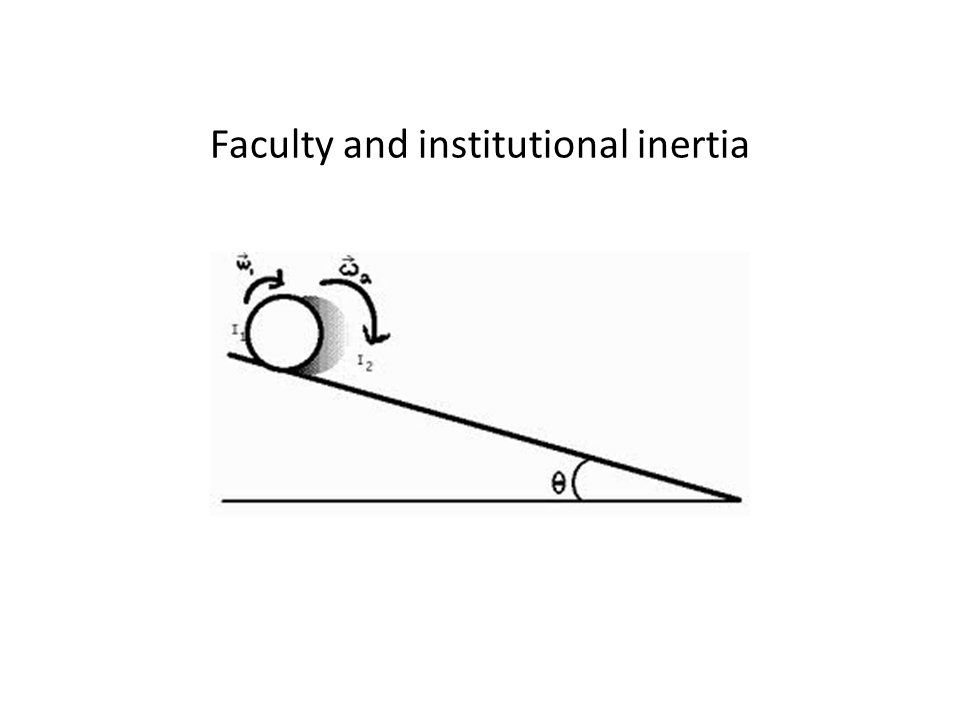
There is a lot of institutional inertia. Textbook publishers want to stay with their old, profitable business models. Faculty are used to adopting a single textbook with ancillary material like PowerPoint slides and test banks. Adopting the same textbook year after year is expedient. They have investments in familiarity with a given textbook, prepared lectures, course outlines, and so forth. 

School administrators are also slow to change. For example, little or no consideration is given to time spent developing new teaching materials during faculty evaluation.


We don't know the future of teaching and teaching material, but it won't center on digital textbooks, learning management systems and recorded lectures. We will have things like modular teaching material, peer teaching, open source and subscription models rather than book purchases, very large classes and things yet to be dreamed up.

Teaching material will be fine grained and narrowly focused on a specific concept or skill and will be used by faculty, students and self-learners.


Change will come faster than in Gutenberg's time or the era of movies and television. The cost of experimentation is greatly reduced in the Internet era, and as we see here, there is an attractive economic incentive. The textbook industry is an oligopoly and textbook prices have risen faster than inflation for many years.


Faculty members at every university are creating and experimenting with new teaching materials. There are many non-profit and publicly-funded experiments in creating and curating teaching and leaning material. And, as we see here, the private sector has noticed the opportunity provided by the price gap shown above.


The Internet has disrupted many industries and organizations. Will the university be next?

For example, what would happen if massive classes with hundreds of thousands of students turn out to be good alternatives for, say, half of the undergraduate curriculum?

Which will look better on your resume – a certificate of completion from Stanford or MIT or a bachelors degree from California State University, Dominguez Hills?  Will schools that focus on teaching survive?  Will universities be able to fund research?  Will a better educated work force improve the overall economy?


For more information, see this teaching module.


-----

Update 7/3/2013

The first shoe drops as Cengage files for Chapter 11 protection That is what happens when you mix the greed of a private equity fund with falling market demand for print textbooks.

Some faculty will have to revise their courses (shudder) if they drop unprofitable print textbooks.

-----

Update 8/18/2013

Google has joined Amazon in selling electronic text books.

For more on the decline of the textbook, click here.

-----
Update 8/30/2014

The Economist reports that US textbook prices have risen much faster than general consumer prices. (ITextbook prices increased over fifteenfold since 1970, three times the rate of inflation).

Prices increase because the students who purchase the books are not the customers of the textbook publishers -- textbooks are sold to professors who adopt them for their classes. Professors are very busy (and some are lazy) so they like textbook packages which include PowerPoint slides, ancillary material, test banks, etc. It's also easiest for them to teach using a new edition of last year's textbook.

Textbooks are still with us, but these price increases cannot be sustained.

The Public Interest Research Group reports that 65% of college students have opted not to purchase the textbook for a class and 94% of them think it has hurt them academically. (That makes me wonder about the 6% who feel fine without the textbook).

Students have alternatives to the purchase of print textbooks -- e-textbooks, open educational resources, library reserve copies, textbook rentals and, most important, a variety of online courses and materials.

The print textbook market is beginning to crack.

Sunday, November 20, 2011

A "post Gutenberg" e-text for biology 101

In earlier posts, I talked about an electronic text Nature would publish this fall. I suggested that it was a noteworthy departure from the established textbook format and business model -- perhaps the first "post Gutenberg" text.

The etext is out now and being used on some campuses. I've had a chance to play around with it, and remain impressed. Here is what I've seen.

The professor creates a "classroom" like the one shown here. The classroom is personalized with her name and photo and an announcement welcoming the students to the class.

Click to enlarge

The classroom also contains the material she selected to include in the course. The material is organized into units, each of which contains several modules. In this example, she included four modules in the Introduction unit. She could also have included other material like summaries of and links to primary literature, and supporting topics like lab skills or hypothesis formation and data analysis.

Clicking on "textbook" takes us to the etext itself. I put quotes around textbook, because this is not a PDF-like reproduction of a typical textbook. It is not even a "book." It is a collection of 196 modules.

Each module begins with an introduction, listing the topics covered and the skills or learning objectives it teaches and concludes with a summary, which refers back to the topics and skills. Modules also have associated multiple choice quizzes. That is pretty standard textbook fare, but the teaching "pages" covering the material are not.

I've put the word page in quotes because these are not what we think of as pages. For a start, they vary in length and are significantly longer than typical book pages. Lets look at a sample page.

The page I picked is 17 screens long on my laptop. In addition to text, it contains 13 figures, a table and six test your knowledge questions. (The page I picked did not include any animations or videos, but others do).

As shown here, the figures are like those found in Scientific American Magazine -- high quality images with relatively long captions so they can stand on their own. (Nature and Scientific American are both MacMillan Publising companies).


The page I selected contained six open-ended knowledge test questions. After reading the question, the student submits then a suggested answer is displayed. This example shows a question, my answer and the suggested answer. These are not graded or reported to the professor -- they are food for thought.


The pages also include links to supplementary material like essays on the importance of this particular topic and primary references in a narrow, right hand column. The essays on the importance of a topic are written by practicing scientists and are comparable in format and quality to the text pages. The primary references include both summaries and links to the journal articles, and there are roughly 100 all together.

Modules also include multiple choice quizzes. The first time a student takes a quiz, the results are reported to the professor, but they can re-take the quiz as often as they wish. The professor has tools to analyze the quiz data, for example comparing the scores of a particular student to the class as a whole and, most interestingly, to other classes around the world which use this text. My guess is that we will see more analytic tools in the future -- perhaps one day giving very specific feedback to students.

As you see at the top of the screenshot, the classroom also contains links to a threaded discussion, grade book, and teaching resources, which include PowerPoint slides for all of the figures, a list of all the primary sources, and 2,000 test questions.

We have been talking about the professor's view of the classroom. The student view is somewhat different. They have access to flash cards and cheat sheets for each module. They can take notes while they study, and aggregate those annotations into a single study guide for the module. They can also hide or display their notes while reading.

The professor can see a student's annotations, but, at this time, there is no ability for students to share them among themselves. Students expect social networking these days, so my guess is that Nature will probably build support for study groups and sharing notes in future etexts.

The modular structure and content of this etext is different than a traditional etext and so is Nature's business model. Traditional textbooks are written by one or a small group of authors who write the entire book and receive royalties. By contrast, Nature has contracted with teachers and scientists to write specific modules and supplementary essays for a fee.

The payment model is also different. Traditional textbook publishers bring out new every two or three years to create demand for new books instead of used or rented books. Alternatively, they offer access to an electronic version for a limited time.

Nature has a different model. The student pays $49, which includes lifetime access to the material. Nature is committed to making continuous updates as the science and pedagogy change. The student gets a subscription, not a book. The $49 price is less than that of a typical print or electronic textbook, but every student in a class must subscribe. It seems to me that this would be attractive to the general public as well as enrolled students.

I don't know Nature's costs and revenues, but, since fewer than half of the students taking a class today purchase a new book, this subscription model might be more profitable than selling books. If this model catches on, it will hurt the used book, college book store and book rental (hard copy or electronic) businesses.

The reader does not have to download and install a program to use the book. The book is published in HTML and CSS, so it can be used with any modern Web browser. The server automatically detects the size and resolution of a user's display and delivers appropriate content. That allows students to use laptops, desktops, tablets, etc., but imposes extra cost on Nature -- they have to prepare around twenty different versions of each piece of art.

Gutenberg would not recognize today's books. About fifty years after Gutenberg, Aldus made signficant changes in typography, book size and production and the publishing business model. But Aldus would not recognize today's books either. Things like paragraphs, punctuation characters, chapters, indices, and tables of contents would seem to be radical innovations.

Nature has gone beyond the traditional ebook with this text, but, as with Aldus, I think this is just the first step.

Thursday, June 02, 2011

More on Nature's forthcoming digital texts

A few days ago, I posted a positive note about a series of electronic texts announced by Nature Publishing. It sounded like a significant improvement over the electronic textbooks being offered by other major publishers, so, I followed up with an email interview of Vikram Savkar, Publishing Director for Nature Education. The questions and answers follow, and the added emphasis is mine, not his -- all good stuff.

When will it be possible to play around with the etext or at least a sample interactive lesson or other material?

We expect to be able to demo sample modules for press in early to mid August, ahead of publication of the full product for the broader market on September 1 2011. Review access will be available to instructors from September 1, 2011.
Is the etext a collection of interactive lessons or are the interactive lessons a supplement to an integrated textbook?
The interactive lessons in fact are the textbook. Each lesson is a thorough exploration of the topic at hand, beginning with background information, followed by a discussion of core concepts, mid-point self-tests, interactive activities to allow the student to apply core concepts, and end of lesson test questions. There are approximately 200 such lessons arranged in the sequence in which introductory biology courses are usually taught. Instructors will be able to rearrange the lessons if they teach topics in a somewhat different order. The lessons are interactive in two senses. First, because they are online - and integrated with the gradebook, annotation tools, self-tests, end of lessons test questions, and so on - students will actively drive their own progress through the material, with continual feedback to let them know where they stand. Second, most lessons contain rich interactive demonstrations (available in both Flash and HTML5 versions) that immerse students even more deeply in particularly key concepts. Taken as a whole, the interactive textbook combines what is best from print textbooks (thorough text, peer reviewed figures) with the best of what is only possible online. Note that the textbook will come with a rich set of supplements, including lecture notes, instructor guides, and more.
How often will it be revised?
One of our core goals in designing Principles of Biology was to enable it to evolve frequently, in response to both emerging scientific discoveries and suggestions that instructors have on how to expand particular modules. We plan to make these revisions on an ongoing basis. Instructors will be able to choose on a case by case basis whether or not they import these revisions during the semester, so no instructors will ever be surprised by an automatic update to the text. We think of this approach as creating a "living edition".
Will it be for sale to the general public as well as students?
Yes (and I agree with you, I think there are many lifelong learners who could benefit from this book) Principles of Biology will be available for individual purchase from the Nature Education website from September 1, 2011. The general public can pay $49 by credit card and will receive the same lifetime access that students do, with the same continual revision to maintain scientific currency.
To what extent, if any, will uses be able to cache material for offline study?
Students will have access to an offline digital version, which has most of the instructional content but won't be tied into the gradebook and a few other connection-dependent features. It's not a substitute for the full interactive textbook, but it should allow students to do some good studying on a plane or wherever else they happen to have time but no internet access.
What about DRM?
There is some DRM, but the heart of the anti-piracy strategy we've chosen for this program is ensuring that the official product is so effective that there is a significant disincentive to use a pirated version. For example, the assessments that we've integrated into every page of the textbook will feed into the online gradebook that instructors use to evaluate students' progress. Students who don't purchase the digital product won't be in the gradebook . . . that will be inconvenient for them. I'm sure some people will try to bend the rules. Overall, by pricing this product affordably, adding in plenty of value online, and mixing in a little bit of DRM, I believe we've created a strong case for people to use this product as intended.
Have you any art or sample videos that we can look at or link to?
Not just yet . . . the website is still in development and testing. We'll have samples available to you in August. We do have a few mock-ups of an iPad view of Principles of Biology if you would like to use them in the BYTE.com piece. These are early design concepts at this stage. You can see an example here.
Will there be a computer science "book" in the series? Will there be versions for non-majors, for example, "IT literacy" as opposed to computer science?
Since the natural sciences are our core strength as a publisher, our primary focus is to expand the program across most of the life and physical sciences in next few years. I would say that expansion into fields like computer science would likely only be through partnerships with publishers who specialize in those spaces.
If they deliver what they seem to be promising, and live up to the policies I've highlighted above, these will be terrific books. Since they are limiting themselves to life and physical science, I hope other publishers are watching.

(Here is another interview of Savkar -- check it out).

Friday, May 27, 2011

Textbooks -- moving beyond the "Gutenberg Bible"

Nature Education, in partnership with the California State University System (my employer), has announced a series of digital textbooks in college-level science. The first book in the series, Principles of Biology, is intended for biology majors and will be available September 1, 2011. It will be used at three CSU campuses in the fall.

Gutenberg's first books were reprints of the large handwritten bibles of the time. Today, traditional textbook publishers are offering machine readable versions of previously printed books and chapters. Nature's books promise to depart from tradition in the way they are created and distributed.

Nature's books will be "born digital" -- created from scratch by a group of scientists, instructors, artists, and interaction designers working together under the guidance of their editorial team. The first book will not be out until September, but it is undergoing extensive peer review by CSU faculty and is slated to include 175 interactive lessons and the usual supplementary material like test banks and PowerPoint presentations.

Nature's business model is also is also different. The biology book will retail for $49, which is cheap by the standards of the mainstream textbook industry. But that is not the big change. Students purchasing electronic versions of textbooks today typically gain access for a limited time, perhaps a year. Nature is proposing lifetime access to a continuously-updated book -- a textbook with an open-ended subscription.

They plan to sell direct to students through college book stores or sell site licenses to schools. But, if the subscription/books are as good as they sound in the press release, won't there be a general retail demand for them? Hey, I want one.

The textbook industry is ripe for change. There are a few dominant companies (including Nature’s parent company, MacMillan) with large sales forces, high printing and distribution costs, and bookstore markups. (Click the image above for a cost breakdown). These books from Nature may be game changers. Nature is a prestigious publisher, the CSU is a large textbook customer, and the access model and price are very attractive.

Nature is departing from the traditional textbook model by having a team of collaborators create a digital book from scratch and selling it as an ongoing subscription at a low price. If they can deliver, they may be the Aldine Press of our day. (Aldine's 15-16th century innovations included publishing small, portable books, punctuation like the period at the end of a sentence, and typography like italic text). Stay tuned for more when we get some hands-on experience with the biology book and interactive lessons.

Thursday, May 19, 2011

Some experience with a modular electronic text


I have been building and using a modular electronic text (etext) for an IT literacy course this term.

I recently gave a presentation on modular electronic texts and my course. You can see a link to the presentation and comments on it here.

The following is a digest of those comments and some of my reactions to them.

Cost: Several people noted that lower cost was an advantage of etexts. The etext for my course is free, but traditional publishers charge for etexts. While those charges are high today, they will eventually decline to reflect savings in printing and distribution cost.

Environmental concerns: An etext can be read from a screen, which requires power, but no printing. Many students print the module transcripts, but that is not as costly to the environment as printing and distributing a book.

Portability: My course would easily fit in a flash drive; however, there is (at present) no facility for one-click download of a module, subset of modules or the entire course. This is less important to people with Internet-connected portable devices like tablets and smart phones.

Internet connectivity: Several people pointed out that Internet connectivity is needed to access the etext. Without a simple module-download function, that is the case. On the other hand, being connected is valuable even if you have a local copy of the entire etext. If one is online while studying a module, they can search for complementary information, send messages to other students, the professor and the module content creator, follow the module resource links, etc.

Flexibility: Several people pointed out that an etext was more flexible -- new content or a new way of explaining or illustrating a point can easily be added. However, others pointed out that this caused a versioning problem -- the transcript a student printed or the presentation they studied from might not be current. Furthermore, the videos might lag behind the presentations and not reflect all changes. An explicit version history can solve that problem -- I will start recording significant changes to presentations in the topic module comment section.

Campus infrastructure: This etext can be used for self-study, but I use the presentations in a face-to-face classroom. All of today's classrooms do not have Internet-connected computers and projectors, though they are becoming common. In general, infrastructure must become ubiquitous to generate cultural change. (See this post for more on ubiquity in education).

User interface: Several people mentioned the simplicity of the user interface. The fact that each topic module and each assignment has a unique URL makes it easy for the topic modules and assignments to link to each other and for a teacher to include one or many modules in a class. The presentations also follow a uniform format.

Still, the user interface is not as simple and standardized as turning a page in a book or looking up a term in the index. Some people mentioned that an etext user interface might be confusing to a student who was not comfortable with computers. For example, one person pointed out that a newcomer might have trouble differentiating between the links comprising a topic module (on the left side of the screen) and the cloud tag and links to other documents and sites on the right side. I will add that distinction to the "About our electronic text" page.

Focused content: Several people liked the relatively narrow focus of the annotated slide presentation format. The skills and concepts covered were explicitly stated, and the students knew what to study. For enrichment, they could follow the "resource" links at the end of each presentation. Each module is the rough equivalent of a section in a textbook chapter.

Multiple learning modes: Some students prefer the video presentations, others the PowerPoint presentations or the presentation transcripts. Some prefer reading from paper to reading from a screen. The modules are flexible in that a student can go through a presentation online, watch a video or print the transcript with its slide images for offline study.

I could easily provide audio recordings of the video sound tracks for podcast listening. I plan to add audio recordings of classroom presentations next term, which will provide another option -- a more spontaneous presentation plus classroom interaction.

Marginal notes: Marginal notes can be done by printing the transcript and writing on it or by keeping a notepad window open while watching a presentation online. There is definite room for improvement here -- one can imagine writing/drawing/dictating marginal notes while using a computer or tablet. (Dictated notes should be coupled with well integrated speech recognition to convert them to text).

Instructor convenience: One person commented that a modular etext makes it easier for a professor to develop a customized course. That is true, but most faculty do not worry about customization -- they simply select a textbook and build a course around the accompanying PowerPoint slides, test banks, etc.

Professors are used to adopting a textbook and letting it structure their course. The modular etext requires that they become editors and curators, not mere textbook adopters, and that takes time and thought.

Standards: The material for this course is browser based -- no special reading program is required. The material is in widely used formats -- HTML, pptx, docx, and Flash video. But, the electronic text is in its infancy, and I suspect that other standards for file formats, collaboration, and user interfaces will emerge.

Collaboration and community: An etext allows for collaboration among students, professors, and authors of the teaching material. This collaboration is particularly easy and scalable in the case of a modular etext, in which a community can form around a single module in the same way as Wikipedia users can focus on the articles they are interested in.

I had expected that the topic module and assignment comments would be used for this sort of collaboration and interaction, but they were not. Instead, students used an email list server and face-to-face contact in the classroom to give me feedback and to help each other. (We met twice a week). The comments or other collaboration mechanisms would be more important in a distant education or self-study setting.

Friday, May 06, 2011

The future of the (text)book

New media start by emulating old media, then evolve. Gutenberg's movable type was first used to print large bibles that, like their hand-copied predecessors, were kept in monasteries. It took about 50 years to evolve the form factor of the smaller "portable" book and still longer to settle on conventions for typography, punctuation, tables of contents, figures, indices, footnotes, and so forth. It took 80 years for early movies, shot with a relatively static camera, perhaps filming a stage play, to evolve into the fast-cutting style introduced by MTV.(Change is not always for the better :-).

The textbook is no different. A couple weeks ago, our class saw a digital book presentation by McGraw Hill. They are developing digital versions of their print books, starting with the best sellers and moving down the list. They supplement those with PowerPoint presentations, test banks, links to video, etc. geared to that textbook.

But, like the Gutenberg Bible, this is only the first step. I do not know where the textbook is headed, but I know we are not yet there. A few rough guesses as to future directions are that ...
  • There will be a place for collections of modular teaching material rather than integrated textbooks for an entire course -- the professor will become a curator or editor, assembling material as opposed to a textbook adopter, selecting a textbook.
  • Communities will form -- students, professors, and authors of learning material will be able to interact with each other, and their roles will blur.
  • We will have different user interfaces. We are beginning to see new options with touch interfaces on tablets, but will see more. For example, we should be able to use voice input with speech recognition for control and annotation.
  • Standards will evolve for formats, user interfaces, social platform interaction, etc., just as we evolved standards for book pagination, format, and punctuation. We are at version .1 today.
I could keep going on like this, but it is general and speculative. Many people are working diligently on the task of reinventing the book -- thinking about it and developing research prototypes and early standards and products. Here are some you might want to check out: