Showing posts with label obama. Show all posts

Saturday, August 22, 2020

The TikTok ban in context

The TikTok affair is unimportant when compared to Trump's general tariffs and high-cost trade war against Huawei.What is our long-run goal with respect to China?

Donald Trump recently issued an executive order banning TikTok on the grounds that it was necessary to deal with the national emergency he had declared in an earlier executive order. He says he is concerned that TikTok might turn user's "information such as location data and browsing and search histories" over to the Chinese government.

Trump does not site evidence of TikTok having shared data with China and TikTok says they have never shared user data with the Chinese government or censored content at its request. Furthermore, Kevin Meyer, CEO of TikTok and COO of its parent company Byte Dance, is an American, and TikTok US user data is not stored in China.

TikTok publishes a transparency report on government information requests and the report ending the second half of 2019 shows that the US government made 100 requests for information on 107 accounts, and 82% of those resulted in the transfer of data. Only India, with 302 requests on 408 accounts 90% of which made data transfers, requested more than the US. (Facebook received 51,121 US requests during the same period).

The format of the data TikTok reports to the police is shown below and its terms of service note that the company may also send law enforcement logs of a user's videos, comments, and interactions (source) and the Federal Bureau of Investigation and Department of Homeland Security actively monitored TikTok for signs of unrest during the George Floyd protests. It seems they are cooperating with the US government.

This background and Trump's track record convince me that the TikTok ban was politically motivated -- he wants to seem "tough" on China and get revenge for the way TikTok users tricked his campaign into projecting huge crowds for his disastrous Tulsa campaign rally.

Regardless, let's zoom out.

The TikTok affair is unimportant when compared to Trump's general tariffs and high-cost trade war against Huawei. What is his goal for US-China relations in general and for the Internet in particular? Is he seeking total self-sufficiency and independence from China? A bifurcated Internet?

When one considers the cost of reciprocal tariffs, the supply chains for manufactured goods, and the Chinese market for US goods like iPhones, it is clear that financial and industrial disengagement from China would be an economic disaster for both China and the US. 

The Internet is already bifurcating.  China already has more Internet users than the US, Russia, Mexico, Germany, UK, France, and Canada combined, and the US trade war on Chinese technology has accelerated its push toward self-reliance. China is also innovating --  Huawei, Tencent, and Xiaomi are among Derwent's  top 100 innovators and China has passed the US as the top scientific publishing nation in the world.

The Internet was conceived of and has served as a tool for collaboration, and existential global threats of economic inequality, climate change, pandemics and biological and other weapons require global collaboration. We need them and they need us.

Let me be clear -- there are no good guys here. China bans Facebook and Twitter, plays dirty tricks on the Internet, and imprisons and surveils citizens, but we seem to be caught in a prisoner's dilemma game in which both sides have defected and that could be fatal. 

There may not be a way out of our dilemma, but our recent relations with Cuba suggest a strategy worth considering. President Obama published a new Cuba policy and began rapprochement negotiations. He visited Cuba and made several Internet-related announcements, but the response was disappointing while Raúl Castro was in charge. His successor, Miguel Díaz-Canel, is a pro-Internet engineer and there may have been an opportunity for change when he replaced Castro if Trump had continued President Obama's policy, but that did not happen. Trump has made no substantive Internet-related policy changes regarding Cuba, but his politically-motivated rhetoric and Cuba Internet Task Force have assured continued hostility. 

We will never know how Díaz-Canel would have reacted had Trump continued President Obama's policy, but the outcome could not have been worse for the Cuban people or better for the expansion of China's Digital Silk Road

Whether we try the sort of engagement Obama tried with Cuba or something else, we cannot do it alone -- we must work with like-minded allies, which is surely not Trump's way. 

It's time for a change.

Update 8/26/2020

TikTok has answered Trump's executive ban and filed a law suit challenging it on the grounds that they were denied due process. They say they have never shared data with the Chinese, opened their publishing algorithm to show there has been no censorship, employ many Americans, provide a platform that is used by Americans for expression and income, and more.

While the suit asserts that TikTok was banned without due process -- claiming that the Administration has "ignored their extensive efforts to address its concerns," I wonder about the First Amendement guarantee of press freedom. TikTok is a publisher. What is the essential difference between banning TikTok without presenting evidence that it posed a threat to national security and banning the Washington Post because it had publishhed or might one day publish fake news that undermined national security?

In another twist, it turns out that Microsoft had been negotiating to purchase TikTok, and shortly before issuing the ban, Trump said the U.S. Treasury should collect a “very substantial” portion of the sale price. That sounds like a mob shakedown -- if you don't sell your company and give me cut I will shut it down leaving you with nothing. I can see the tweet -- "I got the Chinese to sell their company to Microsoft, created THOUSANDS of American jobs, stopped espionage and got a cut for the taxpayers as well."

Update 5/27/2021

Comparatech Editor Paul Bischoff points out that Trump’s executive order set a deadline of 45 days, but it was largely ignored and is techcally still in play. He reports that US national security officials are in talks with TikTok's parent company ByteDance about data security and preventing US user data from being accessed by the Chinese government.

In the meantime, TikTok was the most downloaded app in the first quarter of 2021 and the Senate Homeland Security and Governmental Affairs Committee unanimously passed a bill that would ban U.S. federal workers from downloading the TikTok onto U.S. government devices.

This puts President Biden in a political bind. Young voters like TikTok but the President is concerned about China's economic and political power. That being said, TikTok is insignificant in the long run -- we need to learn to cooperate and coexist with China in the face of global challenges like climate change, epidemics and economic inequality.

Wednesday, August 13, 2014

The White House forms USDS and 18F to improve e-government.

The government has formed two new IT organizations in response to the HealthCare.Gov fiasco -- was HealthCare.Gov a blessing in disguise?

The White House just launched the U.S. Digital Service (USDS), headed by Mickey Dickerson, who led the team that bailed out the troubled HealthCare.Gov Web site and earlier worked on President Obama's campaign.

USDS is a management consulting firm for federal agencies, but they do not sound like typical management consultants. They are young technologists and entrepreneurs from startups, Internet companies and and e-government projects. I'm not sure, but I bet none are Harvard MBAs. (Maybe a few from Stanford).

USDS favors lean startup methods, open source and agile development by small teams. They seem more like folks who wear t-shirts to work than wear suits -- reminiscent of an earlier group of young people the government found to develop the ARPAnet.

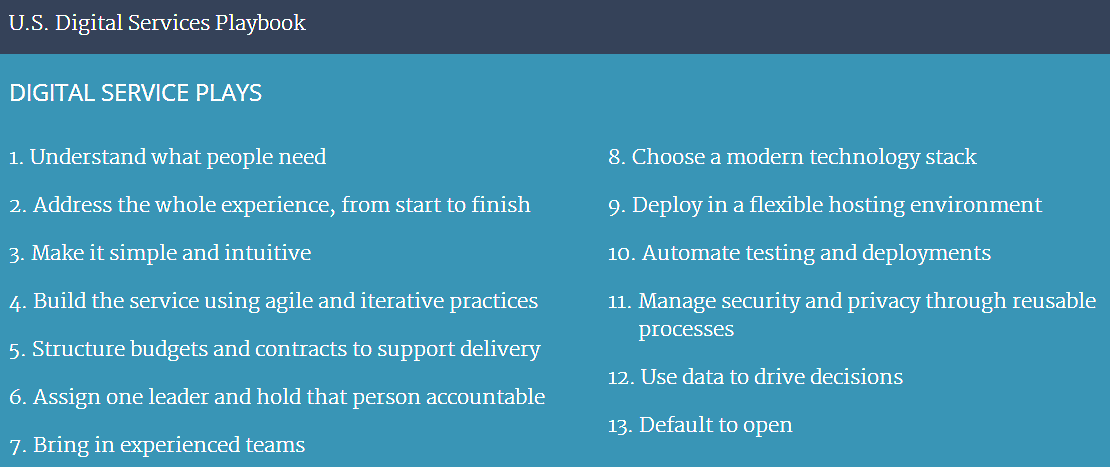
This list of "plays" from their "playbook" gives you an idea of their development and management style:

You can see more (and comment) on the the playbook here.

USDS will complement 18F, a government agency that was formed last March. (Their office is at the corner of F and 18th in Washington). Both groups are largely staffed by former Presidential Innovation Fellows and they have a common point of view. Unlike USDS, 18F actually builds tools and implements government systems. I am sure they will work closely together.

President Roosevelt (radio) and Kennedy (TV) were leaders at using new commuication media and President Obama was the first succesful Internet campaigner. Now he hopes to modernize government IT -- he might be remembered as the Internet President.

-----
Update 8/13/2014

USDS is also offering suggestions for addressing problems with the federal procurement process that leads to IT failures like HealthCare.Gov -- the TechFAR Handbook, which highlights the flexibilities in the Federal Acquisition Regulation that can help agencies implement “plays” from the Digital Services Playbook that would be accomplished with acquisition support — with a particular focus on how to use contractors to support an iterative, customer-driven software development process, as is routinely done in the private sector.

-----
Update
8/23/2014

18F is building tools and expanding -- hacking bureaucracy and promoting open source. They've reduced the hiring cycle from six to nine months to six to eight weeks by making Schedule A hires, which are limited to four years. That is sufficient for people used to working in "startup mode" and reminiscent of the grad students who worked on short-term grants to build the ARPANet and NSFnet.

-----
Update 9/9/2014

18F is building a new system for processing Freedom of Information Act (FOIA) requests.

Since the passage of the FOIA in 1966, journalists and other citizens have been able to request copies of government documents, but the system is often slow and fails to find relevant documents. 18F hopes to fix that with a consolidated FOIA request submission hub.

They began the project by meeting with stakeholders, both inside and outside the government, to discuss some of the practical obstacles impeding the current FOIA experience. They are now have a rough prototype of the FOIA request system running and the development process is open to public scrutiny and participation. You can follow, comment and contribute to the project here.


-----
Update 11/1/2014

18F Executive Director Greg Godbout, speaking at the 50th annual TechAmerica Foundation Vision conference reported that since its founding in March, 18F has grown from 14 to 100 employees -- it is now a small business, not a startup.

He said they were not competing with Federal contractors, but were a third-party trusted adviser to the contracting agency and developer, with "no skin in the game."

Their expertise is in "agile" hiring and development and "user centered design." Let's hope these are more than buzz words and their consulting pays off.

-----
Update 12/4/2014

USDS is expanding, working on Healthcare.gov 2.0, digitizing the VA and collaborating with 18F.

Monday, November 12, 2012

A quick look at the use of the Internet in the 2012 election

In an earlier post, we looked at the election coverage on the Internet. Now, we take a quick look at the way the campaigns used he Net.

As in the last election, both campaigns used Facebook, Twitter and other social networks, but this time they moved on to the targeted advertising we are now used to on the Internet -- white males saw different campaign ads than their wives. (See articles in both The Economist and The New York Times.

Perhaps Obama was a more aggressive in tracking clicks than Romney.  The Times checked Obama and Romney's Web sites during the campaign, and found that Obama was using 76 click tracking services and Romney 40.  I checked yesterday and found that Obama was down to 32 and Romney only one (click on the image to the right to see which ones).
In another article on the use of the Internet in the election, The New York Times gave the Obama campaign the edge in their use of the Net in organizing volunteers for door to door canvasing, phone calls and fund raising. They did that using a Web site called Dashboard and mobile apps that could access it.

A couple of factoids to establish context: The Economist quotes Borrell Associates as estimating online ad spending in 2012 at $160 million, six times what it was in 2008, but it remains a small percent of the estimated $6 billion spent on the election. This understates the impact of online campaigning, because it costs very little -- the Obama campaign built about 200 different programs that ran on Amazon's cloud services.

Saturday, September 01, 2012

Politicians using media, from Roosevelt's fireside chats to Obama's Ask me Anything

President Roosevelt used radio -- "fireside chats" -- to communicate with the American people. President Eisenhower was the first to campaign on television and Kennedy used it effectively. One can argue that President Obama is the first president to effectively use the Internet.

The most recent example of his use of the Internet was the live "ask me anything" (AMA) session he held at Reddit.com earlier this week. Reddit users typed questions for the president and he answered the ones that were voted up. The questions he took and his replies are shown below.

In our class, we talk about the implications of the Internet for individuals, organizations and society. Internet chat and AMA provides a new way for a candidate to campaign and for an official to interact with the public. In that sense it is reminiscent of President Roosevelt's fireside chats.
You can see the questions President Obama replied to along with his answers below. It is a mix of personal (he's a Bulls fan, eats with his family then goes back to work, and plays a game of basketball or golf every week) and political dialog. You also hear a conversational tone -- "Hey everybody -- this is barack" -- not the polished public speech voice.

Here is what he had to say:

"Hey everybody - this is barack. Just finished a great rally in Charlottesville, and am looking forward to your questions. At the top, I do want to say that our thoughts and prayers are with folks who are dealing with Hurricane Isaac in the Gulf, and to let them know that we are going to be coordinating with state and local officials to make sure that we give families everything they need to recover."

SharkGirl: We know how Republicans feel about protecting Internet Freedom. Is Internet Freedom an issue you'd push to add to the Democratic Party's 2012 platform?

Obama: Internet freedom is something I know you all care passionately about; I do too. We will fight hard to make sure that the internet remains the open forum for everybody - from those who are expressing an idea to those to want to start a business. And although their will be occasional disagreements on the details of various legislative proposals, I won't stray from that principle - and it will be reflected in the platform.

PartyInYourMouth: How are you going help small businesses in 2013 and 2014? and what if any bills are you going to impliment for small businesses, in 2013, and 2014?

Obama: We've really focused on this since I came into office - 18 tax cuts for small business, easier funding from the SBA. Going forward, I want to keep taxes low for the 98 percent of small businesses that have $250,000 or less in income, make it easier for small business to access financing, and expand their opportunities to export. And we will be implementing the Jobs Act bill that I signed that will make it easier for startups to access crowd-funding and reduce their tax burden at the start-up stage.

karlfranks: Who's your favourite Basketball player?

Obama: Jordan - I'm a Bulls guy.

Silent1mezzo: What's the recipe for the White House's beer?

Obama: It will be out soon! I can tell from first hand experience, it is tasty.

Suzmerk: What are you going to do to end the corrupting influence of money in politics during your second term?

Obama: Money has always been a factor in politics, but we are seeing something new in the no-holds barred flow of seven and eight figure checks, most undisclosed, into super-PACs; they fundamentally threaten to overwhelm the political process over the long run and drown out the voices of ordinary citizens. We need to start with passing the Disclose Act that is already written and been sponsored in Congress - to at least force disclosure of who is giving to who. We should also pass legislation prohibiting the bundling of campaign contributions from lobbyists. Over the longer term, I think we need to seriously consider mobilizing a constitutional amendment process to overturn Citizens United (assuming the Supreme Court doesn't revisit it). Even if the amendment process falls short, it can shine a spotlight of the super-PAC phenomenon and help apply pressure for change.

Fifth Surprise: What was the most difficult decision that you had to make during this term?

Obama: The decision to surge our forces in afghanistan. Any time you send our brave men and women into battle, you know that not everyone will come home safely, and that necessarily weighs heavily on you. The decision did help us blunt the taliban's momentum, and is allowing us to transition to afghan lead - so we will have recovered that surge at the end of this month, and will end the war at the end of 2014. But knowing of the heroes that have fallen is something you never forget.

Daveforamerica: What is the first thing you'll do on November 7th, win or lose?

Obama: Win or lose, I'll be thanking everybody who is working so hard - especially all the volunteers in field offices all across the country, and the amazing young people in our campaign offices.

hmlee: I am recent law school graduate. Despite graduating from a top school, I find myself unemployed with a large student loan debt burden. While I'm sure my immediate prospects will improve in time, it's difficult to be optimistic about the future knowing that my ability to live a productive life -- to have a fulfilling career, to buy a house, to someday raise a family -- is hampered by my debt and the bleak economic outlook for young people. I know that I'm not alone in feeling this way. Many of us are demoralized. Your 2008 campaign was successful in large part due to the efforts of younger demographics. We worked for you, we campaigned for you, and we turned out in record numbers to vote for you. What can I say to encourage those in similar situations as I am to show up again in November? What hope can you offer us for your second term?

Obama: I understand how tough it is out there for recent grads. You're right - your long term prospects are great, but that doesn't help in the short term. Obviously some of the steps we have taken already help young people at the start of their careers. Because of the health care bill, you can stay on your parent's plan until you're twenty six. Because of our student loan bill, we are lowering the debt burdens that young people have to carry. But the key for your future, and all our futures, is an economy that is growing and creating solid middle class jobs - and that's why the choice in this election is so important. The other party has two ideas for growth - more taxs cuts for the wealthy (paid for by raising tax burdens on the middle class and gutting investments like education) and getting rid of regulations we've put in place to control the excesses on wall street and help consumers. These ideas have been tried, they didnt work, and will make the economy worse. I want to keep promoting advanced manufacturing that will bring jobs back to America, promote all-American energy sources (including wind and solar), keep investing in education and make college more affordable, rebuild our infrastructure, invest in science, and reduce our deficit in a balanced way with prudent spending cuts and higher taxes on folks making more than $250,000/year. I don't promise that this will solve all our immediate economic challenges, but my plans will lay the foundation for long term growth for your generation, and for generations to follow. So don't be discouraged - we didn't get into this fix overnight, and we won't get out overnight, but we are making progress and with your help will make more.

gobearss: How do you balance family life and hobbies with, well, being the POTUS?

Obama: It's hard - truthfully the main thing other than work is just making sure that I'm spending enough time with michelle and the girls. The big advantage I have is that I live above the store - so I have no commute! So we make sure that when I'm in DC I never miss dinner with them at 6:30 pm - even if I have to go back down to the Oval for work later in the evening. I do work out every morning as well, and try to get a basketball or golf game in on the weekends just to get out of the bubble. Speaking of balance, though, I need to get going so I'm back in DC in time for dinner. But I want to thank everybody at reddit for participating - this is an example of how technology and the internet can empower the sorts of conversations that strengthen our democracy over the long run. AND REMEMBER TO VOTE IN NOVEMBER - if you need to know how to register, go to Gottaregister.com. By the way, if you want to know what I think about this whole reddit experience - NOT BAD!

-----

You can see the transcript and thousands of comments on Reddit.

Monday, December 15, 2008

The Obama Transition Team creates ad hoc threaded discussions using Intensedebate.com

The Obama Transition Team wants input on issues from citizens, and is now hosting discussion of questions like "What social causes and service organizations are you a part of that make a difference in your community".

People post their answers to the questions, and others can post a reply, check the reputation of the person who posted the answer, or vote it up or down. In the example shown below, we see that Denise C., who has 34 reputation points, submitted an answer to the question. So far, two people have voted her answer up, and the user is invited to vote up or down.

If you follow the link to a discussion question, you will see a fairly polished Web site with a short video elaborating on the question and the ensuing discussion. The Transition Team was able to quickly create this ad hoc site with a mashup in which the video is stored on YouTube and the threaded discussion, with its reputation and rating scheme, is hosted by intensedebate.com.

Would you respond to a Transition Team question? Do you think this process will generate meaningful input from the public and that the Transition Team will read it? Will it make people feel they are being listened to? Will it change politics?

Sunday, December 07, 2008

Change from Obama -- using the Internet for transparent, two-way communication during the transistion

We've discussed Obama's use of the Internet, and the difficulty of gathering meaningful input from many users.

You may recall the Bush energy policy controversy. In his second week in office, George W. Bush created the National Energy Policy Development Group (NEPDG), charged with developing a national energy policy.

NEPDG meetings were secret, and the administration refused to share information about them with Congress. This led to the General Accounting Office, the investigative arm of Congress, filing a lawsuit against the administration. The suit was dismissed.

The Obama Transition Team will hear from many groups over the next several weeks, and, in sharp contrast to Bush's policy, they will use the Internet to open those meetings. They have established a Web site for two-way communication with the public, where one can track Transition Team meetings, read documents presented at those meetings, and offer comments. You can read more and see a short video in this press release.

Do you have an interest in any of the meeting topics at "seat at the table?" Have you posted any comments? Do you feel such feedback will be meaningful, or is this sugar coating for one-way communication?

Wednesday, August 27, 2008

The Internet and the presidential election

We eventually learn to use new media, but at first we mimic old media. For example, this 1952 presidential ad for Eisenhower is like a radio jingle with crude animation:


It seems goofy today, but was made by intelligent, creative people at the time.

Many people feel that John Kennedy was the first presidential candidate to effectively use television. Checking his commercials from the 1960 campaign, we see sincere statements by the candidate, attack ads and celebrity endorsement ads as well as Eisenhower-era jingles. Kennedy also had the ability to speak directly to the voter as shown in this clip:


Earlier, Franklin Roosevelt broke new ground by communicating directly with the people in weekly fireside chats on the radio.

The Internet is today's new media. Howard Dean and John McCain pioneered in using the Net for fund raising during the 2000 and 2004 elections, and both of the current candidates are using it for position papers, fund raising, community formation, video, instant messaging, Twitter streams, email, etc. this year.

In this interview, Phil Noble of the consulting firm Politics Online says Obama may be to the Internet what John Kennedy was to television and the New York Times published this excellent article on the importance of the Internet in the campaign on the day before the election.

For more examples of presidents using radio and television, see the archives of presidential speeches at the University of Virginia and presidential campaign commercials at Living Room Candidate.

Have you registered with either (or both) the presidential campaign sites? Have you contributed to a candidate on the Internet? Have you created blogs on either campaign site? Do you see differences in the way Obama and McCain are using the Internet?