Showing posts with label starlink. Show all posts

Sunday, February 05, 2023

Starlink comes to Africa -- markets and competition

Source

SpaceX Starlink Internet service will be available in several African nations in the second quarter of this year and the price in Nigeria has been announced -- $600 for the "residential" terminal and a monthly fee of $43. Is there a market for Starlink at that price in Nigeria and other Sub-Saharan African nations?

The IMF projects a GDP per capita of $2,580 for Nigeria this year (and $1,900 in Sub-Saharan Africa and $2,260 for Africa overall) so the market for individual consumer accounts will be much smaller than in what the IMF refers to as "advanced economies." Instead, we will see shared accounts in government and commercial Telecenters, WiFi hot spots, etc. (Some private companies may encounter payment problems since Nigeria currently has a currency conversion ban).

The first Cabina Publica (source)
The first Internet Telecenter was a "Cabina Publica" in Lima Peru, providing access to the non-profit Peruvian Scientific Network founded by Jose Soriano. Around the same time, India was offering Internet services at rural Postal Offices and experimenting with "information Shops." The Telecenter movement grew and was documented in a book by Andy Carvin in 2005, (Coincidentally, Starlink just became available in Peru).

The availability of mobile phones and laptop computers has enabled widespread WiFi access but some telecenters still exist. For example, the Cuban government operates both fixed telecenters and WiFi access points,

Note that a rural satellite Telecenter can pivot from satellite to terrestrial connectivity if it becomes available and continue operation offering Internet and other services.

A clinic in Rural India (source)
Telecenters and hotspots are shared by individual customers, but government and private organizations in rural areas -- schools, clinics, local government offices, small businesses, etc. may also use Starlink connections to the Internet. Here is an early example where Starlink is connecting a school and clinic in rural Chile. Organizations or public access facilities may also create multi-terminal and local area networks on their own using Starlink mesh routers or third-party equipment. A multi-user organization that is more complex than a single residential terminal will require professional support. Starlink can also be used for backhaul from mobile towers in remote areas.

I've been talking about the residential Starlink offering because that is all that is currently available in Nigeria, but in other nations, SpaceX also offers a business configuration that is faster, comes with a guaranteed service-level agreement, and offers some support. The current business price is much higher -- a $2,500 terminal and $500 monthly charge -- but SpaceX has adopted an affordable pricing strategy for the residential service and may do the same for the business service. They also offer maritime and mobile services and may one day introduce other configurations.

Starlink will have competitors. 

Today they are the only low-Earth orbit (LEO) broadband Internet service provider, but OneWeb, Telesat, Amazon subsidiary Kuiper Systems, and China SatNet all plan to offer LEO broadband and SES offers competing medium Earth orbit connectivity. With the possible exception of China SatNet, none of these companies plans to offer retail residential service -- they are designing for and marketing to multi-user markets such as we are discussing here and have competitive advantages.

For example, Kuiper will have integration with Amazon Web and Ground station services, OneWeb will soon be offering service and they have technology and distribution partners with experience in developing nations, OneWeb and Telesat are well positioned to offer multi-orbit service through their geostationary orbit partners. SES is already serving potential Starlink customers and has begun launching next-generation mPower satellites. China SatNet will have political and financial advantages in Digital Silk Road nations.

Sources: Price and Speed 
There will also be competition from terrestrial ISPs. Internet customers in Nigeria and sub-Saharan Africa do not have the same expectations as those in wealthier nations. That is illustrated in this table contrasting the United States with the five nations SpaceX expects to serve in the second quarter of this year Nigeria, Mozambique, Angola, Tanzania, and Kenya. Mobile speed is faster than fixed in Africa and slower in the United States and mobile service costs less in these and other African nations. 

If it turns out that a $600 terminal and a $43 monthly charge do not attract enough customers to utilize available capacity, SpaceX will lower prices, as they have done in other nations.


An early speed test in Nigeria (source)


Available capacity is of course a moving target. Capacity per user decreases as new users come online and increases as new satellites are launched. Elon Musk claims the capacity of their second-generation "Starship" satellites will be close to ten times that of their current satellites and they are testing second-generation residential terminals which Musk says will cost a lot less.

I began by asking about the market for a $600 terminal for $43 per month service. I don't have an answer, but I bet the price will have changed within a year or two.

Update 2/9/2023

The experience of Poa Internet in Kenya indicates the viability of a residential Internet market in Africa. Poa CTO Mike Puchol reports that when they deployed ~160 outdoor Wi-Fi hotspots in Kibera, a district of Nairobi, users consumed little data in spite of the price being 10% of the mobile network operator's rate and when Poa offered 4 Mbps service with no caps over wireless links to residences, average consumption hit ~140 GB/month and is now over 200 GB/mo. People share access, use desktop and laptop computers, and do different things at home than on mobile networks or Wi-Fi hotspots.

Private or community ISPs will be able to provide wireless or wired residential service using Starlink at, say, 4 Mbps as long as there is sufficient capacity in the community. When Sanjay Bhargava was selected to head Starlink in India in late 2021, he gave a presentation in which he stated a rule of thumb of 100 Starlink terminals in 300 square kilometers. Around the same time, three academic researchers published a paper in which they estimated a mean per-user capacity of 24.94 Mbps at a density of 1 user per 10 km^2. Capacity has increased since 2021 as SpaceX has launched more satellites, some with inter-satellite laser links and perhaps greater throughput, and, as noted above, second-generation satellites promise significant capacity increases

Saturday, June 18, 2022

Ten SpaceX Starlink updates

Starlink availability map (Source)

Starlink now has nearly 500,000 users and is available in 32 countries and nine languages. It is either available, wait-listed, or coming soon in every nation except Afghanistan, Belarus, Cuba, China, Iran, North Korea, Russia, Syria, and Venezuela.

There are now 15,000 Starlink terminals in Ukraine with service throughout the nation through connections to ground stations in Poland, Lithuania, and Turkey and they have made a significant contribution in the war with Russia. For better or worse, they have demonstrated the value of low-Earth orbit satellites in combat.

A Chinese research paper called for the development of systems to track, monitor, and disable Starlink satellites. Quotes include "The country needs to be able to disable or destroy SpaceX’s Starlink satellites if they threaten national security" and "A combination of soft and hard kill methods should be adopted to make some Starlink satellites lose their functions and destroy the constellation’s operating system.” The paper in Chinese is here and an English translation is here.

SpaceX has begun launching version 1.5 satellites with optical terminals and Elon Musk says they will be operational by the end of the year. They are about to run a test using laser links to provide connectivity in Polar regions (above 53 degrees latitude) where there are no ground stations. It will take some time for them to connect all the satellites in the constellation in an orthogonal mesh, but this simulation predicts a ~2x latency improvement over long links when the mesh is complete. 

Astronomers worry about reflections from larger Version 2
satellites. (source)
The version 1.5 satellites do not have visors that reduce reflection which interferes with astronomical observation because they were incompatible with the laser terminals. Principal engineer David Goldstein says they're working on technology that will make version 2 satellites ten times dimmer than Vantablack paint.

SpaceX tested Starlink roaming in the US and later in Ukraine and they have now rolled out two new commercial services, Starlink for RVs, a low-priority service that can be paused, and Residential Starlink + Portability which provides priority service at your registered residence, but low-priority service when away. Elon Musk reported that they had 30,000 Starlink-for-RV orders within three weeks of its availability.

Service is not yet offered for moving vehicles, but it has worked well in the tests mentioned above and in Ukraine. Since the technology works, they may be delaying availability until they have a capacity allocation/pricing scheme, or they might be working on a new terminal. How long will it be before they have a terminal for Tesla and other cars and trucks? (They will eventually be competing with Geely for automobile connectivity).

Starlink's new business service is intended for locations with up to twenty users. It includes a $2,500 terminal with a high-gain antenna and promises download speeds of 150-500 Mbps and latency of 20-40ms. It includes 24/7, prioritized support and a publicly routable IPv4 address, but does not offer on-site support or a guaranteed service-level agreement.

Starlink began by serving the consumer market, but they have begun selling to air and ship lines. Starlink has contracted to offer service on JSX and Hawaiian Airlines and has applied to serve Royal Caribbean cruise ships. The airlines will use a new high-gain antenna that can deliver 500 Mbps down and40-50 up with 400w peak power consumption. I'll be curious to see what sort of terminal they will have for cruise ships with thousands of passengers but little nearby congestion when at sea.

SpaceX published a detailed description of its approach to space sustainability and safety in a February 22 post on their Starlink Updates blog. The post reports that Starlink satellites made 3,300 autonomous maneuvers to avoid collision during the second half of 2021 and describes the policies and technology Starlink uses to avoid collisions, including "ducking" -- retracting the solar panel and orienting their attitude to have the smallest possible cross-section in the direction of conjunction. Unfortunately, SpaceX cannot solve the space debris problem unilaterally and all debris objects cannot be tracked from Earth, though improved tracking from satellites might help and at least one company, Privateer, is exploring that possibility.

(Click here for a Starship update).

Update 6/29/2022

Royal Caribbean has run an informal test of Starlink aboard one of their cruise ships. Starlink significantly outperformed geostationary satellite service with a Ping time as low as 38ms and up and download times as high as 77/03 and 15.72 mb/s. That is fast enough to stream video or teleconference but does not shed much light on what to expect when connectivity is distributed throughout a ship with 5,000 passengers and a crew. It will be interesting to see how LEO service on ships ends up competing with O3b Mpower MEO connectivity

Update 6/30/2022

The Minister of Digital Transformation of Ukraine, Mikhail Fedorov, said that in the future, Internet from Starlink will appear on Ukrainian trains and it has been demonstrated in a successful pilot test in which Starlink technicians were surprised that it worked at high speeds. Ukraine’s Special Communication and Information Protection State Service chief Yurii Shchyhol said Starlink will be available in all Ukraine Railway trains by the end of 2022.

It looks like SpaceX is using Ukraine as a testbed for connectivity in moving vehicles and as a war tool in general.

Update 7/1/2022

The FCC has authorized Starlink connectivity to RVs, large trucks, ships, and planes. They expect to be on planes "very shortly" according to Jonathan Hofeller, Starlink's commercial sales chief. Elon Musk has said he didn't see "connecting Tesla cars to Starlink, as our terminal is much too big." That's true for today's terminals, but I wouldn't rule it out in the future -- by SpaceX or, as mentioned above, Geely.

Update 7/7/2022

Starlink Maritime is available now near coasts where they can reach terrestrial ground stations. Coverage will expand in the fourth quarter of this year and expand to global coverage in the first quarter of next year as more satellites are equipped with inter-satellite laser terminals.


With a price of $5,000 per month and a one-time hardware cost of $10,000 for two high-performance, ruggedized terminals for a download speed of "up to" 350 Mbps, they are marketing to merchant vessels, oil companies and Russian oligarchs with Yachts, not the few thousand customers on a Royal Caribbean cruise ship. Latency will on average be greater than terrestrial Starlink due to hops through inter-satellite links. Customers can pause and resume service at any time, but when they turn it on, they will have to pay for the month.

For those who might be worried about performance in severe weather and rough seas, SpaceX points out that Starlink is currently being used to get high-quality video of rocket landings at sea, providing continuous coverage next to engines capable of generating up to 190,000 pounds of force.

Update 7/15/2022

The first phase of Starlink launches consists of 4,408 satellites in five orbital shells. Over half of those satellites are in orbit already, but just last week they launched the first forty-six of the 520 operational V 1.5 satellites that will be in near-polar orbits with inclinations of 97.6 degrees.

Phase 1 orbital shells -- 4408 satellites

These polar orbit satellites will enable them to offer global coverage on land and sea as described above.

Update 8/31/2022
Following on the trial described above, Royal Caribbean has agreed to provide Starlink connectivity on their entire fleet of 63 ships. They will begin outfitting ships immediately and expect to have them all online by the end of the first quarter of next year. 
Other cruise lines connect through geostationary satellites, but Royal Caribbean has been using SES middle Earth orbit satellites on two of their ships. Starlink LEO satellites will provide better performance and offer full global coverage, which the others cannot.


Monday, June 13, 2022

Can SpaceX launch version 2 Starlink satellites this year?


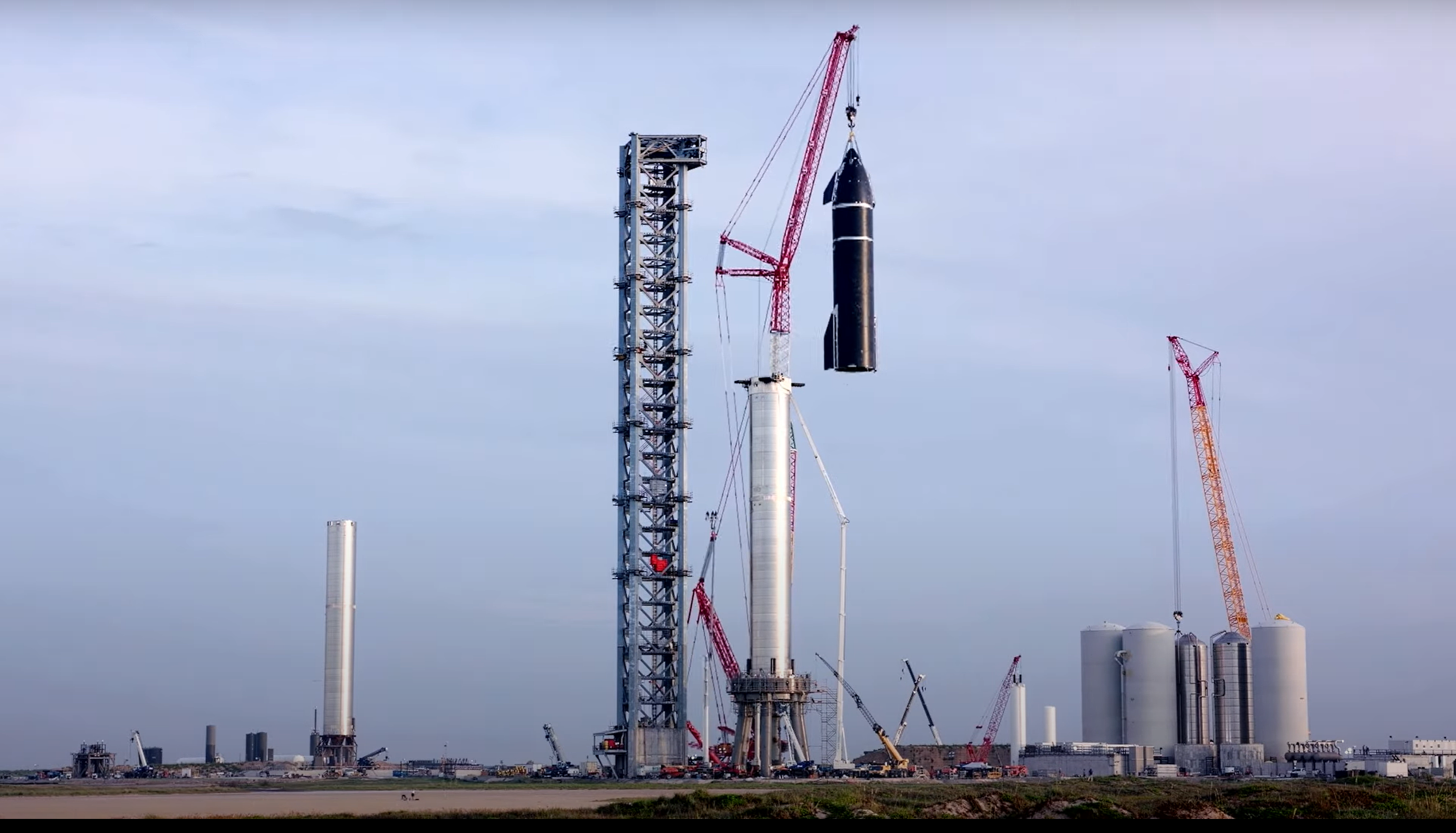
A Starship spacecraft being lifted onto a Super Heavy booster

The answer to the question in the title depends on the availability of SpaceX’s new Starship spacecraft and Super Heavy booster rocket, collectively referred to as Starship. Elon Musk says he is highly confident about getting Starship to orbit this year. He also says, “At Space X we specialize in converting things from impossible to late.” 
Starship is critical to Starlink because the version 2 satellites are seven meters long and weigh about 1.25 tons and the current Falcon 9 rockets have neither the cargo volume nor the mass-to-orbit capability to economically launch them. As Musk put it, they "need Starship to launch and fly frequently or Starlink version 2 will be stuck on the ground." 
Version 2 satellites will be ejected
using a "Pez dispenser" mechanism
modeled after industrial pallet
stackers.
Musk has said the performance of the version 2 satellites will be nearly an order of magnitude better than that of the current satellites and they will include inter-satellite laser links. He did not elaborate on his order of magnitude estimate and it will be interesting to see how they handle a mixed-satellite constellation, but all the analysts predicting the profitability and capacity of Starlink will have to go back to work. The projected improvement also reminds us of the advantage of short satellite life.
Today's terminals will work with the version 2 satellites, but performance will be better with a new terminal that is being developed. Perhaps Starlink will allow current terminal owners to trade them in on Version 2 terminals.
But can SpaceX launch the remaining 9,500 approved satellites or the 30,000 that are awaiting approval in a timely manner? They can if they achieve rapid reuse of Starships. The total world mass-to-orbit to date is 16,000 tons. Musk estimates that a single Starship launching three times a day could put 109,000 tons in orbit in a year.
Today they are doing about one launch per week and the current average turnaround time for boosters is 21 days -- can they reuse a Starship three times a day? Boosters fly for about six minutes before returning to Earth and SpaceX plans to have them land back on the launch pad ready for refueling, installation of a spaceship, and re-launch. (They will need more spaceships than boosters). 
During an interview/tour of the Starbase manufacturing and launch site in Boca Chica, Texas, Musk spent time at a launch pad discussing the 10-second booster landing and capture sequence and the design decisions it entailed with Andrew Krebs, Director, Starship Launch Engineering. It was apparent that various tradeoffs are still being evaluated and change is constant. Musk said there is a good chance they will fail to capture the booster on the upcoming orbital flight. (Recall the "unscheduled disassembles" tape of attempts to safely land Falcon boosters). 
They spent some time on the tour at an assembly bay talking about Starship design and manufacturing. Since they need Starship to launch and fly frequently, they expect to eventually have ten or twelve manufacturing bays and Musk expects to manufacture a new spaceship and booster every month. (He estimates that they will eventually have 1,000 Starships for building a city on Mars).
Raptor 1 vs Raptor 2 (source SpaceX)
The greater mass of the Starship and satellites requires more powerful rocket engines than SpaceX is currently flying so Starship will use thirty-nine Raptor 2 engines -- 33 for the booster and six for the spaceship. The Raptor 2 is more powerful than its predecessor, has a much simpler design, and costs about half as much. They had trouble manufacturing them at first but now expect to make seven or more per week.
If all goes well, Musk estimated the variable cost per orbital flight as being a few million, "maybe" as low as one million, dollars. 
In addition to engineering and manufacturing, there are regulatory hurdles. The Federal Aviation Administration (FAA) requires an environmental review before they can do the first orbital test launch and they are currently being required to make over seventy-five environmental adjustments to do an orbital launch in Texas. I have no idea how long these adjustments will take, and Musk has considered moving the first orbital flight to Florida. You can see the latest FAA report here.
There are a lot of unknowns and precisely landing and catching a 68-meter long, 9-meter diameter rocket might turn out to be impossible, but SpaceX specializes in converting things from impossible to late.
---
This post is based on a Starship update talk Musk gave at Starbase in Boca, his recent all-hands company presentation, and videos of interviews with Tim Dodd, the "Everyday astronaut," conducted while touring Starbase. Those videos are here, here, and here. I've only selected some Starlink-related material from these sources. Check them out to learn a lot more about Elon Musk and rockets.

(Click here for a Starlink update).

Update 6/17/2022

The FAA has concluded that continued launches "would not significantly affect the quality of the human environment" and Elon Musk, who has said there would be no more "hops," expects to attempt a Starship orbital launch in July. Musk thinks they will be able to satisfy the FAA quickly and get on with the orbital launch test. He tweeted “There will probably be several launch countdowns before we pass all the abort triggers, but hopefully the first countdown is this month.”

Update 8/4/2022

Alternative plan -- booster returns to launch pad
The answer to the question in the title is "no," but they are pushing hard and next year is a possibility. Version 2 satellites are already at Starbase, and the next Starship launch will try to reach orbit. It would be surprising if the first attempt reached orbit, but Elon Musk is confident that they can do it within twelve months. Whenever they do it, if all goes well, they will try to land the booster on the launch pad rather than allowing it to fall into the ocean. 
Musk previously predicted that the first orbital test would be as early as last January, so he is nearly a year behind schedule, but that prediction did not include an attempt at landing on the launch pad. 

Monday, April 11, 2022

The unprecedented role of the Internet in the war in Ukraine

The impact of the Internet in the Russia-Ukraine war is unprecedented in speed and scope. The most visible example of this has been President Zelenskyy's use of social media and teleconferencing in his roles as Commander in Chief of the armed forces, a global diplomat, and a leader of the Ukrainian people.

As shown here, Zelenskyy's military meetings mix in-person and remote participants in a digital war room equipped with large displays for sharing information. Contrast this modern war room with the image of Putin meeting with military leaders around a huge conference table in an ornate room with a single monitor that is turned off and a console on a table at his left that looks like a 1950s intercom.

President Zelenskyy uses social media and teleconferencing in his roles as a national leader and global diplomat. He has been posting on the Presidential Telegram channel since he was inaugurated in May 2019. He has 1,421,358 followers and his posts have included 414 videos and 499 photos -- about half since the invasion. (Zelenskyy's Telegram feed and other Internet content created during the war will be available to historians).

The post-invasion photos include visits to hospitals, troops, and national leaders. Sadly, the majority are evidence of war crimes, and the most winning are accompanied by love poems to his wife on her birthdays -- reminiscent of President Obama. (You can see the 499 photos here and I will update the collection periodically).

Zanny Minton Beddoes, editor-in-chief of The Economist,
describes her experience interviewing President Zelenskyy.
His Telegram videos show him receiving standing ovations during speeches at parliaments in Japan, Israel, the US, Canada, and Europe as well as mutational organizations like The Doha Forum and The United Nations Security Council. He even gave a talk during the US Grammy Awards and has been interviewed by news programs like Face the Nation and Sixty Minutes in the US. He also reaches out to individual leaders as in this message to Hungarian Prime Minister Viktor Orbán and posts daily messages for the Ukrainian people and the world, which are reminiscent of Franklin Roosevelt's Fireside Chats with the American people.

Those and other photos and videos are available on the Internet, but more importantly, they are picked up by television and print media throughout the world. The resultant information flood led Russia to resign from the UN Human Rights Commission after 93 nations voted to suspend its membership. This occurred six weeks after Russia invaded Ukraine.

While this information is blocked on the Russian Internet and in Russian media, it will gradually trickle in through virtual private networks, Internet services like callrussia.org and 1920.in that enable Russian speakers to call and send texts to randomly selected Russians, Russian casualties, and contacts with friends and family abroad.

Note that many of the videos and photos mentioned above were recorded by drones. Ukraine has used drones extensively for surveillance and targeting, as weapons, and for documenting atrocities and war crimes.

President Zelenskyy is in front of the cameras -- a Churchillian rock star -- but his contribution would not have been possible if Ukraine had not been digitally prepared. 

For a start, they have a cabinet-level Ministry of Digital Transformation, headed by 31-year-old Vice Prime Minister Mykhailo Fedorov. The first time I saw his name was in a tweet asking Elon Musk to supply Starlink terminals. Two days later the first shipment arrived, within a week more had arrived and were being used and there are now more than 5,000 in service.

Ukraine was working on "digital transformation" before the invasion. For example, they had a mobile app and platform called DIIA that enabled them to distribute subsidy payments of about $221 to nearly five million Ukrainians in war-affected regions electronically. When Tim Berners-Lee put the Web in the public domain, Zelenskyy was fifteen years old and Fedorov two -- they are "digital natives."

Of course, none of the above would have been possible without the Internet and Doug Madory, who monitors global Internet outages, says there have been temporary local outages, but for the most part, the country has remained online. (Mariupol is an exception). This resilience can be attributed to a combination of the courage and resolve of Ukrainian technicians and the competitive market and decentralized structure of the Ukrainian Internet. Madory also points out that the Russian army is using the Ukrainian Internet and may be reluctant to destroy assets that they hope to acquire (steal).

Early Internet users received first-hand accounts of the 1989 Tiananmen Square demonstrations and massacre via Usenet News and email. Usenet and email were used both to report on and organize the demonstrations during the 1991 Russian coup attempt and Facebook and Twitter played prominent roles in the Arab Spring of the early 2010s. 

This is the teleconferencing and drone war.

Update 4/12/2022

This 4m 35 video is on the Turkish Bayraktar drone which Ukraine uses to launch strikes and then post the results on social media. It shows soldiers literally singing its praise in a viral song, a tour of the very modern-looking factory with the drone's designer Selcuk Bayraktar, the chief technology officer of Baykar Technologies. 

Bayraktar is also the son-in-law of the Turkish president ErdoÄŸan and he is clearly moved by the plight of the "brave people of Ukraine" who are "giving their lives up ... defending their homeland from an illegal occupation. That's what brave people of Ukraine and its leadership has done."

Update 4/21/2022

According to the Daily Mail, the Russian Black Sea flagship the Moscova was hit by missiles launched from Crimea and subsequently sunk. Russia initially claimed that an accidental explosion, had sunk the ship but ex-president Dimitry Medvedev admitted the ship was sunk by Ukrainian missiles. He claimed that Starlink had been used in targeting the ship and said the destruction of Starlink satellites over the territory of the Russian Federation had been ordered. The Bayraktar drones mentioned above were used as decoys distracting the ship's defenses.


Update 4/28/2022

Viktor Zhora, deputy head of Ukraine's State Service of Special Communications and Information Protection reports that:
  • Starlink terminals have been instrumental in keeping the country online. 
  • He isn't aware of any cyberattacks on those terminals, however.
  • Some Starlink customers have been attacked and some terminals have been destroyed during shelling. 
  • The state only distributes the terminals, it doesn't necessarily run them, so he can't say how many were hit.
  • He expects most of the hits on Starlink terminals were "coincidental."
  • While Russia may have tried to geolocate those terminals, he does not expect that they've been successful.

Update 5/3/2022

War correspondents used to be writers who sometimes accompanied troops and reported on combat.

The Internet enables soldiers themselves to act as war correspondents in Ukraine. For example, James Vasquez, @jmvasquez1974, is using SpaceX Starlink to post reports on combat while he is engaged in it. In this video, he is thanking Elon Musk for his Starlink terminal.

Update 5/28/2022

The PBS News Hour aired a segment on crowd-sourced and open-source intelligence in the Ukraine war. Two projects are featured Intel Crab and Bellingcat which use information from people on the ground in Ukraine and various online sources to debunk fake news and inform the public and the Ukraine armed forces of the movement and location Russian assets. The segment also has short interviews with experts 

The Internet has also been instrumental in informing the Russian public about the war despite the government blocking many Web sites and closing down all independent media. Putin's "iron firewall" is porous.

Update 8/29/2023

New types of drones are striking deep within Russia but scaling up is hard and Russia is learning to defend against them and use drones themselves. For example, they put jamming devices on tanks and other high-value assets to make it difficult to target them using first-person-view drones.

Strikes on Moscow make headlines and bring Russians closer to the reality of war, but most of Ukraine's strikes directly support the three-month-old counter-offensive,

Sunday, March 27, 2022

Five thousand SpaceX Starlink terminals for Ukraine

Starlink terminals at the Lviv IT Cluster
On March 1, I wrote that a small number of SpaceX Starlink terminals had arrived in Ukraine, and they would be an important asset for distribution to selected government and resistance leaders and journalists. I didn't know who would get the terminals or how many there were, but it was a single truckload. A week or so later, we learned that two more shipments of terminals had arrived and fifty of them went to DTEK, a company struggling to repair Ukrainian electrical infrastructure. However, as far as I knew, it was still a small number of terminals.

That changed on March 19 when the Washington Post reported that "A person familiar with Starlink’s effort in Ukraine, speaking on the condition of anonymity to discuss sensitive matters, said there are more than 5,000 terminals in the country." We'd seen pictures of three truckloads before, but this was a whole new level. Enough for armed forces, infrastructure companies like DTEK, NGOs, and government leaders.

I am speculating, but I think those 5,000 terminals may have been purchased in a joint project of SpaceX and Lviv_IT_Cluster, a community of over 180 leading information technology companies, authorities, and educational institutions employing over 25,000 IT experts that appears well on the way to achieving the goal of making Lviv the technological center of Eastern Europe. 

On March 22, Lviv IT Cluster announced they had purchased a large number of Starlink terminals, and the first batch had arrived in Lviv. By March 26, they were distributing terminals to critical infrastructure providers.

Lviv IT Cluster says these terminals were not contributed but were purchased at a "most-favorable" rate and while the number of terminals was not disclosed it is "sufficient to support critical and military infrastructure as well as IT business in Western Ukraine."  The terminals will not be resold, but "will be handed over to strategically important enterprises and institutions such as electric utilities, medical system, rescue services, security system, power grids, transport hubs, government agencies, and much more."

I'm impressed by the speed of delivery of this aid to Ukraine as well as its scope. Terminals were delivered to Lviv, in western Ukraine and distributed to users a few weeks after an email exchange between Lviv IT Cluster CEO Stepan Veselovskyi and Elon Musk. 

Niels Groeneveld has compiled a list of fourteen types of military aid that have been provided to Ukraine by twenty-seven nations. I would add Starlink terminals to the list.

Update 3/28/2022

Aerorozvidka, a specialist air reconnaissance unit within the army that was created by model plane enthusiasts in 2014, has been picking off tanks, command trucks, and vehicles carrying electronic equipment since the invasion began. They rely on Starlink for secure communication and "strike at night when Russians sleep ... we use a drone with thermal vision at night, the drone must connect through Starlink to the artillery guy and create target acquisition.” They also have bomb-equipped drones. 

Hundreds of civilian drone fliers using public communication channels have also been mobilized. I bet Putin didn't plan on that.

Identifying targets using drones with night-vision cameras

Russian tanks, stranded after the destruction of Russian supply trucks

Update 4/8/2022

Here is an example of citizens using a Starlink terminal when the terrestrial Internet is unavailable. When the Russians retreated from a town near Kyiv, electricity and mobile communications were down, but residents were able to communicate through this Starlink terminal with its Wi-Fi router.


Update 4/10/2022

On April 5, The US Agency for International Development (USAID) reported that SpaceX donated "roughly $10 million" worth of 3,667 Starlink terminals and associated internet service to Ukraine. 5,000 terminals were delivered in total, with USAID buying "the additional 1,333 terminals." That press release was replaced the following day with a release omitting the details and simply saying 5,000 terminals had been delivered. This article adds more details.
I asked SpaceX and USAID if these were the same 5,000 terminals described in this post but got no answer.

Update 4/20/2022

Nexta_TV reports that there are 10,000 Starlink terminals in Ukraine. If that is the case, the 5,000 terminals described in this post and the 5,000 terminals attributed to USAID & SpaceX were separate shipments.

Update 4/22/2022

Mykhailo Fedorov, Vice Prime Minister and Minister of Digital Transformation of Ukraine has confirmed that there are now 10,000 Starlink terminals in Ukraine. An unspecified number of them have been given to the Army and others are being used to maintain the operation of critical energy and telecommunications facilities, in health care facilities, and even in agriculture. This announcement was also reported here.


Update 6/9/2022

In an all-hands company presentation, Elon Musk said there were now 15,000 Starlink terminals in Ukraine, and as of May 2, Mykhailo Fedorov, Vice Prime Minister and Minister of Digital Transformation of Ukraine said there were about 150.000 daily Starlink users. I wonder how many there are now.


Tuesday, March 08, 2022

SpaceX Starlink in Ukraine -- a week later

The Internet has been down in the city of Mariupol since March 2. If there is a Starlink terminal there, it is still online.

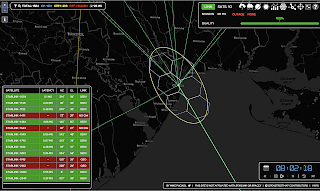
Ten Starlink satellites serving Odessa through ground
stations in Turkey, Lithuania, and Poland

Last week I wrote about the arrival of a truckload of SpaceX Starlink terminals in Ukraine and their potential value to government and resistance leaders. A lot has happened in the ensuing week -- this is an update.

Last week, using Mike Puchol's Starlink tracking service, I found that users in Kyiv would have 100 percent uptime with connections through as many as nine satellites to ground stations in Turkey, Poland, and Lithuania. When the Turkish ground station was unreachable it dropped to as few as five, but uptime remained 100%.

I've since used his service to check connectivity snapshots in three geographically dispersed cities -- Odessa, Lviv, and Kharkiv. I always found between seven and ten satellites in service in Odessa and Lviv and between two and six in Kharkiv. This is not surprising since Lviv is west of Kyiv, hence closer to the Polish and Lithuanian ground stations, Odessa in the south is closer to the one in Turkey and Kharkiv is to the east -- near Russia.

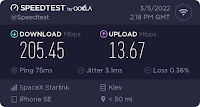
Starlink Speedtest in Kyiv
Puchol's simulation mode shows there should be 100% availability throughout the country at all times and, since there are few terminals, performance should be good. That was confirmed by an OOKLA Speedtest run by Oleg Kutkov in Kyiv. During the third quarter of 2021, OOKLA observed median upload and download speeds of 87.35 and 13.54 Mbps in the United States and as shown here, Kutkov observed much faster download speed and similar upload speed. The Kyiv test showed a "ping" time of 75 ms compared to a median "latency" of 44ms reported by OOKLA. I'm not sure if their reported "latency" is one-way or round trip. If the latter, they are comparable,

There have been several software updates since last week. Most importantly Elon Musk tweeted that SpaceX had enabled roaming in Ukraine so anyone with a terminal can transmit for a while then turn it off and move to another location or, if necessary, can remain online in a moving vehicle. In the same Tweet, Musk announced that they had reduced peak power consumption so the terminal could be powered by a car cigarette lighter. (There must have been some performance hit).

Musk also tweeted that "Some Starlink terminals near conflict areas were being jammed for several hours at a time" and they were bypassing the jamming with a software update. He added that he was curious to see what they tried next -- this sounds like "whack-a-mole."

It's noteworthy that in our "software-defined everything" world, SpaceX can make significant changes to the constellation with a software update. (The downside is illustrated in an over-the-air software hack of ViaSat modems).

Musk warned that Starlink terminals could be targeted and advised users to turn them on only when needed, to place an antenna as far away from people as possible, and to cover it with light camouflage. He also tweeted that some governments (not Ukraine) had asked him to block Russian news sources, but, as a "free-speech absolutist," he refused to do so.

President Zelenskyy Tweeted that the second shipment of terminals was on its way after speaking with Musk. 

In related news, Anonymous has declared cyberwar on Russia and there are Telegram channels for IT professionals in support of Ukraine, one of which is English-language.

Finally, there was also a PR tweet by Ukraine's famed heavyweight champion boxers the Klitschko brothers posing with a couple of Starlink terminals. 

Some Musk critics see his disaster-relief efforts or delivering terminals to Ukraine as publicity stunts of little practical value. Starlink terminals in Ukraine are terrific publicity, but they are also valuable tools for communication by political and resistance leaders if they are unable to safely access the Internet or it is blocked. For example, it has been reported that Mariupol is without electricity and water, and the Internet has been down since March 2. If there is a Starlink terminal there, it is still online.


Update 3/10/2022
Oleg Kutkov reported faster connectivity with a wired connection to the router instead of WiFi.

Update 3/14/2022

Photos of Starlink terminals in various locations have been posted on Telegram's Ukrainian IT Army and Facebook's SpaceX Starlink in Ukraine groups, but little was said about their use and users. 

Fifty of the square-antenna terminals from the second shipment have gone to the DTEK Group. Half of them will be used for support of Ukrainian energy infrastructure and half will go to DTEK businesses. Click here for more on DTEK's war effort

Update 3/17/2022

The Internet in the port city of Mariupol has been down since March 2 and the city is reported to be without electricity, gas, and water. If there are any Starlink terminals in the city, they should have no trouble getting online. I've periodically checked connectivity there and found between two and six satellites in service. (The rare time it got down to two satellites, the connection was through the Lithuanian ground station).

Six satellites in service over Mariupol

Update 3/19/2022

From the Washington Post: "A person familiar with Starlink’s effort in Ukraine, speaking on the condition of anonymity to discuss sensitive matters, said there are more than 5,000 terminals in the country. We'd seen pictures of three truckloads before, but this is a whole new level. Enough for armed forces, infrastructure companies like DTEK, NGOs, and government leaders.

Update 3/26/2022

DTEK's power engineers have received another 170 Starlink satellite terminals from SpaceX. The terminals "will help the company's power companies to maintain stable operation of power grids more efficiently and will help emergency repair crews to restore power as soon as possible." This sounds like part of the 5,000 terminals mentioned above. 

Update 5/5/2022

It's been over two months since I first wrote about Starlink terminals in Ukraine. At that time, a few hundred Starlink terminals had been delivered. Within a month there were 5,000 terminals and that was soon updated to 10,000. Now it's being reported that there are 150,000 daily users and the Starlink app has been downloaded 215,000 times. 

As predicted, Starlink has become an important government asset. This article shows some of the ways Starlink terminals are being used. The article is in Ukrainian, but the Google and Microsoft Translations are perfectly readable.


Update 10/13/20

I've previously written about the unprecedented role of the Internet in the war and the contribution of Starlink. Some current measures of the magnitude of the contribution of Starlink are: