Showing posts with label policy. Show all posts

Monday, May 25, 2020

Public and private infrastructure investment alternatives

Electrifying rural South Dakota

The strategic goal of infrastructure is not to derive economic benefit from the asset itself, but to generate economic benefit by maximizing the use of the asset. Steve Song.

Eric Yuan, CEO of the Zoom teleconferencing service, stated that the average number of daily meeting recipients increased from 10 million in December 2019 to 200 million in March 2020 in a webinar last month. I've been teaching 21 students using Zoom as a result of the COVID-19 pandemic and the audio and video are smooth and switching between speakers is seamless. Offhand, I cannot think of any technology that has scaled so well so fast.

When I teach, I use transport offered by Charter, Amazon, and others to reach Zoom’s application on a server in an Amazon data center in Virginia. (Zoom has servers in 16 data centers around the world). Zoom's rapid expansion would not have been possible without the transport and application-service infrastructure provided by private investment. 
It is a remarkable success story, but imperfect.
Two of my students have been unable to participate in our Zoom meetings because they cannot afford fixed Internet access at home, the campus labs are closed and data caps limit their participation with mobile phones.  I can afford home connectivity, but Charter is the only broadband provider on my block, so I must pay whatever they decide to charge me. That is the situation in Los Angeles and there are rural areas in the US and many locations in other nations where broadband connectivity is not available at any price. (Amazon has competition but their dominant infrastructure position provides them with opportunities to be "be evil" if they are not monitored). 
The Federal government funded the research, development, and procurement that led to the Internet then turned to private companies like Amazon and Charter to create the infrastructure Zoom and others use. The COVID-19 pandemic with its attendant substitution of communication for transportation highlights the fact that Internet access is as much a necessity today as access to sidewalks, roads, and highways. 
Can publically-owned infrastructure fill the Internet infrastructure gap? 
Singapore ISP equity, June 2000
We have some municipal broadband in the US, but it is roadblocked or outlawed in 22 states, and the states with restrictions have higher Internet prices on average than the others. Public Internet infrastructure planning and investment are found in other nations as well. For example, Stockholm has provided municipal fiber as a service for over 25 years and around the same time,  the Singapore government decided Internet infrastructure was strategic and therefore took equity positions in the nascent Internet service providers. (Internet service in Sweden and Singapore costs less than half of what I pay in Los Angeles today.) 
China seems to follow a semi-public strategy of funding private companies and allowing them to compete against each other while retaining political control rather than equity. They followed this strategy in developing terrestrial Internet infrastructure and applications and are doing the same with satellite broadband. Community networks, where the users own and operate the network, are another form of quasi-government ownership.
I don't mean to imply that public ownership is inherently superior to private ownership. Public ownership may lead to cronyism and bureaucracy.  For example, Cuba has a bureaucratic government-monopoly Internet service provider and Cuban infrastructure and access lag behind other Latin American and Caribbean nations, content is controlled and they recently confiscated SNET, a large and successful community network (that was not connected to the Internet).
There is no simple, optimal public/private policy and whatever we do needs to be continuously monitored and adjusted as people learn to game the system, but the proposal for the creation of a National Investment Authority (NIA) by Cornell University law professors Saule Omarova and Robert C. Hockett is a good place to begin the discussion. 
The NIA would bail out citizens and critical organizations during a crisis like COVID-19 and invest in socially valuable collective goods like rural broadband, renewable energy, affordable housing, and clean water during stable times. An independent NIA governing board would set development goals and strategies but would not make investment decisions. Those would be made by a National Infrastructure Bank (NIB) and a National Capital Management Corporation (NCMC). 
The NIB would buy and securitize bonds that municipalities and other public and private actors issue and the NCMC would seek investors in a collection of socially valuable investment funds the way a privately owned asset management/venture capital firm like Blackrock does.
But, why would a private investor invest in an NCMC fund that was focused on long-term social return instead of a fund of a private asset management firm that seeks to maximize financial return? The government would guarantee an attractive, relatively short-term return on investments in NCMC funds. It would convert the expected long-term return to society into a reasonable short-term return to private investors.
The public foots the bill for bailouts today and the NIA would give us a seat at the investment decision table. It would face political hurdles, but so did the New Deal at the time of an earlier crisis. If the NIA sounds interesting, check out this short article, podcast interview (with transcript), or this detailed paper.
Update 3/31/2023

A partial explanation for the popularity of active industrial
policy Source
The collapse of prominent banks and the FTX cryptocurrency exchange have led Saule Omarova and Todd Tucker to renew their call for a new American industrial policy that discourages deleterious investments, like in FTX (financially and environmentally bad), and encourages socially beneficial investments like in clean energy, semiconductor production or infrastructure.
Lest this seem an impossible dream in today's divided political environment, check out Tucker's long Twitter thread with examples of congressional House and Senate candidates -- including some Republicans -- who won while running on an industrial policy "focused mainly on building up the nascent industries that policymakers want to see grow" like "domestic semiconductors and 'infant industries' like green hydrogen and floating offshore wind." (Be sure to click on "show replies" since the thread is in three parts).
A democratic industrial policy would allow the public to have a say in which industries should survive and thrive and Omarova and Tucker cite several historical and current examples of such policies and the organizations that implement them including the "more ambitious and strategic National Investment Authority" described above.

Friday, April 26, 2019

Google Plus was about community and collaboration and killing it damaged users

Anti-trust law keeps large companies from stifling competition. Could consumer-protection law keep companies from simply killing services that many people depend upon?

Google Plus chief architect Vic Cundotra "sold" the project to Google CEO Larry Page by convincing him that Facebook was an existential threat and, when Google Plus was launched, Facebook took it as an existential threat and responded accordingly.

Both were wrong, because, while they overlapped functionally, they were not direct competitors. Facebook serves a social feed of posts from family, friends, and people an algorithm identifies as being like you. Google Plus also offered a feed but was more about collaboration and support of communities of common interest.

J. C. R. Licklider, who was responsible for much of the research that led to interactive computing and the Internet, anticipated Google Plus Communities by over 40 years, writing that interactive communities would "consist of geographically separated members, sometimes grouped in small clusters and sometimes working individually. They will be communities not of common location, but of common interest."

I barely use Facebook but did use Google Plus. I didn't pay much attention to my Google Plus feed but used Google Plus Communities extensively. I have an interest in the Cuban Internet, so created a Google Plus Community on the topic and joined several other Cuba-related communities. I also joined communities on other topics I am interested in, like the Internet in developing nations and satellite Internet service.

I am also a teacher and created a Community each semester for my students to share material relevant to our class and study together. My students and I also used Google Plus Hangouts on Air for collaboration and coordination.

At the start, Google Plus was not just a social feed -- it was a collection of services that also included Photos, Hangouts, and Communities. Google separated Photos and Hangouts before they killed Google Plus and could have separated Communities as well, but they did not.

Would Google Communities have been viable as a stand-alone service? Yes. The closest competitor would have been Facebook Groups, but Groups lacks key features like post categories and the Communities user interface was far superior to that of Groups. Revenue sources could have included community-member data, ads, an optional membership fee, etc.

What about fake news, spam and toxic filter bubbles? It's easier to manage those things when the unit of scrutiny is a community rather than posts in a social feed. A community will have a creator and perhaps one or more moderators. They would be the first line of defense against inappropriate content within a community. The operator of the community platform would guard against communities that were intended to violate platform rules.

If they decided not to operate Communities as a separate service, Google could have offered the code and data assets for sale to others or at least put the code in the public domain. Evidentally it was easier for them just kill Communities along with the social feed, but doing so damaged me and other users. I don't know how many Communities there were or how many members they had, but killing Google Plus caused the loss of a large amount of social and monetary capital.

Over the years, Google has killed 137 services, 12 apps, and 12 hardware offerings, beginning with Google Deskbar after a three-year run in 2006. Anti-trust law keeps large companies from stifling competition. Could consumer-protection law keep companies from simply killing services that many people depend upon?

Such a law would not be all bad for Google. If constrained, they would still recoup some of the value of their investment and it would instill confidence in other companies that were thinking of offering products that depended upon them. If I were a developer, I would be reluctant to build a product that depended upon Google with its track record of killing 161 offerings in 13 years. Google Plus also had a symbiotic relationship with other Google services. For example, Google Plus drove some Blogger and YouTube traffic.

Elizabeth Warren and others have suggested breaking up large Internet companies. If we do so, let's not throw away all of the pieces.

Thursday, April 18, 2019

Open data leads to competition

When evaluating proposed mergers and breakups, control of data should be considered along with market impact.

In a previous post, I spoke of Amazon's use of customer and market data in restraint of trade, but they are not alone. For example, leaked internal documents show that plans to sell access to user data were discussed for years and received support from Facebook’s most senior executives. Facebook gave Amazon extended access to user data because Amazon was spending money on advertising and partnered with them on the launch of the Fire smartphone. In another case, Facebook discussed cutting off access to user data for a messaging app that had grown too popular and was viewed as a competitor.

As former FCC Chairman Tom Wheeler points out in a recent post, proprietary data is a source of market control and he cites two examples where opening data has led to competition. In the US, a law mandating open access to video content enabled satellite companies to compete with cable companies and in the UK, open access to customer banking data led about 200 organizations to offer new services in its first year.

Wheeler's position is elaborated in Unlocking Digital Competition, a report from the Digital Competition Expert Panel convened by the British Treasury Department. Their data-related recommended actions are:
  • Establishing data mobility and open standards between services: overcoming network effects which cause markets to tip by requiring systems to ‘talk’ to each other using open, standardised formats. This will mean consumers can port their data between networks, interact with users on other, similar networks, and smaller firms can plug their services into those of bigger ones. New business opportunities will open up that use, manage, and combine data made available. Consumers, in turn, will have new choices of digital services, with switching made much easier.
  • Securing access to non-personal and anonymised data: tackling the data barrier to entry for smaller and newer firms, while protecting privacy. The power of bulk data driving economies of scale and scope is a key reason new firms struggle to compete and bring innovative services to consumers. Overcoming this barrier will allow the digital economy to remain dynamic.
These are only two of the 20 recommended actions in the 140-page report. Those actions are grouped under six strategic recommendations for the government:
  • Sustain and promote effective competition in digital markets, by establishing a pro-competition digital markets unit, tasked with securing competition, innovation, and beneficial outcomes for consumers and businesses.
  • Take more frequent and firmer action to challenge mergers that could be detrimental to consumer welfare through reducing future levels of innovation and competition, supported by changes to legislation where necessary.
  • Update and effectively use tools against anti-competitive conduct to help them play their important role in protecting and promoting competition in the digital economy.
  • Continue to monitor how the use of machine learning algorithms and artificial intelligence evolves to ensure it does not lead to an anti-competitive activity or consumer detriment, in particular to vulnerable consumers.
  • Conduct a market study into the digital advertising market encompassing the entire value chain, using its investigatory powers to examine whether competition is working effectively and whether consumer harms are arising.
  • Engage internationally on the recommendations it chooses to adopt from this review, encouraging closer cross-border co-operation between competition authorities in sharing best practice and developing a common approach to issues across international digital markets.
The two open-data actions mentioned above fall under the first strategic recommendation of promoting competition, but control of data is involved in the others as well. When Amazon acquired Zappos and Whole Foods, they gained access to data on relatively affluent shoppers. Facebook's acquisition of Instagram and WhatsApp and Google's acquisition of Waze also yielded data in addition to eliminating competition. The machine learning recommendation involves training data. When evaluating proposed mergers and breakups, control of data should be considered along with market impact.

The last strategic recommendation -- international engagement -- recognizes the global nature of the Intenet. (Note that the Digital Competition Expert Panel was chaired by an American). Nations like China and the US have different goals with respect to competition, but democratic, capitalist nations should strive to adopt compatible institutions and policies. In the era of Brexit and MAGA, we need to work with other nations -- I'd rather end up with two Internets than fifty.

Saturday, March 04, 2017

Why did't the Internet zap Singapore's Straits Times newspaper?

A Wednesday edition of the Straits Times had 16 pages of color classified ads in spite of Craigslist.

Business Insider
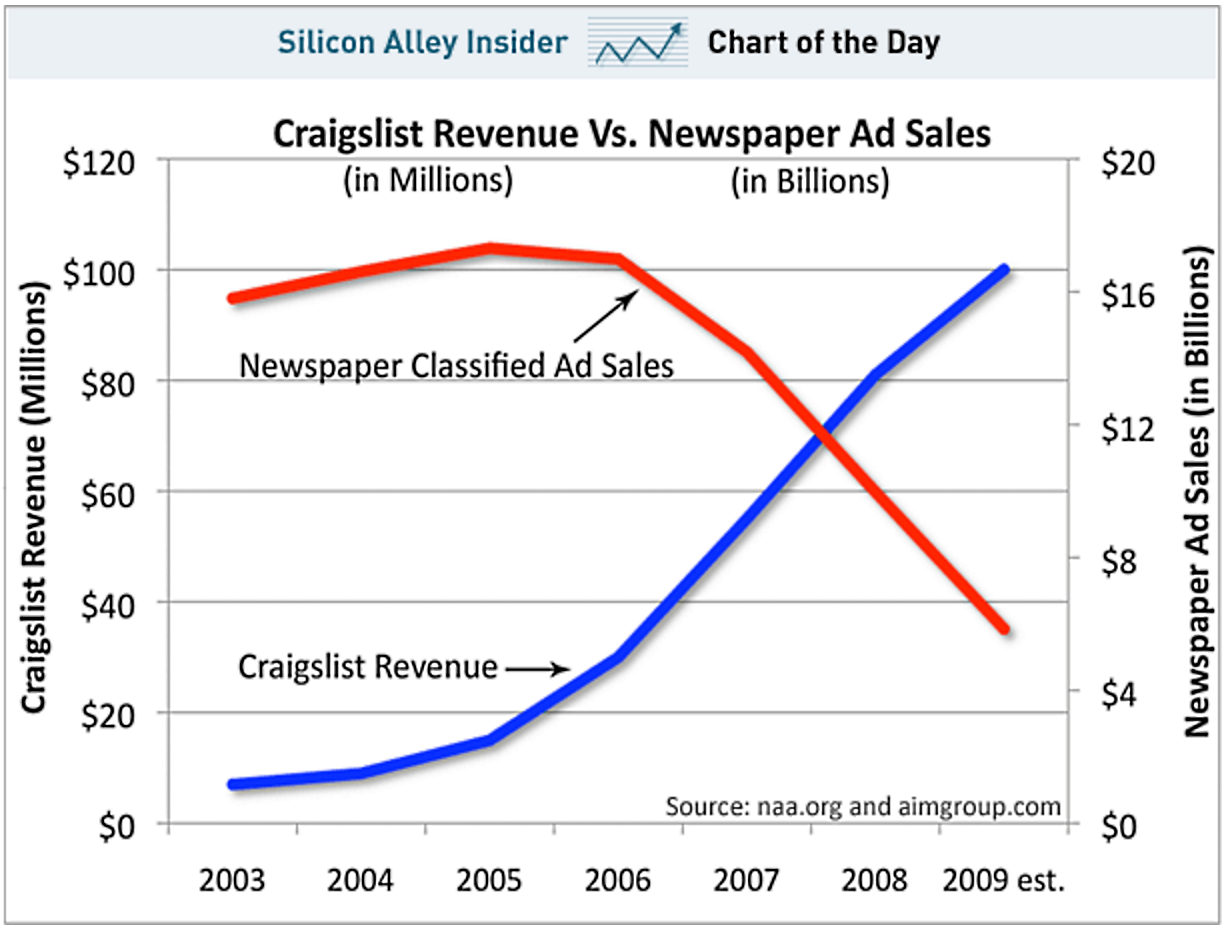
US papers employed 56,900 full-time journalists in 1990, the year Tim Berners Lee began testing his World Wide Web software, and they employed 32,900 in 2015. The disruption of the newspaper business began 22 years ago, when Craig Newmark launched his classified ad site, Craigslist. (Note that Newmark now generously supports investigative journalism and fact-checking organizations). Newspapers have adapted to the Internet by adding digital editions, but they generate less ad revenue than print editions have lost.

Thomas Jefferson and a lot of other smart people believed that democracy requires a free press. (See these quotes). If we agree with Jefferson, et al, that investigative journalism and fact-checking are important facilitators of democracy, can the Internet at least help keep organizations like newspapers alive?

At least one newspaper seems to be OK -- can we learn from it?

I was in Singapore a few weeks ago and picked up a copy of the 2/1/17 edition their major, English language newspaper, the Straits Times. I was impressed -- the paper was physically large, every page had color and the price was only S1.1, about 78 US cents. When I got home, I compared it to a 2/22/17 copy of my home town newspaper, the Los Angeles times, which sells for $2. (Both were Wednesday editions).

Number of pages in each section
The pages of the Strait's Times were 27 percent larger than those of the LA Times (which shrunk after it was purchased by Tribune Publishing in 2000) and there were more of them, as you see here. And what about those "dead" classified ads? The Straits Times had 16 pages of classifieds and the LA Times only 2/3 of a page at the end of the Sports section.

Why does the newspaper business in Singapore seem to be thriving, while US newspapers are having a hard time?

It's not the market size. The population of Singapore is about 5.6 million, the poulation of Los Angles is about 4 million and greater Los Angeles is about 10.2 million.

It's not economies of scale. In August 2016, the Straits Times had a daily print circulation of 277,100 and 116,200 digital. The LA Times media kit says their weekday circulation is 690,870 and it's 955,319 on Sunday.

The Straits Times is not a local paper -- they have 16 bureaus and special correspondents in major cities worldwide. (Both of the stories that were "above the fold" on the front page of the edition I picked up were about US politics).

Maybe there is no Craigslist in Singapore -- but there is.

The government role

Singapore's fast, affordable Internet connectivity makes the digital edition of the Straits Times attractive. There are five competing ISPs and most of the country is covered by fiber as well as copper. A 1 gb/s account will set you back S$49.99 per month if you sign a two year contract or S$59.99 without a contract. For two gig, you pay $69.99 with a two year contract. The slowest offering is 100 mb/s. (Singapore dollars are around 71 US cents).

The Singapore government deserves a good deal of credit for their Internet service. In 2000, I worked on a study of the Singapore Internet and, with the help of my nephew who was with Goldman Sachs in Singapore, developed this figure:

Singapore, Inc.

As you see, the government had equity positions in the ISPs and an indirect link to Singapore Press Holdings, a media conglomerate that owns the Straits Times. The government provides wholesale backbone connectivity to those competing retail ISPs. (Other cities, notably Stockholm, have followed a similar strategy and Google has done so in Africa).

Competition is the key to the success of the Internet in Singapore and, while the current US administration claims to like free markets, moves to weaken net neutrality, set-top box standards and municpal wholesale networks strike me as anti-competitive. (Also, see this interview of outgoing FCC Chairman, Tom Wheeler).

The Singapore government plays an important role in the economy, doing strategic economic and educational planning and they have invested in the oil, shipping, finance, media, Internet and biotech industries since World War II. I am not advocating a Singapore model for the US, but neither should we ignore possible steps local and national government can take to increase competition in the Internet service market.

The Straits Times benefits from the strong Singapore Internet, but I suspect the government also offers direct or indirect subsidy. I understand that we don't want the government to control our press, although there is considerable precedent for US government support of broadcast and print media. That being said, the current US administration will doubtless do its best to eliminate what little federal support remains.

But, since Republicans favor free markets and decentralized choice when it comes to health care, energy and schools, why not the press? How about media vouchers for voting age adults? Individuals would be free to allocate their media subsidy as they see fit -- to the New York Times or Breitbart, NPR or Rush Limbaugh. Milton Friedman might have even gone for that.

Thursday, October 13, 2016

The government role in shaping the Internet in China and the US

The US government invested $124.5 million in building and demonstrating the feasibility and value of the ARPANet, TCP/IP internetworking protocol and subsequent deployment to education and research organizations with the establishment of NSFNet and the NSF developing nations program. That was a pretty good investment. (Government procurement was also important -- for example, lessons learned and programmers trained in building the SAGE early warning defense system played a key role in the progress of networking and computer science in the US).

Internet development timeline


NSFNet was at first the backbone for the international Internet, but the government stepped back once the initial research and development was completed, phasing out the NSFNet subsidies over a four year period. Private telephone and cable companies with local monopolies or oligopolies became Internet service providers and owners of our Internet infrastructure.

In contrast, the market for Internet applications and services was competitive from the start. Private capital has financed and developed our Internet startups and ecosystems of organizations to support them -- incubators, accelerators, co-working spaces, investors, consultants and hackerspaces. The first startup ecosystems were in the Silicon Valley and along Massachusets Route 128, but many, including my home town, Los Angeles, have followed their lead.

1,113 tech startups in Los Angeles

535 startup support organizations

The Chinese have taken a different approach to Internet infrastructure. They established an academic network in 1987, linked it to Stanford University in 1993 and the following year established a full Internet connection. Like all other nations, they began with a slow link to a small academic network, but within a few years, the Chinese had realized the importance of the Internet and had established competing, government-owned national backbone networks.

Unlike the United States, the Chinese government is also playing an active role in support of Internet application and service companies. In his 2016 Report on the Work of the Government, Chinese premier Li Keqiang stated that
Further progress was made in implementing the strategy of innovation-driven development, the penetration of the Internet into all industries picked up the pace, and emerging industries grew rapidly.
The Chinese are funding startup ecosystem organizations like those created by the private sector in the US. For example, 710 subsidized startups are clustered in the Dream Town district of Hangzhou.

Chinese workers remodeling Dream Town spaces

How has it worked out?

The US had a significant lead over the entire world when a small Chinese academic network joined the Internet. One cannot directly compare the US and China -- there are many confounding differences, but we can compare China with India, a nation with some similarities. India's academic networks joined the Internet a little before China, but they essentially started at the same time. By 2002, the Chinese Internet was significantly more advance than that of India.

The International Telecommunication Union's Information and Communication Technology development index (IDI) provides a recent indicator of Chinese progress. The IDI is a function of eleven indicators measuring ICT access, use and skills in a nation. In 2015, China ranked 82nd on the IDI while India ranked 131st. In 2010, China ranked 87th and India ranked 125th.

While China has done better than India to date, their economy is slowing and their program of support for startups can lead to misallocation of resources and cronyism -- as happened in the Chinese construction industry:


The US started at the top, so our infrastructure had no where to go but down relative to other nations. The US ranks 21st in fiber deployment among the 34 OECD nations and our average Internet connection speed ranks 15th among the 74 nations served by Akamai.

Percent of broadband connections with fiber,
OECD, December 2015

Connection speeds, Akamai, Q1 2016

While the US has faltered in infrastructure deployment, we have retained the lead in Internet applications and services. As shown here, the US had 39 of the most popular 100 Web sites as ranked by Alexa in September 2016 while China had only 10.

These rankings should be taken with a grain of salt – SimilarWeb, an Israeli company, rates the US substantially higher with 40 sites in the top 100 as opposed to 10 for China. Chinese sites also focus heavily on China whereas the US sites generally seek a global audience.

It seems that the US private sector has done well in Internet applications and services and not as well in deploying infrastructure. Private companies seek to maximize corporate profit rather than social goals regarding education, the economy, etc. This has contributed to other nations surpassing our infrastructure in spite of our pioneering role.

These are complex issues and I cannot reach definite, generalizable conclusions (nor can anyone else), but, if I had to guess, I would think that China would be better off cutting back on subsidies for Internet application and service companies and the US would be better off with a more competitive Internet service provider market -- discouraging consolidation and "gentleman's agreements" among companies and encouraging ownership of infrastructure by local governments and customers.

-----
Update 10/16/2016

For teachers or others who might like to present this topic, I have prepared (and used) a nine-slide, one-video annotated PowerPoint presentation.


Thursday, January 29, 2015

Regulation of global satellite Internet service providers

Would global Internet service providers require unique regulation and, if so, what should it be and who has the power to do it?

SpaceX CEO Elon Musk, who hopes to orbit a constellation of Internet-access satellites, recently gave an invitation-only talk announcing the opening of a satellite-design office in Seattle. (An attendee recorded the talk and posted it on YouTube).

Many invitees were engineers and Musk was recruiting, saying "it's a difficult problem so we need the smartest engineers in the world." Then, he joked "and at the same time to make sure we don't create SkyNet."

The audience laughed, but he was, perhaps inadvertently, alluding to a serious issue. Issac Asimov wrote of Gaia, a sentient planet, and, while the Internet may be the embryonic nervous system of our planet, I am less worried about Musk creating SkyNet than creating Comcast on Steroids.

Two companies, Musk's SpaceX and Greg Wyler's OneWeb, are competing to provide Internet connectivity in locations that are now unconnected -- as Wyler puts it, to connect "the other three billion." If one or both succeed, we might have have a monopoly or oligopoly ISP serving half the Earth's population.

As a Time-Warner Cable Internet customer, that worries me. They would be able to charge monopoly-level prices and offer the same last-place customer satisfaction as American ISPs. They would be global companies with political power and the ability to control half the world's information -- a combination of the Koch brothers, Fox News and Comcast.

Do these potentially global service providers require unique regulation and, if so, what should it be and who has the power to do it?

What might the regulation be? I can ask the question, but neither I nor anyone else knows The Answer; however, one suggestion is to keep both SpaceX and OneWeb out of the retail Internet service market -- restrict them to providing wholesale transport service on an equal basis to any would-be retail ISP. Even if only one of the two companies succeed, that would allow for retail competition and would help out with the monopoly price and crummy service issues.

A possible approach to avoiding political abuse would be to prohibit them from refusing service to any retail ISP in any nation.

Regardless of what we wish to do, who has the authority to create and enforce such regulations? Musk said SpaceX has the ITU's permission to launch the satellites and recognized that he will have to negotiate for the right to provide service on a country by country basis. SpaceX and OneWeb are both US corporations and therefore subject to US law, but is it right for global infrastructure to be regulated by a single nation?

Lest this sound too negative, I hope SpaceX and OneWeb both succeed in connecting the other three billion people on the planet -- the benefit to mankind will outweigh the difficulty of defining acceptable, effective policy.

Update 1/31/2015

Jason Koebler compares Elon Musk to the 19th century railroad barons, saying that being the first to develop technology to soft-land and reuse rockets will give him an unassailable first-mover advantage in space -- for imaging, communication and other applications.


Elon Musk with President Obama

Thursday, October 16, 2014

Nobel laureate Jean Tirole's lessons for Internet industries

I am not a game theorist or an economist, but it seems that the work of economics Nobel Prize winner Jean Tirole has two Internet industry applications, one regarding two (or more) sided markets, the other in regulation of monopolies and oligopolies.

Two sided markets

The iPhone is a product for consumers and a platform
for developers. The optimal price is not obvious.

The Apple iPhone is an example of a product with a two-sided market -- they sell iPhones to end users and also profit from app sales by developers. In Econ 101 we learned that a company maximizes profit by setting a price at the point where marginal cost = marginal revenue. But, that is too simple because the iPhone is both a consumer product and a developer platform.

Apple wants to attract application developers as well as sell iPhones and the more iPhones they sell, the more attractive the platform is to developers. More developers means more apps, which means more revenue for Apple and it also makes the iPhone more attractive to end users. So, the optimal price for an iPhone is not the point at which marginal cost = marginal revenue, but something lower.

Google's pricing provides an extreme example. They supply search and other services to end users and they sell advertising. The more services they supply, the more they learn about users and the more valuable they are to advertisers. This has led them to an edge case -- they price their consumer services at zero, relying solely on revenue from advertisers.

On the other hand, they charge businesses $50 per user per year for Google Apps for Work ($120 with unlimited cloud storage). The business services have a few extra management features, but the marginal cost for a new user is essentially the same. Why the price difference? Business users can turn off ads and Google does not scan their email to learn about them. It is a one-sided market.

How about Google apps for education? There are no adds, but the service is free. Why does Google give schools a break? Students who are used to Gmail and Google Drive applications will tend to use them after they graduate, generating long run profit for Google. (They did not need a Nobel Prize for that one -- when I worked for IBM we gave universities an 80% discount on computers in order to get students used to IBM equipment and systems).

Tirole and co-author Jean-Charles Rochet give many more Internet-related examples of two-sided markets in this paper, (There is some beyond-me math in the paper, but the mini case studies near the end are straight forward).

Monopolies and oligopolies

US ISPs like Comcast are able to charge content providers
delivery fees and set high high prices for end users.

In awarding the prize, The Royal Swedish Academy of Sciences cited Tirole for clarifying "how to understand and regulate industries with a few powerful firms." Well, that sounds a lot like the network industry.

We have two regulatory conundrums in the US. The first has to do with consumer prices. The incumbent telephone and cable TV companies own the "last mile" infrastructure connecting homes and offices to the Internet, enabling them to set high prices for end users. The second is getting network operators to invest in infrastructure.

Let's consider investment infrastructure first. Joshua Gans, a professor of strategic management at the University of Toronto with close ties to Tirole notes that end-to-end connectivity requires cooperation between competing firms like Netflix and Comcast, but "if you leave firms to come up with the terms of the cooperation themselves, they are going to find a way to remove the competitive parts as well."

Gans says Tirole solved that problem "with a set of rules and practices that would regulate interconnection terms amongst telecommunications companies for decades while ensuring there were adequate incentives to compete — and not just on price — but on investment in infrastructure." His advice to US regulators: "open one of Tirole’s books; it is time you listened."

How about the consumer price problem? Gans says:
The issue in telecoms arises with what is termed the last-mile problem. You only have one set of cables or copper coming into your house. The solution adopted around the world has been to say, okay, one firm owns this cable, but what they have to do is provide access to these cables. So If I want another firm to provide me with TV or Internet, they have to allow that firm to effectively rent the cable from the other firm.
That strategy worked well in the Netherlands, according to Ad Scheepbouwer, CEO of the Dutch telephone company KPN:
In hindsight, KPN made a mistake back in 1996. We were not too enthusiastic to be forced to allow competitors on our old wireline network. That turned out not to be very wise. If you allow all your competitors on your network, all services will run on your network, and that results in the lowest cost possible per service. Which in turn attracts more customers for those services, so your network grows much faster. An open network is not charity from us, in the long run it simply works best for everybody.
But it failed in the US. Congress anticipated the same sort of infrastructure sharing when they passed the Telecommunication Act of 1996, but the incumbent operators were able to thwart that effort in courts, statehouses and local government.

This frustration was expressed by William Kennard, who, as chairman of the United States Federal Communication from 1997-2001, was charged with implementing the Telecommunications Act. Near the end of his term he said “all too often companies work to change the regulations, instead of working to change the market,” and spoke of “regulatory capitalism” in which “companies invest in lawyers, lobbyists, and politicians, instead of plant, people and customer service.” He went on to remark that regulation is “too often used as a shield, to protect the status quo from new competition -- often in the form of smaller, hungrier competitors -- and too infrequently as a sword -- to cut a pathway for new competitors to compete by creating new networks and services.”

If regulators are not able to get ISPs to share their infrastructure, there is another alternative -- government ownership of infrastructure. While the US cable and telephone companies have fought vigorously against municipal networks, they have worked well in other places, like Stockholm, where the municipal government provides wholesale infrastructure and invites retail ISPs to compete. (It is noteworthy here that FCC Chairman Tom Wheeler says he wants to invalidate state laws prohibiting local governments from providing Internet connectivity).

In a column on Tirole's contributions, fellow economics laureate Paul Krugman says that Tirole recognized that there are no comprehensive theories of oligopoly and monopoly and
Basically, [Tirole] made it OK to tell stories rather than proving theorems, and thereby made it possible to talk about and model issues that had been ruled out by the limits of perfect competition. It was, I can tell you from experience, profoundly liberating.
My guess is that the executives at companies like Apple and Google were dealing in stories, like the ones described above, without reading Tirole. Thinking about and elaborating on the story had more to do with Apple's iPhone pricing than the results of a game theoretic model. It also sounds like economists like Krugman and European regulators took Gans' advice -- they read Tirole's books.

Monday, August 25, 2014

Mobile service in the UK is cheaper than in the US

Minh Uong
New York Times
We've looked at the bad deal US landline Internet users get compared to places like Korea, Sweden, Japan or Latvia. (The list could be longer). How about mobile connectivity?

The New York Times just published a short article comparing the price charged by UK Cellular company UK Three (UK3) to that of Verizon in the US. The article compared prices for a two year contract with a subsidised Apple 5s phone.

UK3's price in this example is over $40 less than Verizon's. Furthermore, UK3 allows unlimited data transfer while Verizon has a 2 GB per month usage cap. Since UK3 is a low-cost carrier, I checked the prices of Vodafone accounts in the UK. A 3G Vodafone account with a 2 GB cap costs $72.31 per month. A 4G plan with a 4 GB cap is $79.60.

The author of the post cites one significant difference in explaining the price differences between the two nations:
Britain has forced companies to lease their networks to competitors at cost. The United States has not, allowing a formidable barrier against competitors.
The US Congress tried to spur competition in a similar manner with the Telecommunication Act of 1996, but the incumbent operators and their lobbyists defeated that attempt in courts and state houses.

William Kennard, who, as chairman of the United States Federal Communication from 1997-2001, was charged with implementing the Telecommunications Act, stated near the end of his term that “all too often companies work to change the regulations, instead of working to change the market,” and spoke of “regulatory capitalism” in which “companies invest in lawyers, lobbyists and politicians, instead of plant, people and customer service.” He went on to remark that regulation is “too often used as a shield, to protect the status quo from new competition -- often in the form of smaller, hungrier competitors -- and too infrequently as a sword -- to cut a pathway for new competitors to compete by creating new networks and services.”


Thursday, June 26, 2014

Stockholm: 19 years of municipal broadband success

The Stokab report should be required reading for all local government officials.

Stockholm is one of the top Internet cities in the world -- how do they do it? Wholesale communication infrastructure in Stockholm is provided by AB Stokab, which is owned by the Stockholm City Council. Stokab leases dark fiber and space in nodes/hubs where customers can install communication equipment and interconnect networks since 1994. Stokab's goal has been to build a competition-neutral infrastructure capable of meeting future communication needs, spurring economic activity, insuring diversity and freedom of choice and minimizing disruption to the city’s streets.

How has it worked out?

Quite well, as you see in the following figure, taken from Stokab's report on the socio-economic cost and benefit of the project:

Accumulated investments and socio-economic
return in million Swedish Kronor.

The returns shown here reflect increased property value, returns of the municipal housing companies (currently breakeven, due to large investments), value for tenants, increased employment, Stokab’s profit, saving for the municipality’s and county’s data and IT costs, and increased economic activity in the supplier industry. To drill down into the details, see the Stokab report summary or the full Stokab report.

The Swedish Telecommunication regulator published a report calling for openness and competition at five Internet service infrastructure levels -- from physical access to land, ducts and spectrum through retail Internet service -- based on the Stockholm experience.


A lesson for the US?

The US needs infrastructure investment -- who will make it? The telephone and cable companies were given a chance, and they've dropped the ball. The Stockholm experience shows the role local government can play. National government's have also been important. The US Federal Government underwrote the research that gave us the Internet and governments like those of Singapore or China have worked as planners and venture capitalists. Home and building owners can also contribute to "last 100 yard" investment.

Singapore's government acts as a planner and venture capitalist.

Given the current US Congress, it is hard to imagine the Federal Government investing in Internet infrastructure, but FCC Chairman Tom Wheeler has praised municipal broadband efforts, wants to fight state laws prohibiting or restricting them and he is currently challenging Tennessee's anti-municipal net law.

In spite of the fact that Wheeler came from the ISP industry, you have to like a guy who says:
If the people, acting through their elected local governments, want to pursue competitive community broadband, they shouldn't be stopped by state laws promoted by cable and telephone companies that don't want that competition.
The situation in the US will not change until the Internet becomes a political issue for the general public and that may be happening -- check out comedian John Oliver's piece on the Internet. Wheeler watched Oliver's piece and responded -- check that out too -- it's funny!

ISP industry lobbyists claim that government involvement interferes with The Market, leading to waste and inefficiency, but in Stockholm, the municipal government has created a competitive market. This story is biased because we can't expect every local government to be as skillful as Stockholm's, but their example is worth considering.

Wednesday, April 09, 2014

My son pays $30/month for symmetric, 100 Mbps Internet service ... in South Korea

My son lives in a relatively small city about 50 miles from Seoul.

He has a choice of three major Internet providers -- their monthly list prices for symmetric 100 Mbps Internet connectivity are as follows:

KT Corp: 31,680 ₩
SK Broadband: 33,000 ₩
LG Corp: 31,350 ₩
1,000 won is just under one dollar – about 96 cents, so, they are all around $30 per month.

Here is a copy of his latest bill from SK Broadband:


The top line is his charge for the month. (The second line shows the balance due from the previous month).

The charge is 35,000 ₩ (I guess there are some taxes), but he has a 13,000 ₩ discount because he signed a two year contract. With that contract he is paying about $22 per month for 100 Mbps connectivity.

How does that compare to your Internet service bill and speed?

How about customer service? Here is a quote from a comparative review of South Korean ISPs:
As mentioned earlier of fierce competition between a much-similar service providers, they will dispatch a repairman within a few hours of your call, even on WeekEnd!
How is it that Korea has achieved intense ISP competition? There is no simple answer, but the government has pursued a multifaceted policy encouraging investment and demand creation and providing common infrastructure, which is used by compteting ISPs (as in Singapore, Sweden or Latvia)

By contrast, we have little ISP competition in the U. S., leaving customers in a weak position -- dealing with non-competitve providers of a necessary service.

-----
Update 4/11/2014

My son saw this post and offered a couple of corrections. He sent me prices for the three major ISPs he can choose from, but says there are a number of smaller ones -- he said I understated the level of competition. He also said that the difference between his bill and the list price I quoted was not due to taxes, but the fact that the list price comparison he sent me was from a blog post and may not have been current. His list price is 35,000 ₩, not 33,000 ₩, but the general point remains true.

Monday, February 24, 2014

Comcast is probably not cheating ... yet

Within the last few days, Comcast agreed to purchase Time Warner Cable and Netflix agreed to pay Comcast for direct access to their network. Will Netflix pass the Comcast payments along to us consumers? Will we get better quality and fewer pauses for buffering? Is this the end of network neutrality regardless of anything the FCC might do to restore it? Is this the beginning of the end for the good old Internet we have grown to love?

Maybe not.

It is true that Netflix will be paying Comcast for direct access to their network, but they will save what they had previously been paying intermeidate transit networks like Cogent. The overall cost to Netflix may be more, less or the same -- terms of the deal have not been disclosed. Don't get me wrong -- I doubt that they will be saving money, and, if they do, I am sure they will not pass the savings on to us consumers.

How about speed increases? Netflix has acknowledged performance problems, and this deal should help. It is practically certain that we will see improved performance, even if the blockage was done on purpose. (Hey, that was some good news).

This may not even be a violation of network neutrality. Couldn't the delays have been due to capacity problems of intermediate networks rather than Comcast? Is there evidence that Comcast was dropping or delaying Netflix packets? This is not to say that Comcast was not discriminating against Netflix traffic or that they may not in the future, but, as far as I know, there is no evidence that they did. (Where is Edward Snowden when you need him)?

Don't get me wrong -- I have nothing good to say about my ISP -- Time Warner Cable -- and I am confident that the situation will be even worse if the Comcast deal is approved. That sort of concentrated power cannot be good for anyone except those who have it.

Timothy Lee points out that one result of that concentration may be the elimination of the transit ISPs like Cogent, who are in a competitive market. Comcast and other companies that connect consumers face little or no competition.

GigaOm's Stacey Higginbotham has suggested that transparency -- opening the terms of these deals to public scrutiny -- might be a solution, but I am skeptical.

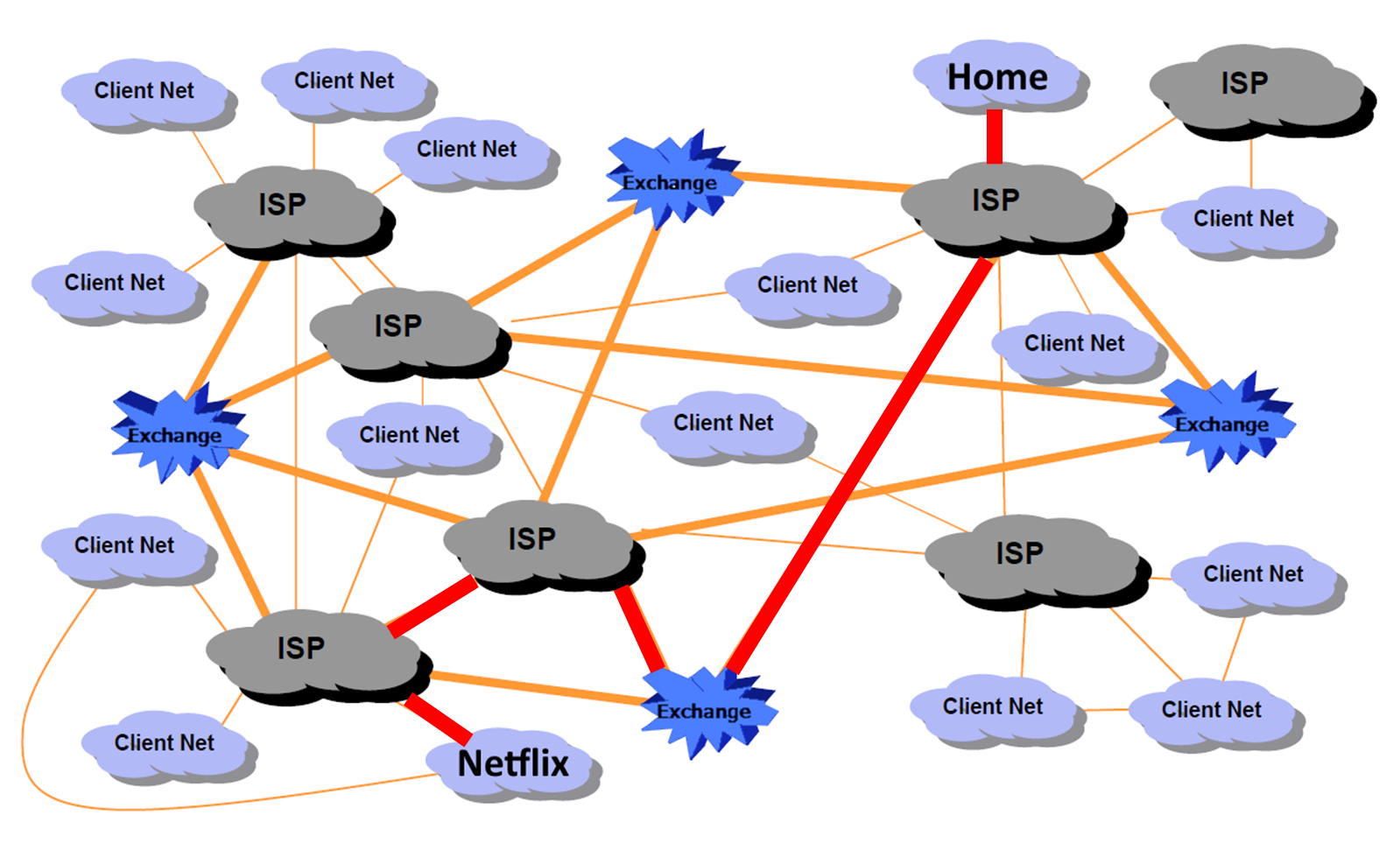
The following images show the route between one's home and Netflix before the agreement with Comcast, the way it is now that the deal has been done and the way it will end up if Comcast has their way.

Before the agreement, transit ISPs connected us to Netflix servers.
Now our ISPs connect us straight to Comcast.
After the merger, Comcast will be my ISP.

Saturday, February 22, 2014

Google may give us some ISP competition

Just after we heard the competition-reducing news of Comcast buying Time Warner Cable, Google has announced that they may become a competitor in the ISP market -- they are evaluating 34 cities in 9 metropolitan areas as potential Google Fiber installations.

This is not a complete surprise. A Google executive announced their intention to expand last year, stating that Google Fiber is "a great business to be in."

Google is evaluating nine metropolitan areas, but none are big like New York or Chicago. I know a large installation would be daunting, but it would also be a learning experience and at least one big city mayor, Eric Garcetti in Los Angeles, is looking for a fiber partner.

(Full disclosure on that last "hint" for Google -- I live in Los Angeles, and my chance for getting fiber dropped to zero when my phone company, Verizon, decided to get out of that business).

Friday, January 31, 2014

Cable companies back bill to prohibit municipal broadband in Kansas -- the same old story

Google Fiber started in Kansas City Missouri, but it has spread to nearby communities in Kansas and there has been speculation that it might expand nation wide. Olathe, Kansas is to be the first Google Fiber community in Kansas.

Well, the cable companies don't like that so they have introduced a bill in the Kansas Legislature to prohibit cities from offering or partnering to offer Internet service.

The bill is called the "Municipal Communications Network and Private Telecommunications Investment Safeguards Act." Opponents suggest that it should have been called the "Incumbent Telecommunications Company Protection Act."

Congress attempted to create competition with the 1996 Telecommunications Act. This is just the latest in endless court and legislative battles waged by incumbent phone and cable companies to thwart the will of Congress and stifle competition.

(I worked on a municipal network in Hermosa Beach, California that was stopped in 2006 by pressure the local cable company put on the City Council).
-----

Update 2/4/2014

Hearings on community broadband services bill have been postponed (http://bit.ly/1brRTCU). It sounds like they are getting some negative feedback, as well they should.

Wednesday, November 13, 2013

Los Angeles to request city-wide fiber proposals

Ars Technica reports that the City of Los Angeles plans to issue a request for proposals (RFP) to bring fiber connectivity to every resident. The RFP is not out yet, but it sounds as though they are not looking for a retail Interent service provider, but for open infrastructure which competitors could use to offer Internet service.

The article is vague, but it seems the city envisions an open network with wholesale pricing for any one who wants to compete as a retail Internet service provider. That is reminiscent of the successful approach taken in Stockholm.

But it is also reminiscent of the thwarted desire of Congress in passing the Telecommunication Act of 1996 in the United States. The incumbent telephone and cable companies used the courts, lobbying and claims of limited facilites to kill the would-be competion.

The rumored RFP has characteristics of Google Fiber, like free or ad supported low speed connectivity for all, tiered pricing for high speed Internet, television and telephone and free or subsidized connectivity to non-profits. On the other hand, Los Angeles is said to seek business access, which Google does not allow.

Speaking of Google Fiber, they may very well have plans to go nation wide -- might they be a bidder in Los Angeles?

The article says the RFP has the support of recently elected council member Bob Blumenfield and new mayor Eric Garcetti.

I live in Los Angeles, and long ago gave up hope that Verizon would deliver their fiber service, FIOS, to my neighborhood, so am stuck with only one viable Internet service provider. (Yes, it's a monopoly). I would love to see something come of this, but seeing is believing.

-----
Update 7/22/2014

The city has received 34 responses to its request for information (RFI). They came from city departments as well as private companies, including my current monopoly ISP Time-Warner Cable and an optimistic report from Angie Communications, a Dutch company. The city will now take these RFIs into account in drafting a request for proposals.

Tuesday, July 16, 2013

Vint Cerf -- a concise history of packets, the ARPAnet and the Internet

Conceptual sketch of the ARPAnet by Larry Roberts
If you are interested in the history of the Internet and only have 16 minutes to spare, watch this interview of Vint Cerf, who was one of the handful of people that created the Internet.

Cerf's narrative begins with the idea of packet switched communication and runs through the creation of the ARPAnet, followed by the invention of internetworking protocols to link three disparate networks -- the ARPAnet, a mobile communication network and a satellite communication network.

This short video is like an annotated table of contents of the early history of the Internet. Cerf introduces us to Leonard Kleinrock, Paul Baran, Donald Davies, Larry Roberts, Thomas Marill, J. C. R. Licklider, Doug Engelbart, Norman Abramson, Robert Taylor, Charles Herzfeld, Steve Crocker, Jon Postel, Bob Kahn, David Reed, Danny Cohen and Bill Joy, summarizing the work of each and putting it in context.

Whether this is all you want to know about the history of the Internet or you want to use it as a jumping off place to learn more about the contributions of these people, this is a good place to start.

Cerf also conveys a sense of common purpose among those pioneers. He does not say so, but one can think of them as working together to realize Licklider's vision of a network running Engelbart's applications. Cerf makes it clear that, although they worked for several different organizations and changed jobs from time to time, these people knew each other well and collaborated closely on creating the Internet. (For example, Cerf, Postel and Crocker went to the same high school and studied under Kleinrock as graduate students at UCLA). The group also had an excellent collaboration tool -- they were the first users of the networks they built.

The ARPA/Internet project was a great example of government as a non-equity angel investor -- providing a small bit of seed funding ($124 million) to a group of smart, dedicated people, rather than setting up a department to do the work internally.

Charles Severance of IEEE Computer Magazine conducted the interview of Cerf, and it is one in a series of computing conversations.

Monday, June 24, 2013

The importance of government research

Blumeberg columnist Mark Buchanan has written an article with the catchy title Who Created the IPhone, Apple or the Government?, in which he argues that government sponsored research has played a major role in the invention of the iPhone and much more.

I wrote a recent post about Presidential science initiatives, including several by President Obama, and have written articles on the role of government sponsored research in developing the personal computer and the Internet:
  • Before the Altair: the history of personal computing, CACM 1993
  • Seeding networks: the federal role, CACM 1996
I also compiled a bibliography of early contributions in:
  • The precursors of personal computing, ACM SIGSMALL/PC Notes, 1988
To retrieve these articles click here and scroll down to or search for the titles.

-----

Update 7/1/2013

In a provocative blog post, Lee Vinsel asks what new technologies might come out of the NSA surveillance activity.  Will we get innovative new technologies or are they just using established techniques of big data mining and server farms? Also -- if there are new technologies, will they belong to the US people or to contractors like Booz Hamilton, which hired Edward Snowden?

This leads me to wonder whether the increasing reliance of government at all levels on contractors will diminish socially shared innovation.

Saturday, June 15, 2013

Executive order directs sharing of Federal spectrum within ten years

Citizen surveillance has been headline news for several days, but something just happened under the radar that may be more important in the long run. The President issued an executive order with a list of actions to be taken by federal agencies and offices to "accelerate shared access to spectrum."

This did not happen over night -- it was preceded by a couple years of research and politicking -- here are two key milestones:If you are interested in this topic, you should check the executive order and the post announcing it. We are venturing into new political and technical territory here, and The President has also authorized $100 million to fund research on spectrum sharing.

No doubt AT&T et al will do their best to thwart this effort as they were able to derail the attempt to create competition by way of the 1996 Telecommunication Act. They may win this battle too, but if they don't, we may be using some interesting technology within the next decade.