Showing posts with label citizen journalism. Show all posts

Thursday, January 05, 2017

History is written and revised by the winners -- can the Internet Archive change that?

Kremvax during the Soviet coup attempt
I was naively optimistic in the early days of the Internet, assuming that it would enhance democracy while providing "big data" for historians. My first taste of that came during the Soviet coup attempt of 1991 when I worked with colleagues to create an archive of the network traffic in, out and within the Soviet Union. That traffic flowed through a computer called "Kremvax," operated by RELCOM, a Russian software company.

The content of that archive was not generated by the government or the establishment media -- it was citizen journalism, the collective work of independent observers and participants stored on a server at a university. What could go wrong with that?

Mumbai terrorist attack
The advent of the Web and Wikipedia fed my optimism. For example, when terrorists attacked various locations in Mumbai, India in 2008, citizen journalists inside and outside the hotels that were under attack began posting accounts. The Wikipedia topic began with two sentences:
The 28 November 2008 Mumbai terrorist attacks were a series of attacks by terrorists in Mumbai, India. 25 are injured and 2 killed.
In less than 22 hours, 242 people had edited the page 942 times expanding it to 4,780 words organized into six major headings with five subheadings. (Today it is over 130,000 bytes, revisions continue and it is still viewed over 2,000 times per month). What could go wrong with that?

The Arab Spring
The 2011 Arab Spring was also seen as a demonstration of the power of the Internet as a democratic tool and repository of history. What could go wrong with that?

What went wrong

The problem is that the Internet turned out to be a tool of governments and terrorists as well as citizens. Furthermore, historical archives can disappear or, worse yet, be changed to reflect the view of the "winner."

Our Soviet Coup archive was set up on a server at the State University of New York, Oswego, by professor Dave Bozack. What will happen to it when he retires?

If someone tried to delete or significantly alter the Wikipedia page on the Mumbai attack, they might be thwarted by one of the volunteers who has signed up to be "page watchers" -- people who are notified whenever the page they are watching is edited. We saw a reassuring demonstration of the rapid correction of vandalism in a podcast by Jon Udell. That was cool, but does it scale? Volunteers burn out. The page on the Mumbai attacks has 358 page watchers, but only 32 have visited the page after recent edits.

Even if a Wikipedia page remains intact, links to references and supporting material will eventually break -- "link rot." If our Soviet Coup archive disappears after Dave's retirement, all the links to it will break.

By the time of the Arab Spring, we were well aware of our earlier naivete -- the Internet was already being used for terrorism and government cyberwar and the dream of providing raw data for future historians and political scientists was fading.

The Internet Archive

Soviet coup archive from Internet Archive
I was slow to understand the fragility of the Internet, but others saw it early -- most importantly, Brewster Kahle, who, in 1996, established the Internet Archive to cache Web pages and preserve them against deletion or modification. They have been at it for 20 years now and have a massive online repository of books, music, software, educational material, and, of course, Web sites, including our Soviet Coup archive. As shown here, it has been archived 50 times since October 3, 2002 and it will be online long after Dave retires -- as long as the Internet Archive is online.

Khale understands that saving static Web sites like the Soviet Coup archive only captures part of what is happening online today. Since the late 1990s, we have been able to add programs to Web sites, turning them into interactive services. As such, he has recently begun archiving virtual machine versions of interactive government services and databases.

Khale is understandably concerned by the election of Donald Trump, who has demonstrated a keen ability to exploit the Internet and a disregard for truth. As such, he is raising money to create a backup copy of the Interent Archive in Canada and working to archive US Government Web sites and services.

The Internet is inconceivably large and growing exponentially. There is no way the Internet Archive can capture all of it, but it is the leading Internet-preservation organization today. Khale and his staff will continue their work and will inspire and collaborate with other relatively specialized efforts like that of climate scientists who are working to preserve government climate-science research results, data and services.

For more on the Internet Archive check out the following PBS News Hour segment (9m 12s):


You can read the transcript here.

I'd also recommend listening to this short (5m 14s) podcast interview of Brewster Kahle. He describes the End of Term project -- a collaborative effort to record US government (.gov and .mil) Web sites and services when a new administration takes over. He describes deletions and modifications from 2008 and 2012 and feels a special urgency today for obvious reasons.

You can read a transcript of the interview here.

-----
Update 1/6/2017

The Internet Archive has launched the Trump Archive with 700+ televised speeches, interviews, debates, and other news broadcasts. Mention by a fact-checking site was the "signal" used for inclusion of a video and links to the fact-check document are included in a companion spreadsheet. I hope they use speech recognition to produce searchable transcripts as well.

Too bad we did not have Trump and Clinton archives during the campaign -- I hope we will have similar, timely archives in the future. One can even imagine similar archives for state and local campaigns if a crowd-sourcing system were developed.


-----
Update 1/7/2017

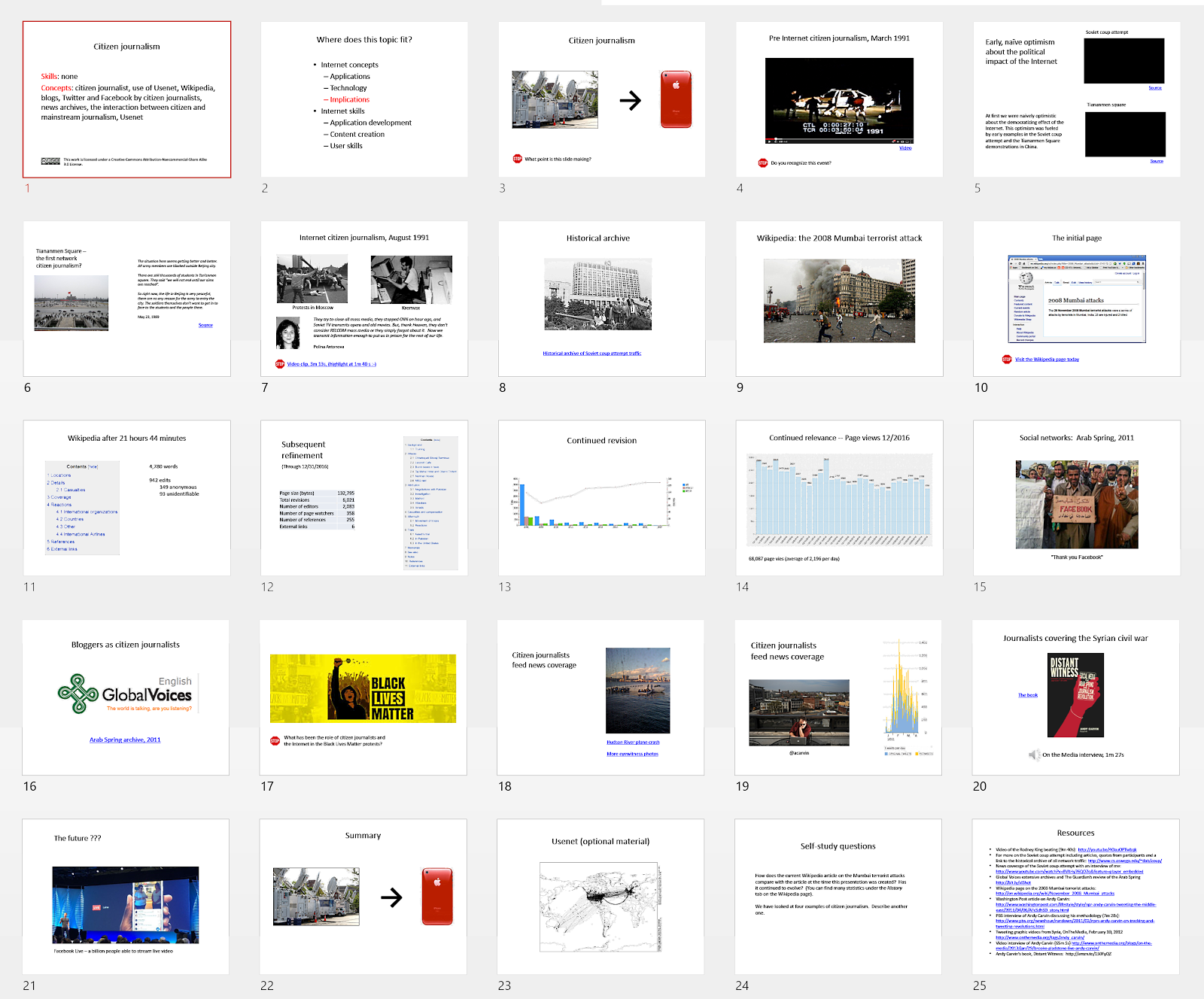
There is an annotated PowerPoint presentation on citizen journalism here. I use it in teaching an Internet literacy class and there is a note on my PowerPoint presentation style here.

-----
Update 2/5/2018

Speaker of the House Paul Ryan posted a clueless tweet bragging that the Republican tax-cut bill had saved a secretary at a public school $1.50 per week -- enough to cover her $60 Costco membership for the year. The tweet was soon deleted, but the Internet Archive had cached a Czech retweet:


Note that embarrassing news travels fast -- the day after the initial tweet, the Czech tweet had 954 retweets and 1,466 likes.

Note also that $1.50 per week will cover the secretary's $60 Costco membership with $18 to spare -- she can use that to cover the tax on her extra income.

Ryan is a more selective tweeter than Trump. For example, he did not Tweet anything when his fund-raising committee received a $500,000 campaign contribution from the Koch brothers shortly after the tax bill passed in the House.

-----
Update 7/17/2018

Yesterday, the Trump Administration shut down the National Guideline Clearinghouse, a database of medical guidelines that for nearly 20 years has been a critical resource for doctors, researchers and others in the medical community.

The shutdown was necessitated by budget cuts -- I guess they had to make a tough choice between paying for the database or Tom Price's charter flights.

The Internet Archive Wayback Machine archived the database on July 15, but that is a static copy that will not be updated.

The administration has also been removing the term "climate change" from Web sites and there have been several efforts to back up client-science data, for example this and this.

Monday, November 21, 2016

Teaching slides on the political impact of the Internet

I teach a class on the applications, technology and implications of the Internet and we begin each week with a discussion of current events relevant to the class. This semester many of those discussions have included material on the implications of the Internet for politics.

I've gone through my discussion slides for this term and put those that deal with the political impact of the Internet in a single, annotated PowerPoint file.

The slides focus on the current election, but also establish context by covering the use of then-new media in earlier elections, starting with radio, and other disappointing political uses of the Internet.

The slides are in chronological order as we have gone through the semester. If you are teaching a related class -- perhaps in political science -- you might find something useful. (I will continue adding new material -- suggestions welcome).


-----
Update 12/1/2016

I've added new slides dealing with the outing of fake news purveyors, truth versus freedom of speech, risk-limiting audits, a Stanford study of junior high, high school and college students reading of Internet news and the possibility that the Internet might become a "vast wasteland."

-----
Update 12/14/2016

I've added new slides dealing with National Security Advisor nominee General Mike Flynn's tweets concerning fake news. He later deleted one of the embarrassing tweets, but it had already been cached by the Internet archive.


-----
Update 12/17/2016

I've added slides dealing with General Flynn, European fake news, Tiananmen Square, the consequences of fake news, good journalism, Trump's continuing post-election lies and Facebook's effort to identify fake news.


-----
Update 12/20/2016

I've added slides on "Alt Right" gaming of Google search and Google's effort to thwart them.


-----
Update 12/21/2016

I've added new slides on "Alt Right" gaming of Google (and Bing) search, Google's effort to thwart them and a Pew Research survey on the public's view of fake news.


-----
Update 12/23/2016

I've added new slides on fantasy versus reality (examples from Trump and Bill Clinton) and whether they matter and Facebook's moves to combat fake news after first dismissing their role.


Update 12/27/2016

I've added new slides on the possibility of real-world consequences to fake news and Russian political hacking in Germany, Italy and the US.


-----
Update 1/6/2017

I've added new slides about the Panama Papers and what they reveal about Secretary of State nominee Rex Tillerson. (Collaborative analysis of the Panama Papers by journalists is a positive application of the Internet in politics).

The new slides are located here.

The cumulative slide deck is located here.


-----
Update 1/9/2017

I've added new slides tracing the impact of a single fake story on the Breitbart News Web site along with some background on Breitbart's Steve Bannon.

The new slides are located here.

The cumulative slide deck is located here.


-----
Update 1/16/2017

I've added new slides dealing with Trump's writing style on Twitter and his reaction to his briefing on Russian hacking by intelligence agencies. (His response also provides an illustration of his Twitter writing style.

The new slides are located here.

The cumulative slide deck is located here.


-----
Update 1/17/2017

I've added new slides dealing with Facebook's efforts to flag fake news in the US and Germany and possible fact-checking collaboration.

The new slides are located here.

The cumulative slide deck is located here.


-----
Update 1/19/2017

I've added new slides dealing with the Internet Archive and others in archiving Internet content that might be deleted or altered for political purposes.

The new slides are located here.

The cumulative slide deck is located here.


-----
Update 9/15/2017

The campaign is over and Trump is president, but I've gone back and added a couple of new slides -- one on Trump's continued lying and another on recent revelations about Facebook. They are part of a collection of lecture slides I used during the campaign. A subset used in another lecture may be found here. I've added the new slides to both decks.


Thursday, October 02, 2014

Dictators versus the Internet -- whack a mole

Since the time of the 1991 Soviet Coup attempt, dictators have played "whack a mole," trying to stem the flow of political information on the Internet during times of protest.

The Internet was a major factor during the Arab Spring and demonstrations in Turkey and Venezuela earlier this year.

Today, the Chinese government is censoring news about the pro-democracy protests in Hong Kong and the dissidents are finding new ways to communicate.

Chinese censors are also trying to erase news of the past, as we learned at the time of the 25th anniversary of the Tienanmen Square protests.

In the early days, we were optimistic that the Internet would end up a great force for democracy, but it is clear now that we were naive -- it is a tool used by both dictators and the people. Who gains the most?

_____
Update 10/6/2014

The Economist reports that the Chinese are censoring posts on Weibo at more than double the rate of censorship for the Tiananmen Square anniversary protests.

Increased censorship of the Hong Kong demonstrations

Relcom's "kremvax" relayed USENET news during the Soviet coup attempt.

Protesters used Facebook during the Arab Spring.

Turkish dissidents painted DNS server addresses on walls

Venezuelan protesters used the Zello walkie-talkie app.

The Chinese government is censoring news of today's Hong Kong protests.

Many Chinese are unaware of the 1989 Tiananmen Square protests


Sunday, March 23, 2014

Internet censorship is a cat and mouse game, and there are many mice

When the Turkish government decided to "obliterate" Twitter, they got a court order allowing them to delete the IP address corresponding to twitter.com from the domain name servers (DNS) used by Turkish ISPs. Twitter.com became an unknown host name.

But the DNS your ISP uses is not the only one on the Internet -- there are many. If you knew the IP address of an alternative DNS, you could continue accessing Twitter.

A few years ago, Google decided to run a DNS as a public service in order to improve Internet security and speed. Word quickly got out that one could change the DNS address supplied by their ISP to Google's: 8.8.8.8 or 8.8.4.4:


The government ploy may have worked a few years ago, but people are now more computer savvy and those who wished to continue using Twitter quickly switched to Google's public DNS.

The government countered by blocking traffic to/from Twitter's IP address, but Turks could circumvent that by using proxy servers, which hide the fact that they are communicating with Twitter.com:

As the government learns the IP addresses of the various proxy servers around the Internet, they can block them, but there are many available and new ones come online when old ones are discovered.

Twitter also posted a tweet showing how to post using SMS rather than the Internet:


This cat and mouse game has been going on since the time of the 1991 Soviet coup attempt, when the network operators abandoned their office for the anonymity of their laptops at home:


At that time, there were only a handful of citizen journalists; today there are millions.
-----
Update 3/24/2014

More on the ability of the Net to route around censorship.
-----
Update 3/26/2014

Turkey will hold municipal and regional elections on March 30, and Reporters without Borders just published a post on the “Toxic climate for media a week ahead of elections.” The post links to several other posts from this month and last. While focused primarily on television and print, the posts also address electronic media. Check, for example “Blocking of Twitter -- worthy of the most repressive regimes,” which offers a tutorial on four ways to remain in contact with Twitter.
-----
Update 3/30/2014

Turkey blocked YouTube after a recording of a top-secret military meeting was posted, but the recording has been copied to Dropbox and circulated online -- you can’t put the toothpaste back in the tube once its out. Their attempt to block Twitter earlier in the week resulted in silencing regime loyalists, but not critics. Twitter now has posts mocking the prime minister’s high voice and the failed attempt to block Twitter.
-----
Update 3/30/2014

The cat fights back -- the Turkish government has blocked access to Google's public DNS -- Turks using 8.8.8.8 or 8.8.4.4 will now be using a fake domain name server.
-----
Update 4/17/2014

Turkey is now blurring (pixelating) offensive tweets. Is that for real? Do they automate the process? Is Twitter cooperating? Is April Fools Day on the 17th in Turkey?


____
Update 10/3/2014

The Turkish Constitutional Court has ruled that Turkey's telecommunication authority does not have the right to close websites on grounds of protecting national security. The court also ruled against their authority to store internet data for up to two years. (They had been granted these powers when parliament passed amendments to the Internet Law on September 10).

Friday, March 21, 2014

A lesson for Turkish Prime Minister Erdogan -- the Net routes around censorship

Yesterday, I gave my class a presentation on citizen journalism. Today, Turkish Prime Minister Erdogan provided a terrific example when he declared his intention to "eradicate Twitter" and went on to block access to their site.


The futility of that act was soon apparent -- Twitter and others published technical tips showing how Turks could continue using Twitter -- and they did.


Politicians -- the President of Turkey, the Mayor of Ankara and the vice-president of the EU commission -- also spoke out against the move by Erdogan.

As the saying goes -- the Net routes around damage. The hashtag #TwitterOlmadanYaÅŸayamam (I can't live without Twitter) soon rose to the top of Twitter's worldwide trending topics.


Internet-based citizen journalism has played a role in politics for nearly a quarter century, but both bad guys and good guys use it as a political tool. I may be naive, but when historians look back years from now, I think the good guys will have won.

Friday, May 17, 2013

New Yorker Strongbox -- citizen+mainstream journalism

Internet-based citizen journalism predates the Web and has played an important role in hotspots around the world. Conventional jourlists typically rely upon and magnify the impact of citizen journalism, as exemplified by the use of Twitter by television stations in the coverage of the Boston Marathon bombing.

The New Yorker Magazine has taken another step toward citizen+mainstream journalism -- The New Yorker Strongbox -- a secure, anonymous means of communicating with New Yorker editors.

Strongbox uses Tor servers to hide the identity and location of a citizen journalist who submits automatically encrypted messages and files to the New Yorker. The New Yorker editors communicate with the submitter using a randomly generated code name and they have no way to learn who the person is or where they are located.

In the past, Wikileaks has served as an intermediary between anonymous citizen journalists and mainstream publications. The New Yorker is now directly reachable. Will other mainstream publications follow their lead?

(If you cover citizen journalism as a teacher, these teaching modules may be of interest).

-----

Update 5/17/2013

Steve Gibson talked about Strongbox during episode 404 of his Security Now podcast. The Strongbox segment begins at the 22m 50s point. Gibson talks about the history of the project, which was developed by Internet Activist Aaron Swartz. Gibson expects many news organizations to follow the New Yorker's lead and he pointed out that the open source project is freely available on GitHub.

Wednesday, May 08, 2013

Citizen journalism and television coverage of the Boston Marathon bombing

Citizen journalism on the Internet began before the invention of the Web. Today it is a significant source of news. Emily Tolan's nine minute video on the Boston Marathon bombing illustrates the interplay between citizen journalism and television.

The video is a chronological summary of events beginning with the explosions caught on cell phones and ending with Twitter and TV coverage of the capture of the second suspect.


For more on citizen journalism, check these teaching presentations.

Sunday, September 04, 2011

Get a free copy of Twitter for Good -- a how-to for organizations with social goals

When Twitter started up, its prompt question was "What are you doing?" A lot of early traffic was simple answers to that question -- interesting to your friends perhaps, but not particularly significant.

The prompt today is "what's happening?," which solicits a broader class of comment.

There are many stories of inventions that came to be used in ways their creators did not envision, and Twitter is one of those. In the preface of Twitter for Good, co-founder Biz Stone tells the story of James Buck, a photo journalist covering Egyptian demonstrations. When Buck was arrested during a demonstration he tweeted one word -- "arrested." The word spread via Twitter to his colleagues and diplomats, and within hours he tweeted again -- "free."

It is now clear that Twitter can be used for more than telling friends what you are doing. It has been used for disaster relief, political organizing, live reporting of events, as a broadcast medium for popular figures like athletes, actors, politicians and journalists, even, sadly, for coordination of terrorist activity.

Twitter for Good is a how-to book with tips and case studies for organizations and individuals that want to use Twitter for good. It's oriented toward social action, but many of the recommendations are also relevant to any organization that wants to use Twitter for public relations, marketing, and customer or community relationship management.

I have only skimmed the book, so cannot write a full, critical review, but, if it sounds interesting, you can get a free copy. Starting at 12:00 AM (midnight) on Tuesday, September 6, 2011 an electronic version of the book will be available for download at Amazon and Barnes and Noble. Click on the Kindle (Amazon) or Nook (B&N) edition, then purchase them for free. The B&N version is in ebook format.

The offer is good for 24 hours. If you miss the free copy, all is not lost -- you can enter to win a copy here.

Saturday, June 04, 2011

The Net is back up in Syria -- why did they take it down? Why reconnect?

As shown in this graph from Renesys. Syria, like Egypt in January, was disconnected from the Internet for 28 hours, but is now back online.

Why did they take it down? Why did they reconnect it?

I am sure the takedown was under consideration and debated internally for some time. The deciding factor may have been the world wide revulsion at the YouTube video showing the tortured and mutilated body of 13-year old Hamza Ali al-Khateeb. (A good place to read about that is David Brooks' commentary on it in the New York Times. If you want to see the video itself, you can find it on YouTube. I've not watched it -- Brooks' description was sufficient for me.)

Why did they reconnect to the Internet? Perhaps they realized the futility of stopping the flow of information into and out of the country, as illustrated by this tweet:
@MadeInSyria Dial up access for #Syria: +46850009990 +492317299993 +4953160941030 user:telecomix password:telecomix, 11 hours ago
Perhaps it was the dictator's dilemma -- Syrian economic institutions had grown too dependent upon the Net to cut it off. Regardless, it is back up and the Twitter stream for #syria is again reporting on the situation, for example:
@MalathAumran: Hama reports tens of tanks gathering about 60 at the southern entrance of the city #Syria, 1 hour ago

@jenanmoussa: Ten dead as helicopter opens fire in #syria(n) city of #Edleb: al arabiya, 2 hours ago

@weddady: 63 peaceful protesters killed yesterday by the regime of Bashar Al-Assad in #Syria.. in other news, the world is watching.., 2 hours ago

@MalathAumran: Idleb: Military helicopters are shooting randomly on Jisr Alshghour city for half an hour now. more details @ http://j.mp/j2wR3s #Syria, 2 hours ago

@guardian: Syrian forces kill 70 protesters http://gu.com/p/2ph93/tw #Syria
2 hours ago

@FlashNewsPlus, #Syria: extremely disturbing report from witnesses that wounded are being taken from Al Badr hospital in #Hama and killed. via @MalathAumran, 8 hours ago
Messages like these are being read by government leaders and citizens around the world, and they cannot easily be ignored. They are also important for the people in Syria who can know what is going on in cities other than their own.

The Syrian government would like to suppress this news, but they cannot. Do they now wish they had reined in the Internet from the beginning, as, for example, Cuba did and continues doing? Cuba has paid a price for that decision, but it may have helped prolong Castro's regime.

Saturday, January 29, 2011

Before the Twitter revolutions, there was the Usenet revolution


Polina Antonova and Eugene Peskin operating Kremvax, the link between
Relcom and the West

The first example of relatively large-scale citizen journalism online was during the August 1991 coup attempt by eight high-level Soviet officials. There were two days of confrontation between demonstrators and troops, during which all Russian media except Usenet news groups were shut down by the authorities. Usenet, a precursor of today's Internet discussion forums, carried traffic into, out of and within Russia (70 cities) during the days of the coup attempt.

One of the quotes from that time foreshadows subsequent attempts to shut the Internet down. Polina Antonova of RELCOM, the Unix distributor that operated the network wrote:
They try to close all mass media, they stopped CNN an hour ago, and Soviet TV transmits opera and old movies. But, thank Heaven, they don't consider RELCOM mass media or they simply forgot about it. Now we transmit information enough to put us in prison for the rest of our life.
After two tense days, the coup failed and president Mikhail Gorbachev was restored to power. For more on the role of the network during the coup attempt, see:
The following video clip (3:13) was part of a documentary on the Internet. (It includes a short interview of me at the time -- no white hair :-).


Usenet played a relatively significant role during the Soviet coup attempt, but there was also some Usenet traffic during the 1989 Tienanmen Square protests. Everyone is familiar with the heroic image of the unidentified man stopping a column of tanks on June 6 1989 -- the day after troops had opened fire on protesters.


But, there was some Usenet traffic as well. Olivier Crepin-Leblond has saved a description of the situation that was posted by a Sun Microsystems employee on May 23. It describes the optimistic time before the storm, beginning with:
The situation here seems getting better and better. All army members are blocked outside Beijing city. The people’s life in the city looks as normal as usual.
Here is a movie clip of the tank man at Tiananmen Square:


This clip was not on the Internet at the time, but it is today -- providing a dramatic view of a heroic act and illustrating the futility of China's attempt to erase the memory of the event.

-----
Update 8/20/2016

Slate has published a relatively long post entitled "An act of courage on the Soviet Internet" on RELCOM's role during the Soviet Coup attempt of 1991. The article describes my involvement at the time, but fails to link to the archive of the network traffic and other material, which is available to historians and others interested in the event.

I believe this was the first example of active citizen journalism involving the Internet. The Internet has given us a means of documenting historical events in detail -- "big data" for historians. We need a mechanism for discovering and preserving such archives.

-----
Update 1/12/2017

Mark Graham, who relayed news over the Sovam Teleport link during the Soviet coup attempt, just sent me an article on their activity at the time. Unfortunately, the data they transmitted and received has been lost. Our archive is still online at the State University of New York site mentioned above and, even better, it is online at the Internet Archive.


-----
Update 7/7/2018

For an excellent article on the role of RELCOM in the Soviet Coup attempt, click here.

Thursday, November 27, 2008

Mumbai terrorist attack: the 21-hour evolution of a co-authored document.

We discuss writing for the Internet, including co-authroing composite and co-authored documents and collaborative writing by small and very large groups.

The Mumbai terrorist attack provides an illustration of a co-authored document with many authors. The Wikipedia page on the attack was started at 18:20, 26 November 2008 by a user named Kensplanet. The initial posting consisted of two sentences:

The 26 November 2008 Mumbai terrorist attacks were a series of attacks by terrorists in Mumbai, India. 25 are injured and 2 killed.
Kensplanet revised his initial post 5 times during the next ten minutes, then others began to contribute. By 15:44, 27 November 2008, the article was 4,780 words long with many links. During this time, there had been 942 edits. Of those, 149 were anonymous (IP address only), 199 people made only one, and 93 authors could not be identified. Two contributors had made over 50 edits. Kensplanet, who started the article, had made 57.

The organization of the article also evolved during this period. While it began as two sentences, 21 hours later it was organized into 6 major sections with 5 sub-sections:


For the story of the evolution of another Wikipedia page, see this most interesting screencast by Jon Udell.

Wednesday, November 26, 2008

Anyone might be a reporter with Twitter

We have seen that portable Internet access devices capable of streaming live video are becoming available. Video cameras are not yet ubiqutous, but portable devices capable of micro-blogging with Twitter are now quite common.

Here is a sad example of the use of Twitter during the terrorist attack in Mumbai.

What would be the implications for news reporting, police work and security if most people carried location-aware, mobile Internet access devices capable of Twittering, uploading pictures and streaming video?

Thursday, April 12, 2007

Internet control: Déjà vu

Several governments have recently tried to tighten control over the Internet:

This is nothing new. The Kremlin tried to shut down the nascent Russian Internet -- mostly UUCP at the time -- during the 1991 coup attempt. (You can read about that here).


Nearly every government makes some attempt to control the Internet -- to preserve culture as well as political power. What are some other examples of government control over Internet content? Does the US government control Internet content?