Thursday, January 31, 2013

They were bullish on MOOCs at the Davos World Economic Forum

One of the stars of the Davos World Economic Forum was 12 year old Khadija Niazi from Lahore, Pakistan, who completed the Stanford artificial intelligence MOOC when she was 11 and has taken Udacity and Coursera courses subsequently.

Ms. Niazi participated in a Davos roundtable discussion entitled "RevolutiOnline.edu - Online Education Changing the World." You can get a sense of the perceived importance of MOOCs by reading through the list of roundtable participants shown here, and you watch the roundtable video here or below.

University presidents and founders of the big three US MOOC companies who met at Davos were generally upbeat and predicted radical disruption in higher education. For example, the the presidents of Harvard, Stanford and MIT all acknowledged that the experiments in new models of online learning will soon radically disrupt higher learning.

The Huffington Post reported that one expert suggested many universities are facing the early days of bankruptcy and another predicted there may only be 10 universities that survive the MOOC transition.

We have pointed out that the online education market is global and MOOCs will be offered by universities and other organizations in many nations and languages. Representatives of Russia's Skolkovo Institute of Science and Technology, Oxford and Cambridge in Britain and Chinese universities were at Davos.

Ms. Niazi's story reminds me of the story of the young mathematician Srinivasa Ramanujan, who rose to fame after writing Professor G.H. Hardy at Cambridge from his village in Southern India. His first two letters to Hardy are said to have been returned unopened -- tomorrow's Ramanujan will have an easier time of it. How many Ramanujans will we find enrolled online and what will be their contribution to humanity?

Read more Davos coverage in the New York Times, Huffington Post and the Harvard Business Review. (If you only look at one of these articles, make it the one in the Harvard Business Review).

Tuesday, January 29, 2013

How Saroo Brierley found his parents after nearly 20 years using Google Earth and Facebook

Planning missile attacks on civilians
In the early Internet days, we were confident that the Net would lead to increased democracy and prosperity, leaving dictators with a dilemma -- the need to risk political instability in order to obtain the benefits of the Internet.

Today, we have a more nuanced view of the Internet -- we see that it is not only used by democrats, but by dictators and even terrorists, as illustrated here by the use of Google Earth to plan missile attacks.

But, Google Earth has plenty of positive uses, and a recent Vanity Fair article A Home at the End of Google Earth gives a moving example. It tells the story of five-year-old Saroo Munshi Khan who was separated from his older brother at a train station and found himself lost in the slums of Calcutta. Nearly 20 years later, living in Australia, he found his way back home using ingenuity, hazy memories, Google Earth and Facebook.
Zeroing in on Khan's boyhood home

Vanity Fair also made a Google Earth video of the search with Saroo narrating. I'd read the story first if I were you.

Wednesday, January 23, 2013

Is the wireless cartel showing signs of cracking?

For some time, we have seen the rise of MVNOs (mobile virtual network operators) -- companies that resell mobile access on nationwide networks. (I personally use an MVNO, Ting.com).

I have been parochial, watching only US MVNOs, but the same thing is happening elsewhere. For example, Phones4U will launch an MVNO, LIFE Mobile, in March, using EE's network in the United Kingdom.

In the US, super retailer Walmart is offering mobile connectivity through Straight Talk for $45 per month. They are advertising unlimited service, but will evidently slow data transmission when a yet-unspecified limit is reached during a month. While the terms are still unclear, the presence of Walmart in a market will lead to very aggressive pricing.

Today, MVNOs are living off the fat, the oligopoly profits, of their wholesale providers, but their aggressive pricing and plans may end up forcing all prices down.

Monday, January 14, 2013

Internet cartoons -- triumph of the nerds

xkcd.com
The Economist published a neat article on Internet cartoons. It begins with a quick history of cartoons, from their origin in the caricatures and illustrations of early modern Europe to Punch in Britain, where the term “cartoon” was coined in 1843. The modern comic strip emerged as a by-product of the New York newspaper wars between Joseph Pulitzer and William Randolph Hearst in the late 19th century, but cartoons became bland with large-scale syndication.

Then the Internet came along -- Punch went out of business, newspapers declined and the quirky, individual comic was reborn online.

The article goes on the highlight several online cartoons: SMBC, XKCD (and its companion blog What If?), The Oatmeal, Hark, a Vagrant, Dinosaur Comics, Megatokyo, Ctrl+Alt+Del, Penny Arcade and Bear Nuts,

Check these out -- if you are the slightest bit nerdy, you are guaranteed to find some you like. The Internet may have zapped newspapers, but it has revitalized comic strips.

----

Update 5/9/2013

XKCD has published a weird cartoon called "Time" at http://xkcd.com/1190/. It appears to be a still image,but just leave your browser open and come back half an hour later and you will see that the image has changed. It goes on and on and on and on. You can read more about this and see the sequence speeded up at: http://econ.st/11ltc8A.

Friday, January 11, 2013

UC online: $4.3 million marketing campaign, one sale

UC Online prices -- click to view
The University of California had a grant and large loan to start UC Online, but the San Francisco Chronicle reported that they have only sold one course to a student outside the outside the university -- to a high school girl who paid $1,400 for an online pre-calculus course at UC Irvine and four units of UC credit.

For more on the financing, see this VentureBeat post.

It seems you can give courses away or sell degrees, but individual classes are hard to sell.

Wednesday, January 09, 2013

Trust, but verify -- Wikipedia is valuable, but not perfect

We teach our students to be skeptical about things they find on the Internet. For example, we can show them this list of Wikipedia hoaxes. (It is noteworthy that the list is published by Wikipedia).

Wikipedia is a great starting place for research, but students should be warned to verify what they find there and elsewhere on the Internet.

On the other hand, the vast majority of Wikipedia information is useful and accurate. This was illustrated by a study published by Nature in December 2005. Scientific experts reviewed articles in both Wikipedia and the Encyclopedia Britannica. Forty two reviews turned up 4 serious errors in each encyclopedia and 162 minor errors in Wikipedia and 123 in Britannica. (Details are found at http://bit.ly/13gnr9Y).

While Britannica edged Wikipedia out, they were close, and, more important, the Wikipedia errors were corrected immediately. Britannica has subsequently ceased print publication.

More Wikipedia evaluations may be found at http://bit.ly/SjSRdn.

Tuesday, January 08, 2013

Babson survey of online education in the US -- online continues fast growth

The results of the tenth annual survey of online education have been published. Here are some key findings:
  • Over 6.7 million students were taking at least one online course during the fall 2011 term, an increase of 570,000 students over the previous year.
  • Thirty-two percent of higher education students now take at least one course online.
  • Only 2.6 percent of higher education institutions currently have a MOOC (Massive Open Online Course), another 9.4 percent report MOOCs are in the planning stages.
  • Academic leaders remain unconvinced that MOOCs represent a sustainable method for offering online courses, but do believe that they provide an important means for institutions to learn about online pedagogy.
  • Seventy-seven percent of academic leaders rate the learning outcomes in online education as the same or superior to those in face-to-face.
  • Only 30.2 percent of chief academic officers believe that their faculty accept the value and legitimacy of online education - a rate is lower than recorded in 2004.
  • The proportion of chief academic leaders that say that online learning is critical to their long-term strategy is at a new high of 69.1 percent.
  • A majority of chief academic officers at all types of institutions continue to believe that lower retention rates for online courses are a barrier to the wide-spread adoption of online education.
The report contains many PowerPoint-ready plots and graphs. You can see some highlights in this infographic.

Monday, January 07, 2013

Massive open online courses (MOOCs) prove popular, if not yet lucrative

This New York Times article recounts the story of several prominent MOOC companies and notes that they are not yet generating any significant revenue. It describes potential revenue sources like charging for certificates of completion, acting as an employment service for successful students, licencing courses to other schools (which could presumably offer them as "inverted" classes), running ads, charging for ongoing forum membership after a class has ended, advertising and charging for follow-on classes.

The article is accompanied by a video that does not say much more than a segment on the evening news.

----

I heard an additional business model suggested on PBS this evening -- developing training MOOCs for organizations.

#digilit #jiscdiglit #highered #edreform #MOOC #pedagogy #EDUCAUSE #bonkopen

Friday, January 04, 2013

An interactive Web site on the Internet economy in the G-20

This interactive Web page from the Boston Consulting Group characterizes the Internet economy and its impact on commerce and small-medium enterprises and benefits to consumers in the G-20 nations. (The site is free to use, but registration is required).

For example, here is the Internet Economy display for the US (click to zoom):

The consumer benefit view includes results of a lifestyle survey, asking respondents whether they would rather give up a year of Internet access or a year of various other things like chocolate and exercise.

It turns out that many people would rather do without satellite navigation, fast food, chocolate, alcohol and coffee than skip the Internet for a year, but they generally prefer sex, their cars and showering to the Internet. Exercise falls in the middle -- about half of us would rather give it up than the Internet, as you see here.

You can have some fun browsing this data and, if you are a teacher, asking students to take the lifestyle survey would be a good way to get them talking.

Thursday, January 03, 2013

The Economist on the past, present and future of MOOCs

The December 22nd issue of The Economist has an excellent survey article on MOOCs. It begins with England's Open University, which has offered degrees on radio, television and more recently the Internet since 1971, surveys the present and speculates on the future.

We have noted the global nature of MOOCs and the article introduces Futurelearn.com, a newly formed coalition of British universities led by the Open University. It also points out that eight of Coursera's 33 universities are outside the US.

In looking toward the future, the article considers various funding and certification possibilities and includes some provocative quotes:
  • Clayton Christensen, a Harvard Business School professor and author of “The Innovative University”, predicts “wholesale bankruptcies” over the next decade among standard universities.
  • Sebastian Thrun of Udacity predicts that in 50 years there will be only ten universities left in the world.
  • A spokesperson from Oxford says that MOOCs “will not prompt it to change anything,” adding that it “does not see them as revolutionary in anything other than scale.”
  • A Cambridge spokesperson says it is “nonsense” to see MOOCs as a rival; [Cambridge] is “not in the business of online education.”
(If Christensen and Thrun are correct, what institutions will pick up the research and service activities of today's universities? Professors do more than teach).

The article covers more -- asking what the implications are for poor people and those in developing nations, whether we will see a two tier education system, how MOOCs will be tested and certified, etc. Check it out for yourself.

#digilit #jiscdiglit #highered #edreform #MOOC #pedagogy #EDUCAUSE #bonkopen


Wednesday, January 02, 2013

The 30th anniversary of the transition of the ARPANET to TCP/IP -- the birthday of the Internet?

Pre-network packet switching -- routing
telegrams by tearing paper tape

New Years day marked the 30th anniversary of the transition of the ARPANET to the TCP/IP communication protocols, a day many consider the birthday of the Internet. Let's look back to see why that date was an important milestone.

The ARPANET, the first large, operational, packet-switched network, was funded by The Advanced Research Projects Agency of the Department of Defence (ARPA, later DARPA) and it went online October 29, 1969. The ARPANET, which began as untested research, grew and evolved and was declared "operational" in 1975.

The ARPANET was a success, but all the connected machines used the same communication protocol -- it was like a nationwide LAN. But DOD had other networks using different protocols, so they funded the development of an inter-networking protocol to enable these dissimilar networks to communicate. The design for that protocol, the transmission control program (TCP, later split into two layers, TCP/IP), was published in a paper by Vint Cerf and Robert Kahn in 1974.

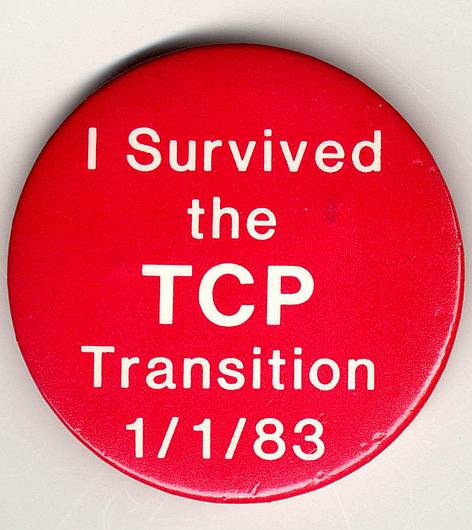
TCP/IP was implemented and tested and, on January 1, 1983, the ARPANET was transitioned to TCP/IP. Was that the birthday of the Internet?
One might argue that the Internet began with the vision of pioneers like Vannevar Bush, JCR Licklider and Doug Engelbart, Paul Baran's RAND reports, early packet switching experiments, the start of the ARPANET, the first tests of TCP/IP, the diffusion of TCP/IP with NSFNet, etc., but the first large scale inter-network began with the deployment of TCP/IP on the ARPANET and TCP/IP (and Ethernet in the LAN) remain the basis of today's Internet.

Here are a few links you might want to follow if you want more on the 30th anniversary:

Saturday, December 29, 2012

Impressions of the Internet in Yangon, Myranmar

Last week, I spent a couple of days in Yangon, the largest city in Myanmar. Here are some quick impressions of the state of the Internet there.


I stopped at two Internet cafes to check email and upload my student's final grades. The computers were old tower PCs with small LCD displays, and they were running Windows 7. The cost was only 50 cents (US) per hour, but the connections were slow -- around 100 kbps as measured by Speedtest.net. At that speed, I was able to read my email, but our campus grade reporting system was unusable.


As in many developing nations, pirated software is sold openly in Myanmar. The labels on the binders shown below indicate the categories of software for sale in a store I visited. (You can see the "production department" against the wall behind the table).


Disks were also displayed on racks in the store. "Installers" -- disks with programs -- cost $US 1.25 and content disks cost just over 50 cents. The selection was quite random and many of the programs were old versions. Windows 7 was available, but not Windows 8.


One of the newest looking shops I saw had computers customers used to make online purchases. This service makes sense in a nation where few people have Internet access and payment and delivery systems are not available.


Finally, I saw a shop selling used consumer electronics and computers. They also had a smattering of electronic parts -- it reminded me a little of the computer and component swap meets back in the early computer hobby days when we were wire-wrapping our own boards and of the auto junk yards where I hung out as a kid.


Myanmar has a population of 48.3 million people and a GDP per capita of $US 1,300, making it the second poorest nation in Asia after Nepal (GDP per capita of $US 1,200). Given this level of poverty, it is not surprising that the Internet has not taken off. The following statistics are comparable to those in a developing nation 15 years ago:

Internet related statistics, Myanmar 2011
Percentage of individuals using the Internet 1.0
Fixed (wired) broadband subscriptions per 100 inhabitants 0.1
Active mobile broadband subscriptions per 100 inhabitants 0
Fixed telephone subscriptions per 100 inhabitants 1.1
Mobile-cellular subscriptions per 100 inhabitants 2.6
International Internet bandwidth Kbit/s per Internet user 8.0
Percentage of households with computer 1.8
Percentage of households with Internet access 1.4
Secure Internet servers 4
Internet (.mm) hosts, 2012 1,055
ICT development index rank 131
Sources: CIA, ITU and the World Bank database

As we see, a very small percent of the population uses the Internet and there is no mobile access. Organization use, as measured by .mm domain names and secure Internet servers, is practically non-existent. The International Telecommunication Union (ITU) ranks Myanmar 131st out of 155 nations using its comprehensive ICT Development Index. (The only Asian nation below Myanmar is Nepal, which is ranked 137th). These statistics explain why my connectivity at Internet cafes in the largest city in the nation was so slow.

That is the bad news. The good news is that Myanmar is rich in natural resources and seems to be emerging from a repressive, capricious and corrupt military dictatorship that dates back to 1962. In 2011, they released Nobel Peace Prize winner Aung San Suu Kyi from house arrest and held elections for a minority portion of the Parliament seats. Aung San Suu Kyi's party, the National League for Democracy, won 43 of 45 seats available in the election, and general elections will hopefully be held by 2014. In recognition of these changes, both Secretary of State Clinton and President Obama have visited Myanmar.

Let's hope this apparent progress is for real and the Internet and the nation develop rapidly.

Wednesday, December 05, 2012

How a broken projector improved my class

I teach in the "smart" classroom shown here. The students sit at computers and the professor has a podium computer. I use the overhead display during every minute of every class -- for presentations and live demonstrations of all sorts of things.

Yesterday morning, I walked into the classroom and discovered that the overhead display was broken, so we had to improvise. I sat down at one of the student computers in the middle of a row (the one with the arrow) and the students crammed in behind me -- sitting on chairs, tables and standing. All of my teaching material is online, so I was able to use the exact same PowerPoint decks and do the exact same demonstrations as I would have used from the podium if the projector had been working. The material was 100% the same -- only the seating arrangement changed. I don't know whether you can picture the scene, but it was cramped and disorderly. (I wish I had taken a picture).

Why am I telling you this? I have been teaching on and off during my entire career, and it was one of the best class sessions I can remember.

I taught a second section of the same class yesterday evening in the same room. The projector worked fine for about half an hour, then broke again. We crammed in behind the student computer and continued. The class lit up. Students listened, spoke, answered questions I threw out, asked a lot of good questions, made relevant comments and wisecracked and teased. It was even better than the morning class.

I was able to do this because my classes are small. A few students were too far from my screen to see it comfortably, so they turned on a couple of computers in the same row and navigated along with me. (We could have automated that by starting up a Google Hangout and sharing screens).

The success of our re-arranged room would not have surprised Michael Wesch, an award winning professor of anthropology who has long noted the impact of room design on teaching. (For a taste of his thoughts on the topic, watch this 3m 46s excerpt I cut from a talk he gave upon receiving an outstanding teaching award).

I'm no anthropologist, but these class sessions felt better than a small seminar around a conference table. The ad-hoc seating arrangement turned the classes into focused bull sessions by breaking down social barriers between the students and me and, more important, between themselves.

The success of this small, ad hoc arrangement is ironic, because it comes at a time when I have been writing about massive open online classes, MOOCS, and have proposed teaching one.

MOOCs have the potential to be extremely cost efficient, but my small class gathered around a PC was extremely costly -- the California taxpayers would not sustain it and the students would get tired of standing up after a while.

Could we capture some of the enthusiasm and interaction of the live class I had yesterday and share it with a mass audience taking a MOOC at the same time? Maybe.

-----

For more on Michael Wesch:

Monday, December 03, 2012

Annals of sleazy marketing -- Network Solutions moves into second place behind Verizon

Last year, I registered the domain larrypress.net with Network Solutions (NS). I had no immediate use for the name, so I opted for automatic renewal and forgot about it. On September 28, 2012, I received an email from NS saying they would automatically renew the registration some time in the next 90 days. (I checked later -- the expiration date was January 12, 2013).

Some time later, I remembered the pending expiration, and renewed. My credit card company notifies me of online charges, and I received an email saying NS had charged $37.99. That struck me as mistakenly high, so I tried to stop the transaction using email.

I could not figure out a way to do that on their Web site, so I called and spoke to a customer representative. I told her that the price was too high, so I wanted to drop the registration. She said she really did not want to lose me as a customer and asked what prices I had gotten from other registrars. When I hedged the answer, she said she would only charge me $9.75. Sleazy.

Being busy, I said OK, but it turned out that she could not authorize the credit card adjustment and transferred me to another woman who said she would adjust the credit card charge. I said great, but that I no longer wanted to auto renew. She offered to cancel my auto renew option, but needed answers to my three security questions in order to do that.

Great, but, since the answer to two of my questions was the same (my first school and my sixth grade school), I would have to log in and change my security questions first.

I asked if I couldn't just log in and drop auto-renew by myself. It turns out that you cannot do that yourself -- you have to call them and have them do it for you.

I logged in, changed my security questions and she turned off auto renewal.

Total elapsed time on the phone -- 38 minutes.

This moves NS into second place in my race for King of Sleaze, but Verizon remains on top (http://bit.ly/RuoWhT).

-----

Update 6/4/2013

After the above experience, I wanted to move the domain to another registrar.  Hover.com pitches themselves as ethical and straight forward, so I went to their Web site to make the switch.

They informed me that the domain was "locked" -- an odd concept.  I surfed over to the Network Solutions Web site, where I learned that one cannot unlock a domain using their account manager -- you have to call them and speak to a representative.

So I called.  After a few menu choices, I was put on hold, but after 3 minutes and 36 seconds the connection hung up.

I called back, went through the menus and reached an operator who grilled me on security questions and account details, then asked why I was transferring the registration.  When I told her why, she offered to let me keep the domain for $9.95 per year.  I asked if that would be "forever," and she said "yes."  I told her that Hover charged $15 per year, and that for $5 per year, I would rather deal with an ethical, straightforward company and wanted to go ahead with the transfer anyway.

She allowed as how unlocking the domain would take at least 24 hours, which seemed goofy, but it turned out that the unlocking was done a minute later -- I guess they were hoping I would reconsider if I waited 24 hours to check.  What marketing genius invents these procedures?


Thursday, November 22, 2012

Dish TV wants to become Dish TV and Mobile

The Financial Times reports that Dish has won FCC approval to use spectrum they already own for LTE cellular communication rather than TV broadcast.

The approval came with a caveat regarding power limitations so as to avoid interference with adjacent spectrum that the FCC plans to auction next year. (That spectrum will also be used for LTE).

Dish said it was not all good news since the power restrictions could "cripple our ability to enter the business." Perhaps they are hoping to negotiate with the FCC over those restrictions.

The Wall Street Journal has speculated that Dish might partner with Google in forming a mobile communication company. Or perhaps Dish will sell the spectrum, which is now worth more than it was before the FCC approval.

Dish's move is reminiscent of the recent case in which the FCC turned down LightSquared, a startup seeking to offer LTE service using spectrum adjacent to GPS frequencies. LightSquared has a new proposal before the FCC, asking permission to share frequencies that are used by weather balloons.

Dish might provide some competition for the mobile cartel, but, then again, they have not exactly driven the price of broadcast TV down. But there are others as well. Google may join in with or without Dish, LightSquared may get a second chance, T-Mobile and Metro PCS want to compete and virtual mobile operators like Virgin and Ting are offering cut-rate prices. The cartel may be weakened.

Sunday, November 18, 2012

Republican critique of copyright and patent system withdrawn

The Well, an early online community, had a saying “you own your own words.”

What you say online may come back to haunt you, so think twice before posting something controversial.


Representative Jim Jordan of Ohio learned that lesson on November 16, when the Republican Study Committee (RSC), which he chairs, published “The Three Myths of Copyright,” a well reasoned critique of the copyright and patent systems and their impact on the economy.

The critique was consistent with Jordan’s view of the government and free enterprise, but it disappeared from his Web site soon after it was published.

But, Lauren Weinstein had made a copy of the RSC document and published it on his excellent blog. Note that he has marked it as “withdrawn,” since it is no longer on Jordan’s Web site.


Jordan has learned a lesson about Internet publication – you own your own words and they are difficult to erase.

And we citizens have gotten another look at the morality of politics and the rapidity with which principle and reason can be set aside.

PowerPoint presentation for teaching


Addenda

12/7/2012
The Republican Study Committee, a caucus of Republicans in the House of Representatives, has told staffer Derek Khanna that he will be out of a job when Congress re-convenes in January. The incoming chairman of the RSC, Steve Scalise (R-LA) was approached by several Republican members of Congress who were upset about a memo Khanna wrote advocating reform of copyright law. They asked that Khanna not be retained, and Scalise agreed to their request.

1/11/2013
ARS Technica interview of Derek Khanna, who was fired.

Friday, November 16, 2012

I blew it -- Twitter was cool on election night


In a recent post, I argued that The AP's interactive results map was better than Twitter, hangouts or a TV stream for watching the election returns online because the map was interactive, putting the user in charge.  I still like the map a lot and have not changed my mind about TV or the hangouts, but I sold Twitter short.

The problem was that I only followed one person's Twitter feed -- Andy Carvin.  I picked Andy because he practically invented the notion of reporting events via a live Twitter stream during the Arab Spring.

I said I found Andy's election coverage boring and often uninteresting to me, but I overlooked the fact that Twitter is social.  I should have followed many feeds, not just Andy's.  For example, if I had been following the candidate's feeds, I would have seen President Obama's victory tweet, the most re-tweeted post ever.

Twitter has published other statistics and memorable tweets.  It turns out they hit a rate of 327,452 tweets per minute, and did not crash.  (They were known for crashing under load in the past).

A terrorist could jam an LTE base station for $650

Click to enlarge and read
Virginia Tech professor Jeffrey H. Reed and Marc Lichtman, a graduate student, filed a comment with the National Telecommunications and Information Administration showing that a terrorist could crash an LTE base station serving thousands of people by jamming control signals using a software defined radio and laptop.

They were commenting because there is a plan for a nationwide public safety broadband network that would use LTE wireless technology.

A Technology Review article on the filing estimates the cost of the jamming equipment at $650 and points out that 2G and 3G wireless would continue to work -- but 2 and 3G wireless are relatively will be phased out.

Reed and Lichtman do not offer a solution -- they merely point out the vulnerability.

Monday, November 12, 2012

A quick look at the use of the Internet in the 2012 election

In an earlier post, we looked at the election coverage on the Internet. Now, we take a quick look at the way the campaigns used he Net.

As in the last election, both campaigns used Facebook, Twitter and other social networks, but this time they moved on to the targeted advertising we are now used to on the Internet -- white males saw different campaign ads than their wives. (See articles in both The Economist and The New York Times.

Perhaps Obama was a more aggressive in tracking clicks than Romney.  The Times checked Obama and Romney's Web sites during the campaign, and found that Obama was using 76 click tracking services and Romney 40.  I checked yesterday and found that Obama was down to 32 and Romney only one (click on the image to the right to see which ones).
In another article on the use of the Internet in the election, The New York Times gave the Obama campaign the edge in their use of the Net in organizing volunteers for door to door canvasing, phone calls and fund raising. They did that using a Web site called Dashboard and mobile apps that could access it.

A couple of factoids to establish context: The Economist quotes Borrell Associates as estimating online ad spending in 2012 at $160 million, six times what it was in 2008, but it remains a small percent of the estimated $6 billion spent on the election. This understates the impact of online campaigning, because it costs very little -- the Obama campaign built about 200 different programs that ran on Amazon's cloud services.

Wednesday, November 07, 2012

NPR's interactive map tops election night coverage on the Internet

How did you watch the 2012 election results? I watched on my laptop. As shown below, there were several approaches to the coverage -- local TV stations holding hangouts, streaming TV coverage from ABC News, live tweeting by Andy Carvin (@acarvin) and an interactive map on the NPR Web site.

Which to watch? I tried them all and frankly found three to be boring.

ABC's coverage consisted of periodic local and national vote updates with "pundits" talking about what all meant.  I found it slow and much of it was irrelevant to me. Streaming linear TV online is liking making a movie by setting camera on a tripod and recording a stage play.  Old wine in a new bottle.

I found that Andy Carvin's tweets came in too slowly and, like ABC's stream, often concerned things I was not interested in. Carvin has been live tweeting events in the Middle East for a couple of years and is probably our best, most experienced live tweeter. (See his book Distant Witness). If he can't make live tweeting of election results work, the medium is probably not a good fit.

(Correction after posting -- I blew it -- Twitter was cool -- I should have followed more than Andy Carvin).

I found several hangouts in which a local TV reporter discussed the election with the public and found them boring and uninformative. I'd rather listen to pundits.

For me, the clear winner was NPR's interactive map. In retrospect, that is no surprise. The key is that it is interactive. Unlike the others, it let me be active, determining what I would see.

As shown below, the map page is divided into three sections. The largest is a map of the US. Above that is a graphic summary of the current state of the presidential, senate, house and gubernatorial races. Interactive results were displayed to the left of the map.

The summary at the top has small red, blue and gray spots -- red signifying a decided Republican victory, blue a decided Democratic victory and gray undecided. The bar below that summarized the state of the presidential election at that time.

The dark red and blue areas signify electoral votes won by the two candidates. The light red and blue areas signify likely electoral votes and the gray area in the middle votes that were too close to call. The image shown above was snapped Tuesday evening, when the race was close. By Wednesday morning, the summary showed that Obama had won the presidency, the Democrats controlled the Senate and the Republicans had retained control of the House and won a majority of the gubernatorial elections.

You could drill down by clicking on a state.  Below I clicked on California and the current vote counts in presidential, senate, house and gubernatorial elections were for the state were displayed to the left of the map.

One could drill down further. The results as of Wednesday morning for the House race in California's 30th District are shown below.

You could also check the tally of ballot initiatives for each state. California's are shown below.

I don't want to leave the impression that NPR was perfect.  The maps were poorly rendered and I had some quibbles with the user interface, but, for me, NPR's interactive map was the election coverage winner.  This reminded me of my comparison between the BBC and NBC coverage of the 2012 Olympic Games. BBC's coverage was more interactive than NBC's. NBC's was more like watching television. There is a general lesson here -- the Internet is an interactive medium. 

------


Added after posting

The NPR site is displaying data from the Associated Press.  I turns out that Google also presented the same data (http://bit.ly/Up9c0D) and it was also posted on the C-SPAN Web site (http://cs.pn/XnY58x).

Monday, November 05, 2012

Pearson announces Operation Blue Sky, a discovery service for open educational resources

There are tons of useful, open educational resources(OER) -- ranging from Creative Commons textbooks to narrowly focused videos, images, presentations and other material. The problem is that it is difficult for a teacher to discover these free jewels.

Pearson hopes that their newly announced Operation Blue Sky will fill that role. The site is not yet live, but the image shown below illustrates its user interface.


OER discovery is a tough nut to crack. Services like MERLOT have tried for years, but what percent of your teaching material did you find on MERLOT?

I personally am looking for much finer grained OER than an open textbook or video. How about a cool image, quote or anecdote to illustrate a point I am trying to make in class?

Pearson says Project Blue Sky will allow instructors "to search, select, and seamlessly integrate Open Educational Resources with Pearson learning materials." The last part about seamless integration indicates their motivation, and, if they are not careful, their Achilles heel. I am not interested in closed silos.

That being said, I am hoping that Pearson will be able to crack the OER discovery nut and will be keeping an eye on the effort.

#digilit #jiscdiglit #highered #edreform #MOOC #pedagogy #EDUCAUSE #bonkopen #merlot #Pearson

-----

Pearson Project Will Let Professors Mix Free and Paid Content in E-Textbooks - Wired Campus - The Chronicle of Higher Education.

Fostering interaction and spontaneity in a MOOC -- in-class students as co-stars

MOOCs have shown that the presentation of material scales dramatically -- thousands of people are willing to watch interactive video presentations -- but we have not demonstrated the ability to scale interaction.

One approach is to encourage peer interaction using threaded discussion, peer grading, social media and face-face meetings in study groups.

But, can we also find ways to scale the sort of spontaneity and interaction that takes place in a face-face (FF) classroom? I doubt that we can ever achieve the level of exchange and enthusiasm in an outstanding classroom session, but those are atypical. A more realistic goal would be to scale interaction to the level that occurs in an average FF class session. I think (hypothesize) that is achievable. Let me give a couple of examples of attempts at using classroom interaction in a MOOC -- one that worked and one that did not.

I am currently dropping in on, though not taking with any discipline, "A History of the World since 1300" offered through Coursera by Princeton professor Jeremy Adelman.

In addition to typical video lectures with breaks for quizzes, they have tried to bring in some classroom interaction using "global dialogs," in which Professor Adelman and a guest scholar hold a conversation in front of a FF class. I've only watched one of these conversations from start to finish (45 minutes), but it did not work. The class observed, but did not participate.

The camera was focused on the professor nearly all the time. About half a dozen times it cut to the audience, which was motionless. (The image shown below was just after Professor Adelman tried to lighten the atmosphere with a quip). The fact that the speakers, not the class, are the stars of the show is emphasized by the class shots being badly out of focus.


This is not to beat up on Professor Adelman or Coursera -- we are all experimenting at this stage of the game.

Now for an example that worked well. My first MOOC experience was in 2006 when I "took" Professor Charles Nesson's Harvard Law School course "CyberOne: Law in the Court of Public Opinion." There were three groups of students -- Harvard law students who attended in a traditional lecture hall and received course credit, extension students who met in Second Life and received extension credit and the general public which followed via weekly podcasts without credit. The course wiki, student notes, lecture videos, and student projects were all online under Creative Commons license and we podcast lurkers were encouraged to participate.


I did not watch the class videos, but listened to audio recordings of the class sessions. I heard professor Nesson lecturing and leading discussions with the students in the room. He was informal and encouraged participation. In spite of the fact that I was only listening to audio recordings while working out in the gym, I became quite involved in the class. I looked forward to the podcasts, read the online material and corresponded a bit with Professor Nesson and the TA (his daughter) via email. I remember the class fondly and would say that the interaction scaled quite well.

The global dialog discussions in the history class are interesting and the participants have deep knowledge of the subject matter, but they are presentations by experts which are passively observed by an audience.

What would I do if I were teaching a MOOC?

I teach a digital literacy course, and I would run the MOOC in lockstep with an on-campus section. Like professor Nesson, I would have our instructional technology staff record every FF class session and edit and post those weekly. The FF students would be co-stars of the videos.

As I do today, I would divide FF class time between lectures based on prepared teaching modules and topical material. Let's take a quick look at both the lectures and topical material.

The lectures are based on teaching modules consisting of pre-recorded lectures (5-10 minutes plus breaks for interaction), transcripts of those lectures, and the lecture slides. I present about half of the lectures in class and assign the others for self-study.

The MOOC students could watch the in-class videos of the lectures as well as the pre-recorded videos. While the live lectures are based on the same material as the pre-recorded videos, they are not scripted. I choose different words and speak differently. Unscripted examples or ways of saying things occur to me. I respond to student questions and stop to ask questions, which the students either answer or discuss with their neighbors. The goal of the in-class recording would be to capture as much of this interaction as possible.

In addition to lecturing, I devote in-class time to topical material. I prepare weekly discussion presentations in the same format as my pre-recorded lectures. A portion of the topical material is class feedback -- common misconceptions I find while grading their weekly quizzes and assignments and the results of anonymous study-habit polls with questions like "did you review presentation X before coming to class?" I also present things that occurred to me after class during the previous week.

While some of the topical material is based on our class, most of it is triggered by current events that are relevant to the class. For example, this week (tomorrow) we will talk about the damage to the Internet due to Hurricane Sandy, the concept of fair use in copyright, triggered by a warning I just got for a YouTube video I posted, Google image search, which has been around for some time, but I had not tried until this week, the use of new media (radio, TV, the Internet) in political campaigns triggered by President Obama's holding Google Hangout and Reddit "ask me anything" sessions and the global diffusion of fourth generation cell technology triggered by a trade association report.

Could we capture the spontaneity and interaction of an excellent FF class using video recording and presentation of topical material? Probably not, but my hypothesis is that we could capture some of it -- perhaps as much as goes on in an average FF class.

Teaching assistants and I would also hold online office hours (Google hangouts) discussing topics and questions submitted by students during the hangout or before. (These office hangouts might run considerably longer than typical course office hours). Videos of the hangouts would be posted online.

There is a question of motivation in the FF class. We all know that some classes are more engaged and lively than others. If the class is to be the MOOC co-star, I would explicitly try to involve and motivate them -- to build esprit de corp and encourage active participation. I am not sure how to do that, but I would let them know they had a responsibility to speak for the MOOC students. I would also encourage communication between MOOC and FF students. I would try bribery with refreshments served during class. I would try negative reinforcement like taking class participation, attendance and participation in office hour hangouts into account in their grades. What else?

#digilit #jiscdiglit #highered #edreform #MOOC #pedagogy #EDUCAUSE #bonkopen #coursera

Friday, November 02, 2012

Internet damage from Hurricane Sandy -- the Internet senses its own failures

Still from Renesys animation
This is a follow up on yesterday's post on the Internet damage done by Hurricane Sandy. That post described data center outages and Paul Baran's 1964 RAND reports spelling out the rationale for and design of a packet switched network. It also includes a link to a terrific interview of a data center CEO who struggled to stay on-line during and after Hurricane Katrina in New Orleans.

The Internet senses its own failures in two ways, automatically and in cooperation with humans.

A network is removed from the global routing table a few seconds after it goes down. Renesys tracks the dynamic state of the Internet by monitoring that table.

This animation shows the percent of networks that are down in small geographic areas hit by the storm. Dark green indicates that at least 99.95% of the networks are up and the dark red indicates that more than 5% are unreachable.

They report that in Manhattan the typical outage rate is around 10% and point out that "silencing ten percent of the networks in the New York area is like taking out an entire country the size of Austria, in terms of impact on the global routing table." That is the bad news. The surprisingly good news is that 90% of the data centers are still up -- running on backup diesel power and caffeine.

On the right, we see another Renesys view showing network outage by state over time. As we see, New York was the hardest hit with around 1,200 networks off line at the peak, but some have come back on-line.

Renesys monitoring is automatic, but people are also monitoring the network with the aid of tools like Twitter. Andy Carvin is known for his use of Twitter and other Internet tools in producing real time news reporting (see the presentation at this location) and the same approach has been used in disaster reporting.


Using Twitter and other sources, Rich Miller of the Data Center Knowledge blog has been reporting on data center outages

J.C.R. Licklider
Internet damage is caused by flooding and power outages and the Internet is also used (by people) to report power outages. Those reports are aggregated and mapped in real time at Web sites run by companies like Con Edison, which serves Manhattan and the Long Island Power Authority. (Note the overlap between the power-outage and Internet outage maps).

Finally, let's note that the human-Internet collaboration on disaster reporting or any other task was anticipated long ago by J. C. R. Licklider who, in the 1960s, wrote of man-computer symbiosis, envisioned the Internet and was instrumental in funding much of the research that led to the Internet and modern personal computers.  (Read two of his highly influential papers here).


Wednesday, October 31, 2012

The Internet damage caused by hurricane Sandy

As GigaOm points out, many data centers are flooded and are running backup generators for power. There has also been some damage to transatlantic cables.

This is reminiscent of the Internet damage caused by Hurricane Katrina in New Orleans. Only one New Orleans Internet service provider, DirectNIC, remained online during and after the hurricane. Shortly after the hurricane, Doc Searles conducted a 40-minute interview of DirectNIC CEO Sigmund Solares. Solares tells a fascinating story of the effort it took to find deisel fuel for their standby generators and keep the data center running. If you are a data center geek -- even a little bit -- you will enjoy the interview.

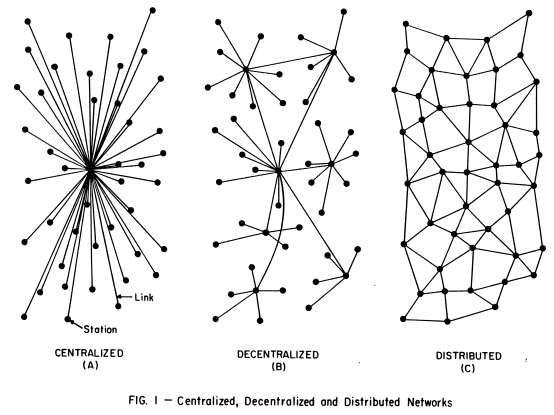
It also reminds me of one of the initial motivations for the invention of packet switched networks -- that they would be able to route around damaged equipment and continue to function in case of a disaster. The figure below is from one of Paul Baran's 1964 RAND reports outlining the rationale and design for a distributed packet switching network.


The problem here is that too much equipment was located in a small area. You can understand why -- there are many large businesses in lower Manhattan and a lot of cable landing points near New York City.


-----

I've added a second post on the damage caused by the hurricane. It talks about ways the Internet senses and reports its own state.

The times they are a changing -- HTwins "Scale of the Universe" updates Eames' "Powers of Ten"

In 1977 the designers Charles and Ray Eames made a film called Powers of Ten, "dealing with the relative size of things in the universe and the effect of adding another zero." It begins with a picnic scene then zooms out to 100 million light years (10^24 meters) and back in to .000001 angstroms (10^-16 meters).


The film was very popular at the time and it has been viewed over 1,728,000 times on Youtube. In 2010 the Eames Studio created a Web site based on it. The Web site adds a bit of interactivity and sharp still images like the one shown here, which depicts a view of the picnic from 10^26 meters.


But, it is re-purposing of old material and it shows.

Contrast that with HTwins' interactive site "Scale of the Universe 2" (Scale2), which was born digital. Here we see some objects that are around 1 meter in diameter.


Instead of watching a video, the user zooms in and out using a slider that ranges from the size of the strings of string theory (10^-35 meters) to the observable universe (10^27 meters). The user can also click on an image to open a small text window describing the object. The text is at least partially available in 20 languages.

Unlike Powers of Ten, Scale 2 is extensible. The translations are provided by volunteers and new images and text descriptions can be added. Powers of Ten has not changed since it was filmed.

While I like the interactivity and extensibility of Scale2, it lacks the interesting and compelling narration that accompanies the Eames film and provides for transitions between the images. The two have their place, and if I were teaching the topic, I would have the students watch Powers of Ten then play with Scale2.

There are two other notable differences between Powers of Ten and Scale2.

Powers of Ten was sponsored by a major corporation, IBM, and Scale2 is sponsored by Google Ad Sense ads. One big client versus a lot of minuscule clients.

Another difference is in the project organization and cost. Powers of Ten was produced by what was arguably the most famous design firm in the world. They had a large studio with many employees and were known for projects like the Eames chair, IBM's World Fair pavilion and the design and colors of IBM's "big blue" mainframe computers. Scale2 was created by Cary Huang, a 14-year-old ninth grader with technical help from his twin brother Michael. (I wonder if their parents helped). Here are the Htwins: