Showing posts with label Olympics. Show all posts

Wednesday, August 10, 2016

NBC streaming the Olympics on the Internet -- quantity, not quality

NBC Sports is allowing many (not all) cable TV subscribers to stream Olympic Games events live and to watch archived copies after they finish. There are several ways to watch the streams -- in a Windows 10 app, on a TV set using the Roku app and on the Web. I checked them out and was generally disappointed.

With the Roku app, watching a live event is like watching a broadcast TV program -- you sit back and watch, but have no control. When you are watching the archived recording of a completed event, you can pause and fast forward/reverse, but that is all.

The event navigation interface is also lame. There are five linear menus: Features, Live and upcoming, Highlights, Full event replay and Sports. You scroll through a list of thumbnail images to find the one you want to watch. That is fine for the 13 features and 34 sports, but not so handy for the 300 Highlights, 771 Live and upcoming or 538 Full event replays. (These numbers will vary of course). Search is sorely missing.

There are also frequent delays for updating content and, if you try to watch a live event, you are often informed that it has concluded or will begin shortly -- they do not update menus at the time an event starts or ends.

The Windows 10 live-event user interface is a little better, but nothing to write home about. As you see below, there is a volume control and buttons to pause/resume, go full screen and to turn on/off closed captions.

NBC Sports app user interface

The navigation interface, shown below, is similar to that of the Roku. There are five linear menus: Features, Live and upcoming, Replay, Highlights and Sports. There are no scroll bars, so you use the cursor control keys to move through the selections.

Windows 10 app navigation interface

As with the Roku, the "live" events are frequently either completed or not yet begun.

The Web user interface is a bit better. As you see below, it includes the handy "15-second rewind" button and rewind and fast-forward buttons.
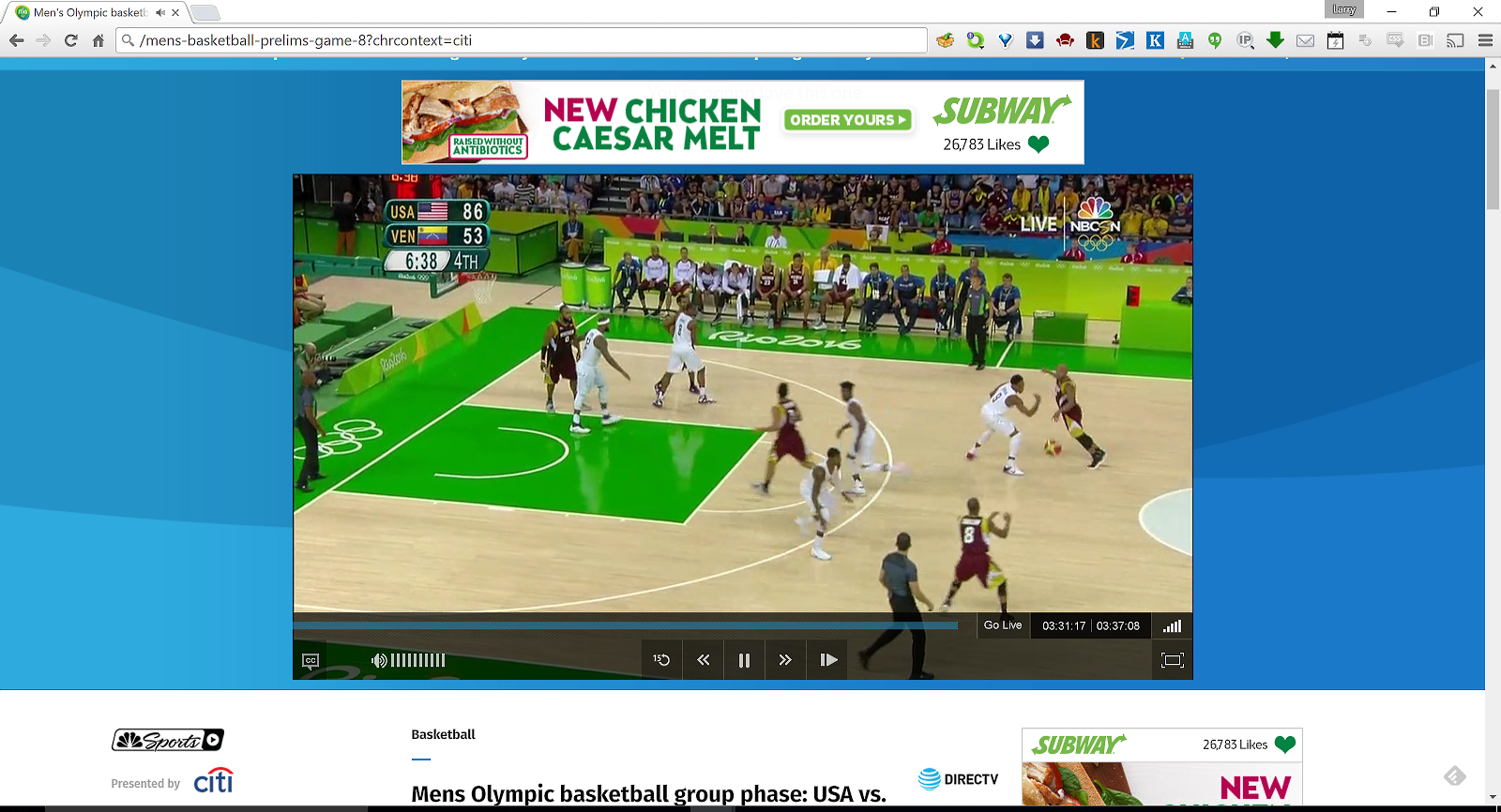
Web user interface

The Web navigation is also more flexible and complete than with the Roku or Windows 10 app. The bad news is that there are ads and you cannot go full screen. (The others also have interspersed ads).

There is also an Android app, but I am not going to bother installing it -- I prefer watching sports on a TV set and it will doubtless have some of the limitations discussed above.

As I said at the start, I am generally disappointed with NBC's streaming coverage. Part of that is because my expectations were raised by NBC's excellent coverage of the Tour de France. The mobile and desktop user interfaces were clean and powerful and they presented real time data during the race and inciteful analysis after each stage was completed. The business model was also different. You pay for Tour de France access, but do not have to watch ads (which are often followed by a screen saying the event you want to watch has already concluded).

I realize that the Olympics are a tougher event to cover -- many venues and many elimination levels -- but I hope that by 2020, the NBC Olympic team will sit down with the Tour de France team and re-design their coverage. I hope they also offer an ad-free option.

Wednesday, August 22, 2012

A gold medal for the BBC's Internet coverage of the Olympics

BBC's Olympic Internet coverage was better than NBC's. In this post I'll tell you why I say that and also take a look at BBC's terrific Sports blog.

I watched both the BBC and NBC Olympic coverage on the Internet and the BBC did a better job than NBC. Four BBC pluses come to mind.

1. The BBC Web viewer was more interactive, less passive and TV-like, than NBC's and they are continuing to improve it. As you see here, the user could display and hide data on demand and jump to the start of a "chapter" corresponding to an event.


2. I watched the BBC stream via a VPN, which, as shown below, slowed my connection considerably.


In spite of the increased latency and decreased speed, the BBC's video experience was as watchable as the video when using YouTube's content delivery network in the US.

3. Many of the NBC events I watched were video feeds with no commentary and every event I watched on the BBC had commentary. That could have been random chance and I watched more NBC than BBC, but it was my experience. (Commentary is more important for some events than others and some people dislike it. Users should be able to toggle commentary and the ambient sound on and off).

4. The BBC was commercial free -- paid for by the British TV license fee.

The BBC also wins the gold medal for Olymic blogging. The developers of BBC sports have a blog with suprisingly informative posts, and around 20 of the recent posts pertain to the Olympics.

Here are snippets from a couple that caught my eye.

Phil Fearnley, General Manager, News and Knowlege at BBC Future Media outlined their goals for the Olympic coverage and placed it in historical context.

The goal was to deliver over 2,500 hours of live sport online via 24 high definition streams - to cover every sport, from every venue on every day – across four screens: PC, mobile, tablet and connected TV. There were not 24 events going at all times, but the screenshot below was taken at a moment when there were -- the user could choose among 24 video streams.


Finley saw this as the start of a new era, writing
Broadcast television’s first big moment was the coronation in 1953, which brought the nation together around the TV screen for the first time. Our aspiration is that 2012 will do for digital and connected televisions what the coronation did for TV.

Cait O'Riordan, Head of Product, BBC Sport presented some statistics and analysis of the site traffic.

Below, you see the number (millions) of people watching the six streams with highest peaks on the first of August. People could easily switch between streams, and chapter links on the time-line let them find specific events they were interested in.


This graph shows relative usage during the day for each of the four screen types between July 28 and Aug 9. It looks like people watched on their computers (at work?) during the day and took their tablets to bed during the evening.


Matthew Clark, the Senior Technical Architect for BBC Online's Olympic website and apps described the site architecture. Here is his architecture diagram -- frustratingly small and impossible to read, but it conveys complexity:


In the post, Clark states that "Over the coming months we'll be working on bringing many of these features to the rest of Sport, and perhaps other parts of BBC Online too."

Alex Perry, Project Manager for the Live Interactive Video Player, outlined its key capabilities, including:
  • Easy switching between up to 24 live streams at any time
  • The ability to pause and rewind live video or jump straight to key moments you may have missed by using chapter markers (eg the Men's 100m final)
  • Alerts for the key events that have happened or are coming up so you don't miss the moments that matter to you
  • Extra facts and info on the sports and competitors you are watching alongside the video

this gives you a taste of the blogs -- if you are a live-stream event coverage geek, be sure to check them out.

Why did BBC do better than NBC? Two things come to mind. BBC's non-commercial culture makes a difference -- the viewers are their customers while NBC's customers are their advertisers. There is another clue in two of the tags on the BBC blog posts open source and open standards. Those tags indicate that BBC "gets" the Internet, and maybe NBC doesn't.

Regardless, the BBC team gets the gold medal for streaming live events.

(I've written several other posts on NBC's coverage of the Olympics and the Tour de France. You can see links to my observations as well as predictions for future event coverage here).

Friday, August 17, 2012

The Olympic live stream -- observations, recommendations and predictions

I watched the Tour de France and the Olympic Games (from both NBC and BBC) online this year. I'm a sports fan, but I also spent a lot of time focusing on the Internet content and experience. You can see my detailed observations here.

For this, the short version, I will list a few observations and conclude with some predictions for the future of live-event coverage on the Internet. First the observations, in no particular order.

Now for a few fearless predictions.

NBC paid the International Olympic Committee $4.38 billion for the media rights to 2014 - 2020 Summer and Winter Olympics. We will see major changes in the coverage and the industry by 2020.

There will two separate markets. The first will be for producing content -- video, commentary, interactive features, Web design, and so forth. NBC was the content producer in this case. The second market will be for efficient networking to distribute that content. During these Olympics YouTube (Google) provided the networking expertise.

Both the content producers and the networkers will have learned a lot from past experience and will do a much better job than they did this year. We have even seen improvement during these Olympics. This is just the start of the IP TV era -- it is like the crystal set era in the early days of radio.

Given the expected improvement, the majority of people will be watching live events and other video on the Internet by 2020 -- we will have cut the cord and be watching over the top.

While there will be both network and content industries, the content industries will not have a lock on production. As the comedian Louis C. K. showed us, the production company will be dropped in some cases. Louis C. K. decided that he could do a better job of producing his comedy DVDs than Sony, and the Internatinal Olympic Committee might decide that it can do a better job than NBC or another production company.

It will be interesting to see what Google does in this area. If their fiber pilot study in Kansas City looks promising and replicable, they may become a networking powerhouse. At the same time, they are developing content and learning by working with folks like NBC. They may end up being able to offer the whole package.

Of course, there is a disclaimer to these predictions -- never underestimate the power of well-funded, entrenched lobbyists and huge corporate legal staffs. On the other hand, it is hard to find good buggy whips these days.

Thursday, August 16, 2012

Three revenue models for online coverage of live events

With the Olympics and Tour de France, we saw examples of three live streaming revenue models: license fee, advertising and pay per view. Here is a quick look at each.

BBC Olympics, license fee

The BBC streamed 2,500 hours of free, live coverage, but you had to have a British TV license. The TV licenses cost £145.50 per year for a color TV and £49.00 for a black and white TV. The fee allowed you to watch the video streams on any device and gave you permission to store, but not distribute, the content. If you came to the site from a non-British IP address, you were blocked, but that was easily circumvented using proxy servers. In the future, they may be more aggressive about discovering and blocking proxy servers.

Archived footage will be available until January.


NBC Olympics, advertising supported

To view their live coverage of the Olympics, NBC required you to have a cable TV account with an authorized provider and a subscription level with access to several NBC cable channels. (That restriction may have been imposed by NBC's owner, Comcast). On top of that, they showed a lot of ads.

Like the BBC, authorized users were free to view the live coverage on the Web or their tablets and phones. One could circumvent the account restrictions by using the user name and password of a friend with a qualifying account. Again, in the future they might be more aggressive in blockng that sort of access.

NBC's archives are on line at this time, but they have not announced their plans for future access. Since they run ads, they may leave them up indefinitely.

NBC Tour de France, pay per view

For the Tour de France, NBC charged a $29 fee, which, as with the other events, entitled the user to watch on the Web, a phone or tablet. There were no ads, but, unfortunately, access to the archive footage was dropped shortly after the end of the event.

My least favorite this year was the ad support model, which was done poorly. When navigating the Web site, it seemed that every new page view had a pre-roll commercial, and arbitrary commercial breaks in the middle of event coverage were irritating and distracting -- the screen would go black for a few seconds in the middle of an event, then they would run as many as six commercials before resuming the action. To add insult to injury, they boosted the audio volume during commercials.

I preferred pay per view, but many viewers would opt for ads, and there is a lot of room for improving the experience. For a start, NBC needs directors to watch the action and insert ads intelligently. Ad targeting -- showing individuals ads based on demographic, social networking and search signals or asking them for hints as to the kinds of ads they were interested in -- would also improve the experience. There could be hybrid models like allowing the user to choose between pay per view with no ads and paying a smaller fee and seeing just a few, well-placed ads.

Wednesday, August 15, 2012

A few Olympic Web design tips for NBC

I wrote an earlier post on the production and direction of NBC's Olympic coverage. That note focused primarily on the production of their video content, but we also noted a few Web site production problems like broken links, slow response time and screen blackouts during transitions to commercials.

Many of these glitches depended upon the network as well as the Web design, but they should be able to improve both of those based on their experience this year.

In addition to fixing those problems, they can take some interface ideas from the BBC's Olympic Web site, which was more interactive than theirs. NBC was more like television -- the viewer watched the video passively, and NBC producers popped up extra information like standings and scores on the screen when they decided to do so. (They also popped up commercials -- something the BBC or Tour de France producers did not have to deal with).

The BBC gave the user more control. If the user clicked on Extras after hovering over the bottom of the screen, they could display information about the athletes and the game. They could also control playback using a chapter-oriented time line.


In the example shown below, the video timeline is divided into "chapters." In this case, the chapters correspond to pre and post-game material and quarters or parts of quarters of the game action. The user is watching the second video chapter (yellow) and has displayed the game statistics of one player, Carmelo Anthony. The chapter-oriented timeline and Extra choices gave the BBC user more control than the NBC user had.

The folks on the NBC Olympic crew can also borrow from their Tour de France team. For example, I really liked the 15-second instant replay button on Tour videos. Again, this example shows a way to give control directly to users, who can replay as much or little as they wish.


The user interface shown above was BBC's default, but they offered two optional user interfaces. The accessible player had text-oriented controls that were designed for keyboard and screen reader access. They also had a pop-out player for people who wanted to keep the action streaming in a small window while the worked on something else.

This is not to beat up on the NBC Olympic team. The Tour de France team had a simpler event to cover -- a single race comprised of stages that all followed the same format. Furthermore, they had previous experience covering the Tour and neither they nor the BBC crew had to deal with commercials.

That being said, I am sure NBC will look back at what they and their competitors did this year, and improve their site design.

Monday, August 13, 2012

The Olympics -- NBC's production and direction

The Olympics were brought to us by two organizations -- YouTube and NBC. YouTube ran the network, and their task was to deliver smooth, high-resolution video streams. NBC handled content production and direction, using video feeds supplied by Olympic Broadcasting Services, OBS. Most of my posts to this point have focused on the former -- the network. How about direction and production?

While some of the content was good, there were significant gaps.

For example, a cycling road race is a difficult event to cover -- it is spread over a large area, the action is continuous and the cyclists break into groups. NBC streamed the video of this and many other events without commentary and with relatively few on-screen graphics. While that may be satisfactory for an event like volleyball or weight lifting, one tends to get lost in a cycling road race.

The camera might be focused on a single group of riders, but, who is in the group, are some of the race favorites or top sprinters in the group and where us the group relative to the rest of the field? Commentators and graphics like NBC used in their coverage of the Tour de France provide that context. (I spent less time watching the BBC's live coverage, but all the streams I saw had live commentators).


Extended tree-obstructed shots like the one shown below are evidence of loose direction. I do not know whether NBC had the ability to switch cameras or they only got one video feed from OBS, but someone should be watching and switch cameras when the view is obstructed or there is something else of more interest to show. Ideally, the person switching cameras would also be in communication with the commentators.


Cuts to commercials at arbitrary points in the action were also evidence of loose direction. Furthermore, seeing a commercial on a TV set is not the same as seeing it on a laptop screen. We subconsciously expect commercials on TV and the transitions are fast, but on the Web they are jarring. You think something is wrong at first when the screen goes black during the transition to a commercial.

NBC's Tour de France video was superior to that of their Olympic video, but that was to be expected. The Tour de France video feed was supplied by France television, working with Euro media France (EMF). France TV and EMF have years of experience, while Beijing was the first Olympics for OBS. They also had only one event to cover, so needed only one set of experts and commentators. Finally, since the coverage was pay-per-view, they did not have to deal with timing of and transition to commercials.

There were also production problems with respect to the Web site -- broken links like the one shown below, slow response, poor user interface design, screen blackouts during transitions to commercials and so forth. (The slow Web site response time is a shared problem between the Web site design team and the networking team from YouTube).


I don't mean to beat up on NBC -- covering 302 events in 32 sports is a huge task, and I am sure they learned a lot about how to produce live events during the Olympics. They even made some mid-stream adjustments like changing the user interface on the live stream menu and perhaps adding more commentators near the end of the games. I cannot be sure of the latter, but it seemed like after the first week or so I found fewer live events without commentary, and the commentators often had English accents.

As video coverage of live events moves online, the production experience NBC and OBS gained at the Olympics and the Tour de France, will serve them well.

-----

You will find a description of EMF's operation during the Tour de France here.


Olympic archives remain online ... for now

Tiled UI with over 4,000 choices
The games are finished and NBC has an archive of over 4,000 videos on their Web site. (As with the live coverage, only NBC cable subscribers in the US can access it).

There are full events, event highlights, interviews, expert analysis, footage from earlier Olympics, medal ceremonies and more. You can filter the videos by these categories, sport, or top athlete and sort them by by date, popularity or recommendation.

But, what about that user interface? I would have called it a Metro-style user interface, but I guess Microsoft has dropped the name "Metro." Maybe a better name would be square icons user interface (SIUI)? Or tiled user interface (TUI)? Or cell-phone user interface (CPUI)? Or an iPhone user interface (iUI)? (Pronounce each acronym and see what you think).
Tiled UI with one choice

Seriously, whatever you call it, this sort of user interface might be more appropriate for a cell phone or tablet with a few installed apps than a library of over 4,000 videos. (On the other hand, it lends itself nicely to using oversize tiles for ads).

As I noted in a post the other day, NBC deleted their Tour de France archive. I asked their PR department what the plans were for the Olympic archive, but got no comment. Maybe they will leave this one up as ad bait.

-----

I want to add a note on the quality of the archival video streams. I expected that it would be better than the original broadcast stream because demand would be lower, YouTube would have had time to push content out to caches around the Internet and there would have been time for additional compression.

To test my theory, I watched the replay of the final basketball game between the US and Spain at 1080p resolution. The streaming was a bit jerky, but the game was watchable.

I could not subjectively say whether it was better or worse than the original live stream at that resolution, so I looked at the performance profile while streaming from the archive (below). As you see, it is considerably different than the live streaming profile.


Whether it is better or not, I am confident that YouTube and other major distribution networks will learn from this Olympic experience and improve performance.

-----

I also tried the BBC archive. The BBC provided up to 24 simultaneous live streams adding up to 2,500 hours of coverage during the Olympics. That material has all been archived, and it will remain online until January.

The BBC streams their video at a variable rate, starting slow and adding speed as buffering and bandwidth allowed. I watched the final basketball game between the USA and Spain. The motion was fairly smooth. There was some stuttering, but less than with NBC. However, the resolution was lower, not exceedinig 512 x 288. Bear in mind that I was watching via a proxy server. The average of three download speedtests was 2.34 Mb/s, about 20% of my local download speed.


At this speed, the following is representative of the best image quality I saw.


Like YouTube, I would expect the BBC network to improve as a result of this experience. I wish they would reconsider the decision to delete the archive in January.

NBC blows it -- deletes the Tour de France archive

All that is left at the Tour de France Web site.
During their coverage of the Tour de France, NBC created a terrific archive of 261 videos of interviews, highlights, full-stage replays, commentary, etc. on the Tour Web site.

I just went back to the site, and discovered that the archive is gone. That is a shame, because it would have been a valuable resource for historians, journalists, fans and remixiers.

What a waste. Doesn't NBC get the Internet? Haven't they noticed Amazon's success with low-selling, long tail books and other retail items?

They need to talk with Brewster Kahle, who founded the Internet Archive to build an Internet library to offer "permanent access for researchers, historians, scholars, people with disabilities, and the general public to historical collections that exist in digital format."

In endorsing the Internet Archive, Stewart Brand wrote that "civilization is developing severe amnesia" due to the rapid turnover of digitized information, that the archiving "norm is total loss."

NBC -- how many early TV video tapes and kinescope recordings have you lost? Don't keep repeat your past mistakes.

-----

Added notes: NBC's Olympic archive is still online, but they have not said how long it will remain there. The BBC Olympic archive (up to 24 live HD streams and 2,500 hours of coverage) will be available until January.

-----

I just learned that the January date was not decided by the BBC, but imposed in their contract with the International Olympic Committee (http://www.bbc.co.uk/blogs/bbcinternet/2012/08/digital_olympics_reach_stream_stats.html?postId=113427062#comment_113427062).

I understand that one can argue that the IOC paid a lot of money and should have the right to maximize their profit on that investment, but I also feel that there is a class of event that should be kept available as part of our cultural and political history for which there is a stewardship responsibility. Do not know where to draw the line, but in this case, I would urge the IOC to plan on keeping the archive available to the public and adjusting the terms of their contract to take that into account.

Sunday, August 12, 2012

NBC's Olympic coverage -- a slick feature, but ...

I like the ability to watch two events at a time, as shown here. The audio and video streams are independent of each other, and the user can swap the large and small screens with a single click.


There is a menu listing the currently available live streams below the right hand screen, and the user can switch among them with a single click.

There is buffering time whenever you make a change and the two streams compete for bandwidth, but it is a welcome feature with a well-designed user interface.

My gripe is with the advertising. When an ad pops up in one screen, the other stops and displays the message shown below.


I guess stopping the video preserves bandwidth for the HD commercial and forces the you to pay attention, but there is a major glitch -- it pisses the viewer off. I may never buy a Coke again, and, if I do, it surely won't be in one of their special Olympic Games cans.

Thursday, August 09, 2012

Olympic video streaming improves further -- bottleneck is in the network

At the start of the Olympics, NBC's live video stream was unsatisfactory, but we noted improvement by day 9.

More good news -- the video seems even better now. On day 12, I was comfortable watching events streaming at 1080p at full screen on my Dell laptop with 4 GB of RAM an Intel Core 2 CPU with a 3.06 Ghz clock speed and an Nvidia Quadro FX 770M display chip.

This is not to say the video was perfect. It stuttered a bit, but was watchable. As you see below, there were thousands of dropped frames:

While the video is watchable for many sports, it is too choppy for something as quick as boxing. It is not like watching television.

When the video was running smoothly, the frame rate remaiined in the low 20s per second, but during stutters, it dropped to single digits. I played around with resolution a bit, and was surprised to see that the dropped frame rate did not change much when I switched from 240p to 1080p. I checked the Task Manager, and noted some, but not much, increase in processor load variablity when displaying 1,080p (shown between the arrows).


Based on this, it looks like my old laptop is not limiting video quality, and my next laptop will be faster and will not be running Flash. The link from my house to my ISP runs at around 15 Mbps, so that is not a problem. It seems like the frame-rate variability is in the network.

But, given the compression and network improvement NBC and their streaming partner YouTube have made during the last 12 days, I am confident that by the time of the next Olympics, Internet video will be TV quality.

Monday, August 06, 2012

NBC's innovative "Metro style" Olympic interface

There are many Olympic venues, so there may be several live streams, upcoming streams and streams of recently completed events at a given time. This wealth of choice presents a user interface problem -- how do you show the user what is available?

At first, NBC and the BBC offered different solutions. BBC displayed a scrolling menu with thumbnail impages, as shown below.


I liked that a lot better than NBC's menus, which were hard to find and mostly character oriented. I was ready to give kudos to BBC until the tenth day of the Olympics, when NBC changed their user interface to the one shown here:


It looks like a taller version of the BBC interface, but, what you cannot see here is that those small thumbnails are in fact video live-windows. NBC has brought a Microsoft Metro interface to the Web.

You can expect to see a lot more "Metro on the Web" after Microsoft ships windows 8 with its new Metro interface.

NBC has seemed a bit like an agile Internet startup during the olympics. First they improved their video streaming quality and now they have revamped the opening user interface for their online coverage -- another quick, significant improvement. Maybe someone at NBC has read Mark Zuckerberg's letter to investors on The Hacker Way.

BBC Olympic streaming video quality

I tried watching BBC's live video on my Dell laptop with 4 GB of RAM an Intel Core 2 CPU with a 3.06 Ghz clock speed and an Nvidia Quadro FX 770M display chip using a proxy server.

I ran two tests. For the first, the laptop was running several other applications and used over 3 GB of memory as shown here.

The BBC does not display the transmission rate, but, as you see, the image quality when viewed full screen is satisfactory; however, there were occaisonal pauses for buffering and the video was a little jerky.

I then stopped all applications but the Web browswer and tunneling application, cutting the memory footprint and CPU utilization.

The video quality remained good and the jerkiness stopped, but the video still paused for buffering at times. The BBC does not display the resolution or data rate, but it looks like 360p to me. Whatever the true speed or resolution is, it was good enough to relax and watch full screen.

Note that I accessed the BBC stream through an English proxy server, which may have affected performance. (I used it only to write this review).

Sunday, August 05, 2012

NBC's online Olympic video improves

Being a cord cutter and sports fan, I tested NBC's online coverage of the Olympics during the first few days and found the video quality to be unacceptable on my Dell laptop with 4 GB of RAM an Intel Core 2 CPU with a 3.06 Ghz clock speed and an Nvidia Quadro FX 770M display chip, but OK on an iPad or iPhone.

To get smooth video during the first day or two, I had to drop the horizontal resolution down to 240p, which, as you see below, is totally blurry on my 1,920 by 1,200 laptop screen. (Click the images for actual size and clarity).


It is now day nine of the Olympics, and I am happy to say that I am back on my couch watching NBC's streaming coverage on my laptop. They have improved the video significantly. It now runs smoothly at 480p resolution, which looks good, as you see here:


If I up the horizontal resolution to 720p, the video is noticeably sharper, but becomes a little jerky, but watchable:


I got greedy and tested 1080p, but that was too slow and jumpy to watch.

I do not know what NBC changed -- more bandwidth, more servers, different compression algorithms or all of the above -- but the performance went from bad to good.

It is noteworthy that Google is NBC's streaming partner. Maybe NBC has learned something of the "Internet way" from them -- deploy early and improve fast. The folks at NBC might also have talked with their colleagues who streamed the Tour de France in July -- that video was great from start to finish.

Lest you conclude that I'm no longer a curmudgeon and have become a soft-hearted fanboy, let me be clear -- the commercials still suck.

Trying to bottle up the Olympics

Searching for WiFi in the stands
The Olympics are big business, so the organizers try to keep control over the content. WiFi is not allowed in the stands and they do their best to stop social media leaks.

Friday, August 03, 2012

iPad streaming of Olympic simulcasts is good

I've been beating up on NBC's streaming of the Olympics, but, some things are working well. The video quality is good on an iPad and you can view simulcasts of the coverage on NBC stations like MSNBC, Bravo and NBC Sports Network as well as real time coverage.

The simulcasts are not typically real time and you may or may not like some of the enrichment commentary, but the running commentary adds a dimension to the coverage. It is more important in some events, like road cycling, where the action is hard to follow, than others.

Tuesday, July 31, 2012

Video quality of NBC's streaming of the Tour de France (good) and Olympics (bad)

I watched NBC's streaming of the Tour de France (TDF) and am now watching the Olympics. The TDF video quality was good and I watched a ton of it. That contrasts with the Web video of the Olympics, which is un-watchable on my laptop, passable on an iMac and fine on an iPad or iPhone. If you'd like some details, read on. Let's start with the TDF.

During the TDF, download speed was adjusted dynamically. The stream would begin immediately, at 360 Kbps. At that speed, the image was blurry, but, as the video buffer filled, the speed increased and the image cleared up.

The user could display the maximum and current speeds, as shown here.


While the current speed varied automatically (.350, .600, .950, 1.5, 2.1, 3.5 Mbps), the maximum seemed to be fixed during a session -- it was either 2.1 or 3.3 Mbps. Perhaps NBC set the maximum as a function of network load at the time the stream started. Note that the last mile connection at my home was not a constraint. As shown here, I was getting over 16 Mbps at the time.


I watched the Tour on a Dell laptop with 4 GB of RAM, an Intel Core 2 CPU with a 3.06 Ghz clock speed and an Nvidia Quadro FX 770M display chip. The video on my 1,920 x 1,200 pixel display was clear and fluid when the speed was 960 Kbps or more even though, as you see below, I had other application open and the CPU usage was high.


Well, that is the good news, now for NBC's streaming of the Olympics -- the bad news.

Unlike the TDF, video quality was reported in horizontal resolution and the user could control the setting, which ran from 240 to 1040p. There was also an automatic setting, which NBC set at 480p.

I don't know how that automatic level of 480p was chosen, but it was overly optimistic. The video was jerky at that speed, with pauses and jumps. The quality was not good enough to watch a fast moving sport like basketball, and it was disconcerting when watching rowing, a less dynamic sport. At the higher speeds, the video was terrible.

To get fluid video, I had to step down to 360p, but, as you see below, the image is noticeably blurry at full screen. (Click the image to see full full screen size):

I found the video on my laptop unacceptable, so I tried it on my wife's iMac, which has a 2.8 Ghz dual core CPU, 2 GB memory and a Radeon HD2600 display chipset. The automatic quality setting was 480p, as for my laptop, but the video was smoother.

I went back to the laptop, killed all applications, and restarted the video stream. The perceived quality was no better than before. I started the task manager to compare it with the TDF run above. It was using less memory because I had killed other applications, but the CPU performance was more variable. Might that be due to Flash somehow?


I also installed the Olympic streaming apps on my wife's iPhone and iPad. There were no video quality controls, but it turned out that the video ran smoothly and looked good on both.


I suspect that that was due to a combination of fewer pixels to push, optimized hardware and no Flash.

The bottom line is that almost all of my Olympic viewing will be on over the air television, as limited as the coverage is. I won't be watching on the Web, but might watch a little on the iPad or iPhone.

Friday, July 27, 2012

The Olympics online -- first impressions


I've registered to watch NBC's Live Extra, live streaming of all 302 events in the 32 sports. I'll be able to see it in a Web browser on my laptop and using the apps I installed on my wife's iPhone and iPad.

I just visited the Live Extra site for the first time, and my first impression was "wow, a lot of ads." Here is a screen shot. What do you think?

Next, I went to the event listings. You can switch between the schedule of currently live events and events on any future day. You can also filter the listing by sport or live TV channel. (Over-the-air is not one of the channels, because one must have a cable subscription to access the live streaming). In the following screen shot, I have selected archery. Live archery events are available between 1/28 and 8/3. Two events will be streamed on the 28th and one will be a medal match. You can also sign up for email notification thirty minutes before an even begins.

This is pretty cool. I only had one small complaint regarding notifications. You have to sign up for notifications one at a time. It would save time and confusion if you could select several events at once and request notification on all of them.


Since there were no events streaming at the time, I clicked on I clicked on the viewer's guide and was treated to a 30 second auto insurance commercial followed by a 2:17 teaser for the days events, which included more advertising.
That was followed by a pause of about 30 seconds after which a second video loaded and played automatically. This one was a 4:16 recap of last year's women's soccer match, which was also preceded by a commercial. There were a bunch of similar videos queued up for viewing.

Well, those are my first impressions. The bottom line: a cool program schedule and a lot of advertising. I also wrote some posts on NBC's online coverage of the Tour de France, which cost $29, but had much less advertising.

Tuesday, July 24, 2012

Thumbs up for NBCs coverage of the Tour de France

I've watched the Tour de France for years on television, but earlier this year, I cut the cord -- gave up my cable TV subscription -- and started streaming my video entertainment online. Since I could no longer get live television coverage, I paid NBC $29 for ala carte access to their 21 day online coverage of The Tour.

The bottom line -- I loved it. Let me list some of the things I liked.

In past years, I had to get up around 5 AM to watch coverage. NBC streamed The Tour live, but they buffered it online, so, if I got up late, I could still watch from the start. As soon as a stage finished, they archived it, so I could watch it later in the day if I was unable to watch live.

Since the real time video coverage was buffered, I could pause, fast forward, etc. My favorite feature here was a single click button to back up 15 seconds. Want to replay the last minute? Four quick clicks do the trick.


Since NBC charged for access, they kept the advertising reasonable. There were some banner ads, but no traditional 30 or 60 second video spots like on television. In full-screen mode, there were no banner ads at all.

There were three viewing modes -- full screen and two windowed modes, expand and reveal.

Here we see the full screen mode, with only narrow logo across the top:


This is the expand windowed mode with banner ads at the top of the screen:


The reveal windowed mode adds extra information like running commentary and links to highlight videos:


The windowed modes had ads, but they did not really bother me. The greater distraction in a windowed mode is the temptation to click away and read your email or do some other work. While I did my share of that, full screen is the mode for sitting back and passively watching.

You could also switch to the NBC Web site to track live race progress and get information on the riders, teams, and standings as well as see interviews, video, news, photos and dynamic stage maps like the one shown here:


Dynamic information on the progress of the race also popped up from time to time, as shown below. The popup in this example conveys a lot of information -- there are 30.9 kilometers remaining in this stage and the race leader, in the yellow jersey, is 8 minutes and 21 seconds behind the leaders, who are shown. There is a pursuit group 53 seconds behind the leading group, and last year's winner, Cadel Evans, is 10 minutes 3 seconds behind the leaders. (Click the image to enlarge it).


These popups were not distracting, and, in fact, I would have liked to be able to display them on demand. (That would probably not be possible since they can only be computed when the riders pass fixed observation points on the road).

The race is over now, but an archive of 261 videos remains on the NBC Web site -- full stage replays, highlights of stages, pre and post stage analysis, interviews of riders, etc.


This video material, along with the other archived extras, is a treasure trove of material for sports historians, journalists, fans and re-mixers. I hope NBC leaves it there forever, but, when I asked them what they planned to do with the material, I got no answer.

I will finish where I started -- this was terrific coverage of a live sporting event -- a win for cord cutters.