Showing posts with label education. Show all posts

Friday, March 11, 2016

The Khan Academy -- on the Internet or a LAN near you

The Khan Academy began when hedge fund analyst Sal Khan started posting short, conversational videos on YouTube to help his cousin with her math class. The videos went viral. Today there are 23 courses in math, 7 in science, 4 in economics and finance, 25 in the arts and humanities, 3 in computing and preparation for 8 tests like the SAT along with content from 25 high-profile partners.

The Khan Academy is a non-profit organization that promises to provide a world-class education that is "free for everyone forever," and their open source software is available on GitHub. Over 39 million "learners" have used the material and it is being translated into 40 languages.

As shown below, the courses are comprised of fine-grained modules focused on a single concept and each module includes a test of mastery. The modules are arranged hierarchically, and a student has not completed the course until he or she has mastered a module -- they encourage experimentation and failure, but expect mastery. (Getting a C in a typical college course means the student understood only about half of the material and will do poorly in classes for which the course is a prerequisite -- an effect that compounds throughout college and into the workplace).

Portion of the beginning arithmetic course knowledge graph

In addition to the teaching content, the Khan Academy software presents a "dashboard" that enables a teacher, parent or other "coach" to monitor the progress of a student or class. The red bar shown in the dashboard view below indicates that a student is stuck on a given concept. The teacher can then help him or her or, better yet, have a student who has already mastered the concept tutor the one who is stuck. (Research shows that the tutor will benefit as well as the tutee -- "to teach is to learn twice").

Dashboard with fine-grained progress reports

The dashboard enables a coach to adapt to the strengths and weaknesses of each student and spot learning gaps. They understand that students may be blocked by one simple concept, and sprint ahead once it is mastered. (I recall sitting in freshman calculus class, and being totally lost for half the term, until I figured out what the teacher meant when he said "is a function of" and the class snapped into focus).

Confusion on a single concept "blocked" this student.

The third major component facilitates community discussion among the students taking a given class, allowing for questions, answers, comments and tips & thanks.

Tracking student participation in the course community

But, what if you don't have Internet access?

Learning Equality grew out of a project to port the Khan Academy software to a local area network at the University of California at San Diego. Their version, KA-Lite, can be customized for an individual learner, classroom or school running on a Linux, Mac or Windows PC as small as a $35 Raspberry Pi.

KA-Lite is three years old and has been used in 160 nations by over 2 million learners from above the Arctic Circle to the tip of Chile and translations are under way into 17 languages. The following shows organizations that are deploying it and installations.

There is an interactive version of this map online.
To learn more, visit their Web site and contribute to their Indiegogo campaign.

See this companion post on MIT's Open Courseware, which is also available off line.

For the history, pedagogical philosophy, accomplishments and future of the Khan Academy along with a video collage showing examples of their content, see this 20-minute talk by Sal Khan:


Monday, September 14, 2015

High school kids are taking more online classes

The UCLA Higher Education Research Institute conducts annual surveys of incoming college freshmen. There are many interesting questions, but since I teach an undergraduate course on Internet literacy, and education applications and services are increasingly important, I focus on two questions in particular:

  1. Have you used an online instructional website (e.g., Khan Academy, Coursera) as assigned for a class?
  2. Have you used an online instructional website (e.g., Khan Academy, Coursera) to learn something on your own?
The following table shows the percent of incoming freshmen who answered frequently or occasionally:


Three things strike me in looking over these results:
  1. Students are not waiting for their schools -- they are taking online classes on their own.
  2. Students attending historically black colleges are doing more online study than others.
  3. Online classes are growing in popularity among students working on their own and as assigned work.
How would you explain these observations? Do you expect them to continue?
(I also wrote a post after last year's freshman survey).


My grandson took a break from Minecraft to complete
Khan Academy algebra 2 before starting high school. 


Wednesday, March 12, 2014

Innovative online courses from World Science University

I have claimed that we would see innovation in educational pedagogy and technology as a result of the feasibility and interest in MOOCs and modular courseware.

Well, I just saw a post by Lauren Weinstein in which he linked to a good example, World Science University (WSU). So far, there is not much there, but what is, is indeed innovative. I've watched part of a course on special relativity and here are some of the innovations.

There are three levels of granularity. The first level is like an FAQ on the topic. The teacher, PBS Nova host Brian Greene, poses questions then answers them. The second level is a no-math short course -- eight or nine hours of self-paced material with no math or homework. The third level is an 8-10 week college-level course with math.


Greene uses a TV-like lecture style. He is not a talking head or a voice behind a screen presentation, but an animated lecturer moving around on a stage -- like a TED talk. The lectures are tightly scripted, shot with multiple cameras and edited like polished TV video.


The user interface features a five-dimension timeline, showing the video lectures, demonstrations, (threaded) discussion, office hours and reviews. It is displayed below the video and can be toggled on and off.


Greene uses two large interactive displays. He can write and draw on the displays -- as one would on a whiteboard. He also uses them to display animations and to interact with programmed demonstrations and simulations.


The lecture segments are interspersed with review videos. In addition to multiple choice questions, the review might have Greene asking, then answering, a significant question or giving a summary of the previous video lecture.

The students can run the demonstrations themselves. For example, during a lecture on experiments to demonstrate that the speed of light is constant, Greene interacts with a binary star simulation. After watching Greene run the simulation, the student can link to and run it themselves.


I've only watched part of one course -- a short course on special relativity -- and found it impressive. It was a better learning experience than sitting back and watching a Nova program, but just as accessible.

So far, WSU has produced hundreds of answers to "FAQ" questions, three physics short courses and three university level physics courses. They are working on biology.

But, can it scale? The production cost and quality are high. (Some of the animations I saw were repurposed from Greene's PBS Nova production "The Fabric of the Cosmos"). Greene is an experienced, dynamic lecturer and author -- can they find other lecturers as good as he is? WSU is a .com -- do they have a viable business model?

Well, I for one hope it scales and prospers -- the course I've been taking is terrific.

Here is Greene's preliminary description of WSU:

)

Saturday, July 13, 2013

A provocative column on Georgia Tech's $7,000 MS in computer science

Astute industry analyst Robert Cringely says that Georgia Tech's $7,000 online MS in computer science is watered down, will cheapen the Georgia Tech brand, will earn Georgia Tech a lot of money, and may be the future of education.

The self-paced (typically three year) program is being developed with Udacity with the help of a $2 million grant from AT&T. They will start with 300 students, many of them AT&T employees, and hope to expand to 10,000 students while hiring only eight new instructors.

Cringley sees this as a recipe for a "crappy" degree, but says it will make a ton of money because professional degree students typically pay for their education while research students provide cheap teaching and research labor funded by grants. He also sees the Georgia taxpayer subsidizing offshore students -- as Cringely puts it "programmers in Bangalore will soon boast Georgia Tech degrees without even having a passport."

It is noteworthy that the courses will be offered as free MOOCs for those not seeking a degree -- only enrolled, degree-seeking students will pay and only they will get tutoring, online office hours, proctored exams, etc. We have talked of the importance of the non-degree MOOC audience in an earlier post. The business model here seems to be counting on for-credit students paying the cost of production, with a by-product of high-quality, free MOOCs.

What do you think? Is programmers in Bangalore getting low-cost degrees a bug or a feature? Will students pay $7,000 for certification from Georgia Tech when they can get the same content in a free MOOC? Will the free MOOCs turn out to be the most important part of this experiment -- particularly in developing nations? How will prospective employers value the credit and non-credit completion of the courses? Can eight faculty adequately serve 10,000 students? Will other universities follow suit?

-----

Update 7/15/2013

Laura Gibbs pointed me to an in-depth discussion of the Georgia Tech MS CS program. Christopher Newfield challenged the economic projections in the Georgia Tech contract, and Udacity co-founder Sebastian Thrun answered in a blog post to which Newfield replied.

Thrun said a couple of things that caught my eye. One was that they predict that the majority of the income will come from non-degree students. We've written about the non-degree student market being potentially much more lucrative than that for degree programs. This venture will provide data on that hypothesis, but it will be a while before we know the results.

Thrun also said that data on the for-credit collaboration between Udacity and San Jose State University (SJSU) had been collected and would be released in a few weeks (from June 24). That should shed some light on the disagreement between Thrun and Newfield in spite of the fact that the students and the introductory undergraduate courses in the SJSU trial differ significantly from those of a graduate computer science degree at Georgia Tech.

We are just starting to innovate in online education after years of textbook facsimiles. Georgia Tech, SJSU and Udacity are experimenting with new models of certification and education financing, as opposed to teaching material and pedagogy. These are early, important experiments.

-----

Update 7/18/2013

SJSU Provost Ellen Junn reported that students in three online classes did significantly worse than those in conventional classes.  A preliminary presentation showed that 74 percent or more of the students in traditional classes passed, while no more than 51 percent of Udacity students passed any of the three courses.  Junn emphasized that the results were preliminary and they plan to start working with Udacity again in spring 2014.

-----

Update 7/29/2013

Slate takes a look at Georgia Tech’s Computer Science MOOC -- says it could change American higher education. - Slate Magazine (http://slate.me/1e67VzV).
-----

Update 8/18/2013

The New York Times says the masters degree is the "new frontier" of study online (http://nyti.ms/1eUs7Fr).  They go on to highlight the Georgia Tech offering and discuss the future of MOOCs more broadly. Enthusiasts and skeptics are quoted. I've also revised the original post -- stressing the inclusion of free MOOCs for non-credit students.
-----

Update 12/13/2013

Georgia Tech designs its Udacity pilot to avoid failure.
http://bit.ly/1hRnZf8
They distance the themselves from Udacity's debacle at San Jose State University.

Monday, July 08, 2013

OECD study: investment in tertiary education pays for individuals and the public

The Organisation for Economic Cooperation and Development (OECD) has published Education at a Glance, 2013, which provides data on the structure, finances, and performance of education systems in more than 40 countries, including OECD members and G20 partners.  The title says "at a glance," but the report contains many education-related indicators along with analysis.  The OECD has also prepared detailed country profiles, and video, slide and Prezi presentations.

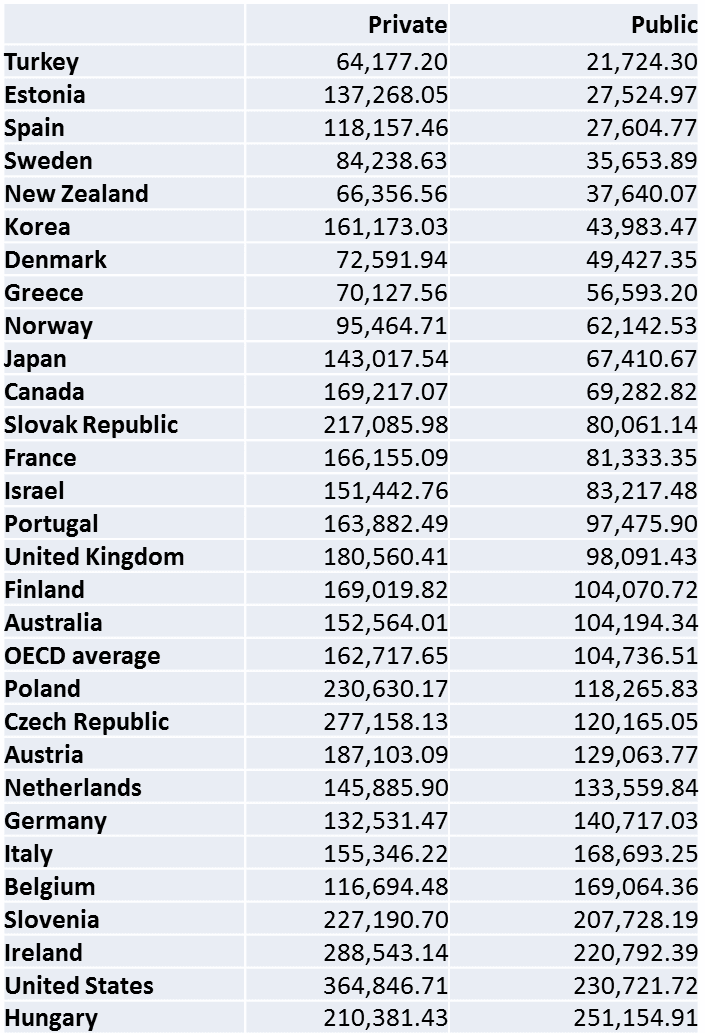
There is way too much to summarize here, so let me show you just one example -- the private and public returns on tertiary education for men.  (They also report on women).

The private returns on investment in tertiary education are substantial.  Not only does education pay off for individuals, but the public also benefits in the form of greater tax revenues and social contributions.  The following table shows the public and private gains associated with a man attaining tertiary education (2009) as compared with upper secondary or post-secondary non-tertiary education.


The net public return on investment for a man with tertiary education is over US$100,000 across OECD countries – almost three times the amount of public investment (direct cost plus foregone tax on earnings). For a woman, the public return is around US$60,000, almost twice the public investment.  Note that the public return for the United States is second only to that of Hungary.

The report includes the data in tables and downloadable spreadsheets and spells out the methodology and definition of indicators in detail.  Here, for example, are the indicators leading to the table shown above:


Most of this data is from 2009, so critics might counter that the cost of education has risen substantially since that time and the payoffs have dropped, and they would be correct.  On the other hand, we are experiencing a spurt of innovation in online education.
In the nations surveyed, education paid off handsomely for individuals and the public.  My guess is that, as we improve online education and begin to define its role in certification and employment, the payoff from education will grow.
If this report sounds interesting, you can download a copy  here.  Note that it includes links to Excel spreadsheets with all of the raw data, so you can draw your own conclusions. 

Monday, June 24, 2013

University consortium will innovate in on-line education

Provosts from a consortium of 13 research universities (mostly in the Big Ten) have issued a position paper calling for shared effort to take advantage of "new technologies and course redesign" to "improve instructional quality, enhance student learning outcomes, and extend the reach of campus instructional offerings."

They do not say so explicitly, but they seem to be saying they can innovate themselves rather than rely on the MOOC industry, and they propose collaborting on their online offerings.

As we have noted, there are now two major open-source MOOC platforms, which could be used by these or other universities to develop and offer their own material for offering as MOOCs or to supplement other teaching material, and we hope to see them offered as hosted services in the future.

Hopefully other consortia and university systems like mine (California State University) are thinking along similar lines. Let a thousand flowers bloom.

Thursday, May 16, 2013

Google Play Store for Education and the new 3Rs

Google announced Google Play for Education at Google I/O yesterday.

The store will be geared toward K-12 schools and organized by subject and grade, as shown here.

The apps will be focused on the Common Core State Standards which spell out the language and math skills and concepts students are expected to learn for success in college and careers.

The subject-grade organziation and focus on The Common Core, will make discovery of good apps relatively efficient.

The store will not be online till next fall, but they are encouraging developers to build apps now.  I'd be surprised if folks like The Khan Academy and MathisPower4U were not far down this path already. If they and independent developers and creative teachers begin building apps, we may see a loosening of the textbook publisher's grip. (Apple can't be too happy about this announcement either).

This is a K-12 Play store, but it sounds like it could be used as remedial source for today's university students -- you would be astounded by the math and language skills of many of today's undergraduates.

Some may chafe at the standardization and focus of Google Play for Education, but it only addresses a portion of the school day and the material is essential -- the 3Rs of our time.

Wednesday, March 13, 2013

The California legislature may endorse credit for MOOCs.

Governor Brown is following in his father's footsteps.

Governor Pat Brown is remembered for developing the California master plan for higher education in 1960. His son, Jerry Brown, the current Governor of California, may be remembered (for better or worse) as an Internet-era reformer of higher education.

Last fall, Governor Brown signed a bill designed to generate open text books, in order to alleviate the rapid rise of textbook prices compared with consumer prices, shown below. (Click images to enlarge).

This spring, San Jose State University is running a trial offering of credit for massive online courses from Udacity, a private company. The hope is that this will reverse the rising cost of tuition and fees.

Now the California legislature is considering a bill requiring the state’s public colleges and universities to give credit for faculty-approved online courses taken by students unable to register for oversubscribed classes on campus.

For a glimpse of the thinking behind these measures, this is what the Governor had to say higher education in his January State of the State speech:

With respect to higher education, cost pressures are relentless and many students cannot get the classes they need. A half million fewer students this year enrolled in the community colleges than in 2008. Graduation in four years is the exception and transition from one segment to the other is difficult. The University of California, the Cal State system and the community colleges are all working on this. The key here is thoughtful change, working with the faculty and the college presidents. But tuition increases are not the answer. I will not let the students become the default financiers of our colleges and universities.
And, it's not just California. In the supplemental notes to President Obama's State of the Union speech, under the heading "Holding colleges accountable for cost, value and quality," we read a call for revision of the federal student aid system, allowing for new measures of value and new system of accreditation:
The president will call on Congress to consider value, affordability, and student outcomes in making determinations about which colleges and universities receive access to federal student aid, either by incorporating measures of value and affordability into the existing accreditation system; or by establishing a new, alternative system of accreditation that would provide pathways for higher-education models and colleges to receive federal student aid based on performance and results.
If you want to dig deeper, you can see the text of the ambitious bill introduced February 21 and some March 8 amendments.

Tuition and fees
Textbook prices

-----

Update 4/6/2013

The California State Senate unanimously passed Senate Bill 520, authorizing the granting of credit for courses taken online. The bill now goes to the Assembly.

-----

Update 8/2/2013

California puts SB 520 on ice. State Senator Darrell Steinberg, who introduced the bill, has put it on hold in the face of faculty opposition and to take time to evaluate new online programs proposed by the University of California, California State University and California Community College system. For example, the California State University will offer 35 online courses statewide.

Tuesday, March 05, 2013

Survey of employer hiring criteria for bachelor's degree graduates -- internships pay off

The Chronicle of Higher Education and NPR Marketplace have reported results of a survey they commissioned of employers of college graduates.

They found that where a student goes to school is not as important as you might think. Graduates of "flagship" state universities are only seen as a little more "preferable" (on a 5-level Likert scale) than private or regional public campuses.

They also reported that, with the exception of education majors, the perceived value of a bachelor's degree was somewhat lower than it was five years ago.

Online degrees were rated "undesirable" (2.84 on a 5-level Likert scale), but I suspect that is based online private schools like the University of Phoenix.

Universities are moving increasing numbers of their classes online and that trend is stronger in public than private schools Will employer's perception of their graduates decline? What of fully online public programs like Calstate Online?

For me, the most interesting result was that internships were rated as more important than where one went to college, their major or GPA. Completing an internship was reported to be the most important credential for recent college graduates.

A related survey of 2012 college graduates reinforces the value of internships. They found that 55% of the students had internship and/or co-op experience and 51% of interns were offered jobs. Payed interns fared better than volunteers. They did less busy work and 63% got at least one job offer, compared to 41% of unpaid interns.

The Chronicle/Marketplace survey was conducted by Maguire Associates, but I could not find a report of it on their Web site. I would like to see the actual survey questions and analysis, but this article is worth reading. You should also listen to or read the transcript of the Marketplace podcast (2m 46s) on the study.

-----

Update 3/8/2013

College students or even high school students planning their college career should crawl around the NACE Web site. There is a lot of useful information there, including a salary calculator for many different jobs in many different locations, based on your background.

Actually, the NACE calculator is hosted on the Web site of their partner Jobsearchintelligece.com. JSI maintains a database with salary data for up to 1,000 occupations in 560 regions of the U. S. - with a minimum of 25 respondents for each occupation in each region to ensure statistical significance. You can easily query the database to find, for example, starting salaries for specific full time jobs given specific majors along with salaries for those same jobs ten years after graduation.

I decided to goof around with an example, and searched for data on modeling jobs. I said I was a recent grad with a GPA between 3.5 and 3.9 who had gone to CSUDH and majored in language and literature.

I learned that there are 60 persons employed as models in the Los Angeles area, and starting, median and top salaries are $27,120, $43,810 and $72,290. Based upon the background I provided, they estimated my starting salary at $38,900, but after looking at their overall employment picture for models, shown here, I decided to look for a different career.

Remember that college is about a lot more than hoped-for jobs and salary. The best thing that can happen at college is not finding a major that leads to job offers with good starting salaries, it is finding something you are passionate about. That is way more important -- put your energy there.

Tuesday, February 05, 2013

NMC-Educause report on technologies that will impact higher education

The New Media Consortium and Educause have teamed up on a report that looks into the crystal ball to predict technologies that will impact higher education in the next year, the next two or three years and the next four or five years.

The technologies they are bullish on are listed below. Do you agree? Can you think of educational applications for each of them? Download the report and see the basis of their predicitions.

Time-to-Adoption Horizon: One Year or Less
  • Flipped Classroom
  • Massively Open Online Courses
  • Mobile Apps
  • Tablet Computing
Time-to-Adoption Horizon: Two to Three Years
  • Augmented Reality
  • Game-Based Learning
  • The Internet of Things
  • Learning Analytics
Time-to-Adoption Horizon: Four to Five Years
  • 3D Printing
  • Flexible Displays
  • Next Generation Batteries
  • Wearable Technology

Tuesday, October 09, 2012

Inverting classes and outsourcing teaching material

Last week, I sent my class a copy of the announcement of Stanford's forthcoming MOOC An Introduction to Computer Networks.

One of the better students replied immediately, thanking me and saying it was just what he had been looking for. Since our on-campus introduction to networking involves some lab work, the two classes will not be identical, but could they be complementary?

This morning I read that NYU will run an inverted class in programming. The students will work through online teaching material at Codeacademy.com, then come to class to address problems and ask questions. The weekly class will also have guest lectures from technology industry leaders.
I find myself running an increasingly inverted class, expecting students to study my online modules on their own, freeing up class time for questions over the material and feedback based on their weekly assignments and quizzes. We also discuss current events that are pertinent to the class, which I describe in blog posts and Google Plus posts during the week.

Are you using any "outsourced" teaching material? Inverting your classes?

=====

San Jose State has reported improved test scores in a pilot comparison of an inverted class section using MIT material. It was just a midterm result from one section, so is far from conclusive, but we will keep an eye on the project and hope others do similar comparisons.

#digilit #jiscdiglit #highered #edreform #MOOC #pedagogy #EDUCAUSE #bonkopen
Collapse this post

Monday, October 01, 2012

Governor Brown signs California open source textbook bills

Spurred by the rapidly rising cost of textbooks, California Governor Jerry Brown signed two bills designed to provide Creative Commons textbooks and other teaching material to students in large-enrollment lower division courses. Senate Bill 1053 establishes the California Digital Open Source Library and Senate Bill 1052 establishes the California Open Education Resources Council to oversee and acquire material for the library.

As I read it, the nine member Council will be composed of three faculty members from University of California, the California State University and the California Community Colleges and this is what they will do:
  • Determine a list of 50 lower division courses in the public post secondary
    segments for which high-quality, affordable, digital open source textbooks
    and related materials would be developed or acquired
  • Review and approve developed open source materials and to promote strategies for production, access, and use of open source textbooks to be placed on reserve at campus libraries in accordance with this section
  • Regularly solicit and consider, from each of the statewide student associations of the University of California, the California State University, and the California Community Colleges, advice and guidance on open source education textbooks and related materials, as specified
  • Establish a competitive request-for-proposal process in which faculty members, publishers, and other interested parties would apply for funds to produce, in 2013, 50 high-quality, affordable, digital open source textbooks and related materials, meeting specified requirements
  • Submit a report to the Legislature and the Governor on the progress of the implementation of these provisions by no later than 6 months after the bill becomes operative and to submit a final report by January 1, 2016

This sounds good, and I am optimistic, but have a couple of questions:

Is the bill funded? The act states that all of this is conditional upon funding with State, Federal or Private funds.

At first, publishing companies opposed the bills, then removed their opposition. I wonder what they are thinking. Will they be applying for funds to produce these textbooks? How big a business might that end up being?

Finally, will these end up re-purposed versions of traditional textbooks, or will the library also acquire born digital teaching and learning materials?

It will be interesting to see how the funding goes, who ends up providing the textbooks in 2013 and how much it costs the tax payers.

#digilit #jiscdiglit #highered #edreform #MOOC #pedagogy #EDUCAUSE #bonkop

Thursday, August 16, 2012

What is a MOOC?

MOOCs (massive, open, online classes) are a hot topic -- they've generated a lot of experimentation, press, venture capital, etc. When my colleagues ask what it is all about, I point them to these quick resources:

1. Peter Norvig, The 100,000-student classroom. This is a six-minute TED talk describing the MOOC Norvig and a colleague taught at Stanford along with some of the principles that guided the course design.

2. A twenty minute audio interview of George Siemens, a professor at Athabasca University. Siemens was one of the first to teach a MOOC. (He may have coined the term). He describes his decentralized approach to MOOC design and, like Norvig, focuses on the need and opportunity for pedagogical research.

3. A twenty minute Ted Talk by Coursera co-founder Daphne Koller presents their MOOC techniques and highlights a few pedagoical research results.

4. Two blog posts that give a sense of the video production process at Udacity, a prominent, venture funded startup:

Disclaimer -- these are all presentations by enthusiasts. I've written several posts on MOOCs in the last year or so, and see a lot of potential, but there remain many unanswered questions.

Wednesday, June 27, 2012

Google to offer a MOOC with certification

Google will offer a MOOC on becoming a power searcher starting in July. The course will consist of six 50-minute classes with interactive activities.

The topic may sound mundane and self-serving, but there are two interesting aspects that make this course worth watching.

Students will use Google Plus, Groups and Hangouts to form learning communities and help each other out. These assets might give Google a strategic advantage in online education, and it will be interesitng to see how students and the course faculty end up using them.

It will also be interesting to see how the certificates of completion are used by others. For example, an undergraduate might be required to complete this MOOC as part of a digital literacy course or as a pre-requisite for a more advanced course.

I'm curious enough to sign up and see for myself.

----

The course is now complete and you can take it at your leisure. The six 50-minute classes are at:
http://www.powersearchingwithgoogle.com/course

Sunday, June 10, 2012

Can we use automated test essay graders as writing tutors?

Massive online classes are a hot topic -- they may disrupt and democratize education. Large classes offer economies of scale in the cost of developing and delivering teaching material, but grading does not scale as well. Multiple choice questions and simple computer algorithms can be graded automatically, but grading essays and other forms of assessment is labor intensive.

Might we automate essay scoring?

Kaggle is a company that organizes contests where teams of data analysts -- data miners -- are given a training data set, which they use to develop a predictive algorithm. In a recent contest, teams were given 16,000 student essays that had been graded by humans. The essays were responses to questions on state standardized tests. The contestants used this data to develop scoring algorithms that were then used on another set of test essays.

Randall Stross, writing in the New York Times, says the winning predictive algorithms were "eerily accurate" compared to human graders.

This $100,000 contest was sponsored by the William and Flora Hewlett Foundation, and is part of a broader program on automated grading. They recently published an analysis of the efficacy of commercial essay grading programs and a Kaggle blog post says they will run a second contest for grading of short-answer questions this summer. Three additional automated grading studies are in development.

Whether they are graded by humans spending a couple of minutes each or computers, the short-essay questions on standardized tests are not terrific indicators of writing ability.

Giving students feedback on rough drafts as they write would be a better application of this sort of technology. Writing online is increasingly important, and I have developed teaching modules on several types of writing, including short documents like these essays. I urge students to use spelling and grammar checkers, but that is rather shallow. Could short-essay grading algorithms be turned on their heads to give students feedback on the quality of their drafts while they are writing?

Monday, June 04, 2012

Global online education is taking off

Education cost and consumer prices
As shown here, the cost of education (in the US) is rising faster than general inflation. At the same time, voters are cutting spending on public education. As a result, online schools are springing up all over. There are many variations on the theme, and it will be fascinating to see which models survive. Here are some examples:
  • Calstate online: Charge tuition and grant degrees. Self-sustaining, non-profit.
  • edX: Free for now, but will they one day offer certificates for a fee? Large cash endowment, but what happens when that runs out?
  • The Khan Academy: Free forever? Contract with school districts? Foundation support.
  • Udacity and Coursera: Venture backed university spin offs are free for now, but investors will want income in the future.
  • NPTEL, the National Program on Technology Enhanced Learning: Produced by the Indian Institutes of Technology. Government funded and free.
  • Open University: Grants degrees and charges tuition (discount for UK students).
  • Open University Learning Space: Free online courses from 1-20 hours long from the Open University and the BBC.
Venture capital comes to education
There are also students with different goals:
  • Young people seeking a degree or certification at the beginning of their careers
  • Working people seeking a degree or certificate in order to improve their positions
  • Working people seeking training in a specific job skill
  • Curious people who want to learn about a subject as an end in itself
  • Curious people who want to acquire a skill as an end in itself
To make matters even more interesting, while US entries in the online education have been getting a lot of attention, this is a global phenomenon. We see offerings from the US, UK, India, Namibia and many other nations. Needless to say, there are also online students in every nation.

-----
Update 4/10/2013

UK Universities Minister David Willetts urged university leaders to invest in the "historic opportunity" presented by global online education.  The BBC article covering his talk also summarizes current online education efforts in the UK and places them in a global context.

-----
Update 4/25/2013

Coursera has launched its first international course, Science, Technology, and Society in China I: Basic Concepts, from the Hong Kong University of Science and Technology.

According to an article in the Chronicle of Higher Education, 17,000 students registered for the three-week course -- around 60 percent of them from the United States, the United Kingdom, Canada, and other rich nations, with the rest from countries like Brazil, Mexico, South Africa, and middle-income countries in Asia.  The article continues with an interesting discussion of the opportunity and barriers presented by the Chinese market for online education.  Will it be open or dominated by Chinese companies and universities?  Will Chinese universities and faculty be allowed to use Coursera and other platforms or will China erect a "walled campus?"  This course is in English -- will Coursera offer classes in Mandarin?

Other posts on MOOC globalization.

-----
Update 7/8/2013

The Chronicle of Higher Education profiles five international MOOC providers:

-----
Update 10/3/2013

Futurelearn, a coalition of universities in the United Kingdom, announced their first round of courses recently and now Udacity, with support from Google, has announced an effort to translate their existing courses. You can see an example here, with closed captions available in a variety of languages. Will English with sub-titles be sufficient or will students prefer native language presentation?


-----
Update 10/12/1013

list of MOOC providers They say it is up to date as of September 27 th.

-----
Update 10/16/2013

Two European MOOC providers, iversity and Futurelearn, are launching this month. The first course offered by Futurelearn, a coalition of UK universities, starts October 21. It is an ecology course called "Fairness and nature: When worlds collide" and it will only last two weeks. I will enroll to get a look at the Futurelearn delivery platform.
Iversity began with a scholarship from the German Federal Ministry of Science and Technology and is now venture funded. They will be offering MOOCs by university professors from around the world and are launching with six courses this month. Their course promotion videos are innovative, for example, combining video and graphics and using 3D video, as shown below. I want to keep an eye on their platform as well.


-----
Update 11/4/2013

Global competition is heating up. Coursera is establishing "learning hubs" around the world and has found a Chinese parnter, NetEase.

Coursera learning hubs

-----
Update 1/17/2014


Two thirds of all MOOC users live abroad in countries like Rwanda, Kenya, China, and Brazil according to this post by David Blake.

His post includes links to these MOOC providers:

ALISON (Ireland), Ewant (China), FutureLearn (United Kingdom), iVersity (Germany), Open2Study (Australia), Rwaq (Saudi Arabia), Schoo (Japan), UniMOOC (Spain), Veduca (Brazil), and XuetangX (China).


Tuesday, May 22, 2012

Is college's stone age is about to end?

Mark C. Taylor, chairman of the department of religion at Columbia University, asks whether college's stone age is about to end in a three part article on the university in the Internet era.

The three parts are at:
Here are a few quotes and paraphrases:
  • We produce too many unemployable PhDs.
  • Is one paying for education or certification when attending college?
  • Some subjects can be outsourced; for example, let one college have a strong French department and another a strong German department.
  • Online education will be modular.
  • There will be online winners and losers.
  • Financial pressure and improved technology have reached the point where much education will soon go online.
  • The networking of higher education will transform how teachers teach and what students learn.
  • Disciplines will need to be reconfigured -- departments can be transformed or abolished.
  • Faculty will increasingly serve as academic counselors who advise students on designing classes and integrating programs at different institutions.
  • Excessive competition and overspecialization are the plagues of higher education.

Monday, May 21, 2012

The online education market is global

There has been a lot of talk about and investment in open online classes from elite US universities like MIT, Harvard and Stanford, but let's not lose sight of the fact that online education is a global market -- on both the supply and demand sides.

Excellent universities in other nations than the US are offering classes, certificates and degrees online. There are Big Names like the Inidan Institutes of Technology, Cambridge, and Oxford and not-so-big names like the University of Namibia. Universities big and small in every language group are thinking about distance education today -- we can look forward to a lot of competition and choice.

The student population is also global. Stanford's AI course had students from 190 countries.  The class was also free, and the most exciting promise of open online education is that it can reach the disenfranchised.

One is reminded of the story of the young mathematician Srinivasa Ramanujan rising to fame after writing Professor G.H. Hardy at Cambridge from his village in Southern India. (His first two letters to Hardy are said to have been returned unopened). Tomorrow's Ramanujan will have a much easier time getting the attention of his tutors. How many Ramanujans will we find enrolled online and what will be their contribution to humanity?

I can't leave this post without pointing out the irony that Springer publishes a math journal named after Ramanujan. The print version of Ramanujan is $719 per year plus $67.50 shipping and handling and the electronic version is $590. Ramanujan could not have afforded it -- but the disruption of academic publishing is a different post.

Monday, April 30, 2012

John Boyer's massive face-to-face class at Virginia Tech

There has been a lot of talk about massive, open, online classes (MOOCs) like those taught at Stanford earlier this year.  But what about massive face-face classes?

Last year I saw John Boyer give a presentation on his 2,670 student, face-to-face World Regions geography class at Virginia Tech.

Boyer teaching his class
The class typically had 50-70 students when Boyer began teaching it in 1998. As the word got out, enrollment grew and the class moved from a classroom to a lecture hall to a large auditorium.

The weekly class meets for four hours, with a one hour dinner break. He has students interact with each other during the class, and also conducts Skype interviews on stage. His most famous interview was with Myanmar's Aung San Suu Kyi.

He and his class invited her to do the interview in a short (1:36) video clip. Check it out and you will see his trademark plaid jacket and get a feel for his style. You will also see nearly 3,000 cheering students.

Aung San Suu Kyi interview
She accepted their invitation and you can see the interview (33:37) in which students ask questions below. Be sure to watch the last couple of minutes.

As you see, Boyer is a flamboyant teacher who takes plenty of risks and they seem to pay off.

He holds his office hours online and the class uses the hashtag #wrvt. For his office hours, textbook, weekly news and more, go to his Web site.

Boyer concluded the presentation I attended with a few of the things he has learned teaching this large class:
  • A class this large needs less structure, not more. For example, he provides a menu of activities and allows students to select what they will do to accumulate points toward a grade.
  • A class this large cannot work unless students communicate with and help other students.
  • The teacher knows a lot about the topic, but the students collectively know a lot he does not know. (Michal Wesch, who teaches anthropology says the same thing).
Office hours
I did not get around to writing this post when I saw Boyer last year, but was reminded of him by an article in the Chronicle of Higher Education today. Check it out and see his student's comments here.

Finally, I saw Boyer's presentation at the Campus Technology Forum.  I've been to three of them, and they were all excellent learning experiences.

Monday, January 09, 2012

A student's evaluation of Stanford's massive, free, online courses

I wrote a couple of blog posts about Stanford's experiment with massive, free online classes when they were announced. The courses are now over, and Ben Rudolph, a Stanford student who took one of them on campus, has written a blog post describing his experience.

The basic format of the class was: watch 5-6 short (~10 minute) videos with interspersed review questions and complete a programming assignment each week.

Rudolph thought the video lectures were excellent, but found the programming exercises and review questions too simple. It seems the programming exercises were simplified so that they could be graded automatically and, while he found that the review questions helped him refresh what he had learned, "they hardly ever asked anything that the lecture didn’t explicitly state."

(This is not surprising, since making up short answer questions that require thinking and deduction is very difficult).

The bottom line is that he considered the course to be easier than other Stanford computer science classes he had taken.

There has been lively discussion of his post on his blog and others. I would particularly recommend that you read Debating the ‘Flipped Classroom’ at Stanford, which includes the reaction of Andrew Y. Ng, the professor who taught the course, to Rudolph's criticism.