Showing posts with label isp. Show all posts

Tuesday, September 04, 2018

Might CubeSats provide broadband Internet connectivity one day?

It's hard to believe that the capability of the satellites companies like OneWeb and SpaceX are contemplating might one day fit in a CubeSat, but think about the phone in your pocket.

In November, 2016, SpaceX filed a request for approval to launch 4,425 Internet-service satellites using the Ku and Ka frequency bands. The satellites were expected to measure 4 x 1.8 x 1.2 meters. In February, 2018 SpaceX launched two Internet-service test satellites -- TinTin A and B -- that measured only 1.1 x .7 x .7 meters.

Why the size difference?

Maybe some functions were omitted from the test satellites -- for example, they may not have included inter-satellite laser communication capability -- but technical progress also steadily reduces the size of electronic devices.

Might the capability TinTin A or B one day be packaged in a CubeSat?

A CubeSat is a small satellite composed of one or more 10 x 10 x 10-centimeter cubes (units) that weigh under 1.33 kg each. For example, the 3-unit (3U) CubeSat shown below would be 10 x 10 x 30 centimeters (plus a little more for the frame holding the cubes) and weigh under 3.99 kg.
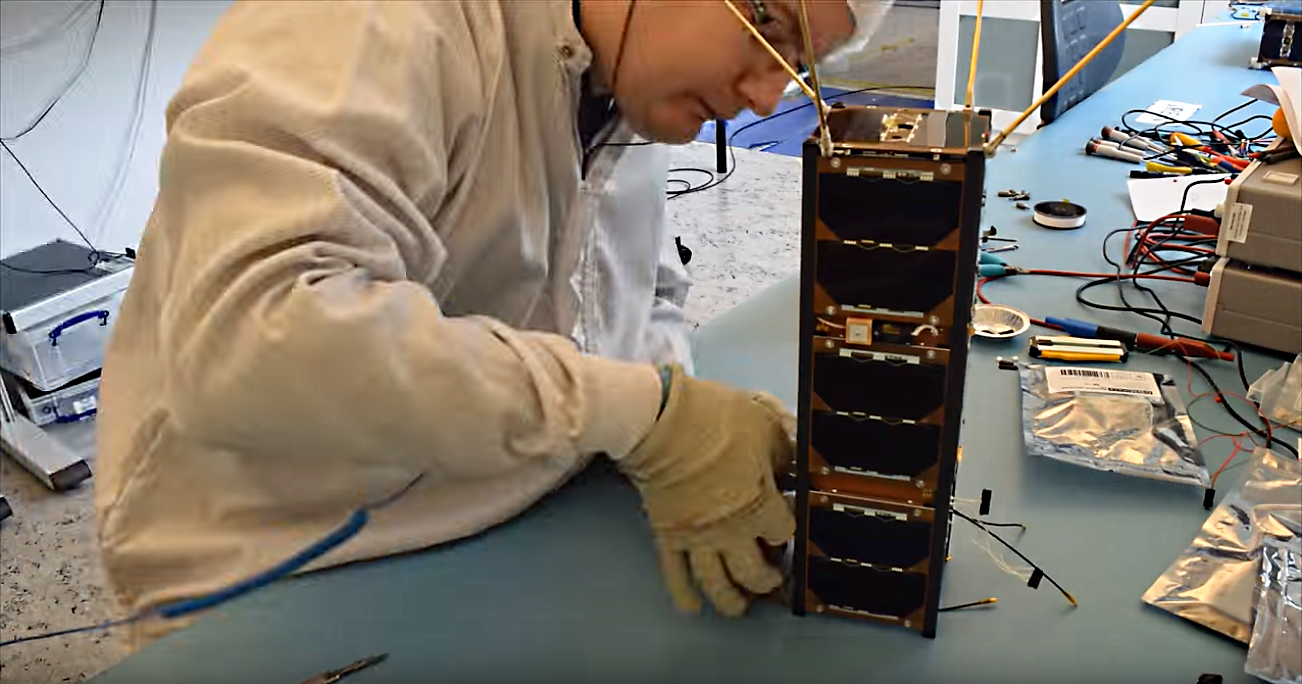
Assembling a 3U CubeSat

CubeSats were initially developed to support low-cost access to space for university research, but today they are being used in both commercial and research projects and many companies are manufacturing CubeSats and components.

Several startup companies are working on narrowband communication applications. Let's look at two examples.

SAS equatorial orbits (source)
Skyandspace (SAS) is off to an early start. They have three 3U CubeSats in an equatorial orbit and they have demonstrated instant messageing, voice calls, financial transactions and integration with public switched telephone network.

They plan to begin launching a 200-satellite constellation next year and to be fully operational in 2020. When complete, the constellation will serve the +/- 15-degree latitude region and provide personal voice calls and messages and connectivity for machine-machine communication and "Internet of things" applications.

SAS CEO Meir Moalem estimates that the "full constellation of the 200 nanosatellites will cost somewhere between $120 and $160 million,” which, he said includes "the production, launch, and operation of the constellation." They expect that that relatively low cost will enable them to replace 25% of the constellation each year, enabling them to constantly upgrade their technology. (APP Company Research used a figure of $150 million in an independent forecast).

SAS hopes to eventually provide global narrowband coverage with 1,000 satellites, but they are not talking about broadband service. On the other hand, "Internet in space" is the long-term goal of Kepler Communications.

Kepler KIPP (source)
Just over two years after the company was founded and a year after being funded, Kepler had KIPP, their first operational satellite, in orbit -- a testimony to CubeSat cost and development time.

KIPP, a KU-band, 3U CubeSat, is in polar orbit and providing high-speed, global store-and-forward service through their gateways in Inuvik and Svalbard. They are serving customers with latency-tolerant applications like bulk transfer of scientific and video data. (This is reminiscent of the first satellite Internet project I know of -- VitaSat -- which provided email and other asynchronous services in developing nations in the mid-1990s).

The next launches will be CASE, a slightly upgraded version of KIPP, which will add to their store-and-forward capacity and TARS, a redesigned 6U CubeSat that will be used for both store-and-forward and Internet of things applications. TARS will be the final service-demonstration satellite prior the early 2020 launch of the first 10 satellites of their 140 satellite constellation.

Both SAS and Kepler are small startups. SAS has issued stock and Kepler is venture funded. Kepler has also received In-Orbit Demonstration Mission funds from Satellite Applications Catapult, a non-profit company funded by Innovate UK which in turn is funded by UK Research and Innovation. (This sounds like an interesting public-private funding chain).

Like OneWeb (and unlike SpaceX), both work with partners in design and production of satellites, antennas, radios, etc. and both sound like fast-moving, innovative companies with a sense of purpose -- reminiscent of the early days of both personal computing and the Internet. The "careers" page of the Kepler Web site captures this feeling well. It offers the opportunity to "join the team that's building the Internet in space," recognizes that "a good cultural fit can oftentimes be more important than technical competency when building a company" and lists "indoor bike storage" as one of the perks of employment. I'm ready to sign up!

It's hard to believe that the capability of the satellites companies like OneWeb and SpaceX are contemplating might one day fit in a CubeSat, but think about the phone in your pocket. Also, as the following time-lapse video (1:54) shows, today's CubeSats are hand built -- what would mass-produced CubeSats cost and how many could a BFR launch at once?

Thursday, May 18, 2017

Comcast and Charter -- declining competition among ISPs

I am not an expert on the retail ISP industry -- just a dissatisfied customer of the monopoly service provider in my neighborhood -- but the following events have caught my attention during recent years.

In 2012, Comcast and Verizon agreed to stay out of each other's markets -- Comcast would focus on landline Internet and Verizon mobile Internet.

Last year, Charter Communications merged with two other companies to become the second largest ISP in the country.

This month, Comcast and Charter Communication have agreed to cooperate on mobile connectivity, to "explore potential opportunities for operational cooperation" -- "creating common operating platforms, technical standards development, and harmonization, device forward and reverse logistics, and emerging wireless technology platforms."

They also agreed not to make a major acquisition in the wireless sector without the other’s involvement for one year.

They will both resell Verizon wireless service.

President Obama & the Comcast CEO
(source)
A visual inspection of the coverage maps of Charter and Comcast does not reveal a lot of geographic overlap in their current service areas. (I'd be curious to see the actual statistics).

Many of us had only one or two choices for a landline ISP during the Obama administration and mobile connectivity remained a stable oligopoly. It does not sound like Charter and Comcast will be fierce mobile connectivity competitors, does it?

Capitalism needs competition to work well and a lack of competition offers a partial explanation for the US, home of the ARPANet, being ranked 15th on the International Telecommunication Union ICT Development Index. It certainly does not look like we can expect more ISP competition during the Trump administration.


Thursday, October 27, 2016

Internet service providers -- still the lowest ranked US industry on customer satisfaction

The performance of the ISP industry is as bad as it gets -- what do you expect from companies in monopoly or duopoly markets?

The other day, I got a notice saying my Internet service provider, Time Warner Cable (TWC), was changing its name to "Spectrum." At first I hoped they were changing their name because they were ashamed of the way I had been trashing them in blog posts. (For example, this is the most viewed post in the history of this blog).

But, then I remembered that Charter Communications bought TWC a while back.

The last time I looked at the University of Michigan American Customer Satisfaction Index (ACSI), TWC was rated next to worst among Internet service providers and the ISP industry was the lowest rated of all.

Can I expect service to improve now that I am a Charter customer?

I guess not. The latest ACSI survey shows that the ISPs are still the worst regarded industry by Americans:

The six lowest rated industries

TWC was the worst of the worst last time I looked -- might Charter pull them up? Here are the latest ISP ratings:

ISP ratings

TWC has improved since I last checked -- they are no longer the lowest rated ISP. That's the good news. The bad news is that Charter is ranked lower than TWC. I guess it could have been worse -- Frontier Communications, the lowest ranking ISP, could have purchased TWC.

An irony -- Verizon FIOS, the highest rated ISP, was abandoned by Verizon years ago and has now been sold.

The performance of the ISP industry is as bad as it gets -- what do you expect from companies in monopoly or duopoly markets?

Thursday, September 22, 2016

Verizon wouldn't lie to sell phones -- would they?

In previous posts, I have been unkind to my local-monopoly Internet service provider Time Warner cable and the US ISP industry in general. I've also been unkind to Verizon FiOS in their battles with Netflix and criticized their "gentleman's agreement" to abandon fiber to focus on wireless connectivity, leaving me at the mercy Time Warner Cable.

Those stories all had to do with landlines -- what about Verizon mobile? My wife had an unlimited account with a reseller of Verizon mobile service (a "mobile virtual network operator" or MVNO). She no longer needed the unlimited account, so decided to switch to Verizon.

This was shortly before the new iPhones came out, so she wanted to keep using her old phone for a month or so and, since she had been using it on the Verizon network, she assumed it would work after shifting her account from the MVNO.

To be safe, I went online and had the following chat with a Verizon salesman named Brandon:

Chat transcript -- click image to enlarge

As you see, I gave him the phone's mobile equipment ID (MEID) number and he said it was incompatible with the Verizon network and offered to sell me a new phone. I pointed out that the old phone had worked on the Verizon network for years and he suggested that it may have been blacklisted or have the wrong antenna -- like AM versus FM radio. He elaborated, saying it might be compatible with some, but not all, of their network or perhaps my wife had been roaming for five years.

Maybe the phone would not work somewhere on Earth, but it has worked everywhere my wife has been in the United States and abroad for the past five years. (She is not an early adopter :-). Here are the specs (MEID 990001106522642):


I am not a mobile phone geek -- Is there something that would render the phone incompatible with Verizon mobile service?

We ignored Brandon's warning and opened a Verizon account -- the phone worked fine (in southern California) until it was replaced with a new iPhone.

My guess is that Brandon was just telling me what he saw when he queried Verizon's database, so he was not lying. But is the Verizon compatibility database accurate and, if not, is Verizon lying in order to sell new phones? (This reminds me of the Volkswagen smog check shenanigans).

-----
Update 10/10/2016

Let's talk about customer service.

In spite of Verizon saying it was incompatible with their network, my wife has been using her old iPhone 4 on their network without problems. When she transferred her account to Verizon, they said she had to sign up for a billed (post-pay) account, but could then switch to an automatically-charged, pre-paid account (to get a higher data cap) whenever she wanted to.

She did that two days ago. Doing so required that she speak on the phone with three different Verizon employees -- a support person, a sales person and an account verification person. There were long waits on hold before each of those conversations and she had to explain the situation to each of the people -- there was evidently no transfer of information between them. The entire process took well over an hour.

I am posting this for two reasons:
  1. Verizon has sold their FiOS landline service, but it was the lowest ranked company in the lowest-ranked industry (Internet service providers, ISPs) on the American Customer Satisfaction Index before the sale. I've not seen a ranking for mobile ISPs, but based on this experience, I would expect Verizon to look bad.
  2. One frequently hears complaints about poor service from bureaucratic government agencies. Government agencies are large organizations with monopoly power. ISPs are also large organizations in monopoly or oligopoly markets. A large, private organization in a monopoly or oligopoly market is nearly as likely to provide poor service as a government agency.

-----
Update 10/15/2016

The customer-service saga continues.

I made two payments on my wife's pre-paid account. Perhaps because she changed her account from post-paid to pre-paid, Verizon failed to credit one of the payments and does not seem to realize that she is now post-paid and should be getting a higher data cap.

I tried to clear it up by going to the "My Plan" page on the Verizon Web site, but the page was temporarily down:

That was 25 hours ago. The page is still temporarily down.

I also tried to clear this up with a phone call or chat, but could only find sales pages on their Web site. (I got the phone number last week from a Best Buy store clerk).

Verizon is making the folks like the IRS or Department of Motor Vehicles look good.