Showing posts with label arpanet. Show all posts

Saturday, February 23, 2019

Rethinking technology policy - the 50th anniversaries of the moon landing and first ARPANET message

The anniversaries of these milestones remind us of the economic and social returns we have seen from ambitious Federal research, development and procurement programs. Why isn't this a Sputnik moment for the United States?

Log entry for the first ARPANET
message (Source)
On July 20, 1969, Neil Armstrong stepped out of the Apollo 11 lunar lander and set foot on the moon. On October 29th, Charley Kline, an ARPANET programmer at UCLA, attempted to log in to a host at Stanford Research Institute (SRI), but the system crashed after he had typed LO. After a bit of debugging, he succeeded in typing LOGIN and the rest is history.

These events were milestones in ongoing, federally-funded research and development efforts -- the manned spaceflight program and the development of digital telecommunication networks from Morse's telegraph to early electronic digital computers and telemetry experiments, the SAGE early-warning system and eventually the ARPANET and the Internet. (The previous link is to a text version of the history article. Contact me if you would like a pdf of the article as it appeared in the Communications of the ACM).

The anniversaries of these milestones remind us of the economic and social returns we have seen from Federal research, development and procurement programs. When President Franklin Roosevelt was inaugurated in 1933, he enacted many ambitious government programs aimed at ending the great depression -- a "new deal." He initiated programs like Social Security and infrastructure projects like rural electrification. Confidence in the Federal Government being able to pull off large, successful programs continued through World War II, the Berlin Airlift and Marshall Plan, the Interstate highway system and the space program.

Early ARPANET sketch, showing
UCLA and SRI nodes (Source)
President Kennedy kicked off Apollo program in 1961, saying he believed "that this nation should commit itself to achieving the goal, before this decade is out, of landing a man on the moon and returning him safely to Earth." But pendulums swing and, in a 1986 press conference, we heard President Reagan say “The nine most terrifying words in the English language are: I’m from the government and I’m here to help you.” Today we are discussing a "green new deal" -- is the pendulum about to swing back?

Update 3/14/2019

Former National Security Advisor Tom Donilon addressed technology policy in an terrific interview. The following is a paraphrase of his reflection on the emergence of collaboration between government, universities and private companies that was born when the Russians launched their Sputnik satellite:
I don't think we're having anywhere near the conversation we need to have about the missing piece of China policy which is: what is the United States going to do? Why isn't this a Sputnik moment for the United States? In the late 1950s, when the Soviets launched the Sputnik satellite, the United States undertook an enormous national effort that changed the way we taught math and established NASA and the Golden Triangle of technological and innovation development between the government and research universities and private companies.

We face a similar challenge at this point in terms of technology competition with China. That is something I think we need to be talking about and the discussion includes immigration policy, infrastructure investment, education investment and [consideration of the] impact of technology, particularly artificial intelligence, robotics and automation on labor markets. Populism is not at its peak right now -- we need a really serious discussion about how we are going to manage the future of work in the face of technology.
This comment was made at around 33:15 of the interview:


Tuesday, July 16, 2013

Vint Cerf -- a concise history of packets, the ARPAnet and the Internet

Conceptual sketch of the ARPAnet by Larry Roberts
If you are interested in the history of the Internet and only have 16 minutes to spare, watch this interview of Vint Cerf, who was one of the handful of people that created the Internet.

Cerf's narrative begins with the idea of packet switched communication and runs through the creation of the ARPAnet, followed by the invention of internetworking protocols to link three disparate networks -- the ARPAnet, a mobile communication network and a satellite communication network.

This short video is like an annotated table of contents of the early history of the Internet. Cerf introduces us to Leonard Kleinrock, Paul Baran, Donald Davies, Larry Roberts, Thomas Marill, J. C. R. Licklider, Doug Engelbart, Norman Abramson, Robert Taylor, Charles Herzfeld, Steve Crocker, Jon Postel, Bob Kahn, David Reed, Danny Cohen and Bill Joy, summarizing the work of each and putting it in context.

Whether this is all you want to know about the history of the Internet or you want to use it as a jumping off place to learn more about the contributions of these people, this is a good place to start.

Cerf also conveys a sense of common purpose among those pioneers. He does not say so, but one can think of them as working together to realize Licklider's vision of a network running Engelbart's applications. Cerf makes it clear that, although they worked for several different organizations and changed jobs from time to time, these people knew each other well and collaborated closely on creating the Internet. (For example, Cerf, Postel and Crocker went to the same high school and studied under Kleinrock as graduate students at UCLA). The group also had an excellent collaboration tool -- they were the first users of the networks they built.

The ARPA/Internet project was a great example of government as a non-equity angel investor -- providing a small bit of seed funding ($124 million) to a group of smart, dedicated people, rather than setting up a department to do the work internally.

Charles Severance of IEEE Computer Magazine conducted the interview of Cerf, and it is one in a series of computing conversations.

Wednesday, January 02, 2013

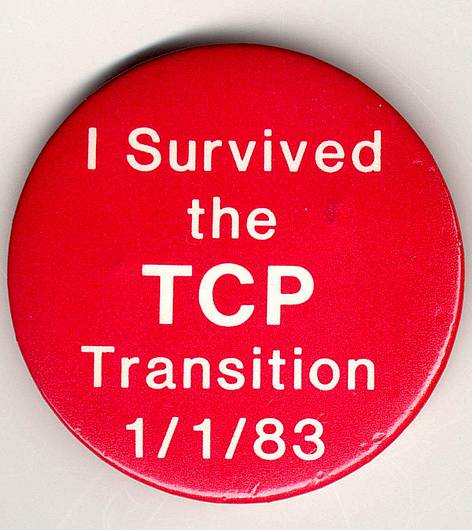
The 30th anniversary of the transition of the ARPANET to TCP/IP -- the birthday of the Internet?

Pre-network packet switching -- routing
telegrams by tearing paper tape

New Years day marked the 30th anniversary of the transition of the ARPANET to the TCP/IP communication protocols, a day many consider the birthday of the Internet. Let's look back to see why that date was an important milestone.

The ARPANET, the first large, operational, packet-switched network, was funded by The Advanced Research Projects Agency of the Department of Defence (ARPA, later DARPA) and it went online October 29, 1969. The ARPANET, which began as untested research, grew and evolved and was declared "operational" in 1975.

The ARPANET was a success, but all the connected machines used the same communication protocol -- it was like a nationwide LAN. But DOD had other networks using different protocols, so they funded the development of an inter-networking protocol to enable these dissimilar networks to communicate. The design for that protocol, the transmission control program (TCP, later split into two layers, TCP/IP), was published in a paper by Vint Cerf and Robert Kahn in 1974.

TCP/IP was implemented and tested and, on January 1, 1983, the ARPANET was transitioned to TCP/IP. Was that the birthday of the Internet?
One might argue that the Internet began with the vision of pioneers like Vannevar Bush, JCR Licklider and Doug Engelbart, Paul Baran's RAND reports, early packet switching experiments, the start of the ARPANET, the first tests of TCP/IP, the diffusion of TCP/IP with NSFNet, etc., but the first large scale inter-network began with the deployment of TCP/IP on the ARPANET and TCP/IP (and Ethernet in the LAN) remain the basis of today's Internet.

Here are a few links you might want to follow if you want more on the 30th anniversary: