Showing posts with label netflix. Show all posts

Monday, August 11, 2014

An estimate of Netflix's "fast lane" fee to Comcast -- $.86 per subscriber per month

Netflix, ISPs and transit providers blame each other for poor Internet performance. The public would be well served by transparency -- seeing the cost and traffic data underlying the debates on network neutrality and, more important, the high cost of US Internet service and lagging investment in US Internet infrastructure.

Generator Research has estimated the cost of delivering Netflix content in their report Over-the-Top Television, 2014, which includes an estimate of the cost to Netflix and Comcast of delivering Netflix content and of the fee Netflix is paying Comcast.

They begin by noting that Netflix's total cost of revenue (including content, delivery and other costs) was reported as $1,849 million in 2013 and they had an average of 29 million US subscribers for the year, then make the following assumptions:
  • The cost of content is 80% of the total cost.
  • The cost of delivery is 80% of the remaining cost.
  • 75% of delivery cost is in the access network, 25% in the ISP network.
  • Comcast earns $30 per month per subscriber, $24 of which is as a result of delivering Netflix traffic.
  • 80% of Comcast traffic is due to Netflix.
Based on this, they estimate the total cost of delivering Netflix content as $2 per subscriber per month, with Netflix paying $.86 and Comcast $1.15. Assuming they split the cost in proportion to their monthly revenue ($7.99 for Netflix and $24 for Comcast), Generator guesses that Netflix's fee to Comcast is around $.28 per month per subscriber -- less than 5% pf the cost of a subscription. (Compare that to my ISP increasing my bill by 5-10% every year because, as a monopoly provider, they can).

Generator's conclusion is based upon several assumptions, which you may question, but it is a starting point in estimating cost of content delivery.

-----
Update 8/26/2014

Whatever the marginal cost, someone has to pay for investment in Internet infrastructure. Netflix CEO Reed Hastings says it would cost the ISPs very little to upgrade in order to provide the level of service they advertise to their customers.
It's worth noting that Netflix connects directly with hundreds of ISPs globally, and 99 percent of those agreements don't involve access fees. It is only a handful of the largest U.S. ISPs, which control the majority of consumer connections, demanding this toll. Why would more profitable, larger companies charge for connections and capacity that smaller companies provide for free? Because they can.
Hastings' post is one in a series on How to Save the Net running at Wired.com.

-----
Update 9/24/2014

Netflix CEO Reed Hastings was on a panel at the Cable and Telecommunications Association for Marketing EuroSummit Conference in Copenhagen last week. Mike Fries, CEO of Liberty Global was a fellow panelist. Hastings "jokingly" offered Fries the following deal:
Consumers are choosing Netflix and if we’re supposed to pay some of the cost of the network, maybe we should get some of the broadband revenue ... we’ll pay 10% of your network costs if we get 10% of broadband revenue. Or we’ll pay 10% of your network costs if you want to pay 10% of our content costs.
Hastings also stated that
The crazy thing in this whole debate is the actual amount of money being talked about is trivial to both of us – but we’re both worried on both sides about the precedent and what does it mean in the longterm?

Monday, June 09, 2014

Netflix blames Verizon, Verizon blames Netflix -- let's see the data.

Netflix says Verizon is a streaming bottleneck, Verizon says the congestion is upstream -- we need data not accusations.

Netflix recently showed messages like this one when they had to adjust the bit-rate on their streams to FIOS customers:

Verizon responded, claiming that the congestion was upstream from FIOS, and threatened legal action. Netflix says they will drop the messages for now.

The public and regulators need more data and transparency, not less. For example, here are Netflix data rate histories for Google Fiber, Comcast, Verizon FIOS and Verizon DSL:

This data clearly shows the improvement in Comcast speeds when they and Netflix agreed to terms in February. (One wonders how that rapid improvement was achieved and how much investment it required).

Verizon DSL is slow because of the technology. Those Verizon customers who can get FIOS are surely better off, but one wonders why Verizon fiber is so much slower than Google fiber and Comcast cable.

If Netflix congestion is upstream from Verizon, they should present data demonstrating that.

-----
Update 6/10/2014

Google also publishes data on YouTube streaming performance for ISPs. I checked the performance of Time Warner Cable, my not-so friendly ISP, in Los Angeles, my city.

The following graph shows YouTube video consumption for time slots beginning at 6 AM and peaking at 9 PM.


Google also reports the percent of the time an ISP delivers high definition (720p), standard definition (360p) and lower quality. For me, the worst performance, HD 81% of the time and SD 19%, occurs between 9-10 PM.


This is one more source of ISP performance data -- check it out and see how your ISP rates compared to others in your location (if there are others).

-----
Update 6/13/2014

The FCC will scrutinize the pay for service deals Netflix and Comcast and Verizon. They will also look at others, including Google.

FCC Chairman, Tom Wheeler, said he already had copies of the contracts, but I hope he asks the companies to provide traffic data and also disclose the cost of the infrastructure investments they make to keep service reasonable.

-----
Update 7/7/2014

YouTube has joined Netflix in linking to data when video delivery slows down. I was watching a YouTube video that began to stutter. When it paused to rebuffer, I saw this message:

When I clicked on the find out why link, it took me to Google's Video Playback Checklist, which lists things that might go wrong and suggests fixes -- no blame on your ISP -- so far. If none of those fixes help, they also provide a link to the Google Video Quality Report (described above). As we asked -- they show us the data.

-----
Update 7/19/2014

I've asked to see congestion data and to know the cost of alleviating the bandwidth shortage noted by Netflix customers and other Internet users. Mark Taylor, VP of Content and Media at Level 3, a transit provider used by Netflix, has given us some data and some costs. This diagram shows data at one of the of the ten exchange points between Verizon and Level 3:


We see that the congestion between Level 3's customer (Netflix) and a Verizon retail customer occurs in the forwarding of packets between their routers (in the same building). Both the Level 3 and Verizon networks are uncongested (green) but the links between their routers are congested (red).

That is the data for this exchange point, but what about the cost of alleviating the problem? Taylor says it is a few thousand dollars and five minutes work to install 10gb port cards in the routers. He says they have been asking Verizon to install the cards for many months and offers to have Level 3 pay for them. He says he will throw in the short cables between the routers.

If more capacity were needed after those eight port cards were installed, new equipment would have to be purchased, but that would be a small fraction of the cost of the networks the routers connect.

Note that the above diagram is based on a Verizon post describing the situation at the Los Angeles exchange point. Furthermore, it shows under utilization on the Verizon network -- no need for data caps in that case :-).

-----
Update 7/24/2014

David Young, Verizon's Vice President for Regulatory Affairs, has posted a reply to the claim by Mark Taylor of Level 3 that Verizon is causing Internet congestion. Young says the problem is not datacenter exchange point congestion, as Taylor claims, but congestion in the Level 3 network. In fact he says that:
Level 3 insists on only using its existing settlement-free peering links even though, as Level 3 surprisingly admits in their blog, these links are experiencing significant congestion.
This is Verizon's view of the situation -- transit providers like Level 3 are the problem:

But, when I looked back at Mark Taylor's post, I saw no such admission. In fact, Taylor says "our network has plenty of available capacity" and goes on to state that:
I can confirm once again that all of those thousands of links on the Level 3 network are managed carefully so that the peak utilizations look very similar to those Verizon show for their own network – IN BOTH DIRECTIONS (his caps).
These are conflicting statements -- who to believe?

Considering Verizon's track record, I'd give the benefit of the doubt to Level 3. Verizon promised to install FIOS fiber in my neighborhood several years ago, but subsequently changed their mind and decided instead on a "gentleman's agreement" dividing the wireless (Verizon) and land-line (cable companies) ISP markets. Indeed Verizon has a track record of broken promises -- Bruce Kushnick has documented 300 billion dollars worth of them.

That history makes me suspicious that Level 3 is telling the truth, but it is not proof. Proof would require transparency on both sides. Level 3 and Verizon should show us the data -- let's see the traffic logs for your networks. (Or at least let the FCC staff see them).

-----
Update 10/15/2014

I've asked to see the data. It's not congestion data, but Generator Research has estimated the cost of delivering Netflix content in their report Over-the-Top Television, 2014, which includes an estimate of the cost to Netflix and Comcast of delivering Netflix content and of the fee Netflix is paying Comcast.

Their estimate of Netflix's "fast lane" fee to Comcast is $.86 per subscriber per month. That is a small portion of the inflated monopoly/oligopoly prices we pay to Comcast and other Internet service providers. It seems to me that we should be paying more attention to the lack of competition in the ISP industry than to network neutrality.

-----
Update 11/9/2014

M-Lab monitors Internet performance and has published a report on ISP Interconnection and its Impact on Consumer Internet Performance.

The report concludes that
Using Measurement Lab data, and constraining our research to the United States, we observed sustained performance degradation experienced by customers of Access ISPs AT&T, Comcast, Centurylink, Time Warner Cable, and Verizon when their traffic passed over interconnections with Transit ISPs Cogent Communications (Cogent), Level 3 Communications (Level 3), and XO Communications (XO). In a large number of cases we observed similar patterns of performance degradation whenever and wherever specific pairs of Access/Transit ISPs interconnected. From this we conclude that ISP interconnection has a substantial impact on consumer internet performance -- sometimes a severely negative impact -- and that business relationships between ISPs, and not major technical problems, are at the root of the problems we observed.

It seems that interconnection between transit ISPs and ISPs that connect customers (access ISPs) is indeed the weak link in the content delivery chain.


The above figure gives an overview of download throughput between Access ISP and Transit ISP pairs during 2013. For each of the 28 graphs, the Y axis shows the % of hours with the given download throughput, and the X axis shows the download throughput (Mbps). Red, on the left, indicates sub-broadband speeds (download throughput below 4 Mbps). What this table demonstrates is not simply a proliferation of performance issues, but that these issues cannot be laid at the feet of any one Access ISP, or any one Transit ISP: no Access ISP performs badly to all Transit ISPs, and no Transit ISP performs badly for all Access ISPs. Therefore, if the problem is not at one end, and not at the other, it must be in the middle around the interconnection between the two.

For example, my ISP, Time Warner falls below 4 Mbps (red) over 30% of the time when delivering Cogent packets, but does much better with data from other transit ISPs.

Monday, June 02, 2014

Comcast speed dips then recovers rapidly after the Netflix agreement is made

What caused the sudden improvement in Comcast service and how much did it cost?

As shown here, Netflix download speed began dropping for Comcast customers last November and began picking up in February. It rose another 2% in April.


What happened? The cynical, but quite plausible, answer is that Comcast refused to upgrade their equipment while negotiating with Netflix on fees for faster service, resulting in poor performance and angry customers, and they made the necessary investment after a deal was concluded in February.

Infrastructure investment is central to the network neutrality debate. If this improvement was due to investment upstream from Comcast, they should present data demonstrating that. Regardless of who made it, I would like to know how much we are talking about here -- what did it cost to increase performance so dramatically?

The public, the FCC and the FTC need that sort of transparency to formulate policy that will incent infrastructure investment.

Saturday, March 22, 2014

Netflix CEO Reed Hastings has posted a call for “strong net neutrality.”

In a post entitled Internet Tolls And The Case For Strong Net Neutrality, Netflix CEO Reed Hastings says that deteriorating customer experience fored him to agree to pay Comcast an interconnection fee. While that was a necessary short term step, he argues that, in the long run, such tolls would lead to escalating fees. Soon, every large ISP would be charging interconnection feesa toll, as depicted here:


Here are a couple of quotes from Hastings’ post:
For any given U.S. household, there is often only one or two choices for getting high-speed (10 Mbps) Internet access and that’s unlikely to change.

and

When an ISP sells a consumer a 10 or 50 megabits-per-second Internet package, the consumer should get that rate, no matter where the data is coming from.
As a consumer, I like the sound of that second quote -- I think that is what Hastings considers “strong net neutrality.” But, if the ISPs are not allowed to charge a “toll” for your traffic, won’t they pass their interconnect cost on to us consumers?

Isn't the monopoly market the real problem? If Netflix and others do not pay a fee to the ISP, won't they raise consumer prices?

What can be done to solve the real problem (for individuals and society) -- a lack of ISP competition?

Regulation or competition from local government-operated networks are two traditional answers and there are hopeful signs on both fronts. The FCC wants to formulate new rules with regard to net neutrality and is considering measures to overturn state laws restricting public broadband. Perhaps the citizens (voters) are getting fed up and the FCC is beginning to hear them -- is there a glimmer of light at the end of the tunnel?

-----
Update 9/24/2014

Netflix CEO Reed Hastings was on a panel at the Cable and Telecommunications Association for Marketing EuroSummit Conference in Copenhagen last week. Mike Fries, CEO of Liberty Global was a fellow panelist. Hastings "jokingly" offered Fries the following deal:
Consumers are choosing Netflix and if we’re supposed to pay some of the cost of the network, maybe we should get some of the broadband revenue ... we’ll pay 10% of your network costs if we get 10% of broadband revenue. Or we’ll pay 10% of your network costs if you want to pay 10% of our content costs.
Hastings also stated that
The crazy thing in this whole debate is the actual amount of money being talked about is trivial to both of us – but we’re both worried on both sides about the precedent and what does it mean in the longterm?

Monday, February 24, 2014

Comcast is probably not cheating ... yet

Within the last few days, Comcast agreed to purchase Time Warner Cable and Netflix agreed to pay Comcast for direct access to their network. Will Netflix pass the Comcast payments along to us consumers? Will we get better quality and fewer pauses for buffering? Is this the end of network neutrality regardless of anything the FCC might do to restore it? Is this the beginning of the end for the good old Internet we have grown to love?

Maybe not.

It is true that Netflix will be paying Comcast for direct access to their network, but they will save what they had previously been paying intermeidate transit networks like Cogent. The overall cost to Netflix may be more, less or the same -- terms of the deal have not been disclosed. Don't get me wrong -- I doubt that they will be saving money, and, if they do, I am sure they will not pass the savings on to us consumers.

How about speed increases? Netflix has acknowledged performance problems, and this deal should help. It is practically certain that we will see improved performance, even if the blockage was done on purpose. (Hey, that was some good news).

This may not even be a violation of network neutrality. Couldn't the delays have been due to capacity problems of intermediate networks rather than Comcast? Is there evidence that Comcast was dropping or delaying Netflix packets? This is not to say that Comcast was not discriminating against Netflix traffic or that they may not in the future, but, as far as I know, there is no evidence that they did. (Where is Edward Snowden when you need him)?

Don't get me wrong -- I have nothing good to say about my ISP -- Time Warner Cable -- and I am confident that the situation will be even worse if the Comcast deal is approved. That sort of concentrated power cannot be good for anyone except those who have it.

Timothy Lee points out that one result of that concentration may be the elimination of the transit ISPs like Cogent, who are in a competitive market. Comcast and other companies that connect consumers face little or no competition.

GigaOm's Stacey Higginbotham has suggested that transparency -- opening the terms of these deals to public scrutiny -- might be a solution, but I am skeptical.

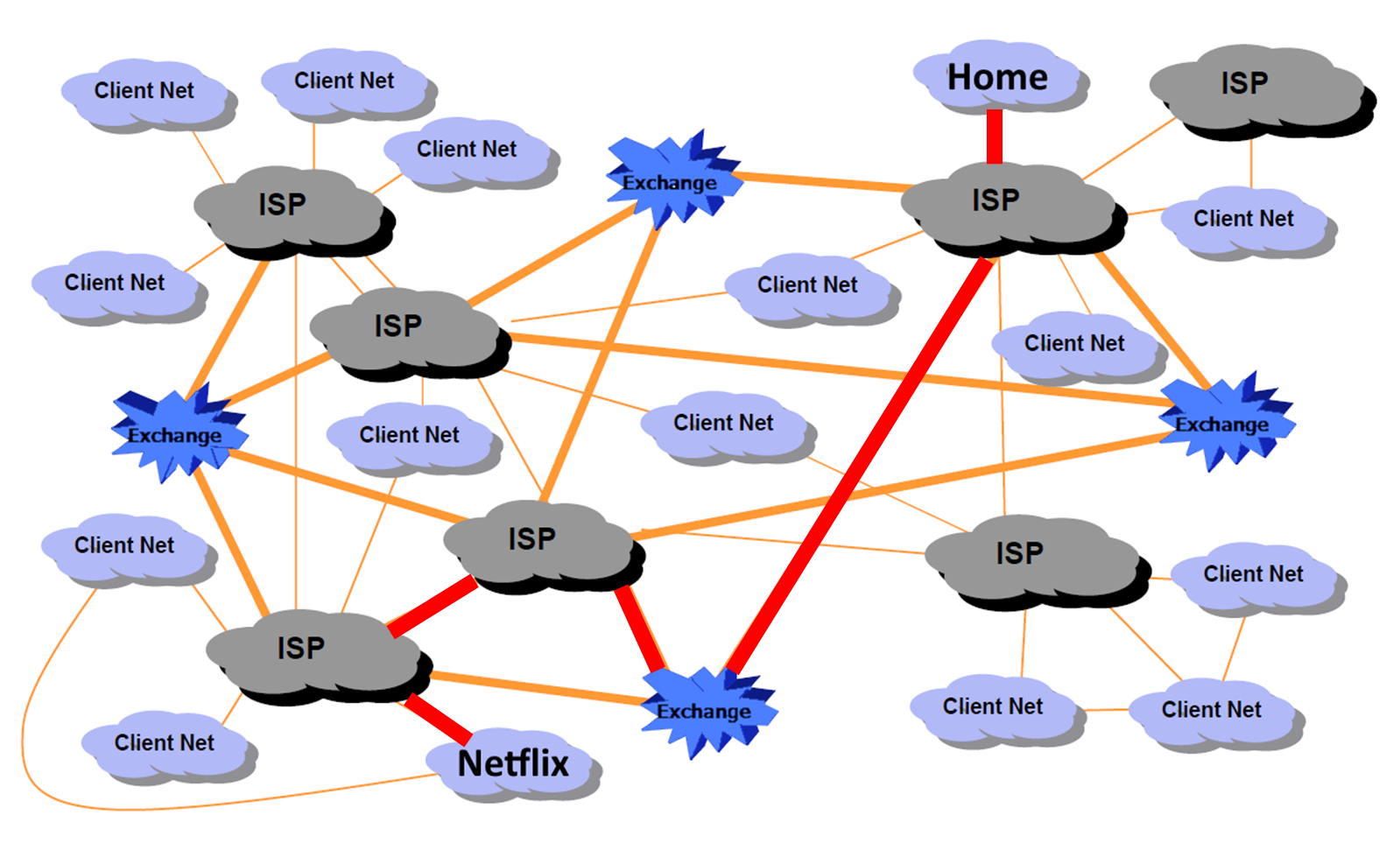
The following images show the route between one's home and Netflix before the agreement with Comcast, the way it is now that the deal has been done and the way it will end up if Comcast has their way.

Before the agreement, transit ISPs connected us to Netflix servers.
Now our ISPs connect us straight to Comcast.
After the merger, Comcast will be my ISP.

Thursday, September 19, 2013

Thirty eight percent in the US watch Netflix online -- each one knows how to "cut the cord"

Yesterday I posted a note on Netflix' vision for their company and the TV industry in general. They now see themselves as a "movie and TV series network" and predict rapid growth for Internet TV. Today, I came across a Nielsen survey that supports both of those contentions.

The survey showed that 38% of the people in the U. S. subscribe to or watch Netflix streaming video service. That is up from 31% last year.


I don't know about you, but that is a lot more than I would have guessed. It is about 119 million people if they consider the entire population -- babies and all. Note also that Hulu and Amazon also have significant, growing numbers of subscribers.

Netflix' view of themselves as a series network is also confirmed by the study. Forty five percent of Netflix streaming subscribers say the types of shows they watch when they stream are original programming -- series like "House of Cards."

And, when they watch those series, they tend to “binge.” Eighty eight percent of Netflix users and 70 percent of Hulu Plus users report streaming three or more episodes of the same TV show in one day. As we pointed out in our previous post, both consumers and creators like the full-season format of Netflix productions.

The survey also showed, that Netflix and Hulu are watched on a variety of devices:


The above figure also suggests a trend away from computers and game machines toward phones and tablets. People want to watch TV on any device at any time and at any place.

"Over the top" Internet television is not just for geeks any more -- 38 million people understand how easy it is to defect from cable and satellite TV, to "cut the cord." As the quality and variety of Internet TV material improves, it will be easy for them to drop their cable and satellite subscriptions. When we reach the tipping point, the transition will be rapid.

Wednesday, September 18, 2013

Netflix' vision of their company and the future of television

Check out the Netflix Long Term View document for investors. It is interesting because it reveals their vision of the company and for the future of television in general.

As to the vision of the company, they say they are a "movie and TV series network." Note that they see themselves as a "network" -- will Netflix, YouTube, Amazon and the BBC become the new television networks?

But, they are not just a network, they are a "TV series network." That is a testament to their success producing multi-episode series for Internet distribution. People like to watch TV without commercials. They also like watching two, three or maybe all the episodes in one sitting. They like watching TV on phones, tablets, PCs or television sets whenever they want to.

Creators also like the artistic freedom and financial security of the Netflix format. They have the freedom to craft a long story. We can think of the Netflix series "House of Cards" as a 661 minute story, to be watched in one or several sittings. The 13 episodes vary from 46 to 56 minutes in length -- the writers are not constrained by time slots and commercial breaks. They could have created more or fewer episodes if they that was the best way to tell the story.

For more on a creator's view of Netflix, watch Kevin Spacey's excellent 2013 James MacTaggart Memorial Lecture 2013 (below). Spacey, who produced and starred in "House of Cards," says he pitched it to the TV networks and cable companies, but he went with Netflix because they gave him total creative control, funded 26 episodes up front and did not request a pilot episode. He feels that pilots are an expensive, misleading digression. He is producing very long stories with evolving characters, and trying to cram that into a single TV pilot or a two hour movie is impossible.

How about the Netflix vision of the future of television?

They sum it up saying that "While Internet TV is only a small percent of video viewing today, it will keep growing because:"
  • The Internet is getting faster, more reliable and more available;
  • Smart TV sales are increasing and eventually every TV will have Wifi and apps;
  • Smart TV adapters are getting better and cheaper;
  • Tablet and smartphone viewing is increasing;
  • Internet TV apps are improving through competition and frequent updates;
  • Streaming will be the leading source for 4k/UHD video;
  • Internet video advertising is becoming more personalized and relevant;
  • TV Everywhere provides a smooth economic transition for existing networks;
  • New entrants like Netflix are innovating rapidly and driving improvements.
Do you like "binging" on a commercial free TV series? (I just finished "Orange is the New Black"). Do you agree with Netflix' reasons for the future growth of IPTV? Are they enough to overcome the power of the incumbents?

Check out Kevin Spacey's lecture:


Tuesday, May 28, 2013

Netflix drops Sponge Bob Square Pants (and why it matters)

Netflix is on a roll. They had the first big "made for the Internet" drama, House of Cards; they are by far the largest source of North American Internet traffic and their stock price and subscriber rolls are growing.

But, when my grand daughter and I settled down to watch an episode of Sponge Bob Square Pants yesterday, it was not available! (It still turns up as a search choice -- a tantalizing bug for fans of The Sponge).

A quick Google search turned up this quote in Netflix' bullish April 22nd, 2013 letter to shareholders:

As we continue to focus on exclusive and curated content, our willingness to pay for non exclusive, bulk content deals declines. At the end of May we’ll be allowing our broad Viacom Networks deal for Nickelodeon, BET, and MTV content to expire.
That sounds good in theory, but in practice, they zapped Sponge Bob, one of the leading entries in the frequently-viewed list in my house. We are still a long way from ala-carte TV.

-----

Update 6/5/2013

Sponge Bob is back -- Amazon picked up the children's programming that Netflix dropped.

This is a strange market -- -- we have two (three if you count Hulu) buyers and one seller (more if you think of the item for sale as TV content in general).  Kind of an oligopsony, but not.

Saturday, May 11, 2013

An informative article on Netflix in Bloomberg BusinessWeek

The Netflix article is a profile of the founder, Reed Hastings, and goes into some detail on their technology and strategy. Some of the points that struck me were:

  • In spite of the fact that Netflix and Amazon are direct competitors in the IP video market, Netflix is hosted on Amazon Web Services.
  • Netflix streams during the day and analyses data at night. They load servers between 2 and 5 AM local time. Shows they predict will be popular are served from flash storage.
  • The master copies of all the shows and movies available to Netflix take up 3.14 petabytes of storage space. Netflix compresses the master files creating more than 100 different versions, each tuned for the varying bandwidth, device, and language needs of its customers. The compressed catalog is about 2.75 petabytes.
Check the article for more on the technology, Hastings and Netflix.

North American downstream traffic

-----

Update 6/18/2013

*Cogent says Verizon is not provisioning capacity to handle Netflix traffic*

From a GigaOm article at http://bit.ly/11XvMzn:

Cogent and Verizon peer to each other at about ten locations and they exchange traffic through several ports. These ports typically send and receive data at speeds of around 10 gigabit per second. When the ports start to fill up (usually at 50 percent of their capacity), the internet companies add more ports. In this case, through, Verizon is allowing the ports that connect to Cogent to get crammed. ”They are allowing the peer connections to degrade,” said Dave Schaffer, chief executive officer of Cogent said in an interview. “Today some of the ports are at 100 percent capacity.”

Monday, March 25, 2013

IP TV is taking off -- which organizations will run the next global "networks?"

I recently wrote a post on Netflix's made-for the Internet series, House of Cards, saying that I did not like it as much as the HBO series The Sopranos. I've since finished watching House of Cards, and, even if I did not find it as compelling as The Sopranos, I was hooked and enjoyed watching it.

I ended that review by saying I hoped House of Cards would succeed and Netflix would give us more high production value entertainment online. It did succeed -- as you see here, it has an average rating of 4.6 stars.


In retrospect, that is not such a surprise. As David Carr points out, Netflix's use of big data pretty well guaranteed them a hit. Before starting production of the series, they knew that people liked the movies of director David Fletcher and star Kevin Spacey as well as the British version of House of Cards, upon which this series was based. Given that history, they were confident the series would be a success, so they produced 13 episodes without a pilot test.


As you see here, the episodes vary in length from 46 to 56 minutes -- the writers were freed from the constraint of broadcast television episodes, which must fit into time slots.


Having 13 episodes recorded ahead of time, meant that viewers, including me, could watch two or more together. We were freed from the weekly release schedule of broadcast television. The season constraint is also gone -- it could have been 12 episodes or 14 -- whatever the writers felt worked well.

We were also freed from commercials, which I really hate now after a year or two as a cord cutter.

They could have also dropped the episode constraint. One can think of House of Cards as a 661-minute movie. A viewer could pause whenever he or she felt like it and resume later or the writers could have inserted suggested pause points. I am not sure how well that would work out for viewers or how the writers would have handled the 11-hour format, but it would have had one positive advantage -- the viewer would not have to watch the series introduction and credits 13 times.

Netflix has committed to more Internet production, and they are not alone. YouTube is bankrolling productions and their audience exceeds 1 billion views per month.

The BBC has announced plans to produce Internet programs, and they are experienced content producers. Netflix jumped out to an early lead, but the BBC commitment reminds us that the Internet is global and we will see global productions as well as global audiences.

The times they are a'changing. The situation is well summarized in a quote by Netflix's chief content officer Ted Sarandos, who said "The goal is to become HBO faster than HBO can become us." Will Netflix, YouTube, the BBC and others become HBO-like content producers before HBO is freed of contractual obligations and moves their content to the Internet?

Historians look back at movies like Birth of a Nation, with its use of panorama shots, panning, night photography, a musical score and a large battle scene, or The Jazz Singer, with its sound track, as production technique breakthroughs. We may one day look back on House of Cards as a distribution breakthrough.

-----

Update, 3/28/2013

Amazon has committed to production of five children's programs in addition to six comedies they announced earlier.

Netflix is not standing pat -- they announced an 8-episode series to be called, Sense8, by the creators of the Matrix movies and Babylon 5. As with House of Cards, they are betting on a near-sure thing.

Update, 4/22

Even Twitter wants in on the video goldrush. Next week, Comedy Central will host a comedy festival on Twitter. That sounds like a long shot, but I love comedy, so will give it a shot. The hashtag is #ComedyFest.

Update, 4/29

Amazon has debuted pilots of their initial productions (http://indy.st/11doxAs). Netflix accurately predicted the success of House of Cards using past history and was confident in producing 13 episodes at one time. Amazon will use the public as a very large "focus group" in deciding which shows to produce and which to drop.

Netflix has released its second complete series, Hemlock Grove (http://nflx.it/14HdTIg). It has a four star rating -- Netflix mitigates their risk by mining their Big Data before producing the episodes.

Netflix and Amazon have an advantage over traditional producers in their ability to predict the likely success of new productions.

Update, 7/18

House of Cards was nominated for best drama for the 65th Primetime Emmy Awards.  The series earned nine nominations overall, including lead acting nods for Kevin Spacey and Robin Wright.

Update, 7/27/2013

Netflix profit grows but stock dropped because the number of subscribers was disappointing.  Subsequently, they got a big boost in trials when Google bundled a 3-month subscription in with their new Chromecast device.


-----

Update 10/7/2013

HBO is offering access to seven series in the Google Play store. They cost between $2 - $3 per episode and $19 - $29 for a full season. They say more will come.

Netflix said they wanted to become HBO before HBO became Netflix -- the race is on. (This looks good for Google too).


-----


Update 10/23/2013

As we see above, Netflix's chief content officer, Ted Sarandos, said "The goal is to become HBO faster than HBO can become us." It seems the race is getting close and hot. Consider these recent developments:
  • You no longer have to be an HBO subscriber to see HBO programs -- you can order individual episodes or full seasons ala carte from Google. (Individual episodes cost between $1.99 and $3.99 and full seasons are between $14.99 and $38.99, depending upon the show and the video quality.) The selection is limited today, but HBO says they will add more -- this must be a delicate marketing and contractual issue with their cable and satellite carriers.
  • Bloomberg projects that Netflix is poised to pass HBO in paid subscribers and is in talks about offering their content through cable providers like Cox Communications.
Consumer choice is growing and we are seeing more and more content on the Internet, but, will we settle into the usual ologopoly pricing situation?

Today, we notice some pricing differences and some similarities. HBO charges for episodes or seasons. Amazon offers current season releases for $1.99 (or $2.99 for HD). Amazon offers their Prime customers a lot of free content, but it is limited. A Prime subscription costs $79 per year, but it also includes fast shipping on things you purchase from Amazon. Netflix offers all you can stream for $7.99 a month, but its streaming service is limited -- for example they offer movies on DVD that are not available for streaming.

Amazon and HBO charge an additional dollar per episode for high definition video, and my guess is that is a lot more than the extra bandwidth cost and that difference will drop as bandwidth becomes cheaper. It will be interesting to see if they keep that differential. (That may seem like gouging, but it is nothing like the phone company pricing for text messages).

It would be cool if you could get any content from any "channel" and they were all competing on price, but with a relatively limited number of channels and production companies, I expect the market will eventually settle into a comfortable oligopoly/oligopsony.

Update 11/13/2013
-----

Netflix rolls on:

Update 11/13/2013
-----

HBO Go shows up as a supported Chromecast app in the Google Support page.

_____
Update 10/15/2014

HBO CEO Richard Plepler announced that the pay-TV channel would launch a stand-alone, online streaming version of its service next year.

This move was predicted by Netflix's chief content officer Ted Sarandos, who, nearly two years ago, said "The goal is to become HBO faster than HBO can become us."

This will make cord cutters happy, but, Plepler made the announcement at a Time Warner Cable meeting. As long as ISPs maintain their monopoly/oligopoly market positions, they will be able to raise their Internet service prices as consumers shift away from bundles of TV channels toward Internet streaming.

-----
Update 7/11/2015

Linear TV viewing is down 15% over last year and Netflix is the number three broadcaster in the US.


Sunday, February 03, 2013

Netflix's House of Cards disappointments (me)

Last night I streamed two episodes of Netflix’s miniseries "House of Cards."

House of Cards was produced by Netflix for distribution on the Internet, not via the traditional cable TV services. I am not a big TV watcher and am certainly not a drama critic, but I hoped it would be a terrific program, helping Netflix disrupt the status quo -- like comedian Louis CK's production of his own comedy show or Bill O'Reilly and John Stewart's comic debate.

I was disappointed. The protaganist, is Frank Underwood, a Machiavellian leader of the House of Representatives, who is out for revenge against the President who passed him over for Secretary of State.

I didn't get hooked because Frank Underwood is no Tony Soprano. Frank is one dimensional -- all selfish and plotting -- there is nothing to like about him. Tony is an evil murderer, but he is also loyal to his gang, loves and worries about his family and is a likable teddy bear of a guy.

The entire Netflix cast is one-dimensional -- the Lucretia Borgia wife, the hip reporter who blogs and knows that print is dead, etc.

There were a couple of innovations. I liked the way they showed people sending text messages on screen, and they released all of the episodes at the same time so people can watch them marathon-style if they do get hooked.

I hope I'm in the minority and most people love House of Cards, because I want Netflix to succeed and give us more high production value entertainment online.

Saturday, December 06, 2008

High definition video is coming to the Net

We have seen that new data types become mainstream as technology improves, and high definition video is now becoming available on the Internet.

YouTube is now offering "high definition" video, and NetFlix and others promise to follow soon. These still frames from a YouTube video illustrate the quality improvement.

YouTube claims their high definition video is 720p -- each image is made of 720 horizontal scan lines with every line refreshed in every frame. That would place the quality somewhere between an old style TV set (525 lines, alternatively refreshed every other frame) and high quality new TV sets (1080 lines, refreshed on every frame).

Since YouTube streams video, high definition requires a high speed Internet connection.

Would you be willing to watch 720 line video on a television set? Would you be willing to pay extra for a high speed Internet connection at home if you could watch 720 line movies and television programs? How might this effect movie and television production and distribution?