Showing posts with label government role. Show all posts

Wednesday, November 29, 2017

An example of effective government support for new communication technology

Based on their questions and comments during the Senate Commerce, Science, and Transportation Committee hearing on the commercial satellite industry, one could not tell whether a senator was a Democrat or Republican.

The US government has a history of support of telecommunication. On March 3, 1843, the US Senate passed a bill "to test the practicability of establishing a system of electro magnetic telegraphs by the United States." The bill provided $30,000 for Samuel Morse to conduct the test. He built a telegraph link between Washington and Baltimore and the rest is history.

Source

US government R&D, procurement, regulation, and expertise also played an important role in the development of the Internet -- see Seeding Networks, the Federal Role. (If you do not have access to the paper, send me a request for a copy). Government collaborated with universities and industry on the development of the Internet up to the time they phased out support, as shown below:

Federal funding prior to the NSFNet phase out
Source: my ACM bibliography (scroll down)

The October Senate Commerce, Science, and Transportation Committee hearing on the commercial satellite industry provides a current example of effective government support of new communication technology.

The hearing focused on broadband access, primarily from low-Earth orbit (LEO) satellites. Witnesses from four companies -- Intelsat, OneWeb, ViaSat and SpaceX -- testified and the tone of the hearing was set by the opening statements of Committee Chairman John Thune and Ranking Member Bill Nelson. Thune began by saying "I believe we are at a critical moment in the development of satellite capability, and I am excited to hear from our panel of distinguished witnesses today." In his opening remarks, Nelson echoed Thune's optimism and among other things stated that he "would like to thank our witnesses for being here today and I look forward to discussing how we can work together to bring about this new Space Age."

The senators were sincere in their desire to serve the American people and they were asking for recommendations as to how they could craft legislation to realize the potential of satellite broadband service. A short introductory statement by each witness was followed by questions and answers. The senator's questions were constructive -- trying to learn from the witnesses, not score political points with their constituents. Based on their questions and comments, one could not tell whether a senator was a Democrat or Republican. They were all constructive.

I was also struck by the degree of overlap in the recommendations given by the four executives, for example:
  • They are all in favor of sharing spectrum among themselves and with terrestrial service providers. They agree that dividing frequency bands among operators is the least desirable and most inefficient way to avoid interference.
  • The four agree that satellite safety and debris mitigation will be critical in an era of large constellations of LEO satellites and that we need to work with International agencies to establish standards. They understand that a disastrous collision would set the entire industry back so they have a common interest in satellite safety.
  • Global standards are needed for debris mitigation, spectrum sharing, etc. and the US, with its history and expertise at NASA and the staffs of agencies like the FCC and NTIA, can and should take the lead in establishing those international standards.
  • The government definition of "broadband Internet" should be technology neutral. Today's geostationary satellite service is slower than terrestrial service, but speeds of coming LEO services will be comparable to terrestrial service.
  • OneWeb is also working on a grappling mechanism for retrieving spent satellites and Greg Wyler said they "hope to open source" the design. No other witnesses mentioned open source, but given Tesla's open source policy, we might expect open source designs from SpaceX as well.
The only explicit disagreement I heard was OneWeb arguing against the Connect America Fund subsidy, but, if it is not limited, I am sure they would like to receive funds. In general, the satellite providers have many common interests and they would like procedures and policies adjusted to allow them to compete on a level playing field with terrestrial ISPs.

Watching this hearing reminded me of the collaboration between Intel, Digital Equipment Corporation and Xerox to create the Ethernet standard. Potential competitors grouped together to define a standard that would enable a large, competitive market as opposed to several small proprietary markets. LEO satellite broadband feels like a startup industry -- reminiscent of the early personal computer days in the US, the ARPAnet and Internet in the days of the Acceptable Use Policy or even the Cuban start-up scene today.

You can see the hearing yourself -- the senators' opening statements, the written testimony of the witnesses and a video of the entire hearing, including questions, answers, and discussion among the senators and witnesses may be found here. SpaceX and OneWeb are both planning large LEO satellite constellations and you will find summaries of their testimonies at the end of these progress reports: SpaceX and OneWeb.

Friday, October 10, 2014

NIH announces big data research and education grant recipients

Vannevar Bush and an artist's rendition of his hypothetical scientific
collaboration work station, dubbed the "memex" -- memory extender

In the 1940s, Vannevar Bush envisioned scientists collaborating using networked desktop machines he dubbed "memexes." That was science fiction, but 70 years later, the Internet has opened the possibility of medical researchers creating and sharing massive clinical and health science databases. (For an early example, check out the Personal Genome Project, which is compiling individual's genome data and detailed medical records for analysis).

The National Institutes of Health has established a program called Big Data to Knowledge with the goal of advancing health and discovery through big data, and they recently announced the recipients of the first round of their big data funding:Government research -- agency funded, as in ARPA's funding of the ARPANet, or through presidential science initiatives -- is crucial to advances in science and technology.


Wednesday, August 13, 2014

The White House forms USDS and 18F to improve e-government.

The government has formed two new IT organizations in response to the HealthCare.Gov fiasco -- was HealthCare.Gov a blessing in disguise?

The White House just launched the U.S. Digital Service (USDS), headed by Mickey Dickerson, who led the team that bailed out the troubled HealthCare.Gov Web site and earlier worked on President Obama's campaign.

USDS is a management consulting firm for federal agencies, but they do not sound like typical management consultants. They are young technologists and entrepreneurs from startups, Internet companies and and e-government projects. I'm not sure, but I bet none are Harvard MBAs. (Maybe a few from Stanford).

USDS favors lean startup methods, open source and agile development by small teams. They seem more like folks who wear t-shirts to work than wear suits -- reminiscent of an earlier group of young people the government found to develop the ARPAnet.

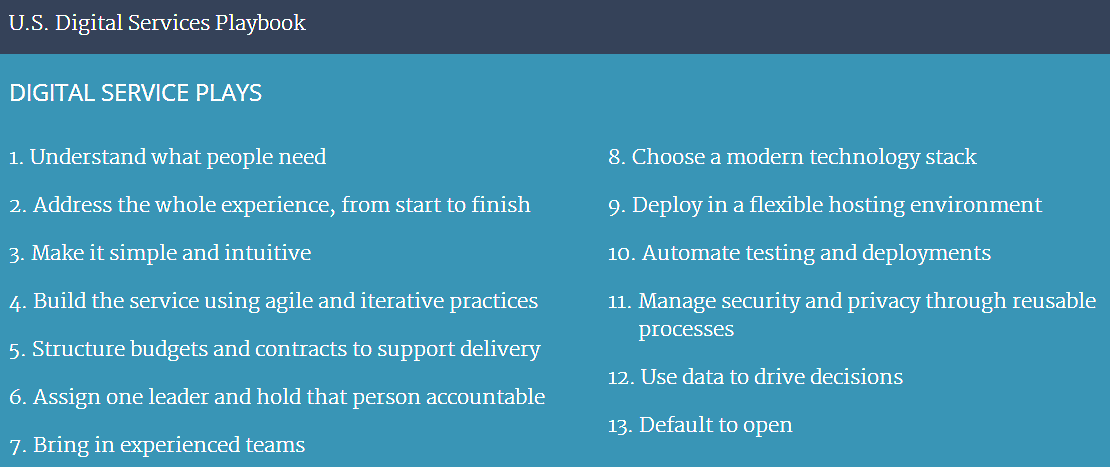
This list of "plays" from their "playbook" gives you an idea of their development and management style:

You can see more (and comment) on the the playbook here.

USDS will complement 18F, a government agency that was formed last March. (Their office is at the corner of F and 18th in Washington). Both groups are largely staffed by former Presidential Innovation Fellows and they have a common point of view. Unlike USDS, 18F actually builds tools and implements government systems. I am sure they will work closely together.

President Roosevelt (radio) and Kennedy (TV) were leaders at using new commuication media and President Obama was the first succesful Internet campaigner. Now he hopes to modernize government IT -- he might be remembered as the Internet President.

-----
Update 8/13/2014

USDS is also offering suggestions for addressing problems with the federal procurement process that leads to IT failures like HealthCare.Gov -- the TechFAR Handbook, which highlights the flexibilities in the Federal Acquisition Regulation that can help agencies implement “plays” from the Digital Services Playbook that would be accomplished with acquisition support — with a particular focus on how to use contractors to support an iterative, customer-driven software development process, as is routinely done in the private sector.

-----
Update
8/23/2014

18F is building tools and expanding -- hacking bureaucracy and promoting open source. They've reduced the hiring cycle from six to nine months to six to eight weeks by making Schedule A hires, which are limited to four years. That is sufficient for people used to working in "startup mode" and reminiscent of the grad students who worked on short-term grants to build the ARPANet and NSFnet.

-----
Update 9/9/2014

18F is building a new system for processing Freedom of Information Act (FOIA) requests.

Since the passage of the FOIA in 1966, journalists and other citizens have been able to request copies of government documents, but the system is often slow and fails to find relevant documents. 18F hopes to fix that with a consolidated FOIA request submission hub.

They began the project by meeting with stakeholders, both inside and outside the government, to discuss some of the practical obstacles impeding the current FOIA experience. They are now have a rough prototype of the FOIA request system running and the development process is open to public scrutiny and participation. You can follow, comment and contribute to the project here.


-----
Update 11/1/2014

18F Executive Director Greg Godbout, speaking at the 50th annual TechAmerica Foundation Vision conference reported that since its founding in March, 18F has grown from 14 to 100 employees -- it is now a small business, not a startup.

He said they were not competing with Federal contractors, but were a third-party trusted adviser to the contracting agency and developer, with "no skin in the game."

Their expertise is in "agile" hiring and development and "user centered design." Let's hope these are more than buzz words and their consulting pays off.

-----
Update 12/4/2014

USDS is expanding, working on Healthcare.gov 2.0, digitizing the VA and collaborating with 18F.

Tuesday, July 16, 2013

Vint Cerf -- a concise history of packets, the ARPAnet and the Internet

Conceptual sketch of the ARPAnet by Larry Roberts
If you are interested in the history of the Internet and only have 16 minutes to spare, watch this interview of Vint Cerf, who was one of the handful of people that created the Internet.

Cerf's narrative begins with the idea of packet switched communication and runs through the creation of the ARPAnet, followed by the invention of internetworking protocols to link three disparate networks -- the ARPAnet, a mobile communication network and a satellite communication network.

This short video is like an annotated table of contents of the early history of the Internet. Cerf introduces us to Leonard Kleinrock, Paul Baran, Donald Davies, Larry Roberts, Thomas Marill, J. C. R. Licklider, Doug Engelbart, Norman Abramson, Robert Taylor, Charles Herzfeld, Steve Crocker, Jon Postel, Bob Kahn, David Reed, Danny Cohen and Bill Joy, summarizing the work of each and putting it in context.

Whether this is all you want to know about the history of the Internet or you want to use it as a jumping off place to learn more about the contributions of these people, this is a good place to start.

Cerf also conveys a sense of common purpose among those pioneers. He does not say so, but one can think of them as working together to realize Licklider's vision of a network running Engelbart's applications. Cerf makes it clear that, although they worked for several different organizations and changed jobs from time to time, these people knew each other well and collaborated closely on creating the Internet. (For example, Cerf, Postel and Crocker went to the same high school and studied under Kleinrock as graduate students at UCLA). The group also had an excellent collaboration tool -- they were the first users of the networks they built.

The ARPA/Internet project was a great example of government as a non-equity angel investor -- providing a small bit of seed funding ($124 million) to a group of smart, dedicated people, rather than setting up a department to do the work internally.

Charles Severance of IEEE Computer Magazine conducted the interview of Cerf, and it is one in a series of computing conversations.

Monday, June 24, 2013

The importance of government research

Blumeberg columnist Mark Buchanan has written an article with the catchy title Who Created the IPhone, Apple or the Government?, in which he argues that government sponsored research has played a major role in the invention of the iPhone and much more.

I wrote a recent post about Presidential science initiatives, including several by President Obama, and have written articles on the role of government sponsored research in developing the personal computer and the Internet:
  • Before the Altair: the history of personal computing, CACM 1993
  • Seeding networks: the federal role, CACM 1996
I also compiled a bibliography of early contributions in:
  • The precursors of personal computing, ACM SIGSMALL/PC Notes, 1988
To retrieve these articles click here and scroll down to or search for the titles.

-----

Update 7/1/2013

In a provocative blog post, Lee Vinsel asks what new technologies might come out of the NSA surveillance activity.  Will we get innovative new technologies or are they just using established techniques of big data mining and server farms? Also -- if there are new technologies, will they belong to the US people or to contractors like Booz Hamilton, which hired Edward Snowden?

This leads me to wonder whether the increasing reliance of government at all levels on contractors will diminish socially shared innovation.

Monday, April 08, 2013

Presidential science initiatives (including the Internet)

President Obama has called for initiatives to map the human brain and bring an asteroid to Earth for study.

What a breath of fresh air to see a president who is thinking beyond today's simple-minded political jousting -- even if the proposed budgets are just a down-payment for planning and design. It is reminiscent of President Kennedy telling Congress:

I believe that this nation should commit itself to achieving the goal, before this decade is out, of landing a man on the moon and returning him safely to Earth.
(I get kind of misty typing that quote).


Of course there have been other noteworthy presidential efforts -- check the "Progressive Professor's" list of the top 15 presidential science investments, starting with Thomas Jefferson's sponsoring of Lewis and Clark.

Although no single president can take the credit, I would add a sixteenth to the professor's list -- the funding of the research and development that led to the Internet. The US taxpayers got quite a bargain -- this is what it cost us:

One can argue that this $124 million was only for research and development and we should also count the money spent on government procurement -- most notably SAGE, a networked early warning system for manned bomber attacks (video), which cost an estimated $8 billion. (The SAGE video is a bit off topic for this post, but it highlights technical progress beautifully .  Even if you include SAGE and prototypes like MIT project Whirlwind, the networking investment has paid off handsomely.

-----

Update 4/9/2013

Prominent scientist thinks the brain map should have more funding.  Harvard professor George Church, a veteran of the human genome project and an advocate for this study says the project should start small and have funding from several agencies. be ambitious and focus on developing new technologies from the start.  Lots more ... this is a recommended article.

-----
Update 8/13/2014

For Vint Cerf's description of the ARPA/Internet project, see this post.

-----
Update 4/27/2015

In this video of his keynote presentation at the SCI Institute, Alan Kay describes the ARPA funded research that led to the development of the Internet and the personal computer. The talk begins with the visions of people like Vannevar Bush and JCR Licklider and runs through the years at the Xerox Palo Alto Research Center (PARC).

Kaye concludes that the work at PARC cost Xerox about $40 million in 2012 dollars -- funds for around 30 researchers for four years. He estimates that Xerox made 300 times its that through sales of laser printers, even though they failed to capitalize on other PARC inventions. He estimates that the payoff to the US and world from all the PARC inventions was around $33 trillion by 2012.

The entire talk is over and hour, followed by questions and answers. The portion in which he talks about PARC and estimates the return on investment, begins at the 1 hour, 1 minute point.


-----
Update 10/22/2015

The US National Economic Council and Office of Science and Technology Policy have published a Strategy for American Innovation.

It is a long document with both strategic and specific points. This is one paragraph from a section on the Federal Government’s Foundational Role:
When U.S. companies develop a breakthrough product like a smartphone, it is appropriate to celebrate American firms and workers. But it is also important to recognize the value of the decades of Federal investment in R&D that provided these new products’ scientific and technological foundations, such as the Internet, the Global Positioning System, speech recognition, electronic design automation for advanced microprocessors, and artificial intelligence for virtual assistants. Although companies must ultimately invest a great deal to commercialize emerging technologies, the new insights, early prototypes, and the first markets for them are often supported by the Federal Government. Absent Federal investment, many new products would not ever reach the market, let alone reach world-changing scale.
The smartphone example is taken from Mariana Mazzucato's “The Entrepreneurial State," and provides a good example of the role of the Federal Government in research and procurement of early, limited-market products.

Sunday, August 05, 2012

Government spending: seeding the Internet cost $124.5 million, Morse's telegraph $30 thousand

On July 22, Wall Street Journal columnist Gordon Crovitz wrote an article giving "full credit" for the invention of the Internet to the Xerox Corporation.  That article was embarrassingly inaccurate in denying the role of the US government, and there have been a spate of rebuttals.

Steve Crocker, Internet pioneer and current chairman of the Internet Corporation for Assigned Names and Numbers, has summed up the roles of government and industry in an excellent article. He explains why the Internet could not have been created by private industry without government’s help and also points out that once the initial infrastructure was in place and its feasibility demonstrated, it was vital for industry to step in and develop products, software and services.

That initial infrastructure began with research and theory leading to the ARPANet, which demonstrated the feasibility of a large scale network. Critical mass and training were achieved when the government funded the spread of networking to universities through CSNET for computer science departments, the National Science Foundation NSFNet for connecting all US colleges and universities and the NSF International Connections program, which brought in university and research networks in 28 nations, most of which were in the developing world.

In a 1996 Communications of the ACM article Seeding Networks: the Federal Role, I documented the cost of that government effort. The ARPAnet cost $25 million, CSNET $5 million, the NSFNET backbone $57.9 million, connecting universities to the backbone $30 million, and the NSF International connections program $6.6 million. The US taxpayer got a pretty good return on an investment of $124.5 million.

The US government investment that led to the Internet paid a handsome return, but it was not the first federal networking investment. As we see here, in 1843, the US Congress appropriated $30,000 for the construction of a line of electro-magnetic telegraphs under the supervision of Professor Samuel F. B. Morse in order "to test the capacity and usefulness" of the system he invented. He used the money to construct a 37 mile telegraph connection between Washington and Baltimore, and, indeed, it turned out to be useful. That was a pretty good investment too.

Of course it is not only the US Government. Donald Davies was at the National Physical Lab in England when he coined the term "packet switching" and built an early test network and Tim Berners Lee was working at CERN, which was funded by 20 European governments and the European Union, when he invented the Web.

-----
Update 4/21/2016

The Internet is one example where Federal funding of research has paid off handsomely. For other examples, see this post on Presidential science initiatives.