Showing posts with label Roaming. Show all posts

Tuesday, March 08, 2022

SpaceX Starlink in Ukraine -- a week later

The Internet has been down in the city of Mariupol since March 2. If there is a Starlink terminal there, it is still online.

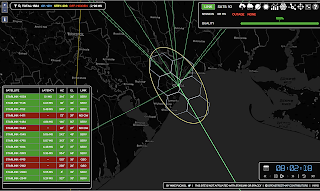
Ten Starlink satellites serving Odessa through ground
stations in Turkey, Lithuania, and Poland

Last week I wrote about the arrival of a truckload of SpaceX Starlink terminals in Ukraine and their potential value to government and resistance leaders. A lot has happened in the ensuing week -- this is an update.

Last week, using Mike Puchol's Starlink tracking service, I found that users in Kyiv would have 100 percent uptime with connections through as many as nine satellites to ground stations in Turkey, Poland, and Lithuania. When the Turkish ground station was unreachable it dropped to as few as five, but uptime remained 100%.

I've since used his service to check connectivity snapshots in three geographically dispersed cities -- Odessa, Lviv, and Kharkiv. I always found between seven and ten satellites in service in Odessa and Lviv and between two and six in Kharkiv. This is not surprising since Lviv is west of Kyiv, hence closer to the Polish and Lithuanian ground stations, Odessa in the south is closer to the one in Turkey and Kharkiv is to the east -- near Russia.

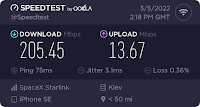
Starlink Speedtest in Kyiv
Puchol's simulation mode shows there should be 100% availability throughout the country at all times and, since there are few terminals, performance should be good. That was confirmed by an OOKLA Speedtest run by Oleg Kutkov in Kyiv. During the third quarter of 2021, OOKLA observed median upload and download speeds of 87.35 and 13.54 Mbps in the United States and as shown here, Kutkov observed much faster download speed and similar upload speed. The Kyiv test showed a "ping" time of 75 ms compared to a median "latency" of 44ms reported by OOKLA. I'm not sure if their reported "latency" is one-way or round trip. If the latter, they are comparable,

There have been several software updates since last week. Most importantly Elon Musk tweeted that SpaceX had enabled roaming in Ukraine so anyone with a terminal can transmit for a while then turn it off and move to another location or, if necessary, can remain online in a moving vehicle. In the same Tweet, Musk announced that they had reduced peak power consumption so the terminal could be powered by a car cigarette lighter. (There must have been some performance hit).

Musk also tweeted that "Some Starlink terminals near conflict areas were being jammed for several hours at a time" and they were bypassing the jamming with a software update. He added that he was curious to see what they tried next -- this sounds like "whack-a-mole."

It's noteworthy that in our "software-defined everything" world, SpaceX can make significant changes to the constellation with a software update. (The downside is illustrated in an over-the-air software hack of ViaSat modems).

Musk warned that Starlink terminals could be targeted and advised users to turn them on only when needed, to place an antenna as far away from people as possible, and to cover it with light camouflage. He also tweeted that some governments (not Ukraine) had asked him to block Russian news sources, but, as a "free-speech absolutist," he refused to do so.

President Zelenskyy Tweeted that the second shipment of terminals was on its way after speaking with Musk. 

In related news, Anonymous has declared cyberwar on Russia and there are Telegram channels for IT professionals in support of Ukraine, one of which is English-language.

Finally, there was also a PR tweet by Ukraine's famed heavyweight champion boxers the Klitschko brothers posing with a couple of Starlink terminals. 

Some Musk critics see his disaster-relief efforts or delivering terminals to Ukraine as publicity stunts of little practical value. Starlink terminals in Ukraine are terrific publicity, but they are also valuable tools for communication by political and resistance leaders if they are unable to safely access the Internet or it is blocked. For example, it has been reported that Mariupol is without electricity and water, and the Internet has been down since March 2. If there is a Starlink terminal there, it is still online.


Update 3/10/2022
Oleg Kutkov reported faster connectivity with a wired connection to the router instead of WiFi.

Update 3/14/2022

Photos of Starlink terminals in various locations have been posted on Telegram's Ukrainian IT Army and Facebook's SpaceX Starlink in Ukraine groups, but little was said about their use and users. 

Fifty of the square-antenna terminals from the second shipment have gone to the DTEK Group. Half of them will be used for support of Ukrainian energy infrastructure and half will go to DTEK businesses. Click here for more on DTEK's war effort

Update 3/17/2022

The Internet in the port city of Mariupol has been down since March 2 and the city is reported to be without electricity, gas, and water. If there are any Starlink terminals in the city, they should have no trouble getting online. I've periodically checked connectivity there and found between two and six satellites in service. (The rare time it got down to two satellites, the connection was through the Lithuanian ground station).

Six satellites in service over Mariupol

Update 3/19/2022

From the Washington Post: "A person familiar with Starlink’s effort in Ukraine, speaking on the condition of anonymity to discuss sensitive matters, said there are more than 5,000 terminals in the country. We'd seen pictures of three truckloads before, but this is a whole new level. Enough for armed forces, infrastructure companies like DTEK, NGOs, and government leaders.

Update 3/26/2022

DTEK's power engineers have received another 170 Starlink satellite terminals from SpaceX. The terminals "will help the company's power companies to maintain stable operation of power grids more efficiently and will help emergency repair crews to restore power as soon as possible." This sounds like part of the 5,000 terminals mentioned above. 

Update 5/5/2022

It's been over two months since I first wrote about Starlink terminals in Ukraine. At that time, a few hundred Starlink terminals had been delivered. Within a month there were 5,000 terminals and that was soon updated to 10,000. Now it's being reported that there are 150,000 daily users and the Starlink app has been downloaded 215,000 times. 

As predicted, Starlink has become an important government asset. This article shows some of the ways Starlink terminals are being used. The article is in Ukrainian, but the Google and Microsoft Translations are perfectly readable.


Update 10/13/20

I've previously written about the unprecedented role of the Internet in the war and the contribution of Starlink. Some current measures of the magnitude of the contribution of Starlink are:


Tuesday, March 01, 2022

SpaceX Starlink Service in Ukraine Is an Important Government Asset

The terminals will be used by key people who are running the government and resistance.

At 4:04 AM on February 26 Mykhailo Fedorov, Vice Prime Minister and Minister of Digital Transformation of Ukraine requested Starlink service from Elon Musk and at 2:45 PM on the 26th, Elon Musk tweeted "Starlink service is now active in Ukraine. More terminals en route." On February 28 at 12:29 PM Fedorov posted a photo of a truck load of terminals. (Kyiv is 10 hours ahead of California). 

I don't know where the terminals had been stored or how they shipped them, but the delivery time was impressive and twenty-four minutes after the truck arrival was posted, Oleg Kutkov, an engineer, tweeted an OOKLA Speedtest result. 

I don't know how many terminals are in Ukraine now -- Elon Musk has promised to send more -- or who will get them, but I assume it is a small number -- perhaps 100. They will be used by government and army officials who run the government and coordinate the resistance and journalists and communication specialists who report to Ukraine and the world. 

Until Starlink satellites are equipped with inter-satellite laser links, terminals will require access to ground stations. I checked for connectivity in Kyiv at two separate times using Mike Puchol's Starlink tracking Web service and found ground stations in Turkey, Lithuania, and Poland. 
Kyiv connects thru satellites (blue)
to ground stations (orange).
The first time I checked, there were nine satellites that could reach all three gateways (as shown here), and the second time five could reach two gateways -- the Turkish gateway was out of reach.

Does it matter?

In 2009 and 2011 the United States attempted to smuggle satellite Internet terminals into Cuba. The best-known effort was by Alan Gross, who spent five years in a Cuban prison when he was caught and the second was an attempt to bring equipment in by a faux surfing film production company with dishes disguised as boogie boards. (If you are curious, I covered both attempts in-depth on my blog on the Cuban Internet).

These attempts failed, but if they had succeeded, they would have been drops in the bucket -- of little importance to either the US or Cuba.

But Starlink in Ukraine is a very different case because there was no organized opposition in Cuba. These terminals will be used by key people who are running the government and resistance. They will be able to communicate synchronously or asynchronously from wherever they are in Ukraine with each other and the outside world. 

Concerns have been raised about the possibility of Russians finding and destroying these terminals using aerial direction finding, but that would be difficult. For one thing, Ukraine is a large country -- over 233,000 square miles and the terminals could be switched off when not in use. Furthermore, SpaceX is currently testing roaming in California and Nevada, The Starlink terminals are small and easily moved and SpaceX should enable roaming in Ukraine. As an added precaution, terminals could be set up a short distance from the people using them. 

This is more than a publicity stunt by SpaceX. 

Update 3/2/2020

I've been sporadically checking the state of connectivity in Kyiv today and have observed between five and nine links to ground stations. I've only seen as much as 2 seconds outage once and quality has been always 98 or 99%.


Update 3/3/2202

SpaceX has enabled fixed and mobile roaming in Ukraine and reduced peak power consumption. 


Update 5/9/2202

Survey article on SpaceX Starlink in Ukraine:
  • HOW STARLINK WORKS
  • WHO BROUGHT STARLINK TO UKRAINE?
  • WHO ALREADY USES STARLINK IN UKRAINE?
  • IS EVERYONE ALLOWED TO USE STARLINK IN UKRAINE?
  • HOW TO ORDER A TERMINAL IN UKRAINE AND HOW MUCH IT COSTS
  • HOW WELL STARLINK WORKS IN UKRAINE
  • HOW TO CONNECT TO STARLINK
  • DOES IT MAKE SENSE TO USE STARLINK AT ALL?
  • WHAT WILL HAPPEN TO STARLINK IN UKRAINE AFTER THE WAR?
The article is in Ukrainian, but the Google and Microsoft Translations are perfectly readable.

Update 5/12/2022

By March 26, 2022, 590 SpaceX Starlink satellite terminals had been transferred to Ukrainian medical and healthcare institutions according to Health Minister Viktor Lyashko.

Update 5/25/2022

Mykhailo Fedorov, Vice Prime Minister and Minister of Digital Transformation of Ukraine posted a short video saying 150,000 daily users were using over 10,000 Starlink terminals in support of key infrastructure, healthcare, financial institutions, and energy plants as well as providing mobile backhaul in several towns. Fedorov thanks Elon Musk. Pretty Good Publicity.


Update 6/9/2022

A recent Politico story on Starlink in Ukraine showed how quickly SpaceX was able to get their first terminals into and online in Ukraine. The request for terminals and subsequent spectrum access permission took place over twitter -- no dealing with regulatory bureaucracy.
USAID bought the first 1,300 Starlink terminals and SpaceX donated 3,600. The service is free.
The invasion occurred on a Thursday. On Friday Elon Musk said he wanted to get Starlink up over Ukraine. By Sunday Starlink was active and on Monday the first five hundred terminals were delivered. By Wednesday, 475 terminals were online.

Update 2/26/2025

There have been reports that SpaceX might cut Starlink connectivity in Ukraine but Oleg Kurtkov, perhaps the foremost Starlink expert in Ukraine, doubts that Starlink will be turned off. He points out that Ukraine is paying "millions of dollars a month" for over 170,000 active terminals. That is more terminals than in Europe, and the number is growing daily. He adds that cutting service off would lead to "massive reputational losses" and many countries and customers would "review their decisions and agreements."

The majority of the terminals are standard consumer models, costing about $95 per month, but 3,000 are Starshield terminals, costing $30,000 per month. The 30-pound Starshield terminals have Starshield antennas and SIM card slots, can use AC or battery power, have custom cables for quick battlefield repair, and are in hardened enclosures.

Update 5/26/2025

Oleg Kurtkov contacted me and reduced his estimate of the number of Starlink terminals in Ukraine to 130.000. 

On the other hand, Poland has contributed another 5.000 terminals, bringing the total number from Poland to 29,500, Ukraine’s Deputy Prime Minister for Innovations, Development of Education, Science, and Technology, and Minister of Digital Transformation, Mykhailo Fedorov, says these are "Enterprise" terminals, which can support more simultaneous users than standard terminals with faster, more stable connections.
The UK, France, Germany, and Czechia have also contributed Starlink terminals to Ukraine, and Germany has contributed OneWeb terminals. 


Thursday, February 24, 2022

SpaceX is testing Starlink roaming

A failed roaming test
Last April, Elon Musk tweeted that Starlink "should be fully mobile later this year, so you can move it anywhere or use it on an RV or truck in motion." It is good to know that mobility with a standard dish is in the works, but it's not yet available.
David Lang had been able to connect his Starlink terminal about fifteen miles from his home in Simi Valley, California, but when he brought it to my place in Carpinteria California, about forty-three miles away and in a different coverage cell, it failed to connect.

David's experience is not unique -- others have reported similar inconsistency on social media, but if one is willing to change the registered address of their terminal, it can be moved -- if there is available capacity at the new location.

Consider the experience of Marcus and Julie Tuck, who have been digital nomads for eight years and Starlink users since April 2021. As of December 16, 2021, they had registered at one hundred different addresses and had service at 157 locations. 

The Tucks and their truck
They experienced a significant roaming change while driving in central California. On February 11, 2022, they noticed they could move into a new cell and retain Starlink service without registering an address change. Later, when they crossed from California to Nevada, they had to enter a new address, but when they returned to California, they did not have to change it back. They have not changed it subsequently but will have to when they enter Mexico.

When David Lang brought his terminal to my home, he would have risked losing the ability to connect when he returned home if he had temporarily registered his terminal at my address. When the Tuck's experience becomes available, users will be able to leave home for a trip and return without risking the ability to reconnect at home.

David's visit was a week after the Tuck's experience, so roaming has not yet been rolled out. Perhaps the Tucks were in a limited test area or were selected by SpaceX because of their frequent address changes.

The Tucks had fixed roaming, not the in-motion connectivity Elon Musk promised, but it is a first step and there are still unanswered questions about roaming like:

  • Will terrestrial roaming while in motion require a different terminal? (It will at least have to be mounted differently). Planes, ships, and military vehicles will surely use different terminals. 
  • Since capacity must be reserved for roaming, the service will cost SpaceX. Will they charge for roaming and, if so, how -- by the month, the cell transition, the ground-station transition?
  • Will the roaming fee be less in low-demand, unsaturated areas? 
  • Will it be different for transitions into or out of high-demand areas? A function of the number of open slots at the time of transition?
  • Because of capacity limitations, they will not be able to guarantee 100% roaming success. Might we see a collective service-level guarantee like "99% success globally each month"?
  • How long will it be before a Starlink terminal is offered as an option on Tesla cars and trucks? 
  • How long will it be before a Geely Holding Group terminal is offered as an option on Volvo, Mercedes and other Geely brand autos?
  • SpaceX has begun launching satellites with inter-satellite laser links and the other LEO broadband operators will follow -- how will that affect roaming?
  • Eventually, I expect we will have optical links to ground stations with climate and weather-aware routing -- how would that affect roaming?
Elon missed his target date, but he seems confident that we will eventually have "full mobility" -- let's hope he is right.

Update 2/25/2022

This map shows the Tuck's most recent travels. Note that they did not have to re-register during the stops marked with green push points. They re-registered after crossing the state line into Nevada but did not re-register after returning to California.


Star = registered address

A. First of five locations after registering
B. First of seven locations after re-registering
C. First of fourteen locations after crossing the state line and re-registering
D. Fourteenth location after registering, 2/23/2022

Update 3/3/2022

SpaceX has enabled fixed and mobile roaming in Ukraine and reduced peak power consumption.

Update 3/12/2022

The Tucks mounted the Starlink dish horizontally on the top of their RV and used it while in motion. They have reported on a 101-mile drive at an average speed of 45 miles per hour and a top speed of 54. During the test, they live-streamed a video, and Marcus' wife listened to a live UK radio broadcast while doing a range of general Internet surfing, social media, etc. Below is a snapshot from a video log of the entire trip, speeded up to run in 2 minutes.


Update 3/13/2022

When the Tucks crossed into Mexico, they feared roaming would fail, but roaming and in-motion connectivity continued working.