Showing posts with label satellite. Show all posts

Friday, June 16, 2023

Will Electronically Steered Antennas Replace Parabolic Antennas in Satellite Ground Stations? (ChatGPT-Assisted Version)

In a previous post, I asked whether electronically steered antennas (ESAs) would replace parabolic antennas in satellite ground stations. I read a few articles suggested by others and by Google search, used some common sense, produced a list of advantages of ESAs, and concluded that it was likely they would eventually replace parabolic antennas for many applications. 

Many of the articles I found were written by companies selling products or services and I'm not an antenna expert -- more a curious journalist. ChatGPT has access to the entire Internet, and I wondered if it could have helped me improve what I wrote or convinced me to reach a different conclusion, so I queried it three times

Since I had listed the advantages of ESAs over parabolic antennas, I began by asking ChatGPT to list the advantages of electronically steered antennas over parabolic antennas for satellite ground stations.

In my post, I listed twelve bullet-point advantages. The ChatGPT answer was more verbose, beginning with a restatement of the question and listing and elaborating on seven advantages. The elaborated replies included all but one of my bullet points, spectral efficiency, and it included an advantage that I had overlooked, interference mitigation, and explained why that was so.

In spite of these glitches, ChatGPT reached nearly the same conclusion as I had, saying "It's worth noting that while electronically steered antennas offer numerous advantages, they also have some limitations, such as higher cost and complexity compared to parabolic antennas. However, ongoing advancements in technology are continuously addressing these challenges, making electronically steered antennas increasingly attractive for satellite ground station applications."

Since it had failed to mention spectral efficiency, I asked, "What about spectral efficiency?" and it replied with an apology for missing the point and went on to list and elaborate on five ways in which ESA made more efficient use of bandwidth.

You can see the dialog here

Since ChatGPT generally agreed with me, I asked it to play devil's advocate and list the advantages of parabolic antennas over electronically steered antennas for satellite ground stations. 

Perhaps I was biased by the experience of having written my earlier post, but I found myself questioning some of its cited advantages. For example, one was "wide coverage" but that would not apply to Thinkom's array of arrays. Another was "simplicity ... making them easier to manufacture, install and maintain." ChatGPT was contradicting its previous response in which it said ESAs were more reliable and required because parabolic antennas "have mechanical parts that can be subject to wear and require regular maintenance."

I also realized that my question was a bit off -- it focused on the antenna rather than the entire ground station -- so I asked it to "list the advantages of satellite ground stations that use parabolic antennas over satellite ground stations that use electronically steered antennas". One of the advantages it listed was suitability for high-frequency Ka and Ku bands, but both Thinkom and BlueHalo use those bands and Thinkom is targeting even higher frequencies. It also repeated the simplicity advantage.

You can see the dialog here.

Finally, I asked the title question from my previous post -- will electronically steered antennas replace parabolic antennas in satellite ground stations?

It listed points under three headings -- advantages of ESAs, limitations of ESAs, and application-specific considerations and concluded that:

"While there is potential for Electronically Steered Antennas to replace parabolic antennas in certain satellite ground station applications, it is not a straightforward or immediate transition. The adoption of ESAs will depend on factors such as technology advancements, cost reductions, performance improvements, and specific application requirements."

It reversed itself once more by listing improved reliability as an advantage of ESAs, but the conclusion was similar to the conclusion in my original post. It also revealed a shortcoming in my formulation of the question. Since I have been writing a lot about Internet service constellations, I overlooked other applications in my previous post and did not specify that I was interested in broadband Internet service. (A human editor would have known that I was writing for an Internet-related publication, would have been aware of my previous writing, and assumed I was focused on Internet applications).

It pointed out that parabolic antennas had an advantage for deep space communication, so I asked a more fully qualified question -- Will electronically steered antennas replace parabolic antennas in ground stations for LEO, MEO, and GEO Internet service constellations?

The reply seemed vaguer and non-committal this time, but was also similar to mine:

"Considering these factors, it is likely that a combination of ESAs and parabolic antennas will be employed in future ground stations for LEO, MEO, and GEO internet service constellations. The specific configuration and utilization of each technology will depend on various factors, including cost, performance requirements, deployment scenarios, and network architectures." 

You can see the dialog here.

Conclusion

So, what is the role of ChatGPT in this sort of journalism? It served me as an editor or referee reviewing what I had written. I would have made two changes after getting feedback from ChatGPT -- I would have mentioned that I was focused on LEO, MEO, and GEO Internet service applications, and I would have included interference mitigation as one of the advantages of ESAs.

ChatGPT made a couple of misstatements and did not "know" about the possibility of an array of antennas like that of Thinkom with its wide elevation angle range. To its credit, I liked the way it apologized for overlooking spectral efficiency as an advantage for ESAs and it was an indefatigable and patient interviewee. It was also free (for the time being).

I consulted ChatGPT after drafting my article, but I could have used it as a research tool before writing. Had I done so, I might have been misled by some of its mistakes and I wouldn't have discovered Thinkom's innovation. Furthermore, its prose was not clear and concise -- I don't think it could pass a Turing Test on writing style. In this case, an old-fashioned Internet search engine was a far better pre-writing tool.

ChatGPT would be improved if it gave links to the sources of its assertions. Like autocomplete, it generates sentences by repeatedly appending the most probable next word in text documents found on the Internet, so the final string is novel. (That's not the way I generate sentences -- they follow from an idea). Might a list of the documents providing the most words be useful? (Google Bard adds citations, but I've not tried it out yet).

While ChatGPT helped me, I don't believe a ground station expert would have learned anything new by interacting with it and a beginner like a student writing a term paper would have been misled. The curious journalist was the sweet spot in this case, but this is version 3.5 of ChatGPT, which had a data-cutoff date before BlueHalo and Thinkom announced the products I've mentioned. I'll revisit it when I get access to ChatGPT4.

PS -- Let me know if you read the dialogs I linked to and notice something I missed,

Tuesday, August 06, 2019

An optimistic update from Telesat

Once the 100 inclined-orbit satellites are in orbit, they may be able to utilize their inter-satellite laser links to achieve the 30 ms latency Goldman spoke of.

Polar (green) and inclined (red) orbits
Emily Jackson interviewed Dan Goldberg, Telesat President and CEO, in a recent episode of the Down to Business podcast. The interview followed the announcement that the Canadian Government would contribute $85 million (all amounts are in Canadian dollars) to support research and development in support of Telesat's planned constellation of low-Earth orbit (LEO) satellites and another $600 million to subsidize Internet connectivity in rural Canada.

Goldberg pointed out that all governments subsidize rural connectivity and said the $600 million grant was expected to generate $600 million in revenue from below-market-rate sales to telephone companies and ISPs. The remaining capacity would be sold to others and he said they anticipated sales to enterprises, governments, ships, and airlines, but did not mention marketing directly to consumers. (Only SpaceX seems to be targeting consumers from the start).

In return for the R&D contribution, Telesat has agreed to support approximately 500 professional jobs in Canada and invest $215 million in R&D. (That R&D includes the first dozen or so test satellites). Telesat has a profitable, established geostationary satellite business and will fund part of the constellation themselves, but they will also need debt and equity financing and Goldberg said this government support would make it easier for them to finance the constellation.

This financial news is important, but Goldberg's optimism about the technology is what caught my attention. They have been working on their LEO project for six years and during that time the cost of launching satellites -- geostationary as well as LEO -- has fallen dramatically and he expects it to continue to do so. He also predicted that the cost of mass-produced satellites will fall dramatically and he is confident that inter-satellite laser links (ISLLs) and electronically-steerable phased-array antennas will be cheap enough to allow them to compete successfully with terrestrial fiber and 5G, offering fast, 30 ms latency broadband. (ISLLs present both technological and political problems).

The only technological concern he expressed was with regard to the problem of radio interference. He did not say anything specific on these technologies but did point out that Telesat has been providing satellite service for 50 years and is the "leading satellite technical consultant" in the world. (Three percent of their revenue is from consulting).

Goldberg summed up his optimism by saying:
Our confidence level in terms of our ability to bring this disruptive capability to the market and provide an extraordinarily high-quality, disruptive broadband service to Canadians and also to everybody else living in the world is extraordinarily high. This is not some high, big-gamble, futuristic new technology. This technology will be disruptive but it is ready for prime time.
Yes, but ...

SpaceX simulation with uncovered areas
Goldberg said they could could achieve global coverage with only 72 satellites and a simulation by Mark Handley predicts that SpaceX will not completely cover the planet with 792 satellites. How do we explain the difference?

SpaceX with 792 satellites would have much more capacity than Telesat with 72 satellites and Telesat does not plan to offer service with only 72 satellites. They plan to start service at the end of 2022 with around 200 satellites in polar orbit. They will add 100 more in inclined orbit in 2023 and perhaps eventually reach 500 satellites. Those 200 polar-orbit satellites will serve the polar regions, fulfilling their promise to provide connectivity in rural Canada. (This is reminiscent of China's Hongyun LEO satellite project which will focus on rural China).

While the 200 polar orbit satellites will provide coverage in rural Canada, they will be partially reliant upon terrestrial ground stations to reach the entire globe and therefore latency will suffer and they already have two far-north ground stations in support of their established, profitable geosynchronous satellite business. Furthermore, in 2016 Telesat filed for a patent on a "Dual LEO Satellite System and Method for Global Coverage" and once the 100 inclined-orbit satellites are in orbit, they may be able to utilize their inter-satellite laser links to achieve the 30 ms latency Goldman spoke of.

Saturday, June 01, 2019

Hongyun Project -- China's low-earth orbit broadband Internet project

It might be tempting to dismiss this effort as small and behind the broadband satellite projects of companies like SpaceX, OneWeb and Telesat, but that would be a mistake.

Long March 11 rocket and Hongyun-1
satellite (source).
Last December, State-owned China Aerospace Science and Industry Corporation (CASIC) launched the first experimental Hongyun (rainbow cloud) Project satellite and they began testing it in March.

The 247 kg test satellite is in orbit at an altitude of around 1,100 km and they plan to launch four more test satellites this year and begin operating with a 156-satellite constellation in 2022. I don't know anything more about their plans, but with only 156 satellites I suspect they will focus on unserved regions in rural China and perhaps Latin America at first.

It might be tempting to dismiss this effort as small and behind the broadband satellite projects of companies like SpaceX, OneWeb and Telesat, but that would be a mistake. China has an ambitious, global Internet infrastructure and application program called the Digital Silk Road and the "road" is terrestrial with highways, ports, pipelines, and railways, undersea with cables and in space with the Hongyun Project, their Beidou satellite navigation system, which will be global next year, and the Digital Belt and Road Earth observation program. Our withdrawal from the Trans-Pacific Partnership and the current trade war were gifts to the Chinese.

(Other early short articles on the LEO project here and here).

Update 6/4/2019

CASIC broke ground on April 24 for a satellite industry park in Wuhan, Central China's Hubei Province, where they will produce satellites for the Hongyun project.

In keeping with China's policy of funding competitors, another production line operated by a satellite start-up, Spacety, based in Changsha, Central China's Hunan Province, began construction in January. Each facility is expected to produce 100 satellites per year. (China has historically funded Internet service competition).

Update 6/18/2019

U.S. military tracking data shows the satellite is in a nearly circular orbit averaging 1,067 km altitude at an inclination of 99.9 degrees and CASIC confirmed that Hongyun would emphasize service in China's remote regions.

Update 11/26/2019

Speaking at a conference last week, CASIC general manager Zou Guangbao confirmed their planned schedule and said they would serve the broadband communication, navigation & remote sensing markets in China and elsewhere. They are also developing a separate constellation of 80 Internet of things satellites

Update 12/14/2019

GalaxySpace is a second Chinese company working on a LEO broadband constellation. Their first satellite is under construction. The 200 kg satellite will have 10 Gbps capacity, orbit at 1,200 km with a 300,000 square km footprint and use high-frequency Q/V band radio.


Update 12/18/2019


Hongyun has expanded its broadband satellite plan. They are now working toward 864 satellites orbiting at 1,175 km with an 8 Terabytes per second capacity. They hope to serve 2 million 5G users through direct connections to base stations, 200,000 broadband users and 10 million Internet of things users. The focus will be on China and Belt and Road nations.

Update 12/21/2019

Liu Shiquan, Deputy General Manager of CASIC Hongyun satellite reported that Hongyun performance and function tests have been completed. He did not give details but said the tests included Web browsing, video chat, and high-resolution streaming.

Liu also gave a few schedule hints. The post quotes him as saying they would launch four more test satellites "by 2020" but I assume that meant "during 2020." He also said that by the beginning of 2020, users across China will be able to access the demonstration system. There was no elaboration on this, but I assume he is referring to a few test users. He also said they plan to have 156 satellites in operation by the middle of the 14th Five-Year Plan (2021-25).

I wonder if more detailed information is available on the Web in China.

Update 1/6/2020

The Hongyan (Wild Goose) project plans a constellation of around 320 LEO satellites. They have launched one test satellite so far and had hoped to launch 8 more by 2020, but did not make that deadline. They expect to have 60 satellites in orbit and operating around 2023 will be able to provide global coverage with the full constellation by 2025.

As shown in this illustration, they plan to connect buildings, ships, trains, and planes and to provide mobile backhaul and, most interestingly direct service to mobile phones. He Mu, Hongyan Application Director, promised the development of a "chip [that] can be integrated into the mobile phone so that everyone holding an ordinary mobile phone will have access to seamless satellite telecommunication with global coverage." (If this happens, it will be interesting to see how they differentiate this from terrestrial mobile service).

CASIC's Five Clouds
Hongyan is a project of China Aerospace Science and Technology Corporation (CASC) while Hongyun is a project of the China Aerospace Science and Industry Corporation (CASIC). CASIC has four other "five clouds" projects underway in addition to Hongyun:
  • Feiyun, using solar-powered drones
  • Kuaiyun, using near-space airships (dirigibles?)
  • Tengyun, a project to develop reusable space plane.
  • Xingyun, an 80-LEO narrowband IOT constellation using cubsats, the first of which has been launched.

Characteristics of Hongyun and Hongyan satellites


Update 1/20/2020

GalaxySpace has launched a LEO "5G" satellite, Yinhe-1, which is expected to test Q/V and Ka-band communications at up to 10 Gbps. I'm not sure what a "5G" satellite is, but note that the above diagram shows a satellite communicating directly with a mobile phone, as opposed to a mobile tower. Check out this short video on the satellite and launch:


Update 1/30/2020

See this post for some discussion of Chinese space policy.

Update 2/25/2021

Space Engineering Development (SED), a subsidiary of China Aerospace Science and Industry Corporation (CASIC), has begun testing its satellite manufacturing infrastructure and is expected to begin production in March. The plant will manufacture the Hongyun satellites and will be capable of producing about 240 satellites annually. Hongyun plans a 156-satellites constellation, so they should be ready next year when they plan to begin operation.

Amazon's AWS Ground Station service is now available

Amazon announced that they would be providing satellite ground station service last year and Andy Jassy, CEO of Amazon Web services, announced its availability in the video at the end of this post.

AWS Ground Station is a fully managed, ready-to go ground station service, featuring:

  • No upfront cost.
  • Scaleability -- you only pay for antenna time.
  • No long-term contract.
  • Self-service scheduling on a per-minute basis, that can be changed dynamically using their ground station console.
  • Secure transmission.
  • Low latency due to proximity to Amazon data centers.
  • Integration with EC2, S3 and other Amazon services and Amazon's global network backbone.
  • Simultaneous up/download.
  • Support of most common communication frequencies.
This sounds like a compelling case, especially for a small operator or startup, but I don't know how the prices compare to existing services or building proprietary ground stations.

A couple of questions come to mind. I assume Project Kuiper, Amazon's proposed broadband satellite venture, will use this service, but will SpaceX, OneWeb, Telesat and other potential satellite broadband ISPs also use it? If so, will Amazon treat them fairly? Competing ground station companies might also raise the issue of predatory pricing since Amazon will have an opportunity for cross-subsidy with their other services or they might just operate at a loss until competitors are eliminated (as they have done in other cases).

Wednesday, December 26, 2018

Low-Earth orbit (LEO) satellite internet service developments for 2018

At the end of 2017, I posted a review of important LEO-satellite Internet service developments. I've been updating those posts during the year and have also added the following new posts this year:

OneWeb's offer to sell a share of their satellite Internet service to Russia. (December 2018).

OneWeb has a Russian contract to launch Internet-service satellites and a marketing partnership with a Russian company. When the Russian government expressed concern about security and US sanctions, OneWeb made concessions. It was reported that OneWeb had offered to sell 12.5% of the company to Russia, giving them a board seat and access to technical information, but OneWeb denied the report. Given Russia's accelerated investment in their global satellite navigation system, history of hacking the US Global Positioning System and using the Internet to foment social unrest and influence election results in Europe and the United States, I would be reluctant to share technical information with them.

A cool simulation of SpaceX's revised satellite broadband plan. (November 2018)

On November 15, the FCC approved a revision to the plan for Starlink, SpaceX's forthcoming broadband satellite service. The new plan reduces the number of satellites from 4,525 to 4,409 and lowers the altitude of the phase-1 satellites from 1,100 to 550 km. Mark Handley, a professor at University College London, has created videos based on simulations he ran of both the original and revised phase 1 plans. The videos and his narration provide insight into the assumptions he made in building his models and constellation design decisions and tradeoffs.

An in-depth interview of OneWeb Executive Chairman Greg Wyler. (November 2018)

In this "definitive" 2018 interview of OneWeb founder and Executive Chairman Greg Wyler, he said their initial customers will include emergency services, mobility (aviation), health centers and schools. He did not mention individual homes or the problems he has been having negotiating with the Russians or dropping inter-satellite laser links. There is a lot more -- check the interview out.

Obstacles in OneWeb's negotiations with Russia. (October 2018)

OneWeb has a contract to launch satellites on Russian-made Soyuz rockets and has formed a joint venture with Gonets, a Russian satellite operator, as a marketing partner. Recently, Russia has expressed concerns about security, drug their feet on spectrum allocation and complained about US sanctions. Subsequently, OneWeb reduced its interest in the Gonets partnership from 60 to 49 percent, giving Gonets control. This case illustrates the fact that political, security and financial negotiations may be as difficult as designing satellites and rockets for a would-be global Internet service provider.

Might CubeSats provide broadband Internet connectivity one day? (September 2018)

Cubesats are small, standardized satellites. Since they are small, they are relatively cheap to launch and standards and standard components make them relatively cheap. This post looks at the efforts of two startups working on narrowband communication applications using CubeSats. Today's CubeSats are smaller and less powerful than those planned for Internet constellations from companies like OneWeb, Telesat or SpaceX and it's hard to believe that the capability of broadband Internet-service satellites might one day fit in a CubeSat -- but think about the phone in your pocket.

SpaceX Starlink test -- good news but unanswered questions. (June 2018)

Elon Musk tweeted that the two SpaceX test satellites, TinTin A and B, are connecting at "high bandwidth" with 25 ms latency. That's good news but it leaves a lot unanswered. For example, he did not mention the speed and reliability of the phased-array handoffs between the satellites and ground terminals and he said nothing about tests of the inter-satellite laser links, which OneWeb has abandoned.

SpaceX President and COO Gwynne Shotwell on synergy among Musk companies and Starlink profit. (May 2018)

In a recent interview, SpaceX President and COO Gwynne Shotwell said that SpaceX is profitable, but she predicts that Internet service revenue will soon be much greater than that of their launch business and the Wall Street Journal agrees. She also pointed out synergies between Elon Musk's companies and said they remain on schedule to take people to Mars in 2024.

Telesat begins testing low-Earth orbit satellite Internet service. (May 2018)

Telesat's demonstration satellite is now ready for testing with maritime connectivity provider OmniAccess, Australian ISP Optus and in-flight entertainment company Global Eagle Entertainment. They are moving quickly and their initial focus is on these specialized markets.

Elon Musk tells what to expect from the Block 5 Falcon 9 rocket. (May 2018)

On the occasion of it's first production flight, Elon Musk said this will be the last major version of the Block 9 Falcon 9 before their next rocket, the BFR. The Block 5 is designed for rapid-turnaround reusability and he expects there to be 300 or more Block 5 flights before it is retired. The rockets are designed to do 10 or more flights without refurbishment and expected to be capable of at least 100 flights before being retired.

FCC approves SpaceX Starlink's Internet-service constellation -- now there are four. (March 2018)

SpaceX, OneWeb, Telesat and Space Norway (focused on the far north) now have FCC approval to provide fixed-satellite service using constellations of LEO satellites.

O3b satellite Internet -- today and tomorrow. (March 2018)

SpaceX, OneWeb and Telesat are planning to offer Internet-service from LEO, but O3b is already providing connectivity to relatively large customers like mobile phone companies, government organizations, and cruise ship lines using a constellation of medium-Earth orbit (MEO) satellites. For example, they serve mobile phone company Digicell in Papua New Guinea and Cuban ISP ETECSA. O3b plans to add four more satellites early next year and will begin deploying their next-generation constellation, mPower, in 2021. While today's O3b satellites have 10 steerable edge-terminal beams, the mPOWER satellites will have over 4,000 steerable beams that can be switched under program control giving the initial seven-satellite constellation over 30,000 dynamically reconfigurable beams and over 10 Tbps capacity.

The current and future role of satellite Internet service in Cuba. (12 posts)

Today Cuba makes limited use of geostationary and MEO satellite connectivity, but LEO and MEO satellite constellations could play a major role in future Internet connectivity there and in other developing nations.

Tuesday, September 04, 2018

Might CubeSats provide broadband Internet connectivity one day?

It's hard to believe that the capability of the satellites companies like OneWeb and SpaceX are contemplating might one day fit in a CubeSat, but think about the phone in your pocket.

In November, 2016, SpaceX filed a request for approval to launch 4,425 Internet-service satellites using the Ku and Ka frequency bands. The satellites were expected to measure 4 x 1.8 x 1.2 meters. In February, 2018 SpaceX launched two Internet-service test satellites -- TinTin A and B -- that measured only 1.1 x .7 x .7 meters.

Why the size difference?

Maybe some functions were omitted from the test satellites -- for example, they may not have included inter-satellite laser communication capability -- but technical progress also steadily reduces the size of electronic devices.

Might the capability TinTin A or B one day be packaged in a CubeSat?

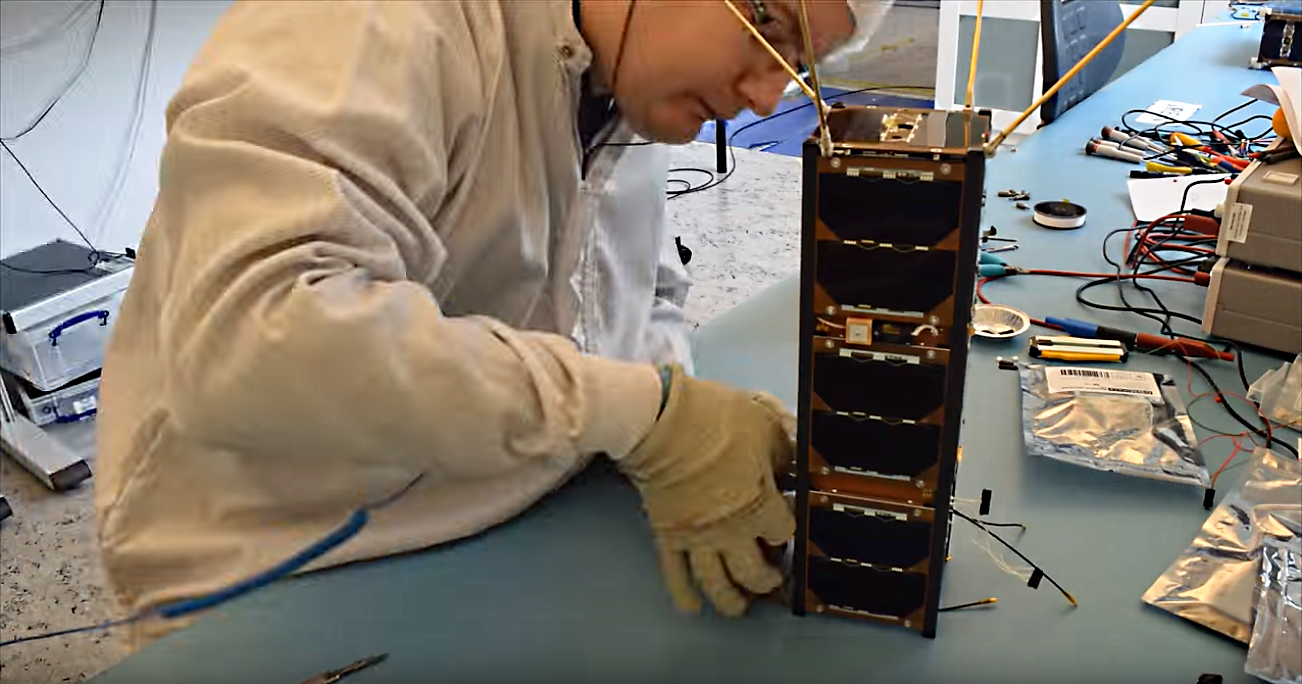
A CubeSat is a small satellite composed of one or more 10 x 10 x 10-centimeter cubes (units) that weigh under 1.33 kg each. For example, the 3-unit (3U) CubeSat shown below would be 10 x 10 x 30 centimeters (plus a little more for the frame holding the cubes) and weigh under 3.99 kg.

Assembling a 3U CubeSat

CubeSats were initially developed to support low-cost access to space for university research, but today they are being used in both commercial and research projects and many companies are manufacturing CubeSats and components.

Several startup companies are working on narrowband communication applications. Let's look at two examples.

SAS equatorial orbits (source)
Skyandspace (SAS) is off to an early start. They have three 3U CubeSats in an equatorial orbit and they have demonstrated instant messageing, voice calls, financial transactions and integration with public switched telephone network.

They plan to begin launching a 200-satellite constellation next year and to be fully operational in 2020. When complete, the constellation will serve the +/- 15-degree latitude region and provide personal voice calls and messages and connectivity for machine-machine communication and "Internet of things" applications.

SAS CEO Meir Moalem estimates that the "full constellation of the 200 nanosatellites will cost somewhere between $120 and $160 million,” which, he said includes "the production, launch, and operation of the constellation." They expect that that relatively low cost will enable them to replace 25% of the constellation each year, enabling them to constantly upgrade their technology. (APP Company Research used a figure of $150 million in an independent forecast).

SAS hopes to eventually provide global narrowband coverage with 1,000 satellites, but they are not talking about broadband service. On the other hand, "Internet in space" is the long-term goal of Kepler Communications.

Kepler KIPP (source)
Just over two years after the company was founded and a year after being funded, Kepler had KIPP, their first operational satellite, in orbit -- a testimony to CubeSat cost and development time.

KIPP, a KU-band, 3U CubeSat, is in polar orbit and providing high-speed, global store-and-forward service through their gateways in Inuvik and Svalbard. They are serving customers with latency-tolerant applications like bulk transfer of scientific and video data. (This is reminiscent of the first satellite Internet project I know of -- VitaSat -- which provided email and other asynchronous services in developing nations in the mid-1990s).

The next launches will be CASE, a slightly upgraded version of KIPP, which will add to their store-and-forward capacity and TARS, a redesigned 6U CubeSat that will be used for both store-and-forward and Internet of things applications. TARS will be the final service-demonstration satellite prior the early 2020 launch of the first 10 satellites of their 140 satellite constellation.

Both SAS and Kepler are small startups. SAS has issued stock and Kepler is venture funded. Kepler has also received In-Orbit Demonstration Mission funds from Satellite Applications Catapult, a non-profit company funded by Innovate UK which in turn is funded by UK Research and Innovation. (This sounds like an interesting public-private funding chain).

Like OneWeb (and unlike SpaceX), both work with partners in design and production of satellites, antennas, radios, etc. and both sound like fast-moving, innovative companies with a sense of purpose -- reminiscent of the early days of both personal computing and the Internet. The "careers" page of the Kepler Web site captures this feeling well. It offers the opportunity to "join the team that's building the Internet in space," recognizes that "a good cultural fit can oftentimes be more important than technical competency when building a company" and lists "indoor bike storage" as one of the perks of employment. I'm ready to sign up!

It's hard to believe that the capability of the satellites companies like OneWeb and SpaceX are contemplating might one day fit in a CubeSat, but think about the phone in your pocket. Also, as the following time-lapse video (1:54) shows, today's CubeSats are hand built -- what would mass-produced CubeSats cost and how many could a BFR launch at once?

Monday, November 13, 2017

Telesat -- a fourth satellite Internet competitor

Telesat will begin with only 117 satellites while SpaceX and the others plan to launch thousands -- how can they hope to compete? The answer lies in their patent-pending deployment plan.

Polar (green) and inclined (red) orbits
I’ve been following SpaceX, OneWeb, Boeing, and Leosat's satellite Internet projects, but have not mentioned Telesat's project. Telesat is a Canadian company that has provided satellite communication service since 1972. (They claim their "predecessors" worked on Telstar, which relayed the first intercontinental transmission, in 1962). Earlier this month, the FCC approved Telesat's petition to provide Internet service in the US using a proposed constellation of 117 low-Earth orbits (LEO) satellites.

Note that Telesat will begin with only 117 satellites while SpaceX and the others plan to launch thousands -- how can they hope to compete? The answer lies in their patent-pending approach to deployment. They plan a polar-orbit constellation of six equally-spaced (30 degrees apart) planes inclined at 99.5 degrees at an altitude of approximately 1,000 kilometers and an inclined-orbit constellation of five equally-spaced (36 degrees apart) planes inclined at 37.4 degrees at an approximate altitude of 1,248 kilometers.

This hybrid polar-inclined constellation will result in global coverage with a minimum elevation angle of approximately 20 degrees using their ground stations in Svalbard Norway and Inuvic Canada. Their analysis shows that 168 polar-orbit satellites would be required to match the global coverage of their 117-satellite hybrid constellation and according to Erwin Hudson, Vice President of Telesat LEO, their investment per Gbps of sellable capacity will be as low, or lower than, any existing or announced satellite system. They also say their hybrid architecture will simplify spectrum-sharing.

The following figure from their patent application illustrates hybrid routing. The first hop in a route to the Internet for a user in a densely populated area like Mexico City (410) would be to a visible inclined-orbit satellite (420). The next hop would be to a satellite in the polar-orbit constellation (430), then to a ground station on the Internet (440).

An inter-constellation route (source)

The up and downlinks will use radio frequencies and the inter-satellite links will use optical transmission. Since the ground stations are in sparsely populated areas and the distances between satellites are low near the poles, capacity will be balanced. This scheme may result in Telesat customers experiencing slightly higher latencies than those of their competitors, but the difference will be negligible for nearly all applications.

They will launch two satellites this year -- one on a Russian Soyuz rocket and the other on an Indian Polar Satellite Launch Vehicle. These will be used in tests and Telesat says a number of their existing geostationary satellite customers are enthusiastic about participating in the tests. They will launch their phase 2 satellites beginning in 2020 and commence commercial service in 2021. They consider 25 satellites per launch vehicle a practical number so they will have global availability before their competitors. Their initial capacity will be relatively low, but they will add satellites as demand grows.

Like OneWeb, Telesat will work with strategic partners for launches and the design and production of satellites and antennae. They have not yet selected those partners, but are evaluating candidates and are confident they will be ready in time for their launch dates. Their existing ground stations give them a head start. (OneWeb just contracted with Hughes for ground stations).

Their satellites will work with mechanical and electronically steered antennae and each satellite will have a wide-area coverage mode for broadcast and distributing software updates. Their patent application mentions community broadband and hotspots, large enterprises, ships and planes, software updates and Internet of things, but not homes as initial markets.

Telesat's Canadian patent application goes into detail on all of the above, and I'd be curious to know what exactly would be protected by it. They also consider their global spectrum priority rights from the International Telecommunication Union as an asset, but they will have to agree to spectrum sharing conventions and debris mitigation agreements.

Let me conclude with a suggestion for Telesat and the Cuban government.

OneWeb has committed to providing coverage to the entire state of Alaska by the end of 2020 and Telesat says they will have global coverage by 2021. I follow the state of the Internet in Cuba and think Cuba would be a good starting place for Telesat service. Cuba has the best-educated, Internet-starved population in Latin America and the Caribbean, they have very little domestic Internet infrastructure and much of the infrastructure they do have is obsolete. Cuba is close to being an Internet "greenfield" and, since it is an island nation, their polar satellite "footprint" would not be densely populated.

Cuba could work with Telesat to leapfrog over several infrastructure generations. If Telesat can deliver on their claims, the barriers would be political and bureaucratic, not technical. Cuba is about to change leadership, and there is some indication that Miguel Díaz-Canel, who many expect to replace Raúl Castro, will favor Internet development.

SpaceX could also provide early Cuban connectivity, but dealing with a US company would be politically problematic and Cuba and Canada have a well-established political and economic relationship. Even if Cuba were willing to work with SpaceX, the current US administration would not allow them to do so. Connecting Cuba would be good for Cubans and good publicity for Telesat.

For more on Telesat and their plans for LEO satellite Internet service see their patent application and you can see animations of their proposed hybrid-constellation connectivity here and here.

Update 11/25/2017

LEO-1, Telesat's low-Earth orbit satellite, has been shipped to India for launch. The 168 kg satellite will be used in two-satellite tests of Telesat's forthcoming broadband service. Testing will begin when both test satellites are in operation. LEO-1 will be in polar orbit and I assume the other will be in an inclined orbit in order to test their two-constellation design.

Update 11/29/2017

The Soyuz 2 launch vehicle that was to have placed 19 spacecraft into orbit has failed, destroying one of the two satellites Telesat had planned to use in the first test of their forthcoming broadband Internet service. The other has been shipped to India for launch, but the project will be delayed until the lost satellite can be replaced.

Update 5/19/2018

SpaceX and OneWeb get a lot of publicity and have ambitious plans, but Telesat is the first LEO ISP to begin testing with potential resellers.

Last January, Telesat launched a demonstration satellite and it is now ready for testing. Maritime connectivity provider OmniAccess and Australian ISP Optus had committed to testing the system previously and this week they were joined by in-flight entertainment company Global Eagle Entertainment.

Global Eagle CEO Josh Marks said he was persuaded to collaborate with Telesat by their planned coverage over oceans, polar regions, and high-latitude routes and their "open architecture" business model. In addition to testing, they "will collaborate with Telesat on both the technology and commercial model for their new LEO platform.”

OneWeb and several airlines have formed the Seamless Air Alliance, which is developing standards for in-flight Internet connectivity through LEO satellites. I wonder whether Telesat and Global Eagle will join the alliance or go their own way.


Update 7/6/2018

Telesat now expects its LEO constellation to enter service in 2022, not 2021 and they have been pledged CA$20 million from Canada’s Strategic Innovation Fund. The delay may be a result of the failure of the launch of their first test satellite, but they are now operating a second test satellite.

Update 7/23/2018

General Dynamics will help develop terminals and Gilat will work on modem technology for Telesat. It seems that Telesat is following the OneWeb many-partners business model as opposed to SpaceX's do-it-yourself model.

Update 8/2/2018

Telesat has entered into two new contracts, one with Thales Alenia Space and Maxar Technologies and the second one with Airbus. Reading the press releases, it sounds like they are both working on comprehensive system designs and at the end of the process, one will be selected as the prime contractor.

Erwin Hudson, vice-president of Telesat LEO, also outlined their marketing strategy. In the long run, they plan to serve consumers directly through LTE or 5G mobile networks, but they will initially focus on government and enterprise companies. The long-run plan sounds similar to OneWeb's.

Update 12/17/2018

The test plane (source)
Unlike SpaceX and OneWeb, Telesat is a well-established provider of geostationary (GEO) satellite connectivity. They have now demonstrated seamless connectivity and switchover between their LEO and GEO satellites and an in-flight airplane. Round trip time from the plane to the ground via LEO satellite was only 19 milliseconds.

While this test was not done with a plane flying at the speed and altitude of a commercial jet, it points toward a future in which airline passengers may be able to stream entertainment and have low-latency Internet access.

The FCC has approved Telesat's application and they plan to award a satellite manufacturing contract in 2019 and are targeting 2022 for the start of commercial LEO service.

Last, but not least, Telesat has a $2.8 million contract to study inter-satellite laser links between their constellation and DARPA satellites. DARPA is also interested in learning about “commercial, commoditized buses, their operational concepts, and to define their mechanical, electrical, and network interfaces,” and they have a four-month contract with Telesat to learn from them. (OneWeb and their satellite supplier Airbus have similar contracts).

Update 2/13/2019

Last year, Telesat said they would concentrate on the maritime, aviation, and cellular-backhaul markets until the cost of end-user antennas came down. As you see here, it seems to have come down. They currently plan to launch 292 satellites but have spoken of the possibility of expanding that to 512. Perhaps they will do it now. (Inter-satellite laser links may still be a difficult technology).

Telesat also announced that an undisclosed number of those 292 satellites will be launched by Blue Origin.

They also completed system requirements reviews with the two teams they contracted with last year to develop system designs Airbus Defence and Space and a consortium of Thales Alenia Space and Maxar Technologies. Each team is continuing to advance its detailed designs for the complete LEO system -- both space and ground segments.

Update 5/10/2019

Erwin Hudson, vice president of Telesat LEO, summarized their plans at the Satellite 2019 conference:
  • They are shopping for a company to manufacture 20-25 satellites per month.
  • They hope to start service at the end of 2022 with around 200 satellites in polar orbit. They will add 100 more in inclined orbit in 2023 and perhaps eventually reach 500 satellites.
  • Their satellites will rely on much less hardware than previous generations -- “basically some antennas, a few computers, and some laser beams.”
  • Each satellite will have four inter-satellite links, two thrusters, and multiple phased arrays.
  • They are designing satellites to operate for at least 10 years – twice as long as OneWeb and SpaceX anticipate.
  • They will leave consumer broadband to OneWeb and SpaceX, targeting aviation, maritime, and fixed communications for cellular backhaul and enterprises.
  • They will have different antennas for each market -- pairs of parabolic antennas on ships, electronically steerable flat panels on airplanes and a mix for enterprises.
For details on these points and links to supporting material, see this SpaceNews post.

Update 2/11/2020

C-COM’s iNetVu® FLY-74 antenna has been tracking Telesat’s Phase 1 LEO satellite over a six-month period. They achieved full-duplex data rates up to 158 Mbps up and down and 20-40 msec latency at elevation angles as low as 10 degrees above the horizon. C-COM is also working on an electronically steerable, modular, conformal, flat panel phased array antenna. In cooperation with the University of Waterloo. That antenna will probably be designed for the broadband LEO end-user market.

Check this video clip showing the quick, automatic setup of an iNetVu antenna.

Update 5/15/2020

Telesat has joined the Rural Broadband Consortium. Telesat will provide analysis tools and experience with LEO technology to help the consortium work on new business models designed to encourage and promote third-party engagement. Microsoft and Nokia are also consortium members and it seems like Telesat's contribution will be backhaul for terrestrial wireless networks in rural areas. The bankruptcy of OneWeb leaves an opening in Alaska and other northern/southern rural markets.

Update 6/26/2020

Telefónica, a major Internet service provider in Latin America and Europe has completed tests with Telesat. (Telefonica owns the Movistar, O2, and Vivo brands). The test scenarios included high-definition video streaming, video conferencing with teams, remote desktop connection to seamlessly manage a remote computer, a VPN connection without any delay or outages, FTP-encrypted file transfers of 2 GB in both directions, and IPSec tunnel encryption with no reduction in the performance of the link. This was done without TCP acceleration or data compression and they achieved round-trip latencies of 30-60ms with no packet loss.

Update 10/1/2020
Telesat will partner with Nelco, India’s leading and fastest-growing satellite communication service provider to provide Layer 2 Metro Ethernet Forum standard connectivity for 4G/5G backhaul, mobile hotspots, distance education, telemedicine, village connectivity, and maritime and inflight connectivity. Apparently, Telesat will not be competing for the end-user market with OneWeb.
The partnership announcement also says the satellites will have inter-satellite laser links improving latency and reducing the need for ground infrastructure.

Update 12/28/2020

Telesat made significant progress this year. Their revised constellation plan calls for 1,671 satellites in both polar and inclined orbits and they received DARPA grants as well as a rural connectivity grant from the Canadian government. They are planning an IPO to fund the constellation and system design is complete and they will announce a prime contractor soon.

Tuesday, August 29, 2017

Boeing's satellite Internet project

2,956 satellites orbiting at inclinations
of 45°, 55° & 88°, Source
Boeing was the prime contractor for Teledesic's failed attempt in the late 1990s.

I recently posted updates on the satellite Internet service projects of SpaceX and OneWeb. OneWeb and SpaceX have received a lot of publicity, but there is a new entry in the global satellite Internet race -- Boeing. (Leosat has kept a relatively low profile).

Boeing has applied for a license to launch a constellation of 2,956 Internet-access satellites orbiting at an altitude of 1,200 km. (In a subsequent amendment, the orbits were lowered to three different levels 970, 1,034 and 1,086 km ). They outlined a two-phase plan -- the first 1,396 satellites would be operating within six years and another 1,560 would be launched within 12 years as demand justified.

There has also been speculation that Apple may be funding and collaborating with Boeing on satellite Internet-service provision. (If you follow this link, read the comments).

Small cells around Washington DC
Boeing will use beam-forming, digital processing and instantaneous handoff between overlapping satellite footprints to generate thousands of narrow spot beams, dividing the Earth's surface into 8-11 km diameter (50-95 km2) cells as illustrated here. Each cell will have 5 Ghz bandwidth and, if a cell contains both user terminals and Internet gateways, time-division algorithms will enable frequency re-use to serve both. These are very smart radios!

In reviewing the FCC filings, I was struck by the degree of cooperation between the competitors. When Boeing proposed 1,200 km orbits, OneWeb filed a comment saying that would interfere with their design which also called for 1,200 km orbits. In response, Boeing met with OneWeb and altered their plan, lowering altitudes to 970, 1,082 and 1,030 km.

There were also concerns that waivers Boeing requested might lead to radio interference and SpaceX responded by stating that:
The Commission should encourage systems that facilitate spectrum sharing among licensed users. The waivers Boeing seeks will help to build a sensible regulatory environment for NGSO operations while honoring the goals of the rules at issue.
These companies value engineering as well as business. (Tesla has shared their patents -- might SpaceX do the same)?

In researching this post, I came across two other Boeing filings -- one for 60 high-altitude satellites (shown here) and another for a low-Earth constellation of 132 satellites and 15 high-altitude satellites. I imagine these smaller constellations will complement the larger constellation somehow, but have not been able to learn how they will interact.

Sixty high-altitude satellites launched in three phases: the Amercas, Europe
and Africa and Asia and Australia. Click to enlarge. (source)

Boeing, OneWeb and SpaceX are from different generations. OneWeb and SpaceX are relatively recent startups and Boeing is venerable. The startups may have less legacy overhead and have gotten off to a faster start, but Boeing has been thinking about providing Internet service using a satellite constellation for over twenty years -- they were the prime contractor for Teledesic's failed attempt in the late 1990s.

We have four potential global Internet service providers -- SpaceX, OneWeb, Leosat and Apple(?)/Boeing. I hope they all succeed, giving us some competition in the Intenet service market. That might one day help current Internet customers who have only one choice for their service provider (like me) but it would surely be a boon for people with no terrestrial Internet access today.

-----
Update 12/10/2017
Boeing CEO Dennis Muilenberg said a Boeing rocket will be used to put the first person on Mars (presumably in a NASA mission).

In response, Elon Musk, who has announced plans to land a person on Mars in 2024, tweeted "do it".

A Boeing infographic shows their Space Launch System (SLS) rocket powering a manned Mars mission in the mid to late 2030s, which raises a couple of questions:
  • Why the sudden acceleration -- is it about competition for NASA funding? Catching up with the SpaceX BFR?
  • If Boeing speeds up the SLS program, will it affect the timetable for their satellite Internet business?
  • I wonder what the SpaceX and Boeing Mars missions will cost the US taxpayer -- which will be more cost-effective?
  • Finally, does the winner of this race gain any legal or property rights advantage?
I'll conclude with a bit of business speculation:

As noted above, Boeing has said they would like LEO satellite Internet partners and Apple was a possibility. More recently, Boeing announced that they will build satellites for O3b, a company Wyler founded. Boeing has also applied to transfer one of its V-band satellite broadband filings to SOM1101, a company controlled by Greg Wyler. Might we see OneWeb teaming up with Boeing in order to compete with SpaceX?

The following short video (3:18) outlines Boeing's Mars plan and previous timetable: