Showing posts with label Simulation. Show all posts

Sunday, July 11, 2021

A simulation of the SpaceX, Amazon, Telesat and OneWeb broadband satellite constellations

Over two years ago, an MIT research group ran a simulation of the low-Earth orbit broadband constellations of OneWeb, SpaceX, and Telesat, and last January they repeated the simulation updating with revised constellation characteristics and adding Amazon's Project Kuiper.

They ran the new simulation twice, once using the planned initial deployments of each constellation and a second time using the configuration shown below, which shows final deployments assuming that change requests that were pending in January would be approved. (SpaceX's have been approved). I will discuss the second simulation here and you can consult the paper for the results of the initial deployment simulation.

The following figure shows the total system throughput for each constellation as a function of the number of ground stations and whether or not the satellites have optical inter-satellite links (OISLs) enabling them to route traffic through the in-orbit grid. (The lines show averages and the shaded regions show interquartile values).

Note that Telesat is committed to having OISLs in all their satellites and SpaceX will have them in their polar-orbit version 1.5 satellites that are launching this year and in all version 2 satellites starting next year. OneWeb initially planned to include OISLs but decided not to for now and Amazon has not committed to them but has formed an OISL hardware team.

The following figure shows the number of satellites in line of sight (LoS) at full deployment and population as a function of latitude. All Amazon satellites are in inclined orbits, so, while major population centers are served, polar regions are not and the altitudes of the OneWeb and Telesat constellations increase the numbers of satellites in LoS.

If interested, you should read this and the earlier paper (links in the opening paragraph) for details on the methodology, assumptions, and results, but I will conclude with a couple of caveats.

This simulation ignores the 7,518 very low-Earth orbit satellites that have been approved for SpaceX and the designs of all of the constellations are in flux. SpaceX will soon be launching version 1.5 satellites followed by version 2 next year. Similarly, OneWeb will be launching improved satellites by the time the constellation is complete and Telesat and Amazon are still in the design phase.

The simulation assumes that demand is proportional to population (based on a 0.1-degree resolution grid), so mobile utilization by ships, planes, and vehicles is not considered. It also assumes each individual consumes an average of 300 Kbps and the total addressable market is 10% of the global population. As they admit, the 10% is optimistic. (Elon Musk expects 3-5%). Since SpaceX will be charging the same price in every nation, their per-capita subscription rates will vary with national income, and the companies' target markets vary. For example, Telesat will not market to consumers

While the specifics will change and this and other simulations will have to be rerun over time, this simulation considers key variables, and general conclusions can be drawn. For example, in this simulation, maximum throughput is from 13-42% higher when 20 Gbps OISLs are assumed. Currently, only SpaceX and Telesat are committed to OISLs, but since OISL technology is improving and they also improve latency, save on ground station cost and enable coverage at sea and other isolated locations, I expect all operators to eventually adopt them. (We may also see OISLs between layers, for example, between Telesat's LEO and GEO constellations).

Monday, December 30, 2019

Starlink simulation shows low latency without inter-satellite laser links

Handley's simulation shows that, while not as fast as an equivalent ISLL path, long bent-pipe paths would typically have lower latency than terrestrial fiber routes between the same two points.

Mark Handley, a professor at University College London, has made two terrific videos based on runs of his simulation of the first -- 1,584 satellite -- phase of SpaceX's Starlink Internet-service constellation. I discussed the first video, which assumes that the satellites have inter-satellite laser links (ISLLs), in recent post.

While SpaceX plans to deploy ISLLs in the future, their early satellites do not have them since at 27,000 km/hr they are state-of-the-art technology and may also encounter political problems in some nations. Since it could be a year or so before SpaceX begins launching ISLL-equipped satellites, Handley has made a second video that assumes the phase one satellites do not have ISLLs. This post discusses that video.

Satellite footprint (source)
Each satellite has four phased-array antennas that can rapidly switch narrowly focused connections to terrestrial antennas falling within a large "footprint" area. The terrestrial antennas might be Internet-connected ground stations or end-user terminals. If there were no ISLLs, long-distance traffic would have to be relayed by bouncing packets up and down between satellites and the ground.

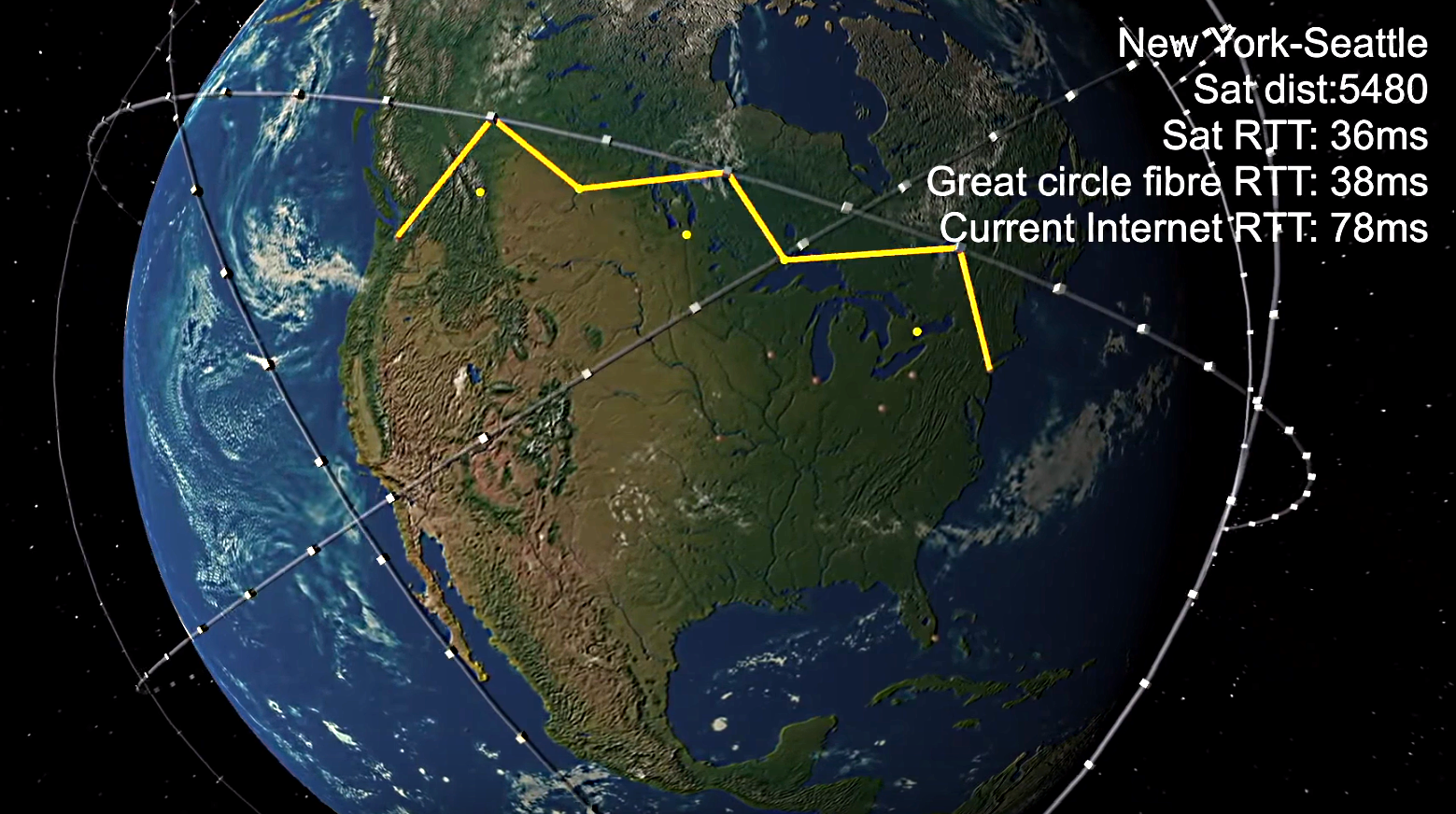
Many people -- me included -- have assumed that these "bent pipe" hops would significantly increase latency on long-distance paths, but Handley's simulation shows that, while not as fast as an equivalent ISLL path, long bent-pipe paths would typically have lower latency than terrestrial fiber routes between the same two points.

Sample Seattle-New York path
Consider, for example, this six-hop route between Seattle and New York. The bent-pipe route has a round-trip time of 36ms versus 78ms for the current Internet and 38ms for an hypothetical great circle fiber route, which would be impossible because of mountains and other obstructions.

That example was taken from a run in which only six orbital planes had been populated and it assumed ground stations at popular SpaceX locations plus a few others that Handley assumed would be added at strategic points. With only six orbital planes, global coverage is spotty but it is solid around 53 degrees north (and south). As more satellites are added, coverage becomes wider and latency improves. By the time all 1,584 satellites are in operation, there is global coverage and latency is consistently better than today's terrestrial Internet.

User terminals as relays
While adding satellites improves performance, adding additional ground stations has an even greater impact. That suggests the possibility of relaying traffic through idle end-user terminals, which also have phased array antennas. Handley ran a simulation assuming relays every 100 km and found that latency across the US was roughly cut in half and jitter (latency variance) also declined, but the number of route changes increased to about one every five seconds. That sounds like a lot of overhead but Handley feels that it is feasible to handle. It would also require a more expensive user terminal, a little power and the permission of the user so SpaceX might subsidize the terminals or charge less for service.

Handley also considered inter-continental relaying, which would require relay stations on strategically placed ships at sea. (It turns out that no ships would be needed to cross the Northern Pacific, but that would require a relay station in Russia, which might be a political problem). He doesn't mention the possibility, but couldn't cargo and cruise ships act as slowly moving relay stations? (They will certainly want to be terminal-users).

The example shown above is for an east-west link but Handley also looked at long north-south links and found that ground relays actually beat ISLLs in some cases and were always better than fiber, but the best results are achieved by a combination of ISLL and terrestrial links, which we can look forward to once SpaceX and others begin deploying satellites with ISLLs.

Handley concludes by pointing out that since he started making the video, SpaceX had revised their constellation configuration from 24 66-satellite planes to 72 22-satellite planes. It turns out that once the first 1,584-satellite phase is complete, there is pretty much no difference between the new and old configurations, but it does require a few more satellites to be deployed before the trans-Atlantic and Pacific relays will work continuously. Note that SpaceX hopes to complete the first phase by early 2021.

I can't conclude this post without mentioning Handley's charming disclaimer that he has no inside information, but, based on public statements, has made reasonable assumptions about "what they could do if they wanted to, but probably isn't what they will actually do."

Watch the video:


Update 1/1/2020

Handley presented a paper on this research at the 2019 ACM HotNets Conference. You can see a video of his presentation and download a copy of his paper here. (The video of his talk is free, but the paper is behind a paywall).

Update 1/13/2020

There has been further discussion of this topic in the Reddit Starlink Community. Commenters have pointed out that ISLLs are cutting edge technology and the current cost of Mynaric's 10 Gbps terminals is prohibitive, though it will doubtless drop with mass production (and Mynaric has hired an ex-SpaceX executive). While SpaceX has announced plans to launch satellites with ISLLs by the end of 2020, those may just be for testing. Furthermore, they will have many legacy satellites in orbit by then and those will not be replaced for around five years. SpaceX will not have a 100% ISLL constellation until 2026. Perhaps OneWeb made a wise decision in postponing ISLLs and Wall Street arbitrage traders will have to wait a few years for ultra-low latencies.

Wednesday, January 02, 2019

Simulation of OneWeb, SpaceX and Telesat's proposed global broadband constellations

Inigo del Portillo and his colleagues at MIT have run a simulation comparing OneWeb, SpaceX and Telesat's proposed low-Earth orbit Internet service constellations. The models are based on the initial FCC filings by the companies and demand and data-rate estimates by the authors. (I will mention subsequent amendments to the filings below).

The first part of the paper presents an overview of the satellites and constellations and simulations predicting the average number of satellites within line of sight at different latitudes:

Source

With 4,425 simulated satellites, SpaceX is the clear leader in all but the extreme north and south, but Telesat, with only 117 satellites, averages more visible satellites than OneWeb with 720 because their minimum elevation angle is 20 degrees while OneWeb's is 55 degrees (SpaceX's is 40 degrees).

Note that SpaceX coverage peaks around the latitude of Seattle, where their center for satellite operations is located, and many large trading and financial cities have 30 or more visible satellites:

Source

They also simulated alternative ground segment configurations. The following figures show throughput as a function of the number of ground stations and assumed optical inter-satellite link (OISL) speed:

Source

They estimated the average data rate per satellite and total system throughput (sellable capacity) for each constellation then computed the number of ground stations needed to achieve full capacity:

SpaceX OneWeb Telesat
Average data rate per satellite (Gbps) 5.36 2.17 22.74
Total system throughput (sellable capacity, Tbps) 23.70 1.56 2.66
Ground stations needed to achieve full capacity 123 71 42
Throughput with 50 ground stations (Tbps) 16.80 1.47 2.66

Note that marginal improvement diminishes as the number of ground stations increases. For example, with 50 ground stations each, the throughputs are SpaceX 16.8, OneWeb 1.47 and Telesat 2.66 Tbps.

Since SpaceX has their own launch capability, they can afford to begin at very large scale, giving them a significant capacity advantage, but Telesat has a significant lead in capacity per satellite. Putting these constellation capacities in context, Telegeography reported that global International bandwidth in 2018 was 393 Tbps, two-thirds of which has been deployed since 2014. Satellite constellations with OISLs will add to that total and provide lower latency times than international terrestrial cables.

As mentioned above, there have been some changes in plans since the FCC filings upon which these simulations were based. OneWeb has reduced the number of satellites in their constellation to 600 and eliminated ISOLs and SpaceX has lowered the altitude of their constellation from 1,100 to 550 km and cut the number of ISOLs per satellite from 5 to 4. (SpaceX was also authorized to use V-band spectrum, but that may be for their planned VLEO constellation).

I asked del Portillo whether they had rerun the simulations using the revised plans, and he said they had not, but he did not think that the numbers for total throughput and number of ground stations would vary a lot for SpaceX and he expected the total system throughput would decrease slightly for OneWeb because of the reduced number of satellites. He also expressed concern about OneWeb being able to provide continuous coverage near the equator where there might be coverage gaps or lower data-rates. (Note that the simulation focused on end-user and backhaul demand, not marine and in-flight connectivity which are priority markets for OneWeb).

SpaceX appears to have financing in place to cover their initial launches and achieve high capacity early and Telesat is making a much smaller initial investment, but should be able to scale up as demand increases. Based on this simulation and problems they have encountered with their Russian partners, OneWeb may be falling behind.

I've summarized some of the results of these simulations, but you should read the paper for details on the model structure, assumptions and a discussion of technical challenges. You can also check out this slide presentation on the paper. I also recommend an earlier paper and accompanying videos on a simulation that predicts routing redundancy and latency with SpaceX's planned broadband constellation.

Update 1/13/2020

Click here to access a subsequent journal article based on this research.

Monday, November 26, 2018

A cool simulation of SpaceX's revised satellite broadband plan

On November 15, the FCC approved a revision to the plan for Starlink, SpaceX's forthcoming broadband satellite service. The new plan reduces the number of satellites from 4,525 to 4,409 and lowers the altitude of the phase-1 satellites from 1,100 to 550 km.

Revised broadband satellite plan (Sources 12 and 3
Mark Handley, a professor at University College London, has created videos based on simulations he ran of both the original and revised phase 1 plans. You should watch the videos, but it will help to first look over a few images from his simulation of the new plan.

Starlink phase-1 is shown below. Handley assumed a phase offset between adjacent planes that would minimize the chance of a collision. The minimum crossing distance between satellites is a little over 90 km -- an improvement over the previous plan.

Starlink phase 1

Looking up, there are several satellites in view at any one time (but fewer than there would have been with the previous 1,100 km plan):

View from the ground

Radio transmission will be used for links between the satellite constellation and the ground and laser links will be used between satellites. Handley assumed that each satellite links to the one before and after it in its plane and to the second closest in the adjacent planes in order to improve east-west routes. In his simulation of the first plan, he assumed a fifth laser linked to a satellite in the crossing plane, but that would be more difficult at this fast-moving lower altitude. It will be interesting to see how SpaceX uses the inter-satellite links.

Each satellite is linked to four others, forming a mesh network.

A simulated route between San Francisco and London is shown below. Note that latency is about half that of current, terrestrial routes. (The latency advantage of satellite routes over terrestrial is generally greater for long distances).

San Francisco-London -- twelve hops in space

Nine parallel routes between New York and London are shown below -- eight have lower latency than the current, terrestrial route.

Eight New York to London routes are faster than a terrestrial route

The following image shows all three phases -- Handley is not sure if the other two will interact with the phase 1 satellites.

Red: phase 1, white: phase 2, Blue, phase 3

Only Elon Musk knows what motivated this revision in SpaceX's Starlink plan, but we can speculate. They have had two test satellites in orbit at around 550 km altitude for some time, and that experience must have informed the decision. Musk reported that the links between the test satellites and the ground were performing well, but did not mention the laser links between satellites. Perhaps they feared difficulty with the longer laser links at 1,100 km or some other engineering problem. (Musk recently fired several managers in an effort to keep the project on schedule).

Because SpaceX and others are planning to launch thousands of new low-Earth orbit satellites, the FCC is focusing their attention on debris mitigation. The chance of a collision with the new plan is reduced since the minimum distance between satellites increases from over 40 to slightly over 90 km and.

The lower-altitude satellites may require more fuel to overcome a slight increase in atmospheric drag, but they will be easier to de-orbit when their life (around 5 years) is up, further reducing the likelihood of a collision.

Starlink's primary goal is affordable global broadband service to individuals and organizations, but Musk has also predicted that they would carry half of the global long-distance traffic. Handley's simulations predict roughly 2X latency improvement over current terrestrial cables on long routes and he points out that low-latency long-distance service will appeal to financial companies with offices in Europe, North America, and Asia. If capacity turns out to be sufficient, I imagine Starlink will also attract tier 1 ISPs and large companies like Google.

Finally, SpaceX also has approval for a constellation of 7,518 very low-Earth orbit satellites operating at altitudes from 335km to 346km. These will not be launched until SpaceX has satellite engineering, regulatory and market experience and time to assess potential cooperation/competition from 5G terrestrial networks.

I recommend watching the videos of both of Handley's simulations because the narratives are different and both are inciteful. You should also read his paper Delay is Not an Option: Low Latency Routing in Space.

Update 5/27/2019

Mark Handley has created a simulation of all 11,927 planned Starlink satellites.

Red: first phase at 550km.
White and blue: 2nd phase: 1,110 to 1,325km.
Yellow: 7,517 yellow VLEO satellites 335-345km.
Blue: Polar orbit

You can see a short video of this simulation here.

Stay tuned for analysis.