Monday, June 04, 2012

Global online education is taking off

Education cost and consumer prices
As shown here, the cost of education (in the US) is rising faster than general inflation. At the same time, voters are cutting spending on public education. As a result, online schools are springing up all over. There are many variations on the theme, and it will be fascinating to see which models survive. Here are some examples:
  • Calstate online: Charge tuition and grant degrees. Self-sustaining, non-profit.
  • edX: Free for now, but will they one day offer certificates for a fee? Large cash endowment, but what happens when that runs out?
  • The Khan Academy: Free forever? Contract with school districts? Foundation support.
  • Udacity and Coursera: Venture backed university spin offs are free for now, but investors will want income in the future.
  • NPTEL, the National Program on Technology Enhanced Learning: Produced by the Indian Institutes of Technology. Government funded and free.
  • Open University: Grants degrees and charges tuition (discount for UK students).
  • Open University Learning Space: Free online courses from 1-20 hours long from the Open University and the BBC.
Venture capital comes to education
There are also students with different goals:
  • Young people seeking a degree or certification at the beginning of their careers
  • Working people seeking a degree or certificate in order to improve their positions
  • Working people seeking training in a specific job skill
  • Curious people who want to learn about a subject as an end in itself
  • Curious people who want to acquire a skill as an end in itself
To make matters even more interesting, while US entries in the online education have been getting a lot of attention, this is a global phenomenon. We see offerings from the US, UK, India, Namibia and many other nations. Needless to say, there are also online students in every nation.

-----
Update 4/10/2013

UK Universities Minister David Willetts urged university leaders to invest in the "historic opportunity" presented by global online education.  The BBC article covering his talk also summarizes current online education efforts in the UK and places them in a global context.

-----
Update 4/25/2013

Coursera has launched its first international course, Science, Technology, and Society in China I: Basic Concepts, from the Hong Kong University of Science and Technology.

According to an article in the Chronicle of Higher Education, 17,000 students registered for the three-week course -- around 60 percent of them from the United States, the United Kingdom, Canada, and other rich nations, with the rest from countries like Brazil, Mexico, South Africa, and middle-income countries in Asia.  The article continues with an interesting discussion of the opportunity and barriers presented by the Chinese market for online education.  Will it be open or dominated by Chinese companies and universities?  Will Chinese universities and faculty be allowed to use Coursera and other platforms or will China erect a "walled campus?"  This course is in English -- will Coursera offer classes in Mandarin?

Other posts on MOOC globalization.

-----
Update 7/8/2013

The Chronicle of Higher Education profiles five international MOOC providers:

-----
Update 10/3/2013

Futurelearn, a coalition of universities in the United Kingdom, announced their first round of courses recently and now Udacity, with support from Google, has announced an effort to translate their existing courses. You can see an example here, with closed captions available in a variety of languages. Will English with sub-titles be sufficient or will students prefer native language presentation?


-----
Update 10/12/1013

list of MOOC providers They say it is up to date as of September 27 th.

-----
Update 10/16/2013

Two European MOOC providers, iversity and Futurelearn, are launching this month. The first course offered by Futurelearn, a coalition of UK universities, starts October 21. It is an ecology course called "Fairness and nature: When worlds collide" and it will only last two weeks. I will enroll to get a look at the Futurelearn delivery platform.
Iversity began with a scholarship from the German Federal Ministry of Science and Technology and is now venture funded. They will be offering MOOCs by university professors from around the world and are launching with six courses this month. Their course promotion videos are innovative, for example, combining video and graphics and using 3D video, as shown below. I want to keep an eye on their platform as well.


-----
Update 11/4/2013

Global competition is heating up. Coursera is establishing "learning hubs" around the world and has found a Chinese parnter, NetEase.

Coursera learning hubs

-----
Update 1/17/2014


Two thirds of all MOOC users live abroad in countries like Rwanda, Kenya, China, and Brazil according to this post by David Blake.

His post includes links to these MOOC providers:

ALISON (Ireland), Ewant (China), FutureLearn (United Kingdom), iVersity (Germany), Open2Study (Australia), Rwaq (Saudi Arabia), Schoo (Japan), UniMOOC (Spain), Veduca (Brazil), and XuetangX (China).


Thursday, May 31, 2012

PCAST presentation on spectrum policy and technology -- attention Obama and Romney

As shown here, demand for mobile connectivity is exploding. It can not be satisfied using existing spectrum allocation policy and technology.

People have been experimenting with various forms of smart radio technology for many years, and a shift to sharing spectrum in new, dynamic, highly local ways seems inevitable.

That shift will cost incumbent spectrum owners, but pay large dividends for the economy as a whole.

The companies and nations that lead the innovation and establish the new policies and technical standards will reap large benefits. (As did the companies and nation that invented the Internet).

The President's Council of Advisors on Science and Technology (PCAST) will soon issue a report calling for the use of smart radios in sharing federal spectrum.

The report is not yet out, but you can see a 23 minute video presentation (followed by 21 minutes of good questions and anwers) on the forthcoming report with specific recommendations for policies and pilot studies. You can also download a copy of the presentation slides.
The presentation, by PCAST member and venture capitalist Mark Gorenberg, reviews the situation, makes policy recommendations and calls for pilot studies using spectrum that is currently allocated to federal agencies.

(I found one thing weird -- they advocate giving agencies budget increases as an incentive to participate. Those agencies are owned by the American public -- why should we pay them to do the right thing on our behalf?).

During the question and answer period, Gorenberg estimated that modern technology could increase wireless capacity by as much as 40,000 times and he stated that the US is in a world-wide race to lead in this technology.

One hopes this report will be taken seriously -- Obama and Romney should be pinned down on this issue.

Update, July 2012:

The report was issued: http://1.usa.gov/10kJk9B

Update, May 14, 2003:

Tom Wheeler, an Invited Expert on the report, was appointed Chairman of the FCC (http://bit.ly/13IS7R8).

Wednesday, May 30, 2012

Kimiko Ishizaka's novel, replicable business model for an open Bach score and recording

Check out pianist Kimiko Ishizaka's recording of Bach's Goldberg Variations. The recording and digital score are in the public domain, under a Creative Commons Zero license. Feel free to listen to, download and share the music and tweek the score.

Excellent -- but how does one fund such a project? It began as a Kickstarter project that started with a $15,000 goal and raised $23,748. The funds were used to create the new score and produce a studio recording.

The recordings are now in the public domain, and Ms. Ishizaka has a Web site which lists her forthcoming concerts. No doubt her concert income will increase as a result of this project. She is also publicizing the recording by offering a free double CD to anyone who will write a thoughtful and honest review of the recording and publish it on their blog, in a music forum, on a public Facebook page, etc.

The score is also online and open. You can download it, modify it, or "play" it on the site, as shown here.

Appropriately, the score was produced using the open source MuseScore notation software from Musescore.org.

I am not a musician -- not even a great lover of music -- but I find this project and the Musescore tools and community totally exciting!

Ms. Ishizaka is experimenting with new ways to make a living as a musician in the Internet era. (Her effort reminds me of Louis CK, who marketed a recording of his comedy concert direct to the consumer). One can imagine 1,000 scores and recordings. Kickstarter cannot provide funding for all of them, but universities, foundations and organizations like the National Endowment for the Arts and its world-wide counterparts surely could.

Tuesday, May 29, 2012

Google's storage pricing model combines the self-serving features of cell phone and ISP pricing

Here is Google's report of my storage utilization. It says I've not used any of my Picasa storage, but when I go to Picasaweb, I am told that I've used 84% of my one gigabyte. (I like the first result best, but I really have used most of my allocated gigabyte).

But, that reporting discrepancy is a minor bug. A more fundamental problem is that Google differentiates between my storing images and video (Picasa), email messages with attachments (Gmail) and arbitrary files (Google Drive).

That makes as much sense to me as differentiating between voice bits, data bits and text message bits on your cell phone bill. It's all bits.

(I am waiting for the water company to begin charging me different rates for my drinking, showering and car-washing water).

But, wait, there's more. Checking Google's storage pricing policy, we learn that pictures and videos you upload from Google Plus do not count against your Picasa limit and Google docs do not count against your Google Drive limit. Etc. (I said "etc.," because I got tired of reading the fine print).

That reminds me of Comcast not counting their own video material against download caps.

Google -- this seems a bit evil -- please unify your storage policy.

Screen sharing during on-air hangouts works, but could be better

Some friends and I do a weekly podcast called Yet Another Tech Show (YATS). We're streaming the podcasts using Google's "on-air" hangouts, and last Wednesday, we experimented with screen sharing during the podcast.

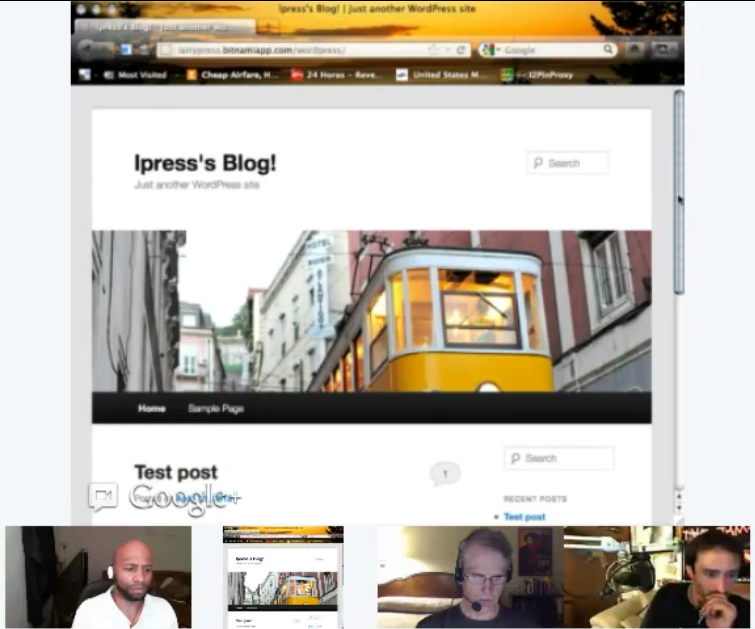
In the middle of the podcast, we talked about the simplicity of deploying servers and applications in the Amazon cloud and demonstrated a virtual server on a shared screen. The discussion went smoothly -- we could easily participate and collaborate -- but, as you see in this screen shot, the video quality was not perfect. You would not want to stream a fine print contract at this level of quality.

In the best of circumstances, real time screen sharing is difficult. A lot of data has to be moved quickly and a lot of processing is required to reconstruct and render the data as it arrives. It gets even rougher when the screens have different sizes, aspect ratios or resolutions. If I share my 1,920 by 1,200 desktop and you are viewing it in a 400 by 400 window, we have a problem.

After our podcast, I played around a bit more with screen sharing. I started an on-air hangout between two computers sharing the same Internet connection -- my laptop and my wife's iMac.
Both machines have 1,920 by 1,200 pixel displays. My laptop has a 3.06 Ghz dual core CPU, 4GB memory and is running 64-bit Windows and the iMac has a 2.8 Ghz core 2 CPU with 2GB memory and is runnng OS X. Google hangouts was the only application running on either machine.

First I shared the Mac's properties screen. It showed up quickly on the laptop, but as you see here, it was blurry. The image gradually sharpened until after around three seconds, it was easily readable, though, as you see, still imperfect. While the screen was easily legible, the rendering delay may have hindered a conversation.
Next I made Word documents with screens full of words on both machines and shared both screens. Again, rendering and "focusing" the pages took around 3 seconds on either machine. Character quality on the laptop was better than that on the Mac (shown here).

Cursor movement on a remote screen was jerky, but it was less than a second behind. The delay in selecting a single word then deleting it was well under a second whether working on the Mac or PC. The delay in deleting a paragraph was more noticable -- about a second.

The delays were caused by some combination of the speed of the computers and communication time. The CPU utilization on both machines varied significantly while screen sharing, even if there was no change on the screens. (At times it was over 90 percent on the laptop). When other applications were running, performance deteriorated noticeably.

While imperfect, hangouts on air was good enough for our demo and conversation to run smoothly. This is version 1 and Google will improve their sharing and rendering algorithms -- version 2 will be better. Communication link speed is controlled by business interests, not technology, so it will be a more persistent constraint in the US.

The video of the YATS session is shown below -- the screen sharing segment starts at just after the 30 minute mark.

Tuesday, May 22, 2012

Is college's stone age is about to end?

Mark C. Taylor, chairman of the department of religion at Columbia University, asks whether college's stone age is about to end in a three part article on the university in the Internet era.

The three parts are at:
Here are a few quotes and paraphrases:
  • We produce too many unemployable PhDs.
  • Is one paying for education or certification when attending college?
  • Some subjects can be outsourced; for example, let one college have a strong French department and another a strong German department.
  • Online education will be modular.
  • There will be online winners and losers.
  • Financial pressure and improved technology have reached the point where much education will soon go online.
  • The networking of higher education will transform how teachers teach and what students learn.
  • Disciplines will need to be reconfigured -- departments can be transformed or abolished.
  • Faculty will increasingly serve as academic counselors who advise students on designing classes and integrating programs at different institutions.
  • Excessive competition and overspecialization are the plagues of higher education.

Monday, May 21, 2012

Developing and deploying applications on the Internet is getting easier

There have been several major changes in the way we develop and deliver IT applications. We began with batch processing in the 1950s and progressed to time sharing, personal computers and now the Internet.  With each new platform, application development has become easier.

To develop an application in the days of batch processing, you had to be a nerd -- a professional programmer.  We used to keypunch assembly language programs then hand the card decks to operators who fed them to the computer in batches.  It typically took a couple of hours to get your results back.  Timesharing shortened the turnaround time, but professional programmers were still needed, and applications took months or years to build.

The personal computer enabled users to develop applications like newsletters, simple accounting systems, small databases and so forth using productivity software.  Today one can develop a complex application like a blog, database, wiki or social network on the Internet with little effort.

But, what if you want to run your own applications on your own server? That is also getting easier and cheaper.

In the early days, you needed a computer to run the service and a connection to the Internet.  It might have been a personal computer in your bedroom or on a shelf in a server room.

If the load grew, you could afford denser server blades in racks, but you were still responsible for maintenance and connectivity.

You could take care of the connectivity by moving your server into a data center, but it was still your server.

As personal computer power increased, we were able to borrow a page out of the mainframe book and partition a single physical server into several virtual servers.  Then Amazon and others took it one step further -- taking care of scaling and connectivity by offering virtual servers in their data centers, but it still took a nerd to configure and manage them.

Today, companies like Bitnami are raising the abstraction level and lowering the nerd bar, making it possible to deploy a server with installed applications in just a few minutes.

To demonstrate the ease of deploying applications, I created a virtual machine on the Amazon cloud and installed Web, wiki and blog servers.  You can visit the server and check the three applications here.  Go there and you will see three fully operational applications.

I am not a system administrator or network engineer, but I was able to create the virtual server in the Amazon cloud and install and deploy the three applications in about ten minutes using Bitnami. (You can see the step-by-step installation here).

Bitnami and others like it are raising the abstraction level. Soon we may be able to describe a virtual machine – its speed, memory and storage – and deploy it and its applications using a form like the one shown here.

In addition to specifying the server and its applications, this hypothetical form allows one to select cloud vendors.  Today, Bitnami is tied to Amazon’s cloud, but one can easily imagine them offering a choice of cloud vendors.

If we were to dynamically allocate the resources needed to run an application -- changing them automatically when some performance thresholds was crossed -- one could just pick a vendor, select the applications to deploy and click submit.

When that happens, your grandmother can be her own system administrator.

The online education market is global

There has been a lot of talk about and investment in open online classes from elite US universities like MIT, Harvard and Stanford, but let's not lose sight of the fact that online education is a global market -- on both the supply and demand sides.

Excellent universities in other nations than the US are offering classes, certificates and degrees online. There are Big Names like the Inidan Institutes of Technology, Cambridge, and Oxford and not-so-big names like the University of Namibia. Universities big and small in every language group are thinking about distance education today -- we can look forward to a lot of competition and choice.

The student population is also global. Stanford's AI course had students from 190 countries.  The class was also free, and the most exciting promise of open online education is that it can reach the disenfranchised.

One is reminded of the story of the young mathematician Srinivasa Ramanujan rising to fame after writing Professor G.H. Hardy at Cambridge from his village in Southern India. (His first two letters to Hardy are said to have been returned unopened). Tomorrow's Ramanujan will have a much easier time getting the attention of his tutors. How many Ramanujans will we find enrolled online and what will be their contribution to humanity?

I can't leave this post without pointing out the irony that Springer publishes a math journal named after Ramanujan. The print version of Ramanujan is $719 per year plus $67.50 shipping and handling and the electronic version is $590. Ramanujan could not have afforded it -- but the disruption of academic publishing is a different post.

Friday, May 18, 2012

Google goes beyond text search with their Knowledge Graph

Soon after he created the World Wide Web, Tim Berners Lee turned his attention to the semantic Web -- a Web of data rather than documents. Google is now rolling out their first step in that direction, the Knowledge Graph.


Google's 2010 purchase of Freebase and Metaweb, the system used to create it, was a key step toward Knowledge Graph. Freebase is a semantic database, which knows the attributes of entities and the relationships between them. For example, Freebase knows that Larry Press is a person and the value of his city of birth attribute is Pasadena, California (not Pasadena Texas).

Google started with the Freebase concept and added data to create the Knowledge Graph database, which now contains 500 million entities with 3.5 billion attributes and connections.

Let's look at an example. I started with a vanity search for myself, and the following profile was displayed on the right hand side of the screen:


Note that it did not know the value of any of my attributes, it just returned a link to my Google Plus profile and the first few sentences of my most recent posts. I guess I am not one of the 500 million entities included in Google's Knowledge Graph.

Next I searched for George Washington, who is a bit better known than me, and is included among Google's 500 million entities.


In this case, it knows his nicknames, date of birth, etc. Since he is not just a person, but a president, he also has a vice president attribute.  It also knows that he died at Mount Vernon, which is another entity that is included in Google's Knowledge Graph:


While the Knowledge Graph was developed using the Freebase tools, Google did not import the user-contributed Freebase data. (I am in Freebase, but not in the Knowledge Graph). That says Google is abandoning the Wikipedia-like openess of Freebase, in which users could add entities and change the values of their attributes, for a database that is currated in house. That will limit its growth and its "Internetness."

This is an interesting announcement, but Google is not the only player in the Web of data game.

Apple has attracted a lot of attention with Siri, a speech-driven application that answers questions by querying Wolframalpha, another semantic database system. Knowledge Graph gives Google an answer to Siri and Wolframalpha. (Wolframalpha goes further, incorporating a powerful symbolic math engine).

Microsoft is also working on the semanticly rich Web of data. They characterize Bing as an "answer engine" rather than a "search engine," and Microsoft Research has a Semantic Computing Intitative. Microsoft will no doubt incorporate their work into Bing.

The Web is getting smarter -- we may move from today's Web of documents to a Web of data and eventually a Web of knowledge (an ill-defined wannabe buzz word I've heard).  It makes you wonder what it will be like in fifty years.

Monday, April 30, 2012

John Boyer's massive face-to-face class at Virginia Tech

There has been a lot of talk about massive, open, online classes (MOOCs) like those taught at Stanford earlier this year.  But what about massive face-face classes?

Last year I saw John Boyer give a presentation on his 2,670 student, face-to-face World Regions geography class at Virginia Tech.

Boyer teaching his class
The class typically had 50-70 students when Boyer began teaching it in 1998. As the word got out, enrollment grew and the class moved from a classroom to a lecture hall to a large auditorium.

The weekly class meets for four hours, with a one hour dinner break. He has students interact with each other during the class, and also conducts Skype interviews on stage. His most famous interview was with Myanmar's Aung San Suu Kyi.

He and his class invited her to do the interview in a short (1:36) video clip. Check it out and you will see his trademark plaid jacket and get a feel for his style. You will also see nearly 3,000 cheering students.

Aung San Suu Kyi interview
She accepted their invitation and you can see the interview (33:37) in which students ask questions below. Be sure to watch the last couple of minutes.

As you see, Boyer is a flamboyant teacher who takes plenty of risks and they seem to pay off.

He holds his office hours online and the class uses the hashtag #wrvt. For his office hours, textbook, weekly news and more, go to his Web site.

Boyer concluded the presentation I attended with a few of the things he has learned teaching this large class:
  • A class this large needs less structure, not more. For example, he provides a menu of activities and allows students to select what they will do to accumulate points toward a grade.
  • A class this large cannot work unless students communicate with and help other students.
  • The teacher knows a lot about the topic, but the students collectively know a lot he does not know. (Michal Wesch, who teaches anthropology says the same thing).
Office hours
I did not get around to writing this post when I saw Boyer last year, but was reminded of him by an article in the Chronicle of Higher Education today. Check it out and see his student's comments here.

Finally, I saw Boyer's presentation at the Campus Technology Forum.  I've been to three of them, and they were all excellent learning experiences.

Monday, April 09, 2012

Requiem for the textbook

At first, new media mimic old media. Early movies were made by filming stage plays with a stationary camera. We still see a few movies based on stage plays, but they are uncommon today.

Early television shows often had performers acting in play-like sets or standing on a stage reminiscent of vaudeville.


Books followed a similar pattern. Johannes Gutenberg’s 1455 bible was the first book printed using movable metal type. The Gutenberg Bible resembled the hand written manuscripts on which it was based. It did not have punctuation or paragraphs, the pages were around 12 by 17.5 inches and its illustrations were added for beauty and feeling, not clarification.

It was like the hand copied books that preceded it -- a religious book suitable for contemplative reading in a library. Gutenberg’s breakthrough was in production, not format or content.


Fifty years after Gutenberg, Aldus improved production by printing eight pages on a single sheet. This led to smaller, portable books that could be carried or placed in a saddle bag. Aldus also introduced punctuation like the commas, periods and semicolons shown here, and italic type, which fit more letters on a page. But, like Gutenberg, Aldus would be surprised by the variety of punctuation and typography in today’s textbooks as well as innovations like chapters, callouts, indices, tables, diagrams, tables of contents and images with captions.


Textbooks today are at the “Gutenberg bible” stage. Textbook publishers have digitized their books, making them available online in various formats. Many maintain the notion of a book-sized page and often preserve the page numbering of the print version. These e-books look better than PDF documents, but they are constrained by the previous format.

Like Aldus, they have gone somewhat beyond their predecessor, but remain tied to the notion that the course is contained in a book of pages.


Many universities are offering online classes, but these also emulate the past. They typically offer the "same" course online as they teach in the classroom. They may record lectures, use digital textbooks, and substitute threaded discussion for in-class discussion and administer assignments and tests using a course management system, but the course and teaching material are not radically changed.


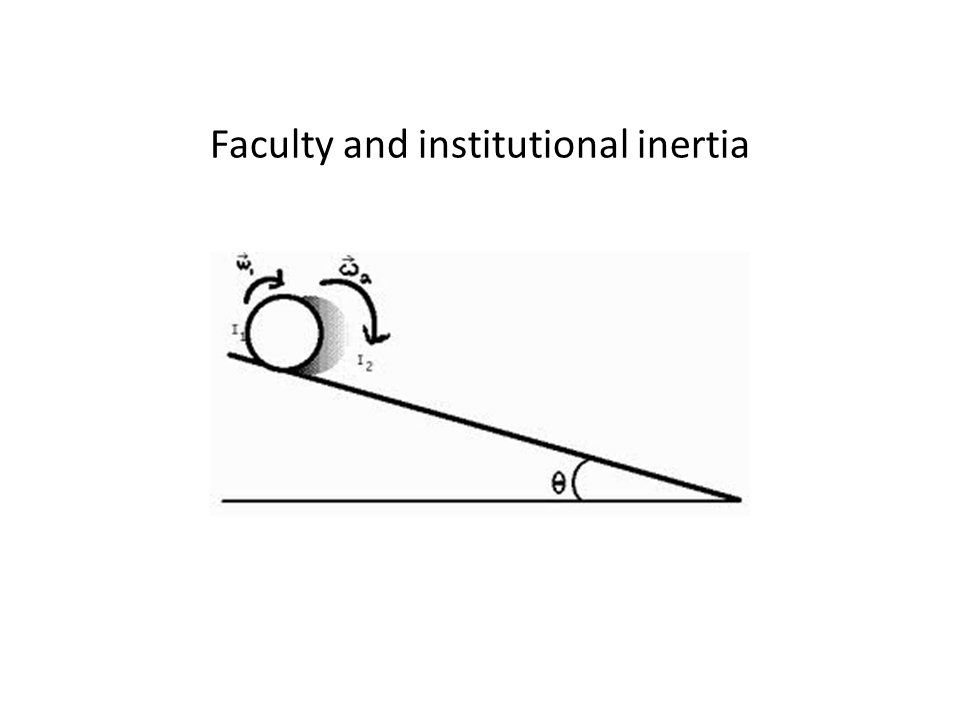
There is a lot of institutional inertia. Textbook publishers want to stay with their old, profitable business models. Faculty are used to adopting a single textbook with ancillary material like PowerPoint slides and test banks. Adopting the same textbook year after year is expedient. They have investments in familiarity with a given textbook, prepared lectures, course outlines, and so forth. 

School administrators are also slow to change. For example, little or no consideration is given to time spent developing new teaching materials during faculty evaluation.


We don't know the future of teaching and teaching material, but it won't center on digital textbooks, learning management systems and recorded lectures. We will have things like modular teaching material, peer teaching, open source and subscription models rather than book purchases, very large classes and things yet to be dreamed up.

Teaching material will be fine grained and narrowly focused on a specific concept or skill and will be used by faculty, students and self-learners.


Change will come faster than in Gutenberg's time or the era of movies and television. The cost of experimentation is greatly reduced in the Internet era, and as we see here, there is an attractive economic incentive. The textbook industry is an oligopoly and textbook prices have risen faster than inflation for many years.


Faculty members at every university are creating and experimenting with new teaching materials. There are many non-profit and publicly-funded experiments in creating and curating teaching and leaning material. And, as we see here, the private sector has noticed the opportunity provided by the price gap shown above.


The Internet has disrupted many industries and organizations. Will the university be next?

For example, what would happen if massive classes with hundreds of thousands of students turn out to be good alternatives for, say, half of the undergraduate curriculum?

Which will look better on your resume – a certificate of completion from Stanford or MIT or a bachelors degree from California State University, Dominguez Hills?  Will schools that focus on teaching survive?  Will universities be able to fund research?  Will a better educated work force improve the overall economy?


For more information, see this teaching module.


-----

Update 7/3/2013

The first shoe drops as Cengage files for Chapter 11 protection That is what happens when you mix the greed of a private equity fund with falling market demand for print textbooks.

Some faculty will have to revise their courses (shudder) if they drop unprofitable print textbooks.

-----

Update 8/18/2013

Google has joined Amazon in selling electronic text books.

For more on the decline of the textbook, click here.

-----
Update 8/30/2014

The Economist reports that US textbook prices have risen much faster than general consumer prices. (ITextbook prices increased over fifteenfold since 1970, three times the rate of inflation).

Prices increase because the students who purchase the books are not the customers of the textbook publishers -- textbooks are sold to professors who adopt them for their classes. Professors are very busy (and some are lazy) so they like textbook packages which include PowerPoint slides, ancillary material, test banks, etc. It's also easiest for them to teach using a new edition of last year's textbook.

Textbooks are still with us, but these price increases cannot be sustained.

The Public Interest Research Group reports that 65% of college students have opted not to purchase the textbook for a class and 94% of them think it has hurt them academically. (That makes me wonder about the 6% who feel fine without the textbook).

Students have alternatives to the purchase of print textbooks -- e-textbooks, open educational resources, library reserve copies, textbook rentals and, most important, a variety of online courses and materials.

The print textbook market is beginning to crack.

Saturday, April 07, 2012

Google is ready to roll out fiber in Kansas City

A while ago, Google invited cities to apply for subsidized installation of fiber infrastructure, and Kansas City was selected.

They have now completed detailed engineering plans and are ready to begin installing fiber in Kansas City.

There are many models for fiber infrastructure ownership -- a mix of private companies, government agencies, home and building owners, etc. For example, the ownership of a portion of the infrastructure by Swedish government agencies has enabled them (and others) to surpass US Internet service.

Here's to the Google experiment and what we may learn from it!

(This fell through the cracks and was not posted at the time I wrote it -- better late than never).

Monday, March 19, 2012

Wishful thinking -- might Ting, Virgin America and T-mobile trigger wireless competition?

Ting pricing example, click to read
Speaking on a panel at the Geek Wire Summit in Seattle, T-Mobile Chief Marketing Officer Cole Brodman said that bundling subsidized mobile phones “distorts what devices actually cost and it causes OEMs, carriers — everybody to compete on different playing fields.” He went on to say that if he were "king for a day," he would do away with subsidized phones.

When asked why T-Mobile did not do it, he said that consumers are used to low phone prices and would not switch even if the long run cost, including usage contact rates, were less.

Well, he may be right, but ting.com is betting that if an unbundled plan is cheap and flexible enough, people will be willing to pay big bucks up front for a phone. How does, say, $62 per month for 2 phones, 500 voice minutes, 1,000 text messages and a 2 gigs of data sound to you? That is a tentative plan I priced out using Ting's rate calculator (see the image above).

But wait, it gets better. There is no contract -- service is month to month. How about their rate plans? There are 216 possibilities. Want more? Ting doesn't roll unused minutes and data over, it gives you cash credit on next month's bill if your actual use is below your plan. What if you exceed the limits of your rate plan? The rate plan is tentative, not hard and fast -- you are bumped up to the next level with not penalty charges. In other words, your bill is a function of your actual usage, not your plan.

It's not all rosy. The phones aren't cheap. For example, a Samsung Galaxy SII 4G is $465, but Ting's billing plans and rates can make up for a lost phone subsidy pretty quickly and you won't be tempted to throw away your phone every two years. For the time being, Ting offers only a few phones and you can't bring your own -- you must buy one of theirs. Another possible glitch -- Ting's carrier is Sprint, and they might have poor coverage in your area.

Virgin Mobile has launched an ad campaign for their unlimited data service. For $35 a month you get 300 minutes of voice and unlimited 3G data and messaging with no contract. Like Ting, they are on the Sprint network in the US, but their 3G phone selection is less impressive.

Might Ting and Virgin Mobile disrupt the mobile phone market? Maybe T-Mobile will jump on the bandwagon. Might we eventually see competition in the mobile market? Stay tuned.

Thursday, March 15, 2012

Britannica is gone -- Grolier struck the first blow

The New York Times announced that after 244 years, the Encyclopaedia Britannica is going out of print.

Wow, I guess it was inevitable and it probably does not mean much to young folks today, but there was a time when every school and library and many middle class homes had copies of the Britannica.

I guess the handwriting was on the wall in the early 1980s, when Grolier, a less prestigous competitor, began offering subscirptions to a text version of their encylopedia through online services Compuserve, Dow Jones, and the New York Times Information Bank.

Grolier's next move was a CD-ROM version, which was developed by Gary Kildall, the creator of CP/M, the mainstream PC operating system before MS DOS. Here's a picture of Gary and the encyclopedia.

Kildall showed the encyclopedia at the 1985 Consumer Electronics Show and it went on sale the following year. The first edition was text only, with 9 million words and 30,000 entries. It was updated quarterly and pictures were added in 1990.

A CD-ROM was faster than Compuserve, but a CD-ROM drive was around $500 in those days. Philips offered a bundle of one of their CD-ROM drives and the encyclopedia. Grolier kept at it for a while, and Microsoft entered the market with their own multimedia CD-ROM encyclopedia, Encarta.

Neither of them was a blockbuster, and the Web and Wikipedia finished them off. (I have compiled a collection of Wikipedia evaluations, including a well-known comparison to Britannica that was published by Nature).

Now the Net has zapped Britannica too. It brings back nostalgic memories of Britannica set on my bookshelf and the time I was lucky to have spent with Gary Kildall back in those heady days of CP/M and CD-ROMs.

Sunday, February 12, 2012

Superbowl streamed -- pirates do IPTV better than NBC


When I reported that the Superbowl would be streamed this year, I saw it as a milestone on the road to IPTV.

I was one of the 2,105,441 people who watched the stream on NBC.COM. I tuned in out of curiosity, but after watching for a few minutes and taking a few screen shots, I turned my computer off and watched the game on TV. (NBC reports that the average veiwer remained online for 39 minutes).

I was not impressed. The action was in a small window surrounded by ads and statistics on a black background. The viewer could switch camera angles by clicking on the insert window on the upper right.

IPTV done poorly -- by NBC
It was too busy and too small for my taste. There were also seemingly constant commercials and other distractions. I did not tune in at the very start, but by the third quarter, the Internet stream was a quarter behind the TV broadcast.

On the other hand, spokesmen for NBC and the NFL were pleased.

Kevin Monaghan, SVP, Business Development & Managing Director Digital Media, NBC Sports Group was pleased by the "record traffic that grew throughout the event." He was also happy with "record high engagement numbers" referring to nearly two million camera angle switches.

Hans Schroeder, NFL, SVP, Media Strategy and Development called the live stream "a tremendous success."

They might have been pleased, but I expected more because I have seen better live streaming of a sporting event. The basketball game shown below filled the laptop screen and was identical to and only four secnds behind the TV broadcast shown behind it.

IPTV done better -- by pirates
One small hitch -- the basketball game was pirated.   NBC and the NFL should check out the music industry experience with pirates. A good way to stop pirates is to offer people convenient, high quality content at a reasonable price.

Perhaps TV executives should think of pirates as market research consultants who are showing them what the public wants.  NBC needs to learn from the pirates that the distinction between "TV" and "the Internet" is broken -- it's all bits.

Monday, February 06, 2012

IT items on the Beloit College mindset list for the class of 2015


Beloit College publishes an annual list of characteristics of their incoming freshman class.  This helps them be sensitive to what their new students do and do not assume.  
Several of the items each year are related to the applications and implications of the Internet and information technology.  Here are the IT-related items for the class of 2015:
  • There has always been an Internet ramp onto the information highway.
  • They “swipe” cards, not merchandise.
  • As they’ve grown up on websites and cell phones, adult experts have constantly fretted about their alleged deficits of empathy and concentration.
  • Their school’s “blackboards” have always been getting smarter.
  • Amazon has never been just a river in South America.
  • Video games have always had ratings.
  • Dial-up is soooooooooo last century!
  • Music has always been available via free downloads.
  • Electric cars have always been humming in relative silence on the road.
  • Some of them have been inspired to actually cook by watching the Food Channel.
  • Their parents have always been able to create a will and other legal documents online.
  • They’ve often broken up with their significant others via texting, Facebook, or MySpace.
  • They won’t go near a retailer that lacks a website.
  • “PC” has come to mean Personal Computer, not Political Correctness.
  • The New York Times and the Boston Globe have never been rival newspapers.
These are just the items relating to IT for this year.  There is a lot more from the Beloit list and other schools at the Mindset List web site.

Sunday, February 05, 2012

Webcam monologues from Amanda Congdon to Felicia Day

New media lead to new art forms, and the Webcam monologue is well suited to the mobile Internet.

The first memorable Webcam monologue I recall seeing was Amanda Congdon's dramatic piece on Hurricane Katrina, in which she intersperses still images and moves the camera a few times:


YouTube is filled with Webcam rants and rambling, but Congdon's monologue was original and moving art.

Here's another example. I just stumbled upon a Web series called The Guild, and saw this clip of Felicia Day talking to a Webcam.

The clip is taken out of context, but she's a funny lady and a master of the Webcam monologue. She's expressive, over-the-top and at the same time, subtle.

These are are well above your typical YouTube videos and I can imagine many others. Have you seen any noteworthy Webcam monologues?

-----

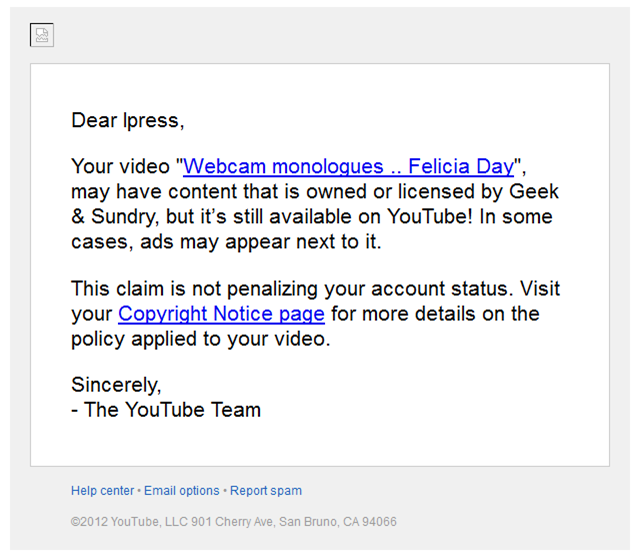
The Felicia Day clip shown above was flagged as possibly infringing on copyright by Google. Rather than take it down, they added ads. Did you see an ad with this post? If so, what was it for? Do you think my including the clip was fair use? Why did I do it? Did I harm Felicia Day? Did I use a substantial portion of the original video?

I wonder if Google or the copyright holder gets the revenue from the ad or they split it. Was the suspected infringement discovered by a Google algorithm or one run by the copyright holder? If Google discovered it, did they ask the copyright holder whether they wanted to take it down or place ads on it?

Monday, January 30, 2012

Is Google turning evil?

Google recently announced that they will be using information from all their applications when ranking search results. (Google lists 35 data sources on their privacy page).

Their corporate motto is "don't be evil." Is Google becoming a bit evil?

When Google started, their page ranking algorithm was based on the number of links to a page. The reasoning was that a page many people linked to was more important than one with few incoming links.

Link count was the first indicator of the importance of a page, but over time, Google, and other search engines, has added ranking signals like the information in your Google profile, your language, location, previous searches, friend's "Plus 1" votes, Gmail messages, calendar entries and more. (The details of the Google search ranking algorithm are a closely guarded secret and it is frequently changed).

Google personalizes search results using these signals. You and I might get different results from the same search terms, and Google will be able to predict whether the "beetle" you are searching for is more likely to be a car or a bug. Privacy advocates are upset because Google uses information from your prior searches, location and language even if you are not logged in. Some also feel this new policy is a unilateral change in Google's terms of service.

Other critics, like Eli Pariser, argue that personalized search narrows our view of the world, creating a "filter bubble."

Google answers these critics in the following video, saying that personalized search results provide more relevant information for users:


Google has also begun promoting their own content in ranking search results. For example, I just did a Google search for Facebook founder "Mark Zuckerberg." The first result was a link to his Google Plus page, which has no posts. That was followed by images of him and a Web post about a fake Mark Zuckerberg. I had to scroll down to the second screen to see a link to his Facebook page. If I search on my own name, I am taken to my Google Plus profile, not my home page on the Web.

Google supporters point out that favoring their own content is reasonable, drawing an analogy to print publications. No one complains that we cannot see articles from the Los Angles Times sports section while reading the New York Times.

But, The Times could not do that even if they wished to, and it is easy to do on the Web. More important, Google has a conflict of interest. Unlike the New York Times, they are in the search business as well as the content business. Google runs the risk of losing brand credibility as a search engine if they start over-ranking their content. They will seem a bit greedy and evil.

And what of the future? Does Google favor YouTube videos over others? Even if they don't today, might they tomorrow?

I don't mind Google personalizing my searches, but they are not serving me well if they rank their information over better information on other sites. Google lets you show or hide personal results with a single click. Maybe they should do the same for "natural" search results in which Google content is not boosted.

Do you think Google has turned evil? Do you want personalized search? Would you want Google to rank their own content the same way they do other's content? If you are not sure, check the first half of this TWIT podcast, in which experts discuss the issue.

You can also see a pretty funny parody showing Hitler reacting to Google's policy changes, but be warned that it is full of profanity and geek in-group references.