Tuesday, August 15, 2017

SpaceX satellite Internet project status update

If all goes according to plan, SpaceX will be offering global Internet connectivity by 2024.

SpaceX orbital path schematic, source
I've been following the efforts of SpaceX and OneWeb to become global Internet service providers using constellations of low-Earth orbit (LEO) satellites for some time. Launch times are getting close, so I'm posting a status update on SpaceX's project. (I'll do the same for OneWeb in a subsequent post).

The Senate Committee on Commerce, Science, and Transportation held a hearing titled “Investing in America’s Broadband Infrastructure: Exploring Ways to Reduce Barriers to Deployment” on May 3, 2017, and one of the expert witnesses was Patricia Cooper, SpaceX Vice President, Satellite Government Affairs.

She began her oral testimony with a description of SpaceX and its capability and went on to outline the disparities in broadband availability and quality and the domestic and global broadband market opportunities.

Next she presented their two-stage plan. The first, LEO, satellite constellation will consist of 4,425 satellites operating in 83 orbital planes at altitudes ranging from 1,110 to 1,325 km. They plan to launch a prototype satellite before the end of this year and a second one during the early months of 2018. They will start launching operational satellites in 2019, will begin offering commercial service in the 2020-21 time frame and will complete the first constellation by 2024.

The LEO satellites launched in the first phase of the project will enable SpaceX to bring the Internet to all underserved and rural areas of the Earth. If all goes according to plan, SpaceX will be offering global Internet connectivity by 2024. These satellites may also have an advantage over terrestrial networks for long-range backhaul links since they will require fewer router hops, as shown in the following illustration comparing a terrestrial route (14 hops) with a satellite route (5 hops) between Los Angeles and a University in Punta Arenas, Chile (The figure is drawn to scale).

Ms. Cooper also said they had filed for authority to launch a second constellation of 7,500 satellites operating closer to the Earth -- in very low Earth orbit (VLEO). A 2016 patent by Mark Krebs, then at Google, now at SpaceX, describes the relationship between the two constellations.

I don't have dates for the second constellation, but the satellite altitudes will range from 335.9 to 345.6 km. (The International Space Station orbits at 400 km). These satellites will be able to provide high-speed, low-latency connectivity because of their low-altitude orbits. Coverage of the two constellations will overlap, allowing for dynamic handoffs between them when desirable. When this second constellation is complete, SpaceX might be able to compete with terrestrial networks in densely populated urban areas.

These VLEO satellites might also be used for Earth imaging and sensing applications and a bullish article by Gavin Sheriden suggests they may also connect all Tesla cars and Tesla solar roofs.

Very low Earth orbit (VLEO) satellites have smaller footprints,
but are faster and have lower latency times than higher
altitude satellites. Image Source

Ms. Cooper concluded her testimony with a discussion of administrative barriers they were encountering and listed six specific policy recommendation. You can see her full written testimony here. The entire hearing is shown below and Ms. Cooper's testimony begins at 13:54.


I will follow this post with a similar update on OneWeb, SpaceX's formidable competitor in the race to become a global Internet service provider using satellites.

Global connectivity is a rosy prospect, but we must ask one more question. Success by either or both of these companies could, like the shift from dial-up to broadband, disrupt the Internet service industry. As of July/August, 1997, there were 4,009 ISPs in North America and today few people in the United States have more than two ISP choices. Might we end up with only one or two global Internet service providers and, if so, what sort of regulation, if any, would be beneficial?

Update 9/21/2017

Evidently SpaceX will name their satellite Internet service Starlink. They applied to trademark the name last month and described the service as follows:


Update 9/27/2017

The SpaceX Internet service project hit a roadblock yesterday when the FCC voted to delay it due to fear of radio interference with OneWeb and Telesat satellites. Like SpaceX, OneWeb is planning to provide Internet service with a constellation of low-Earth orbiting satellites and they and Telesat have reserved International Telecommunication Union (ITU) priority rights to spectrum SpaceX plans to use.

OneWeb technique to avoid inference
with geostationary satellites (source)
ITU priority does not mean they have exclusive use of their frequencies and it is not a permanent designation, but SpaceX will have to work out a spectrum-sharing scheme that OneWeb and Telesat agree to. OneWeb has already patented a technique they say will avoid interference with Telesat's geostationary satellites, which orbit at much higher altitudes around the equator.

I am not an expert in such matters, but it seems that we are at the start of a transition from exclusive spectrum rights to an era of unlicensed spectrum (like WiFi) and spectrum sharing. This fundamental shift will enable efficient use of spectrum (on Earth and in space). It is reminiscent of the shift from circuit-switching to packet-switching and will take years to complete.

I understand OneWeb's desire to delay the SpaceX project for business reasons, but they seem to be on the wrong side of the technology trend in this case and delaying SpaceX is not in the best interest of society.

For more on this ruling and its implications, click here.

Update 9/29/2017

Elon Musk gave a terrific talk on SpaceX's

Reliable reusability makes BFR launches cheaper than others.
The key to reducing cost is their shift to a new rocket, called, for now, the Big F***ing Rocket or BFR. The BFR will carry a 150-ton payload (10 times that of their current Falcon 9) and have an extra landing-guidance engine for reliable reusability. (They have now successfully landed 16 straight boosters with only one engine). As shown here, marginal cost per BFR launch will be the lowest of all SpaceX rockets, which are cheaper than any others.

Musk said they would soon begin soft-landing and reusing second stage rockets as well as boosters and he suggested that the BFR and its reusable second stage may be able to retrieve spent satellites in the future.

I don't know how many Internet satellites will fit in a BFR 150-ton payload module, but the BFR may give SpaceX a cost advantage over competitors OneWeb and Boeing. (Note that Boeing is also planning a Mars mission, so they may have something novel up their sleeve).

For more on the BFR and it's role in the satellite Internet project see this post.

You can see a number of the slides from Musk's talk here and I heartily recommend watching the talk:


Update 10/17/2017

SpaceX has applied for FCC approval to test satellite communication using radios on two buildings in Redmond Washington. The ground station equipment will be mounted on the SpaceX satellite research and development building shown here and the communications equipment that will eventually be in test satellites will be on top of a tall building about 6 km away. You can read more on the application and test on Reddit.

SpaceX satellite research and development building

Update 10/28/2017

Patricia Cooper testifying
SpaceX vice president of satellite government affairs Patricia Cooper testified before the Senate Commerce, Science and Transportation Committee hearing on "The Commercial Satellite Industry: What’s Up and What’s on the Horizon."

She said they would launch two prototype satellites within the next few months and would begin operation in 2019. Launching the full 4,425 LEO satellite constellation will take about five years and commercial service will begin with 800 satellites in the 2020-1 time frame. At that time, they will cover the entire US. (OneWeb will also cover the US first for political reasons and because we have a high-margin Internet market due to our GDP and lack of terrestrial ISP competition).

Ms. Cooper said their emphasis was on building constellation capacity by increasing the throughput of each satellite and increasing the number of satellites in orbit as quickly as possible. When the constellation is fully deployed, they will have "over 20 satellites in view from any spot in the US." She also said that if operators cannot agree on techniques to share spectrum, the FCC (and ITU) will divide and allocate fixed spectrum blocks and no one wants that so they are motivated to rapidly develop spectrum-sharing techniques.

Ms. Cooper did not give a timeline for the second constellation of 7,500 VLEO satellites mentioned above, but it sounds like they expect this constellation to enable them to eventually compete in urban areas and it will be interesting to see how well they can compete with terrestrial ISPs at that time.

You can read her written testimony describing their plans, expected benefits and policy recommendations here or watch her oral testimony, beginning 45:50 of the archived video of the hearing. Representatives of OneWeb, Intelsat and ViaSat also testified, but, Boeing was noticeably absent. Ms. Cooper and the others answered questions after their introductory oral testimony.

Update 12/8/2017

SpaceX has postponed the first launch of their new Falcon Heavy booster until early next January. (It has been delayed several times). The payload will be a Tesla Roadster, which hopefully will be inserted into orbit around Mars:


Musk has a sense of humor (the payload of their first Dragon booster flight was a giant wheel of cheese) but this is also a publicity stunt with symbolic value. If the flight is a success, it will be widely publicized and serve as near-permanent marker of the beginning of our transition from fossil fuels to renewable energy. As a final touch, the car radio will be playing David Bowie's song, Space Oddity.


The Falcon Heavy will also be available for launches of Internet service satellites.

Update 12/20/2017

SpaceX has released photos of the first Falcon Heavy rocket. It is expected to launch next month, putting a Tesla Roadster in solar orbit. When asked why he wanted to put the car in orbit, Musk said he loves "the thought of a car drifting apparently endlessly through space and perhaps being discovered by an alien race millions of years in the future," and so do I. That reply is even cooler than Mallory saying he climbed Mount Everest "because it's there."

They hope to retrieve and reuse the three booster rockets.


Update 1/8/2018

The SpaceX Zuma launch was a success. You can see a video of the launch here, but it ends just after the recovery of the booster because the purpose of the mission is secret. The recovery footage, near the end of the video, shows the controlled descent of the booster -- X marks the spot:


SpaceX has made booster recovery routine. Their next launch will the first for the new Falcon

(It has been rumored that the Zuma mission failed, but SpaceX will not comment because the mission was classified).

Update 1/23/2018

It looks like SpaceX will launch it's two Internet-service test satellites, Microsat-2a and 2b, on February 10th. They will be "ridesharing" with Paz, a Spanish Earth-observation satellite. Here is summary of what is known (and unknown) about the launch plan:


The satellites will measure 1.1m x 0.7m x 0.7m and, with their two 2x8 meter solar panels, will each have a mass of approximately 400kg. Satellite geeks can read the purpose of the test, test procedures and the specifications of the satellites, radios, and orbits here.

This will be a significant milestone in the race with OneWeb and others -- let's hope all goes well on February 10th.

Update 1/30/2018

Correction:

I blew it -- I said it was Mars orbit because, as you see above, Elon Musk tweeted that the "destination is Mars orbit," but he misspoke.

He later corrected himself, as outlined in this post.

It turns out to be a solar orbit -- "an orbit around the Sun that takes it as close to the Sun as Earth and as far out as Mars".

Update 2/6/2018

The Falcon Heavy launch was a success! The roadster is on the way to orbit and the three side booster rockets were recovered. The center booster ran out of propellant and crashed into the ocean while trying to land on a drone ship. This was not a great loss since it was an older version 4 Falcon rocket and they had not planned to re-use it. The side rockets will also be retired since SpaceX only plans to fly version 5 Falcons in the future.

The Falcon heavy can lift a payload of 63,800 kilograms to low-Earth orbit and the Starlink Internet satellites weigh 386 kilograms. If they fit perfectly, a launch could insert about 160 satellites in orbit. The actual number will clearly be less than 160, but since I don't know about the geometric constraints and solar panel sizes, I can't estimate it reliably.

Regardless, the Falcon Heavy will play a stratgeic role in launching the constellation. Fewer launches will be needed, which will speed deployment and, if they are able to continue re-using boosters, launch cost per satellite will be reduced. (The two side boosters used in this launch had been flown previously).

Here are some launch photos:

Ready to go

Ascending

Three bosters burning

View of the three boosters from onboard


Side boosters descending

Synchronized landing

They did it!

The roadster and dummy in orbit -- for a billion years

Update 12/14/2018

MicroSat 1a and 1b, identical test satellites for SpaceX's Starlink constellation, will launch Feb 17 at 6:17 Pacific time. The Starlink test satellites will be "ridesharing" on the launch of Paz, a Spanish Earth observation satellite. Ridesharing with commercial launches lowers SpaceX's cost relative to competitors.


Update 2/17/2018

Federal Communications Commission Chairman Ajit Pai gave SpaceX a Valentine day present when he proposed that the FCC grant SpaceX's request to offer its Starlink LEO satellite Internet service in the US and globally. A formal vote by the Commission may be needed, but that would be a mere formality given Pai's approval.

Telesat
, OneWeb and Space Norway had previously been granted permission to offer Internet service using LEO satellites. I've been following OneWeb and Telesat, but am not familiar with Space Norway's plans. They've proposed using only two satellites and it seems they may be focusing on serving the northern seas.

Update 2/22/2018

On October 29, 1969, UCLA student Charles Kline sent the first test message over the ARPANET. He was trying to log in to a computer at the Stanford Research Institute (SRI), but the system crashed after he had typed only the first two letters of the word LOGIN. (Terminals were typically upper case only in those days).

By December, the ARPANET had expanded to 4 nodes – one at SRI and three at universities, as shown in this sketch which was made at that time.

Early this morning, SpaceX launched the first two test satellites for their planned Starlink Internet-service. Will we look back on February 22, 2018 as the day we took the first step toward a truly global Internet?

Update 2/22/2018

SpaceX succeeded in launching two Starlink test satellites today, but the subsequent attempt to catch and reuse the fairing (nose-cone) failed. The plan was to have the fairing fire small retro-rocket to slow it as it fell back to Earth then catch it in a large net attached to a ship called "Mr. Steven."

This attempt failed, but, as with booster recovery, they will learn from this and any future failures and eventually succeed in recovering fairings, which cost over five million dollars. (SpaceX failed at many attempts to safely land booster rockets, but they learned from each failure and now booster recovery is fairly routine).

Mr. Steven with large "catcher's mitt"

Fairing floating in the ocean near Mr. Steven

Update 3/30/2018

On February 18, 2018, FCC Chairman Ajit Pai endorsed the SpaceX application for a constellation of low-Earth orbit (LEO) Internet service satellites and on March 29, the FCC approved their application to "construct, deploy, and operate a proposed non-geostationary orbit (NGSO) satellite system comprising 4,425 satellites for the provision of fixed-satellite service (FSS) around the world."

That makes SpaceX the fourth company with permission to operate an LEO Internet service constellation in the U. S.

The first was OneWeb on June 22, 2017. OneWeb received permission to deploy 720 LEO Internet-service satellites, subject to an important constraint that they "need to accommodate in-line interference avoidance and spectrum sharing with other NGSOs in the future." That cleared the way for spectrum sharing among all operators.

The applications of Telesat and Space Norway were both approved on November 2, 2017. Telesat was granted permission "to access the U.S. market to provide FSS using a proposed constellation of 117 NGSO satellites" and Space Norway was granted permission to "to access the U.S. market to provide FSS using a proposed constellation of two NGSO satellites." (Space Norway is planning coverage in the area north of 65 degrees N latitude, which includes northern Alaska).

Update 4/11/2018

The final version of the Falcon 9 series, the "Block 5" Falcon 9, was designed for extreme reuse because it will be used to take astronauts to the Space Station and NASA requires seven flights without making any changes in order to qualify for human flight.

Previous Falcon 9 versions were designed to be reused only two or three times, but SpaceX expects Block 5 rockets to have a 100-flight lifespan and only require refurbishing every tenth flight. This will save money and reduce recycle time and the overall time to launch the Starlink constellation. (The FCC's approval of Starlink requires that they launch at least 2,213 satellites within six years).

For a description of previous Falcon 9 version changes and the Block 5, watch this video (17:38):


Update 5/21/2018

On May 11, SpaceX launched a Bangladeshi satellite using their Falcon 9, Block 5 rocket. This was the first production flight for the Block 5. The day before the launch, Elon Musk participated in a call with reporters and the following are some of the points he made. (You can read more analysis and read a full transcript of the call here)

SpaceX accounted for over half of US
launches in 2017 and expects to
double their launch rate.
In 2017, SpaceX had 18 successful launches and Musk stated that they were on track to double their launch rate this year, implying a rate of 3 launches per month. He said that "if things go well, which is a caveat, then SpaceX will launch more rockets than any other country in 2018."

There will not be a Block 6. Musk said that after 8 years of upgrades, the Block 5 will be the last major version of the Falcon 9 before their next rocket, the BFR.

Musk expects the Block 5 "to be a mainstay of SpaceX business," and there will be 300 or more Block 5 flights before it is retired in favor of the BFR.

The Block 5 is designed for rapid-turnaround reusability. It is "designed to do 10 or more flights with no refurbishment between each flight — or at least not scheduled refurbishment between each flight. The only thing that needs to change is you reload propellant and fly again." He also said that "the Block 5 boosters are capable of on the order of at least 100 flights before being retired."

Musk has set a goal of demonstrating "two orbital launches of the same Block 5 vehicle within 24 hours, no later than next year."

The Block 5 was designed "to be the most reliable rocket ever built." They have exceeded all of NASA's human-rating requirements and have met "all of the Air Force requirements for extreme reliability."

Reliable reusability will cut cost dramatically. Musk broke down launch cost as follows: booster about 60 percent, upper stage 20 percent, fairing 10% and the launch cost 10%. If they are able to reuse all three rocket elements, they would be able to "reduce the cost for launch by an order of magnitude ... to $5-6 million per launch." Musk pointed out that getting to this point had taken "16 years of extreme effort" (and a lot of learning from failures).

The ability to launch 30 Falcon 9s per year at a cost of $5-6 million per launch, would be a big plus for SpaceX's Starlink Internet service.

Update 5/27/2018

Source
SpaceX President and COO Gwynne Shotwell gave a recent interview in which she said that SpaceX is profitable, but she predicts a much larger market for the Starlink Internet service. (As we see here, a January 2017 Wall Street Journal article made the same point).

Shotwell also spoke of synergies among Elon Musk's companies: Tesla cars will be online via the Starlink Internet service; Tesla battery technology has been leveraged for the Falcon 9 rocket and Dragon spacecraft and Boring Company technology will be used in housing construction on Mars. They have also learned manufacturing techniques from Tesla and will be able to produce one rocket engine per day and two complete Falcon 9 rockets per month.

She also said they remain on schedule to take people to Mars in 2024, and, when asked about Elon Musk, she said he spends about half his time on SpaceX and half on Tesla and that he is an inspirational leader.

Click here for a survey and updated progress report on SpaceX Starlink and other potential LEO-satellite based Internet service providers.

Update 6/5/2018

Last week, Elon Musk was asked on Twitter how the Starlink tests were going and he replied that the two test satellites, TinTin A and B, are connecting at "high bandwidth" with 25 ms latency.

That's good news but it leaves a lot unanswered. For example, he did not mention the speed and reliability of the phased-array handoffs between the satellites and ground terminals and he said nothing about tests of the inter-satellite laser links.

While we have experience with radio links between satellites and the ground, inter-satellite laser links are new so I'm more curious about those tests. What sorts of speeds and latencies are they seeing on transmissions between TinTin A and B and how well are they doing at creating and maintaining links between the satellites? Fast inter-satellite switching and transmission speed are critical to overall performance of the constellation grid, particularly on long-distance links.

Update 11/26/2018

The FCC approved a revision to the plan for Starlink, SpaceX's forthcoming broadband satellite service. The new plan reduces the number of satellites from 4,525 to 4,409 and lowers the altitude of the phase-1 satellites from 1,100 to 550 km and authorizes the use of V-band frequencies. The FCC has also approved the use of V-band spectrum by SpaceX, but I am not sure whether they plan to use it for their LEO or VLEO satellites. Click here for a cool, inciteful simulation of the revised plan.

Update 12/21/2018

Financial analyst Brian Wang predicts that Elon Musk's Mars plan will be financially unstoppable in four years because of the early success of his Starlink Internet service satellite constellation. Wang assumes that two critical technologies -- free-space laser & phased-array links will be working in 2019 and financial traders will pay big bucks for low latency links. He expects it will be easy for SpaceX to raise capital after 2022, enabling them to self-fund the Mars plan. (It is unsettling to think that shaving milliseconds off of financial trades is a critical link in establishing global Internet service or Mars exploration).

SpaceX is set to raise $500 million at a $30.5 billion valuation -- will that suffice to fund them through the point where Mars is unstoppable?

Wang does not mention competition. OneWeb has dropped their inter-satellite laser links, but Telesat seems to be moving quickly and they too have their eye on the financial market

Update 2/6/2019

SpaceX has formed a sister company, SpaceX Services, to market connectivity. SpaceX Services filed an FCC application to operate up to 1 million Earth stations for end-user customers -- presumably homes and organizations like schools or community centers.

The SpaceX Services application repeats their plan to begin launching satellites to populate its LEO constellation in 2019, so SpaceX must have or be acquiring a low-cost phased array antenna.

For further discussion of the SpaceX Services application, check out this discussion on Reddit.

Update 4/3/2019

Reading the tea leaves in SpaceX's forthcoming launch manifest, Michael Baylor concludes that the second of two upcoming Falcon Heavy missions, sometime after mid-May, will be dedicated to launching several operational Starlink Internet-service satellites.

Eric Ralph speculates that these first Starlink satellites will use only Ku-band spectrum, with Ku added in subsequent versions. He points out that this would be consistent with the continuous incremental improvement strategy that both Tesla and SpaceX employ. (After their first batch of 75 satellites, SpaceX is already committed to switching to materials that will completely burn up in the atmosphere during reentry).

For more on the upcoming first operational launch click here.

Starlink becoming operational this summer, would give SpaceX a publicity jump on OneWeb and Telesat and, more important, the experience would guide subsequent refinement of technology and operations.

Update 4/24/2019

The first tranche of SpaceX's Starlink Internet-service satellites is scheduled to be launched in early May and they have applied for temporary permission for them to communicate with six ground stations immediately after launch rather than waiting until they are at their final approved operational orbit altitude. That will enable early testing and correction of any problems and get them a few extra days head-start over the competition.

I wonder how many satellites will be in that first tranche.

Update 4/27/2019

Tim Farrar reports that Elon Musk is telling potential investors Starlink terminals will cost $500, dropping to $150 over time. If that is the case, OneWeb may have an advantage since they are reporting steady low-cost antenna improvement. (The OneWeb antenna shown here is much smaller than the tablet it is resting on).

That being said, an investment of $500 is a relatively small part of the cost of ongoing broadband Internet service to a home or a school or other organization.

Update 5/12/2019
In a talk last week, SpaceX CEO Gwynne Shotwell said they planned to launch "dozens" of Starlink Internet-service satellites on May 15th and that there could be two-six more launches during the year. She said the first batch would not have inter-satellite links and declined to say how many would be launched on the 15th.

Elon Musk has elaborated in a tweet saying they would launch a surprising 60 satellites. (For comparison, OneWeb has launched six and Telesat 2). Musk acknowledged that this would be a risky launch, saying "Much will likely go wrong on 1st mission." They will be using an untested method for packing so many satellites inside the rocket fairing and imagine the cost of losing 60 satellites in case of a failure.

He also said they would need six more launches of 60 satellites for "minor" coverage and 12 for "moderate" coverage. SpaceX has said they would begin offering broadband service when there were 800 satellites in orbit. If all goes well, we might see commercial service beginning sometime next year.

In her talk, Shotwell referred to these as "demonstration" satellites, but I imagine they will be used for production once service begins. In the meantime, they will probably be used in marketing and also help SpaceX raise capital, which they have had difficulty doing recently.

One question remains -- when will they begin launching satellites with inter-satellite links?

Update 5/23/2019

SpaceX's launch of 60 Starlink Internet-service satellites was a success! Here you see the satellite cluster before launch, the deployment of the cluster at an altitude of 440 km, the beginning of their separation, and the recoverd booster rocket on a SpaceX barge at sea.

The satellites separated because the cluster was slowly rotating, then thrusters fired raising them to an operational altitude of 550km. Recovery of expensive boosters is becoming commonplace for SpaceX.


Update 5/27/2019

Video of the entire launch and deployment:


Video of the train of Starlink satellites passing over Leiden, the Netherlands, about 22.5 hours after launch.
Video with WATEC 902H + Canon FD 1.8/50 mm lens, GPS time inserter:


Miscellaneous Updates 11/7/2019

SpaceX has succeeded in catching half of a $6 million fairing before it hit the water. You can see a video of the catch here. Since they have apparently learned from their failures and are planning a lot of launches, they have also outfitted a second fairing-catching ship. The ships are named Ms. Chief and Ms. Tree.

SpaceX has asked the International Telecommunication Union to allocate spectrum for 30,000 Starlink satellites in addition to the 12,000 that have already been authorized by the US Federal Communication Commission. This is long-range planning -- they will be replacing retired satellites before they start launching the 30,000 new ones.

The US Air Force is Starlink's first paying customer. They signed a $28 million contract last year and have communicated with a C-12 military transport plane in flight at 610 Mbps using SpaceX's two test satellites, TinTin A and B.

This post presents the results of simulations of the first year of Starlink coverage and speculates on long run pricing and potential roadblocks.

Update 2/19/2020

Elon Musk tweeted that the anti-glare coating on their test "dark" satellite is performing well.

That being said, the International Astronomical Union reports continued concern that "Apart from their naked-eye visibility, it is estimated that the trails of the constellation satellites will be bright enough to saturate modern detectors on large telescopes. Wide-field scientific astronomical observations will therefore be severely affected." They also note that "The focus of this Statement has been on the optical wavelengths. This is not to underplay the effect on the radio and submillimetre wavelength ranges, which is still under investigation."

SpaceX has launched another 60 satellites, bringing their total to 300. Unfortunately, they failed to save the booster rocket and fairings for reuse.

Update 2/22/2020

Long run Internet layers (source)
The US Airforce is the first Starlink customer. As noted above, the Block 5 booster has met all of the Air Force requirements for extreme reliability and last year SpaceX demonstrated communication between a C-12 military transport plane in flight at 610 Mbps their two test satellites, TinTin A and B.

SpaceX CEO Gwynne Shotwell has confirmed that they will be testing Starlink with “a number” of additional military aircraft types. The contract also includes testing of communications between satellites in orbit and Dr. Will Roper, the head of Air Force acquisitions, says the branch will have a “massive” demonstration event on April 8 that will include testing applications of SpaceX’s Starlink satellites to “a greater degree,” connecting to platforms both in the air and on land.

We are moving toward a multi-layer Internet -- from terrestrial to deep space.

Update 7/15/2020

Raymond Li looked through the Javascript of the Starlink beta test agreement and discovered that it was limited to users between the 44th and 52nd parallels north.

The JS also states the financial terms of the beta test:

"These charges are not a fee for the Starlink hardware or services but are being requested exclusively to allow for the testing of our ordering and billing systems as part of this beta program. SpaceX is temporarily loaning you the hardware and providing the internet services free of charge. The $1 will be charged 30 days after your hardware is shipped. This invitation is not transferable to any other address."


Update 10/1/2020
After receiving over 700,000 expressions of interest from all 50 states, SpaceX requested an increase in the number of authorized user terminals from one million to five million. They also announced that they are able to manufacture 200 satellites per month, keeping up with their target launch rate.

Update 10/11/2020

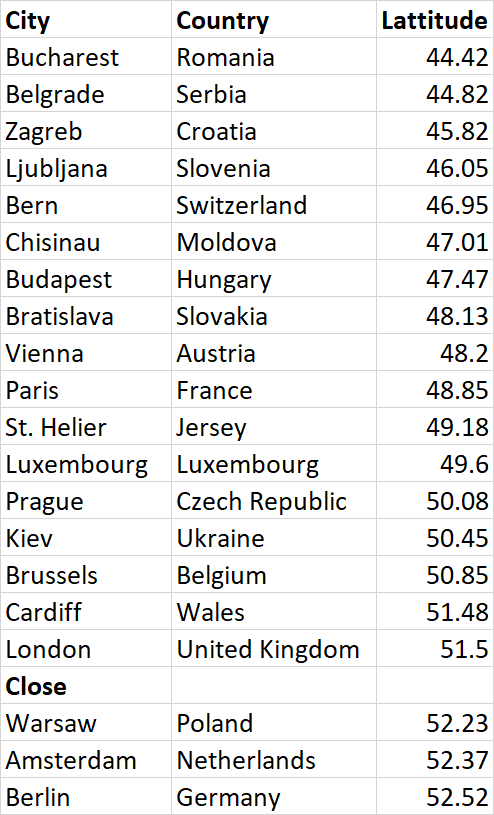
The Starlink beta test is avaialble between 44 and 52 degrees north lattitude, which includes relatively prosperous parts of North America and Europe. A close observer of Starlink reports that SpaceX is said to be trying to secure roof space on data centers in Europe. They already have many US groundstations covering the area beetween 44 and 52 degrees in North America and they have applied for a ground station in Cromwell New Zealand, which is 45.06 degrees south.

The following is a list of European capital cities falling within the 44-52 degree north beta test area. (Let me know if I missed any).
Update 1/7/2021

The Starlink beta rollout is under way. The beta is available in the northern US, southern Canada and parts of the UK. A beta tester has even been spotted in the Czech Republic. Beta prices are affordable for many connectivity-deprived rural users in relatively affluent nations, but may be lower in poorer nations. Affiliate companines have also been established in several nations and ground stations are being built.

Thursday, July 27, 2017

The Tesla Model 3 -- two inflection points

"It's actually even more important to design the factory than it is to design the product itself."
"Expect Level 5 autonomy in "about two years." (Tesla CEO Elon Musk, video interview below)

Telsa will begin deliveries of their Model 3 tomorrow and I think that might mark two inflection points -- one in the manufacture of electric-powered cars and the other in their autonomous control. To put the Model 3 in context, consider two earlier automotive inflection points, the Models T and A Fords.


Model T runabout
The first mass-market car was the Model T Ford, which began production in 1908. Ford was able to produce large numbers of Model Ts and sell them at a relatively low price because they were mass produced on an assembly line, which reduced cost and increased production rate significantly. Ford sold 10,666 Model Ts in 1909. The runabout (roadster) sold for $825 and the four-seat touring car was $850. Over the years, they refined the design and added sedan and coupe models, but by 1927 sales were falling and competitors were offering new features. Ford stopped Model T production and retooled to produce the Model A.

Model A roadster
The Model A began production October 20, 1927, and went on sale December 2. (They called it the "1928" Model A). The Model A offered more models than the Model T and a choice of colors. The mechanical design improved in many ways over the Model T and the driver controls were similar to those of today. If you know how to drive a stick-shift car today, you would be at home in a Model A, but would have to be taught how to drive a Model T. The Model A was a mass-produced, modern car and Ford had plants in Argentina, Canada, Denmark, France, Germany, Japan and the United Kingdom as well as the US.

So, why do I think the Model 3 might be as significant as the Models T and A?


Manufacturing strategy and scale

Gigafactory capacity projection (source)
Ford pioneered the assembly line in a vertically integrated factory and Tesla also hopes to transform the manufacturing process. The size and design of their Gigafactory is unprecedented.

When complete, Gigafactory 1 will be 6 million square feet, making it the biggest building in the world by footprint and second only in volume to the Boeing factory in Washington state. It will produce batteries for homes, vehicles and power companies as well as the Model 3 powertrain -- the motor and gearbox assembly. Final assembly of Model 3s will be done in a separate automotive plant, but they expect subsequent Gigafactories to incorporate the entire auto assembly.

Tesla views a factory as a machine for making machines and they have approached its design as one would approach the design of a multilayer chip. They hope to be able to improve the factory "clock speed" and "density" over time, leading to a 30% cost savings compared to other battery factories. Tesla's manufacturing strategy was outlined in this presentation at the introduction of Gigafactory 1:


Gigafactory 1 output will ramp up as it is built out and, by 2020, they expect its output to exceed 2013 global battery production. They plan to announce three or four more Gigafactories this year, one of which will probably be in China.

Tesla's "wall of patents"before
and after (image source)
Tesla's intellectual property policy is also innovative. On June 12th, 2014 they released their 249 patents, saying they would not sue anyone for using their technology in "good faith." As shown here, they took down the plaques on their "wall of patents" after releasing them, replacing them with an image and the slogan "OEMS all our patent are belong to you." (I think Yoda wrote that for them). It seems that Elon Musk sees other car and battery manufacturers as collaborators in the effort to rapidly achieve conversion to sustainable energy -- he realizes he cannot do it by himself.

Autonomous Control

Many auto manufacturers are working toward self-driving cars, but Tesla seems to be leading the pack. Elon Musk outlined the planned roadmap for the Model 3 in the following interview:


(If you are in a hurry, the discussion of Tesla cars and trucks begins about 11 minutes 10 seconds into the interview, but I'd recommend listening to the entire interview, which also covers boring tunnels, solar roofs, SpaceX and Mars).

Level 5 autonomy
Musk says the Model 3 will come with sensor hardware that will enable them to achieve level 5 automation, as defined by the Society of Automotive Engineers (SAE): "the full-time performance by an automated driving system of all aspects of the dynamic driving task under all roadway and environmental conditions that can be managed by a human driver." For a summary of the definitions of SAE's six levels (0-5) of autonomy, click here and for a detailed defintion click here.

Those sensors will enable an autonomous cross-country drive this year. Musk says "November or December of this year, we should be able to go all the way from a parking lot in California to a parking lot in New York, no controls touched at any point during the entire journey." He added that it could have been any two cities on the highway system in a given country "We could change it and make it Seattle-Florida, that day, in real time. So you were going from LA to New York; now go from LA to Toronto." (I wonder if it would work in nations where they drive on the left side of the street).

But that demonstration drive pales in ambition compared to his prediction that, barring regulatory constraints, they will release a software update that brings the Model 3 up to Level 5 autonomy in "about two years."

Other manufacturers are less optimistic -- why might Tesla have a lead over the others?

The artificial neural net technology employed in autonomous vehicles depends upon software design, fast hardware, and access to relevant data. Musk has made several investments in artificial neural net companies, including Go champion DeepMind, and he says his aim is not a financial return but keeping abreast of developments in the field.

That would keep him at least even with possible automotive competitors in hardware and software design, and he has a definite data-collection lead. Tesla vehicles have been online and collecting data for several years. From their inception, Teslas were conceived of as "platforms" for downloadable control software as well as data-collection input devices.

The Model T Ford was the first mass-market car and it had little competition for some time. While the Model 3 may be innovative it, like the Model A Ford, already has competition like the relatively low-cost Chevrolet Bolt and virtually all auto manufacturers are introducing electric or hybrid vehicles. (Chinese owned Volvo has announced that all the models it introduces starting in 2019 will be either hybrids or fully electric).

Of course, Elon Musk predicting radically improved manufacturing or Level 5 autonomy in two years, does not guarantee he will achieve those goals, but do you want to bet against someone who has made landing used rockets on barges at sea a somewhat routine event?

Monday, July 03, 2017

The long memory of the Internet -- Trump then and now

The Internet has a long memory -- check for yourself by googling "early Trump interviews" and filtering for videos.

In the early days of the Intenet, we naively expected its political impact to be rosy -- leading to informed, intelligent discussion and a flowering of democracy. Many of us held on to that vision as we watched the use of the Internet during the "Arab Spring," but our optimism has eroded steadily since that time. Terrorist recruiting, fake news and lying politicians have dominated recent discussion of the political impact of the Internet, but I have some good news -- the Internet has a long, albeit imperfect, memory.

This was driven home for me by a recent segment on John Oliver's TV show Last Week Tonight. After Donald Trump fired FBI Directory James Comey, he tweeted that he might have recordings of their three previous meetings. Oliver showed and commented on a Fox News interview of Trump after he admitted that he had not recorded the meetings.

Watching the interview, I was amazed by the incoherence of Trump's speech and his dull expression and tone. His wife, who was standing beside, him seemed frozen. I was so impressed by his incoherence that I searched for the clip online and downloaded and transcribed it.

Oliver introduced the interview segment by stating that:
You may remember back in May Trump suggested on Twitter that he may have tapes of his conversations with deposed FBI director James Comey. Well, on Thursday, Trump finally admitted that he had no such tapes and offered this rationale for his claim.

Here is the Transcript of Trump's explanation:

Trump: Well, if I didn't tape him you'd never know what's happening when you see that the Obama administration and perhaps longer than that was doing all of this unmasking and surveillance that you read all about it and I've been reading about it for the last couple of months about the seriousness of the and the horrible situation with surveillance all over the place and you've been hearing the word unmasking, a word you probably never heard before, so you never know what's out there, but I didn't tape and I don't have any tape and I didn't tape.

(Oliver jokes)

Trump continues:When he found out that uh I you know that there may be tapes out there, whether its government tapes or anything else and who knows, I think his story may have changed. I mean you'll have to take a look at that because then he has to tell what actually took place at the events and my story didn't change, my story was always a straight story. My story was always the truth, but you have to determine for yourself whether or not his story changed, but i did not take.

Interviewer: That was a smart way to make sure he stayed honest in his hearings.

Trump: Well, uh, it wasn't uh it wasn't very stupid I can tell you that.

(Oliver jokes)
You can see interview (2:47) along with Oliver's commentary here:


Trump's self-defeating incoherence led me to wonder if he might be mentally impaired, so I searched for other examples online and it turns out that Trump's speech patterns today are strikingly different than when he was younger. For example this survey article compares clips of Trump's earlier interview responses with those of today. Experts interviewed for the article agree that Trump's speech has deteriorated, but all qualified their observations by pointing out that one could not determine the cause without clinical examination -- it could be the onset of dementia, but it could also be explained by normal healthy aging, being tired, stress and pressure, or it might even be a strategic appeal to relatively uneducated voters. I'd throw in narcissism and obsession with Obama as well.

Regardless, the Internet has a long memory -- check for yourself by googling "early Trump interviews" and filtering for videos.

-----
update 7/4/2017

An article in the Atlantic Monthly posits another possible reason for Trump's mental decline, citing research showing that power can lead to a leader's loss of mental capacity -- a phenomenon one researcher refers to as "hubris syndrome."

I experienced this personally when I spent a year and a half as a consultant to the CEO of a large corporation. I was in many meetings with the CEO and various managers and vendors. People jockeyed to sit next to him around a conference table and seldom disagreed with anything he said. It was a status symbol to refer to him by his first name. I had the strong impression that being in a status bubble all day for years had made him somewhat narcissistic and overconfident.

Similarly, Trump is the boss in business and a fan of his cheering, enthusiastic base at political rallies. Perhaps he cannot conceive of being wrong, resulting in flustered incoherence when he is criticized or asked a probing question. Few people would have a sufficiently strong character, sense of purpose or justice not to be affected by being surrounded by "yes people" for years.

Tuesday, May 23, 2017

The political implications of the Internet, with an emphasis on the last election

I teach a class on Internet applications, implications, and technology and last semester one of our foci was the impact of the Internet on the election. I recently gave a two-hour lecture on the topic, pulling together material we had covered chronologically during the semester. These are the topics covered in the lecture:

  • Historical context
  • Lying
  • Fact checking
  • Fake news for money
  • Fake news for politics
  • Fake images
  • Trump dominated social media
  • More historical context - disillusion
  • Non-political consequences
  • Hacking USA
  • The Internet is ephemeral
  • Breitbart – “alt right” press
  • Money behind the scenes
  • Europe
  • (Imperfect) fixes
  • Future fake media
I created a PowerPoint deck for the lecture. The slides are fairly simple -- typically a mnemonic image, a few words and perhaps a food-for-thought question (as illustrated below) -- but they also have notes and links to sources for those wishing to study the material further.

Monday, May 22, 2017

Crooked Media -- my new favorite podcast emporium


If you are a Republican Trump supporter and listen to a full Crooked Media episode, I will listen to a podcast episode of your choice.

Crooked Media, which produces several political podcasts, was started by Jon Favreau, Barack Obama’s head speechwriter from 2005–2013, Jon Lovett, previously a speechwriter for Hillary Clinton and President Obama and Tommy Vietor, who spent nearly a decade as a spokesman for President Obama, specializing in foreign policy and national security issues. They are highly qualified and well connected so are able to attract high-ranking interview guests from government and academia.

They started Crooked Media because they "couldn’t find a place to talk about politics the way actual human beings talk" and are unabashed, but critical, Democrats. Their motto is "Do Something -- Tweets are not The Resistance" and they have plans to go beyond podcasting.

This might sound kind of wonky and dull, but it is actually wonky and funny and relaxed -- you really need to check them out. Not convinced? Check out the following excerpts from two interviews conducted by Tommy Vietor on his foreign policy podcast, PodSavetheWorld.

To whet your appetite, I created two excerpts dealing with US-Cuba policy. (I chose these excerpts because they are typical of Crooked Media interviews and I have an interest in Cuba).

One excerpt is from an interview of Dan Restrepo, who served as a top Latin America advisor to President Obama. Restrepo had written a Cuban-rapprochement roadmap for candidate Obama during his first campaign and he returned to the topic in 2013. He says Obama was playing a "long game," knowing that his executive authority was limited and he could not move faster than US public opinion. Restrepo characterizes Obama's strategy as a bet that by creating a degree of freedom among the Cuban people, for example by expanding reparations and undermining Castro's excuse of blaming all problems on the Evil Empire, the Cuban government would be forced to change. He noted that the blame-US game was a hard sell after the Cuban people saw the Evil Emperor, who looked more like them than the current Cuban leaders, giving a speech on TV or at a baseball game with Raúl Castro.

The excerpt (14:20) is here and the full podcast (48:37) here.

The second excerpt is from an interview of Ben Rhodes, who served as a speechwriter and emissary for President Obama and was one of two White House staff members handling the negotiations leading up to our opening with Cuba. Rhodes and his colleague Ricardo Zuniga traveled to Canada for 12-15 secret meetings with Cuban representatives while working out the rapprochement details. At the start, they were only negotiating for the release of Alan Gross because Obama reasoned that rapprochement would be politically unacceptable if Gross remained in a Cuban prison. Early in the negotiation for Gross, they realized more was possible and the scope of the discussion broadened. Only a few people in the White House knew of these negotiations, but the Vatican was informed early and played a key role. (If you are unfamiliar with the Alan Gross case, click here).

The excerpt (11:30) is here and the full podcast (1:00:48) is here.

Even if you are a Republican Trump supporter, check out Crooked Media's podcasts. (If you are a Republican Trump supporter and listen to a full Crooked Media episode, I will listen to a podcast episode of your choice).

Thursday, May 18, 2017

Comcast and Charter -- declining competition among ISPs

I am not an expert on the retail ISP industry -- just a dissatisfied customer of the monopoly service provider in my neighborhood -- but the following events have caught my attention during recent years.

In 2012, Comcast and Verizon agreed to stay out of each other's markets -- Comcast would focus on landline Internet and Verizon mobile Internet.

Last year, Charter Communications merged with two other companies to become the second largest ISP in the country.

This month, Comcast and Charter Communication have agreed to cooperate on mobile connectivity, to "explore potential opportunities for operational cooperation" -- "creating common operating platforms, technical standards development, and harmonization, device forward and reverse logistics, and emerging wireless technology platforms."

They also agreed not to make a major acquisition in the wireless sector without the other’s involvement for one year.

They will both resell Verizon wireless service.

President Obama & the Comcast CEO
(source)
A visual inspection of the coverage maps of Charter and Comcast does not reveal a lot of geographic overlap in their current service areas. (I'd be curious to see the actual statistics).

Many of us had only one or two choices for a landline ISP during the Obama administration and mobile connectivity remained a stable oligopoly. It does not sound like Charter and Comcast will be fierce mobile connectivity competitors, does it?

Capitalism needs competition to work well and a lack of competition offers a partial explanation for the US, home of the ARPANet, being ranked 15th on the International Telecommunication Union ICT Development Index. It certainly does not look like we can expect more ISP competition during the Trump administration.


Friday, May 12, 2017

The impact of classroom architecture on teaching and learning

Award-winning professor Michael Wesch writes and speaks on the influence of classroom architecture on teaching and learning. I saw a striking example of the impact of classroom architecture when the projector failed in my classroom.

I was reminded of this topic recently when I substituted for a colleague, Larry Rosen, who teaches in a large, half-full auditorium. I was struck by the fact that, as you see here, the students chose to spread out uniformly when there is extra room:

Professor Rosen in a 60 Minutes segment

I can understand that -- I too like space between me and my neighbors and the people in the back row can quietly sneak out of the auditorium if the lecture gets boring -- but it impacts classroom interaction.

Like many others, I encourage student interaction -- with me and among themselves -- during a lecture. One technique I use is to throw out a question and ask them to discuss it or compare answers with their neighbors. The purpose is not to find the right answer but self-diagnosis -- to help them see whether or not they understand the concept I am talking about. That does not work well when the students are spread out as in the auditorium shown above.

For a quick summary of Wesch's view of the implicit messages of traditional classroom architecture, watch the following short (3:14) excerpt from a longer (1:06:12) talk:


Thursday, May 04, 2017

Cool images and video of the latest, increasingly routine SpaceX soft landing

SpaceX has made landing a 549,054 kg rocket that is 70 feet long and only 3.66 meters in diameter and has reached an altitude of 247 km and fallen at a speed of up to Mach 7.9 within .7 m of the target on a drone barge at sea almost routine.

The latest SpaceX launch placed a satellite into orbit and the first-stage rocket soft-landed on a barge. Successful recovery of first stage rockets seems to be becoming routine for SpaceX and that will significantly reduce the cost of launching a satellite, bringing us closer to the dream of low-cost Internet access at every point on Earth.

When the Falcon 9 reached an altitude of 72.6 kilometers, the first stage separated and began falling toward Earth.

Separation and adjustment

Following separation, there were frequent nitrogen-thruster bursts to keep the rocket vertical and position it directly above the landing barge.

Nitrogen thruster adjustment at 160 kilometers

When the first stage had fallen to 61.9 kilometers, it's rocket engines were fired to slow it's decent. The following images show the view from the ground and from the rocket.

Engines fire to slow descent

The rocket has touched down -- speed is 0 km/hour and the altitude is 0 km.


The above images were taken from this 8-minute video which begins at the time of stage-separation and runs through the soft landing on the barge:


For a 22-minute video beginning with the launch and running through the soft landing, click here.

=====
Update 9/4/2017

SpaceX has made landing a 549,054 kg rocket that is 70 feet long and only 3.66 meters in diameter and has reached an altitude of 247 km and fallen at a speed of up to Mach 7.9 within .7 m of the target on a drone barge at sea almost routine. You can see 15 pictures of a recovered rocket being brought back to Hawthorne California for refurbishing here.


Sunday, April 30, 2017

Trump's latest email solicitation is tacky, but is it fraudulent?

You've missed the boat -- it's too late to become a special 100-day member. Yesterday, DonaldJTrump.com sent email soliciting donations saying that "tonight also marks your last chance to go down in the earliest records of our presidency as a special 100-Day Member."


The minimum contribution is $1, but one can contribute up to $2,500 with a single mouse click and even make it a "monthly recurring donation."


In addition to your contribution, you must provide Trump with some information so he can update your mailing-list profile:


(The form says you must provide a true email address, but it does not check).

There is no indication of who is actually getting the money for your "membership" or what organization you are becoming a member of. Who owns the mailing list(s) this solicitation was sent to? Who owns the 100-day club -- the Republican Party? Trump's campaign? Trump? Ivanka or Jared? (DonaldJTrump.com is registered by THE TRUMP ORGANIZATION, located in Trump Tower). Follow the money.

This feels tacky -- reminiscent of radio/TV/tent preachers asking for contributions -- but it is no surprise from the man who owns domain names like TrumpFraud.org, TrumpScam.com, TrumpNetworkPyramidScheme.com and TrumpNetworkPonziScheme.com and founded Trump University.

Is there presidential precedent for this sort of thing? Would the Federal Trade Commission consider it fraudulent or misleading? Can you imagine President Obama soliciting funds for membership in a mailing-list club?

Tuesday, April 25, 2017

Modern, Internet-enabled gerrymandering

The Koch brothers live in Texas and interfere with elections in other states. Putin lives in Russia and interferes with elections in other nations. Are they legally and morally similar?

Charles and David Koch
Do you recognize these two men? They are Charles and David Koch, long-time supporters of libertarian, "tea party" political causes. In 2010 they supported Republican candidates in order to take control of state legislatures.

They focused on state legislatures because they have the power to redefine the boundaries of federal congressional districts. Once in power, the Republicans redrew district boundaries, packing Democrats into as few districts as possible and spreading the rest out across multiple districts.

Drawing districts to favor one party is called "gerrymandering," and it's nothing new. Patrick Henry tried to defeat James Madison in 1788 by drawing an anti-federalist district. Patrick Henry failed because he did not have good data, but in the Internet era, gerrymander technicians have all the data they need -- party registration, demographics, psychographics and personality traits. They also have computer programs like Maptitude that can use that data to draw up party-optimal district maps.

Maptitude heat map

As you see below, the strategy worked well for the Republicans. They control many state legislatures and outnumber the Democrats 238 to 193 in the House of Representatives. Gerrymandering has directly affected the House and the funding focused on state legislature races has had a spill-over effect on other statewide and federal elections.

State legislative seats by party

There are currently 4 vacant House seats and Democrat Jon Ossoff is running for one of them in a heavily Republican district in Georgia. Few politicians (from any party) would admit that gerrymandering is done for political reasons, but speaking of this close race, State Senator Fran Millar clearly acknowledged that it was in an unguarded moment, saying
“I’ll be very blunt: These lines were not drawn to get Hank Johnson’s protégé to be my representative. And you didn’t hear that. They were not drawn for that purpose, OK? They were not drawn for that purpose.”
The Democratic reaction to this strategy was to fight fire with fire by forming their own gerrymandering organization, the National Democratic Redistricting Committee, headed by Eric Holder and supported by President Obama. But do we want elections to be influenced by gerrymandering? Is Democratic gerrymandering any better than Republican gerrymandering?

I think we need a neutral answer. Larry Lessig ran for president in 2016 on a single issue – citizen equality. His proposed Citizen Equality Act would promote equal right to vote, equal representation and citizen-funded elections. Our democracy is threatened by special-interest election financing -- might Lessig's proposal or something similar save it?

Lessig called for an attack on three fronts -- campaign finance reform, voting rights, and equal representation. We may see action on equal representation this year when the Supreme Court takes up the issue of partisan gerrymandering.

The Koch brothers live in Texas and interfere with elections in other states. Putin lives in Russia and interferes with elections in other nations. Are they legally and morally similar?


-----
6/19/2017

In the 2012 Wisconsin State Assembly election, Republican candidates received 48.6 percent of the popular vote but won 60.6 percent of the seats. The Supreme Court has agreed to rule on the constitutionality of the partisan gerrymandering responsible for that result.

A ruling against partisan gerrymandering would probably come too late to force redistricting for the 2020 election, but it would be significant going forward. In briefs to the Supreme Court, Wisconsin’s Republican legislative leaders estimated that if their redistricting is unconstitutional, so is that of about one-third of the other states.

-----
10/3/2017

The Supreme Court heard arguments today on whether a redistricting plan in the state of Wisconsin was unconstitutional. Gerrymandering dates back to the 18th century, but Internet data, GIS software and donors like the Koch brothers have improved and automated it.

Given his vote in a Texas redistricting case, Trump appointee Neil Gorsuch is a likely supporter of Wisconsin's right to gerrymander. I wonder how Merrick Garland would have voted.

-----
10/4/2017

A short message thread on Dave Farber's IP email list makes the point that the Internet could be used as a tool for objectively defining equitable congressional districts as well as for gerrymandering.

Ridgely Evers pointed out that algorithms could be devised to:
  • equalize population +/- X%
  • minimize perimeter
  • respect natural boundaries (rivers, for example)
  • maximize racial diversity
  • etc.
In a second post, George Sadowsky reported that in 1964 he had worked on a project to optimize congressional districts with Morris Davis, then the Director of the Yale Computer Center. Davis had been appointed a Special Master by the Federal Court in Connecticut to come up with a plan for Connecticut's congressional districts. They wrote two algorithms that yielded intuitively sensible partitionings of the state and the legislators used their results in negotiations.

I don't know how the Supreme Court will rule in this case -- Justice Kennedy is said to be the swing voter -- and it is hard to imagine the Republicans voluntarily give up their gerrymandered advantage. (I bet the Democrats would do the same -- politicians like their jobs). One way forward might be using Internet data and algorithms such as those suggested here to generate alternative, balanced partitions and publicize the results -- show the voters alternatives.

=====
Update 1/10/2018

The Internet enabled partisan gerrymandering and now a panel of federal judges has ordered North Carolina to redraw its gerrymandered congressional map.

The panel struck down North Carolina’s congressional map, saying it was unconstitutional because it violates the 14th Amendment’s guarantee of equal protection. Judge James A. Wynn Jr. said Republicans in North Carolina’s Legislature had been “motivated by invidious partisan intent” as they carried out their obligation in 2016 to divide the state into 13 congressional districts, 10 of which are held by Republicans.

The legislature has until January 24 to present a “remedial plan” and the court will institute its own map if it finds the new district lines unsatisfactory. Needless to say, the Democrats reacted positively and the Republican negatively.

The ruling will be appealed directly to the Supreme Court, which is also hearing Wisconsin and Maryland gerrymandering cases. The Wisconsin case is similar to South Carolina's, which is based on the 14th amendment, challenges the state district map and is pro-Democratic while the Maryland case challenges the redrawing of a single district, is based on the 1st Amendment and is pro-Republican.

For more on gerrymandering in various states, see this post.


Tuesday, April 18, 2017

No longer a cord-cutter -- I've spliced the cord

My 2014 post "How I cut my Time Warner bill by 33%" has been viewed 152,846 times -- the most of any in the history of this blog. The bill-cutting technique is simple -- threaten to cancel your service and the ISP will renegotiate the price.

I recently repeated the process, with a twist.

I was an early cord-cutter -- getting my local TV with a rabbit ears antenna and streaming the rest from the Internet. That worked fairly well, but I could not get local content in some of the rooms of my house and even in the best room, there would be an occasional glitch and I had to play around with the antenna orientation. I tried amplified antennas, but none were better than my rabbit ears and I am too lazy to install a rooftop antenna. (The local TV transmitters are on a mountain 24.5 miles as the crow flies from my home).

My monopoly ISP bill crept up over time, as monopoly ISP bills do, and my old monopoly ISP, time-Warner Cable (TWC), had sold to a new monopoly ISP, Spectrum.

Spectrum started sending out flyers offering good deals to new subscribers -- Internet, phone and cable-TV service for a little less than I had been paying TWC. I called and offered to switch to the introductory offer and they accepted -- I spliced the cord.

I now get rock-solid local TV and a DVR for less than I was paying before. That is an improvement, but nothing like I could get by moving to place with a competitve Internet service market like Riga, Stockholm or Korea.

Are you hoping new wireless technology like 5G mobile or PCell technology from Google will provide ISP competition? The technology remains to be seen in the field but, if it turns out to be a threat, the ISPs will work hard to fight competition, for example, by outlawing the sharing of public infrastructure.

In spite of periodic renegotiation with my ISP, the cost is drifting up and I pay for streaming services like Netflix and Amazon Prime, but I seldom go out to a movie these days. It looks like the long-run losers will be movie theaters and the public.

Thursday, April 13, 2017

Presentation on the implications of the Internet for politics

I teach a class on the applications, implications and technology of the Internet and we look at relevant current events each week. Last semester there were many current events dealing with the election and I accumulated a large, chronologically ordered, PowerPoint slide deck on the political implications of the Internet.

Last week I substituted for a faculty colleague and gave two 75-minute lectures on the topic, using selected slides from the full deck. The selected slides are not chronological, but organized as follows:

  • Historical context
  • Lying
  • Fact checking
  • Fake news for money
  • Fake news for politics
  • Fake images
  • Trump dominated social media
  • More historical context - disillusion
  • Real world consequences
  • Hacking
  • The Internet is ephemeral
  • Breitbart – “alt right” press
  • Money behind the scenes
  • (Imperfect) fixes
  • Future fake media
There are over 100 selected slides with mnemonic images, few words, links to supporting material and notes. (I use annotated slides in lieu of a textbook). Here are thumbnails of a few of them:


Saturday, March 04, 2017

Why did't the Internet zap Singapore's Straits Times newspaper?

A Wednesday edition of the Straits Times had 16 pages of color classified ads in spite of Craigslist.

Business Insider
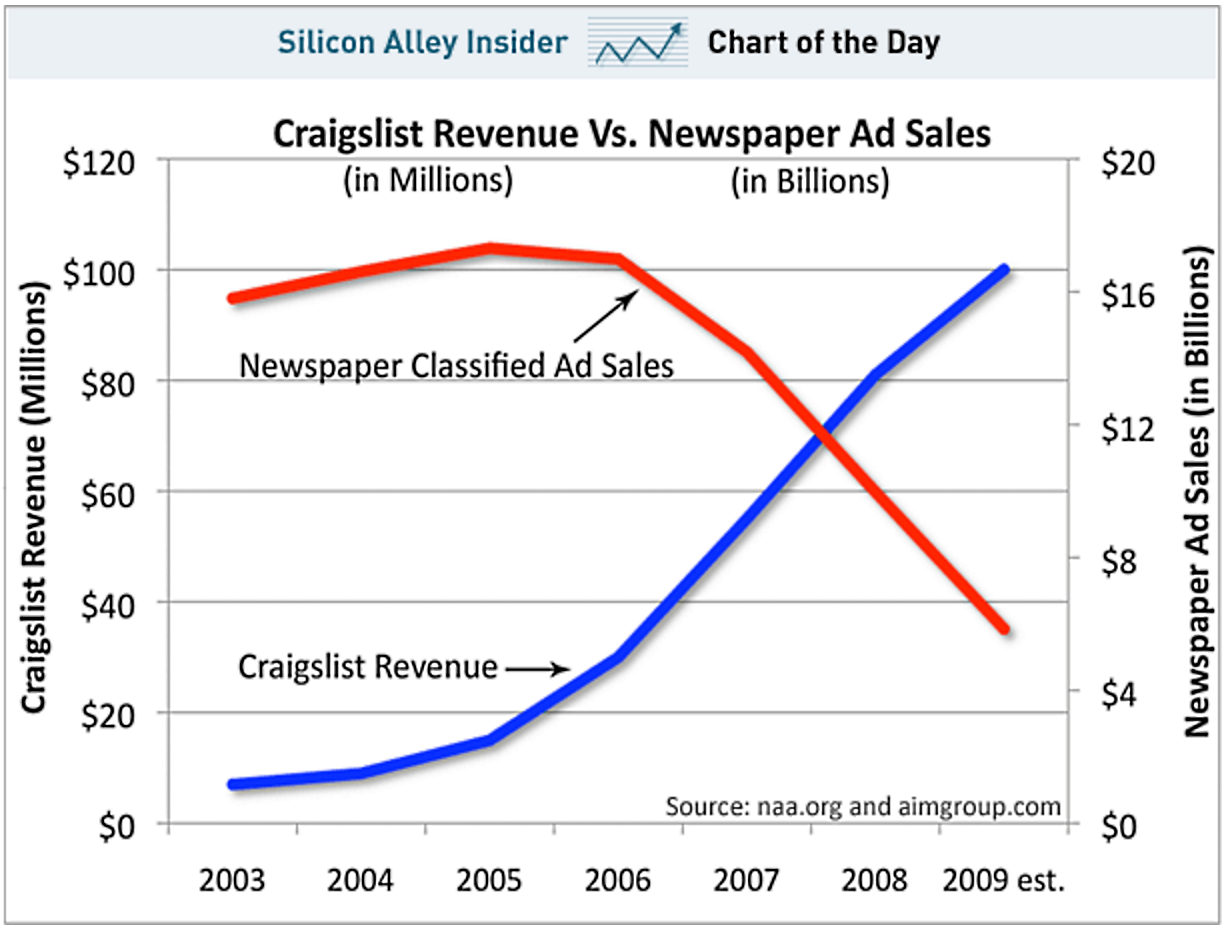
US papers employed 56,900 full-time journalists in 1990, the year Tim Berners Lee began testing his World Wide Web software, and they employed 32,900 in 2015. The disruption of the newspaper business began 22 years ago, when Craig Newmark launched his classified ad site, Craigslist. (Note that Newmark now generously supports investigative journalism and fact-checking organizations). Newspapers have adapted to the Internet by adding digital editions, but they generate less ad revenue than print editions have lost.

Thomas Jefferson and a lot of other smart people believed that democracy requires a free press. (See these quotes). If we agree with Jefferson, et al, that investigative journalism and fact-checking are important facilitators of democracy, can the Internet at least help keep organizations like newspapers alive?

At least one newspaper seems to be OK -- can we learn from it?

I was in Singapore a few weeks ago and picked up a copy of the 2/1/17 edition their major, English language newspaper, the Straits Times. I was impressed -- the paper was physically large, every page had color and the price was only S1.1, about 78 US cents. When I got home, I compared it to a 2/22/17 copy of my home town newspaper, the Los Angeles times, which sells for $2. (Both were Wednesday editions).

Number of pages in each section
The pages of the Strait's Times were 27 percent larger than those of the LA Times (which shrunk after it was purchased by Tribune Publishing in 2000) and there were more of them, as you see here. And what about those "dead" classified ads? The Straits Times had 16 pages of classifieds and the LA Times only 2/3 of a page at the end of the Sports section.

Why does the newspaper business in Singapore seem to be thriving, while US newspapers are having a hard time?

It's not the market size. The population of Singapore is about 5.6 million, the poulation of Los Angles is about 4 million and greater Los Angeles is about 10.2 million.

It's not economies of scale. In August 2016, the Straits Times had a daily print circulation of 277,100 and 116,200 digital. The LA Times media kit says their weekday circulation is 690,870 and it's 955,319 on Sunday.

The Straits Times is not a local paper -- they have 16 bureaus and special correspondents in major cities worldwide. (Both of the stories that were "above the fold" on the front page of the edition I picked up were about US politics).

Maybe there is no Craigslist in Singapore -- but there is.

The government role

Singapore's fast, affordable Internet connectivity makes the digital edition of the Straits Times attractive. There are five competing ISPs and most of the country is covered by fiber as well as copper. A 1 gb/s account will set you back S$49.99 per month if you sign a two year contract or S$59.99 without a contract. For two gig, you pay $69.99 with a two year contract. The slowest offering is 100 mb/s. (Singapore dollars are around 71 US cents).

The Singapore government deserves a good deal of credit for their Internet service. In 2000, I worked on a study of the Singapore Internet and, with the help of my nephew who was with Goldman Sachs in Singapore, developed this figure:

Singapore, Inc.

As you see, the government had equity positions in the ISPs and an indirect link to Singapore Press Holdings, a media conglomerate that owns the Straits Times. The government provides wholesale backbone connectivity to those competing retail ISPs. (Other cities, notably Stockholm, have followed a similar strategy and Google has done so in Africa).

Competition is the key to the success of the Internet in Singapore and, while the current US administration claims to like free markets, moves to weaken net neutrality, set-top box standards and municpal wholesale networks strike me as anti-competitive. (Also, see this interview of outgoing FCC Chairman, Tom Wheeler).

The Singapore government plays an important role in the economy, doing strategic economic and educational planning and they have invested in the oil, shipping, finance, media, Internet and biotech industries since World War II. I am not advocating a Singapore model for the US, but neither should we ignore possible steps local and national government can take to increase competition in the Internet service market.

The Straits Times benefits from the strong Singapore Internet, but I suspect the government also offers direct or indirect subsidy. I understand that we don't want the government to control our press, although there is considerable precedent for US government support of broadcast and print media. That being said, the current US administration will doubtless do its best to eliminate what little federal support remains.

But, since Republicans favor free markets and decentralized choice when it comes to health care, energy and schools, why not the press? How about media vouchers for voting age adults? Individuals would be free to allocate their media subsidy as they see fit -- to the New York Times or Breitbart, NPR or Rush Limbaugh. Milton Friedman might have even gone for that.