Thursday, February 24, 2022

SpaceX is testing Starlink roaming

A failed roaming test
Last April, Elon Musk tweeted that Starlink "should be fully mobile later this year, so you can move it anywhere or use it on an RV or truck in motion." It is good to know that mobility with a standard dish is in the works, but it's not yet available.
David Lang had been able to connect his Starlink terminal about fifteen miles from his home in Simi Valley, California, but when he brought it to my place in Carpinteria California, about forty-three miles away and in a different coverage cell, it failed to connect.

David's experience is not unique -- others have reported similar inconsistency on social media, but if one is willing to change the registered address of their terminal, it can be moved -- if there is available capacity at the new location.

Consider the experience of Marcus and Julie Tuck, who have been digital nomads for eight years and Starlink users since April 2021. As of December 16, 2021, they had registered at one hundred different addresses and had service at 157 locations. 

The Tucks and their truck
They experienced a significant roaming change while driving in central California. On February 11, 2022, they noticed they could move into a new cell and retain Starlink service without registering an address change. Later, when they crossed from California to Nevada, they had to enter a new address, but when they returned to California, they did not have to change it back. They have not changed it subsequently but will have to when they enter Mexico.

When David Lang brought his terminal to my home, he would have risked losing the ability to connect when he returned home if he had temporarily registered his terminal at my address. When the Tuck's experience becomes available, users will be able to leave home for a trip and return without risking the ability to reconnect at home.

David's visit was a week after the Tuck's experience, so roaming has not yet been rolled out. Perhaps the Tucks were in a limited test area or were selected by SpaceX because of their frequent address changes.

The Tucks had fixed roaming, not the in-motion connectivity Elon Musk promised, but it is a first step and there are still unanswered questions about roaming like:

  • Will terrestrial roaming while in motion require a different terminal? (It will at least have to be mounted differently). Planes, ships, and military vehicles will surely use different terminals. 
  • Since capacity must be reserved for roaming, the service will cost SpaceX. Will they charge for roaming and, if so, how -- by the month, the cell transition, the ground-station transition?
  • Will the roaming fee be less in low-demand, unsaturated areas? 
  • Will it be different for transitions into or out of high-demand areas? A function of the number of open slots at the time of transition?
  • Because of capacity limitations, they will not be able to guarantee 100% roaming success. Might we see a collective service-level guarantee like "99% success globally each month"?
  • How long will it be before a Starlink terminal is offered as an option on Tesla cars and trucks? 
  • How long will it be before a Geely Holding Group terminal is offered as an option on Volvo, Mercedes and other Geely brand autos?
  • SpaceX has begun launching satellites with inter-satellite laser links and the other LEO broadband operators will follow -- how will that affect roaming?
  • Eventually, I expect we will have optical links to ground stations with climate and weather-aware routing -- how would that affect roaming?
Elon missed his target date, but he seems confident that we will eventually have "full mobility" -- let's hope he is right.

Update 2/25/2022

This map shows the Tuck's most recent travels. Note that they did not have to re-register during the stops marked with green push points. They re-registered after crossing the state line into Nevada but did not re-register after returning to California.


Star = registered address

A. First of five locations after registering
B. First of seven locations after re-registering
C. First of fourteen locations after crossing the state line and re-registering
D. Fourteenth location after registering, 2/23/2022

Update 3/3/2022

SpaceX has enabled fixed and mobile roaming in Ukraine and reduced peak power consumption.

Update 3/12/2022

The Tucks mounted the Starlink dish horizontally on the top of their RV and used it while in motion. They have reported on a 101-mile drive at an average speed of 45 miles per hour and a top speed of 54. During the test, they live-streamed a video, and Marcus' wife listened to a live UK radio broadcast while doing a range of general Internet surfing, social media, etc. Below is a snapshot from a video log of the entire trip, speeded up to run in 2 minutes.


Update 3/13/2022

When the Tucks crossed into Mexico, they feared roaming would fail, but roaming and in-motion connectivity continued working.


Thursday, February 03, 2022

Update on China SatNet's GuoWang broadband constellation -- can they do it?

In 2020, China applied to operate GuoWang, a constellation of 12,992 low-Earth orbit (LEO) broadband Internet satellites, and in 2021, it became clear that it was intended to become China's global LEO broadband constellation. Can they do it? Maybe, but it will take a long time.

Launch capability

Chinese launch startups (source)
China does not have the capacity to launch 12,992 satellites today. I don't know the mass of their planned satellites, but GuoWang is informally referred to as China's answer to Starlink. Starlink's version 1 satellites were 262 kg each and version 2 is said to be between 800 and 1,250 kg. If, say, the GuoWang satellites turn out to weigh 500 kg, the constellation would require 260 launches using China's most powerful rocket, the Long March 5, assuming no failures and ignoring replacement, and it would be 867 launches using the forthcoming, reusable Long March 8.
But times are changing. In a recent DongFang Hour podcast, Jean Deville said there are about twenty new commercial launch companies in China, and they were raising an unprecedented amount of money. While none of these is in the class of SpaceX's Starship, which they say will be able to launch >100 tons to LEO, China's forthcoming Long March 9 is being designed to launch 150 tons to LEO. (Elon Musk tweeted that they might be able to get it up to ~150 tons in a reusable Starship).
Launching and maintaining a constellation of 12,992 satellites would require a coalition of commercial startups and/or the Long March 9. (In an idealistic, united world one could imagine iconoclastic Elon Musk offering to launch GuoWang satellites using Starships).

Satellite manufacture

GalaxySpace satellite "super factory" (source)
As of last September, China only had 431 satellites in orbit. Chinese state-owned enterprises clearly do not have the capacity to produce and maintain satellites for a mega constellation. As with launch, one or perhaps a coalition of private companies could be called upon to manufacture GuoWang satellites. 

As Deville put it, "2022 could be year one of the significant if not massive deployment of Chinese small satellites." He cited the example of the completion of the GalaxySpace satellite production line at their "super factory" in Nantong and showed the first six broadband communication satellites that were just completed. He also described several other satellite manufacturing companies including auto manufacturer Geely, which has a factory capable of producing 500 satellites per year and deep mass production experience.

Optical links and ground infrastructure

Inter-satellite optical links are a priority for LEO constellations -- they will reduce latency and the need for ground stations -- and China has relatively poor access to global ground infrastructure. As with launch and satellite manufacture, there are promising optical communication start-ups, but China lags established companies like Mynaric and Tesat and is precluded from using their products by the current technology cold war and Xi's Made in China 2025 policy. 

Optical links between satellites and the ground could compensate in part for a lack of radio-frequency ground stations and China's recently released Five-year Perspective white paper says they have tested satellite-ground laser communication. Ground station load can also be reduced by relaying data through geostationary satellites and the Five-year Perspective includes a commitment to a coordinated multi-orbit communication system.

Amazon offers ground-station service; AWS Aerospace and Satellite Solutions offers space/terrestrial systems consulting service and Microsoft offers Azure Orbital ground station service, which enables satellite access to its Azure cloud services. Will Chinese Web services and terrestrial infrastructure companies integrate with GuoWang?

Politics

Belt and Road nations, January 2021 (source)
GuoWang is behind SpaceX Starlink and nearly as far behind the OneWeb, Telesat, and Amazon Kuiper constellations, but the political division between China and the US may protect it enough to survive. Starlink service will not be allowed in China, and they will discourage it in nations that participate in their Belt and Road infrastructure initiative, and GuoWang service will not be allowed in the United States or nations with which we are closely allied. 

This division shields GuoWang from competitive market pressure and it locks in global waste and economic inefficiency by ensuring that LEO constellations will be able to route traffic but will otherwise be idle while orbiting over "enemy" nations. 

I've reviewed three areas in which GuoWang needs to catch up, but GuoWang, Starlink and the other would-be broadband Internet service providers also face joint constraints like LEO debris and spectrum scarcity, (Note that SpaceX has also applied to launch 30,000 more broadband satellites). Optical links between constellations and the ground may relax the spectrum constraint if inter-satellite routing algorithms are climate-sensitive but global collaboration is needed to deal with debris, collision avoidance, and spectrum scarcity.

GuoWang is facing an uphill battle. If SpaceX and the others do not go bankrupt, they will have been operating for years before GuoWang completes a 12,992-satellite constellation. On the other hand, the Chinese government has given GuoWang high priority, their lunar, Martian, and space station programs started long after ours, and China plans to "build a satellite communications network with high and low orbit coordination" within the next five years.

Update 2/22/2022

GuoWang got political affirmation recently when China Satnet signed a strategic cooperation agreement with the Shanghai Municipal Government. (Like state governments in the US, Chinese municipal governments often support commercial efforts). Satnet is a state-owned enterprise, but its executives visited commercial satellite constellation operator Guodian Gaoke signaling openness to cooperation with Chinese commercial space firms. 

It seems clear now that GuoWang will be China's global broadband provider, not Hongyun and Hongyan, less ambitious broadband constellation projects of powerful state-owned enterprises CASC and CASIC.

Update 3/13/2022

The Dongfang Hour reports that the Long March 9 will not be ready to launch for 8-10 years. How many satellites will GuoWang's competitors have in orbit by then? They also reported that the six broadband communication satellites mentioned above were launched. The satellites have a mass of 190kg and a throughput of 40 Gbps.

Several companies are ramping up to build satellites, so a coalition may be able to equip GuoWang, but launch capacity seems to be an even more significant constraint. Either way, they have a long way to go. Here's a wild dream -- SpaceX could launch GuoWang satellites. Elon Musk has been known to help competitors -- he put 249 Tesla patents in the public domain in 2014.

Update 7/22/2022

As we saw earlier, the Long March 9 was expected to be ready for launch in 8-10 years, but a revised design is being considered. Andrew Jones reports that Long Lehao, a veteran chief designer of the Long March rocket series, presented plans for a new reusable methane-liquid oxygen launch vehicle to be ready in 2035. He described a two-stage rocket capable of launching 150 tons to low-Earth orbit. That sounds a lot like SpaceX Starship, but without mention of the launch/land pad with "chopstick" arms to capture a returning booster.


Presentation on the revised Long March 9 (source)

There is no doubt that China is paying attention to and is way behind SpaceX's Starship development. If Starship succeeds, Elon Musk may have an apartment on Mars by 2035 :-).
Update 1/25/2023
Here is confirmation of the 2035 target date for the Long March 9. By that time, several LEO broadband providers hope to have been serving customers for several years. Note the emphasis here is on deep space exploration, not Internet service. 
"Around 2035, China will implement a one-time configuration flight verification mission of heavy rockets, and after the successful mission, heavy rockets will become one of the main forces of China's deep space exploration."
Update 4/18/2023
The 14th Central Inspection Team
China Satnet is undergoing a comprehensive political "physical" (on-site?)  examination by the 14th inspection team of the Central Committee and a new General Manager has been appointed They plan to work on the investigation for about two and a half months. 
The focus of the visit is to report and reflect on violations of political discipline, organizational discipline, integrity discipline, mass discipline, work discipline, and life discipline in addition to assessing progress toward strategic goals.
To an American, that sounds a bit like 1984 but it may be routine for China. (This update was based on a Google translation).
Update July 12, 2023
The seventh test satellite was launched three days ago. The first production satellites will be launched in the third quarter of this year. 

Sunday, January 16, 2022

The US-China technology cold war battle over optical communication in space

The United States and its allies are in a technology cold war with China and its allies. This is evidenced by major battles like the US ban on Huawei and China's drive for technological independence and their global infrastructure program to create a digital silk road. (The cold war began under Trump, but President Biden is continuing it). 

There are other, less well-known battles like the battle over optical communication in space. For example, Mynaric, a 20-year old German optical communication company with a cutting edge line of space, aircraft, and ground terminals, was forced to take sides in the tech cold war:

  • November 19, 2018: Mynaric opens a new site in Shanghai, China, as a consequence of the high demand for its products and the rapidly-expanding Asian aerospace communications market.
  • July 31, 2020: Mynaric announced yesterday that, with immediate effect, it is to cease its business activities in China.
Optical communication links between satellites will be an important technology for forthcoming broadband Internet and Earth observation satellites and China might have dealt with Mynaric or another US-ally supplier, but since they cannot, they will have to develop their own optical communication capability. For example, China’s BeiDou -- their GPS -- is running inter-satellite and satellite-ground station experiments with optical terminals. 

BeiDou is state-owned, and Blaine Curcio of the Dongfang Hour podcast recently described a commercial optical-communication startup called HiStarlink -- one of many new, relatively small, Chinese companies focused on a specific space-related technology or sub-system and often subsidized by a local government. He also linked to an article on HiStarlink and I relied on the Google translation of that article for further details. 

The five-month-old, venture-funded company will specialize in low-power, miniaturized space-borne optical communication terminals. They have already developed an optical transceiver capable of high-speed transmission at distances up to 5,000 km and a dual-channel communication board supporting up to 80 Gbps. Their plan is to complete on-orbit verification of communication capabilities in the first quarter of 2022 and inter-satellite communication by the end of the year.

Company founder Dr. Tan Jun calls low-Earth orbit Internet service "subversive" because the market is "huge." He also said that China urgently needs inter-satellite interconnection more than any other country because of the lack of access to global ground stations. The company is staffed by young people from prestigious universities and institutes and Curcio speculates that the communication board and transceiver had been developed before the company was formed. The article concludes with a short overview of the foreign competitors, including Mynaric and SpaceX, and domestic developments including inter-satellite laser links for the Hongyun project. 

(Curcio's Dongfang Hour co-host Jean Deville points out that a lack of Chinese ground station capacity has motivated the formation of another new company, Hualu Space, that hopes to use optical links between low-Earth orbit and geostationary satellites to relay Earth observation data to the ground).

HiStarlink is far behind Mynaric's products and organization, but China will catch up. As Curcio noted, they have smart people working on optical terminals which will be a critical component of the Gouwang Internet constellation which has been given high priority. That will give them political support, but perhaps the best thing they have going is the cold war itself -- they will not have to face strong international competition. The cold war, like tariffs, offers protectionist cover for domestic industry.


Sunday, December 19, 2021

The Russian anti-satellite demonstration -- a month later

It was a "demonstration," not a "test."

On November 15, Russia demonstrated its ability to destroy an orbiting satellite, Cosmo 1408, by hitting it with a direct-ascent rocket. In an earlier post, I noted the anti-satellite demonstration and speculated on why Russia may have done it and why the Chinese had not condemned it. In this post, I'll look at the evolution of the resulting debris cloud and say more about the possible motivation.

In the immediate aftermath of the collision, when the debris fragments were closely bunched, there was fear of a possible collision with the Chinese or International Space Stations, but over time, the fragments began to spread out, as shown below. (Click the image to enlarge it).


By November 16, LeoLabs had detected 288 debris objects, 253 of which are shown in the Gabbard plot on the left,. A Gabbard plot shows the altitude of the apogee and perigee and the period of each of the orbiting debris fragments. (The circled points show the apogee and perigee of one of the fragments). By December 7, more objects had been tracked and Jonathan McDowell generated the second plot. Its clear that the debris cloud is spreading out with time as more objects are detected and tracked. 
The December 17 visualization from LeoLabs shows the debris as completing a rough orbital plane. (I say it is approximately 591 objects because that was the number of orbiting objects in the Space-Track.org satellite catalog on  December 17 and LeoLabs may have been tracking more since they have the ability to track smaller objects). The fourth image is a visualization of over 2,000 objects six months after a Chinese anti-satellite test in 2007. It foreshadows the ongoing spread of Cosmos 1408 debris.
By December 17, Space-Track.org had tracked 604 objects, 13 of which had been driven to low altitudes and had already decayed. (One of those was from an earlier accident). The characteristics of the orbits of the remaining 591 debris objects are shown below:


The altitudes shown above are near those of many currently approved broadband constellations as well as numerous constellations for Earth observation, automotive, military, and other applications, not to mention apparent nut-cases like Rwanda's application for 327,230 satellites. Furthermore, higher altitude satellites will have to cross these debris orbits on the way up and the way down when they are retired.
Shortly after the breakup, LeoLabs predicted there would eventually be from 1,500 to 2,500 debris objects, but when Jonathan McDowell pointed out that the intercept was generally in the same direction as the satellite vector they reduced their estimate of the number of debris objects and increased expected apogees. While they expect fewer objects, the average mass and size will be greater and they will remain in orbit for longer times.
LeoLabs summed it up by stating that "this occurred at one of the worst possible orbits" and "there will be some potential collision risk to most satellites in LEO from the fragmentation of Cosmos 1408 over the next few years to decades." 
Was it a "test" or a "demonstration?
The Russians chose a relatively large satellite at a dangerous altitude for the "test." Cosmos 1408 had a mass of ~2,200 kg. It orbited with an apogee of 490 km and a perigee of 465 km and its radar cross-section was 8.63 m^2. The U.S. military classifies objects over 1 m^2 as large and  India chose a safer 283 km altitude for their 2019 test.
Russia warned on state television that this "test" showed they could blow up 32 GPS satellites with this new anti-satellite technology, and they tied it to their troop buildup on the Ukrainian border. (GPS satellites orbit at much greater altitude).
This was not Russia's first anti-satellite test. They had previously conducted 10 direct-ascent and 22 co-orbital tests. Ten of the co-orbital tests had hit targets and produced small amounts of debris and the direct-assent tests were preceded by technically similar anti-missile tests. Those were tests. This was a demonstration.
The debris from the destruction of this satellite will not trigger a Kessler syndrome or put SpaceX out of business today, but it reflects a defiant, irrational attitude that threatens the space commons. Imagine the impact of such a collision if it were to occur five or ten years from now.
Related links
Listen to this podcast interview of Brian Weeden of the Secure World Foundation. Weeden puts the Russian demonstration in its political and historical context and discusses efforts to achieve an international ban on the destruction of orbiting objects.
For a discussion of the difficulty of accurately tracking orbiting satellites and debris and acting in time to avoid collisions, check out The Dilemma of Space Debris by David Fikleman -- "This process is very much like quantum mechanics, in which an entity is described by a probability density and a future state can only be estimated statistically." (You can see the 2014 first draft of this article here).
Update 12/26/2021
LeoLabs has released a third assessment of the Russian anti-satellite demonstration. They focused on the above-cited recognition by Jonathan Mcdowell that this was not a head-on hypervelocity collision. The report estimates the number of fragments and the distributions of their size and mass, which will be refined as more objects are tracked.
They plan to continue tracking debris created by the collision and to refine their estimate of its impact, which is that "the statistical probability of collision for satellites with mission-terminating debris in the 300–800 km altitude range has likely doubled due to this event, and will remain high for many years."

Characteristics of non-hypervelocity and hypervelocity collisions 
Update 1/3/2022
Jonathan McDowell's Space Activities in 2021 presents a detailed recap of the year in space. This year's edition includes a December 31 update on the Russian anti-satellite demonstration. The Space Force is now tracking 904 debris objects and the total may eventually be more than twice that. 
McDowell also reports the number of breakups and debris events for the year. There were five in addition to the Cosmos 1408 demonstration. 

He also mentions newly cataloged objects from earlier breakups.
Update 10/17/2022
The majority of tracked Russian ASAT debris has been deorbited -- 1,122 of the 1,783 tracked objects have decayed and are no longer in orbit. That's the good news. The bad news is that the Space Force 19th Space Defense Squadron, which tracks debris, generates 300,000 conjunction data messages a day identifying potential close approaches. “Of that, 53,000 of those are Cosmos 1408-related.”

Thursday, November 18, 2021

Why did Russia test an anti-satellite missile and why doesn't China condemn the test?

Apogee (blue) and perigee (orange) of 253 of the 288
confirmed debris objects two days after the COSMOS 1408
breakup (source)
On November 15th, Russia used an anti-satellite missile to destroy COSMOS 1408, a defunct spy satellite. The explosion quickly created over 1,500 pieces of trackable debris and will likely generate hundreds of thousands of smaller pieces. As a precautionary measure, the astronauts on the International Space Station, two of whom are Russians, took shelter in escape shuttles during two orbits.
The anti-satellite test was widely criticized but the Russian defense ministry released a statement  saying “The U.S. knows for certain that the resulting fragments, in terms of test time and orbital parameters, did not and will not pose a threat to orbital stations, spacecraft, and space activities.”
That is simply not true and there is no doubt that officials in the nation that brought us Sputnik knew it. While the explosion occurred above both the International and Chinese space stations, the fragment cluster instantly began disbursing. As shown above, two days later some of the visible fragments were below the space stations and all will remain in orbit for many years.
That raises the question -- why did they do it? In space, as with nuclear war, mutually-assured destruction is the best guard against an attack, but Russia clearly had the ability to destroy a satellite without this test. Where would Russia be without GLONASS, their global navigation and positing system? Where would we all be without our Earth observation satellites? 
Similarly, why hasn't China condemned the act? China has a space station and plans for many satellites including a 12,992 satellite broadband constellation and they have established aggressive rules for space situational awareness and traffic management. Furthermore, the 14th five-year plan period (2021-25) of the China National Space Administration includes a section on "expanding space cooperation and enhancing the common well-being of humankind." China has a lot to lose.
I can't imagine why Russia destroyed COSMOS 1408 or why China has not denounced the destruction. Are Russia and China trying to slow the progress of SpaceX and other private competitors? Anne Applebaum has coined the term "Autocracy Inc" to describe China, Russia, and several other nations as a club bound together by "a common desire to preserve and enhance their personal power and wealth." She says the members support and don't criticize each other.
I know I'm starting to sound like a Qanon conspiracy theorist, but I can't think of any rational explanations.

Update 1/25/2022
The Space Debris Monitoring and Application Center of the China National Space Administration warned of an "extremely dangerous rendezvous" between China's Tsinghua Science satellite and Russia's Cosmos 1408 debris. Liu Jing, a space debris expert, said the closest distance between Tsinghua's satellite and the Russian debris was 14.5 meters, with a relative speed of 5.27 kilometers per second. There was no collision and subsequent data show the distance between the two objects has increased to five kilometers.
As far as I know, this is the first time the Chinese have spoken out against the Russian anti-satellite demonstration. (For more on the aftermath of the demonstration, see this post).

Tuesday, November 09, 2021

SpaceX's rural development project in India

Starlink will play an important role in catalyzing rural development in India.
Sanjay Bhargava, Starlink Country Director for India at SpaceX (source)

SpaceX Starlink is moving quickly in India. Last April, they said they would be offering service in 2022 and began accepting pre-orders. In July, SpaceX committed to manufacturing antenna systems and terminals in India and, at the end of September, Sanjay Bhargava, who had been with Elon Musk at Paypal, was selected to head Starlink in India. In the last week or two, they set up a wholly-owned subsidiary that will apply for licenses, seek Indian distribution partners, and attempt to sell 200,000 units -- 80% in rural districts -- in 2022.

That's an impressive business ramp-up, but something else caught my eye -- a project committed to catalyzing rural development in India -- an effort to be led by Bhargava's wife Anita Kapur Bhargava who outlined the project in a short presentation (video and PDF). 
The project will begin by installing Starlink terminals in 20 Delhi schools and 80 terminals in a rural district that is near Delhi. (India is comprised of 752 districts with an average population of 164 million). In the second phase of the project, Bhargava and the National Institution for Transforming India will select 12 rural districts in north, south, west, and east India as "labs to build solutions that are globally scalable" and potential solution providers in those districts are encouraged to apply for mentoring. She did not elaborate on the sorts of support a lab district would receive, but one option might be to establish an incubator or co-working space in each. The "stretch goal" of the project is to install 200,000 terminals, 160,000 in rural districts, by December 2022.
The project goals are to increase district GDP, create jobs for all and move the district toward meeting the UN's Sustainable Development Goals. Bhargava outlined a four-dimension project framework during the presentation and gave examples of its application in 8 areas. Let's consider one of those application areas -- school broadband -- to illustrate her framework.


High-quality broadband is the development catalyst in this example and solution providers will be required to install and maintain equipment and develop curricula, applications, and content. Nudging refers to behavioral change in politicians and others -- in this example school administrators and those responsible for certification and hiring standards. The MeTROs (measurable, time-bound real outcomes) are jobs for 80% at age 16 and higher education for 20% at 18. (Note the emphasis on jobs and vocational education). 
Note that both Starlink and OneWeb are listed as catalysts. OneWeb has worked with partners since its inception and Sanjay Bhargava notes that "To make even one district 100% broadband we require a large amount of capital and all broadband providers to collaborate. This is not a competition." 
Neither Starlink nor OneWeb will have sufficient capacity to serve all of India's LEO broadband satellite demand. Furthermore, OneWeb and the other forthcoming LEO satellite ISPs, Telesat and Amazon, have different orbital characteristics and design strengths. For example, Telesat might have an edge in focusing bandwidth on high-demand locations like airports, and Amazon's integrated terrestrial services and orbital inclination may give it an advantage with enterprise clients. Starlink seems to be focusing on individual consumers and it has been reported that they may offer subsidies in India. All LEO operators, including China's Guowang SatNet, have an existential motivation to collaborate on collision avoidance. 
While there is room for several satellite service providers, OneWeb and Starlink India have something in common -- both are headed by Indians who are well aware of the role of the Internet in pursuit of the UN Sustainable Development Goals and India's history of efforts to close the digital divide.
Development projects are generally funded by governments or non-governmental organizations and they involve a lengthy application and evaluation process. By contrast, phase one of this project was funded by SpaceX as soon as they formed an Indian subsidiary and hired Sanjay Bhargava. This small example of private funding of a development project -- which will eventually pay a return -- is reminiscent of SpaceX's effort to secure a contract to ferry astronauts to the International Space Station. Let's hope it's not the last. 

Tuesday, October 19, 2021

Multi-orbit broadband Internet service

Interoperability with GEO satellites must happen -- it's common sense ... Customers don't care whether it's a LEO satellite or a GEO satellite -- all they want is connectivity.

Neil Masterson, OneWeb CEO, at the Satellite 2021 Conference.


SatixFy terminals
Three satellite companies, SES, Telesat, and Hughes, are working toward integrated, multi-orbit broadband Internet service and Eutelsat may join them.

  • SES is already a multi-orbit Internet service provider with its medium-Earth orbit (MEO) and geostationary orbit (GEO) constellations and its second-generation MEO constellation, O3b mPower, will begin delivering service in the third quarter of 2022.
  • Telesat, an established GEO operator, plans to begin offering low-Earth orbit (LEO) service in 2023 with global coverage in 2024.
  • GEO operators Hughes and Eutelsat are investors in OneWeb's LEO constellation and Hughes and OneWeb are working on LEO-GEO integration.
  • Eutelsat and SES are both members of a consortium investigating the possibility of a European Union LEO constellation.

It is too soon for these companies to be offering integrated multi-orbit services, but they have begun testing and demonstrating switching and antenna technology.

  • Hughes and OneWeb have demonstrated seamless switching between the Hughes GEO and OneWeb LEO satellites. Latency-sensitive activities (like video gaming and a video call) were transmitted via OneWeb LEO and bandwidth-intensive activities like video streaming were transmitted via Hughes' GEO satellite. The switching was automated using HughesON active network technology software that instantaneously evaluated the type of traffic and transmitted it over the most efficient path.
  • A demo flight from Melbourne, Florida to the Atlantic coast of Nicaragua saw dozens of switches successfully completed between SES GEO and MEO beams, and between multiple MEO satellites within a beam. Engineers aboard the test flight were able to demonstrate reliable delivery of 4K video streaming, super-fast social media networking, e-commerce transactions, audio conferencing, interactive gaming, and web browsing at rates in excess of 265 Mbps.
  • More recently, in a demonstration with Hughes, SES transmitted high-definition video and sensor data from an unmanned recognizance drone to a command center, automatically switching between the MEO and GEO constellation based on pre-set policies. The command center stayed connected when a signal experienced interference and jamming.
  • Isotropic Systems has demonstrated multiple simultaneous connections to SES MEO satellites and in phase two, they will test simultaneous links between an Isotropic Systems antenna and GEO and MEO satellites.
  • Using Intellian’s 1.5-meter antenna, the Navy was able to maintain a broadband connection while switching between Telesat’s LEO and GEO satellites and Intellian will supply antennas for SES's forthcoming O3b mPower satellites.

These are just some examples of early tests of multi-orbit connectivity and new technology is being developed. For example, check out this short video of a test of a SatixFy multi-beam antenna that was able to lock on to and track LEO and GEO satellites while rotating at 20 degrees per second. 

(SatixFy recently contracted with OneWeb to supply LEO-GEO in-flight connectivity terminals).

OneWeb, Telesat, and SES are working on integrated, multi-orbit services. I don't know what SpaceX and the forthcoming LEO constellation operators -- China SatNet and Project Kuiper -- are planning. China space expert Blaine Curcio told me a China SatNet partnership "would require more GEO-HTS capacity than China currently has, and indeed, maybe even more than they have plans for." A partnership with Hughes would be impossible in today's political climate, but perhaps they could do something with Telesat, SES, or another non-US GEO provider as could Kuiper.

Since LEO Internet service will diminish GEO Internet revenue and free up capacity, GEO operators would probably be open to partnering with SpaceX. If SpaceX were to pursue a multi-orbit partner, Hughes, with its OneWeb experience and HughesON technology, would have the inside track as a GEO-interoperability partner.

Update 1/23/2022

SES CEO Steve Collar: "We are not religious about orbits. There are things that we could do from LEO that are pretty attractive and we have some exciting projects that we are working on that I hope we will be in a position to announce soon that will likely leverage LEO. We have long said we are a multi-orbit operator. What I can say with a pretty high degree of confidence is that our future does not lie in a large LEO broadband constellation."

That would make them the first 3-orbit operator.

Update 12/2/2022

Eutelsat has ordered a geostationary broadband satellite that will support integrated multi-orbit service with its OneWeb low-Earth orbit satellites. The satellite will service the Americas, where immediate multi-orbit demand is expected to be greatest, beginning in 2026.

Before being acquired by Eutelsat, OneWeb demonstrated connectivity from an airplane to their LEO satellite and an Intelsat geostationary satellite. My guess is that they will operate with multiple geostationary operators. 

We will eventually have multi-orbit standards for airlines and other users -- perhaps Aalyria SpaceTime will fill that role.

Update 4/5/2025

Eutelsat’s chief executive Eva Berneke told Reuters the company has provided its high-speed satellite internet service to Ukraine for about a year via a German distributor. She added, "Now we're looking to get between 5,000 and 10,000 there relatively fast," she said, adding it could be "within weeks".

This may seem insignificant compared to over 170,000 Starlink terminals in Ukraine, but Eutelsat's are multi-orbit terminals, offering transparent, automatic switching between Eutelsat's geostationary satellites and their OneWeb low-Earth orbit satellites. 


Monday, September 13, 2021

SpaceX Starlink llega a Sudamérica

Este estudio piloto de un año en las zonas rurales de Chile será productivo y exitoso.

Una imagen que contiene hierba, al aire libre, cielo, casa

Descripción generada automáticamente

Antena Starlink "Dishy" en el techo de la escuela John F. Kennedy

SpaceX tiene aproximadamente 90.000  clientes de pruebas beta de Starlink en América del Norte, Europa, Australia y Nueva Zelanda y ahora tienen uno en América del Sur, en Sotomó, una ciudad aislada a 41,6° Sur en la Región de los Lagos de Chile. La segunda terminal de Chile estará en línea en una escuela en Caleta Sierra en unos días y le seguirán otros lugares piloto. Veinte familias viven en Sotomó y solo es accesible por embarcaciones privadas o servicios subsidiados que navegan por el Estero Reloncaví en el que se encuentra. La localidad cuenta con electricidad unas 12 horas diarias gracias a un generador diésel instalado por el gobierno de la Región de los Lagos en 2019.

Javier de la Barra, el maestro a cargo de la escuela John F. Kennedy de siete estudiantes donde se ha instalado la terminal, dijo que el servicio estará disponible para los miembros de la comunidad, así como para los estudiantes. Se están preparando tabletas para los estudiantes. Espera que la conectividad a Internet enriquezca y mejore el plan de estudios y la experiencia de los estudiantes. Tal vez lo más importante es que espera que mejore su capacidad como educador.

Una imagen que contiene texto, suelo, interior, área

Descripción generada automáticamente

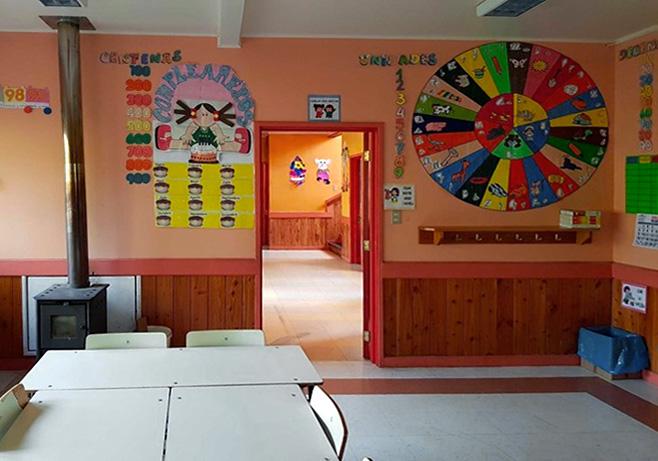
Dentro de la escuela John F. Kennedy en Sotomó

Mi primera reacción fue que eso suena como mucho que esperar de una sola conexión a Internet de 1-200 Mbps, pero luego recordé que esta es una escuela con siete estudiantes y un maestro que está motivado para mejorar su capacidad como educador. Agregue una red de área local con un servidor para cursos descargados como el de la Khan Academy u otro material didáctico y proporcione apoyo técnico y  pedagógico, y esto suena como un proyecto piloto prometedor. Será muy interesante ver qué tipo de procedimientos, software e innovación curricular se desarrolla en torno a un único enlace a Internet y si se replica, por la comunidad online de educadores como Javier de la Barra.

Además, la velocidad y la latencia mejorarán con el tiempo a medida que SpaceX actualice su software y, a largo plazo, la constelación de satélites. Mi conjetura es que la primera actualización del equipo será un nuevo generador o un tanque de combustible diesel más grande para que puedan estar en línea, tal vez descargando contenido, más de 12 horas al día.

También será interesante escuchar cómo los miembros de la comunidad utilizan su acceso. No sé nada de la economía de Sotomó, así que no puedo especular sobre aplicaciones empresariales, pero hay al menos un negocio turístico, Termas de Sotomó,  que ya tiene un sitio web. (Tal vez utiliza un ISP de satélite geosincrónico). Además de las aplicaciones empresariales, apuesto a que se descargarán muchas películas y otros contenidos de entretenimiento, y una próspera red de zapatillas de deporte, compartiendo archivos en unidades flash, evolucionará. ¿Cuánto tiempo pasará antes de que alguien desarrolle un sistema que tome solicitudes de descargas desatendidas? (Para una idea de la amplitud del material que puede circular en una red de zapatillas, ver esta mirada en el contenido de una semana del "paquete semanal" de Cuba).

En los primeros días de Internet, mis colegas y yo estudiamos su difusión y aplicación en países en desarrollo,incluyendo Chile. Sotomó y otros pilotos nos presentan una nueva oportunidad para estudiar las aplicaciones y el impacto social e individual de la Internet actual en una nueva comunidad virgen del impacto de la Internet de alta velocidad.

En el momento de nuestros primeros estudios, Chile era posiblemente la nación con redes más avanzada de América Latina y el PIB per cápita de Chile es el segundo después de Uruguay en América del Sur y un 50% mayor que el de Argentina, que ocupa el tercer lugar. Además, el gobierno y la industria de las telecomunicaciones reconocen la importante brecha digital de Chile y se han comprometido a  corregirla. (Esto no se perdió en SpaceX, establecieron un entidad filial extranjera chilena en julio de 2019). Dados esos antecedentes, no me sorprendería ver a SpaceX Starlink convertirse en parte de la futura infraestructura de conectividad rural de Chile.

La ceremonia de apertura del proyecto Sotomó contó con la presencia de la Ministra de Transportes y Telecomunicaciones de Chile, Gloria Hutt, quien dijo:

La llegada de Starlink a Sotomó marca un antes y un después en cuanto a inclusión digital para nuestro país. Esta revolucionaria tecnología nos permitirá llevar la conectividad de alta velocidad a los puntos más extremos de nuestra inmensa y variada geografía, democratizando el acceso a internet y todos los beneficios que aporta a favor de múltiples áreas de nuestras vidas.

Esa afirmación recuerda a la visión optimista que muchos, incluyéndome a mí, tuvimos en los primeros años académicos de Internet, pero fuimos ingenuos. Desde entonces hemos aprendido que Internet permite a los príncipes nigerianos (que ofrecían cosas que no tenían a cambio de dinero) noticias falsas, burbujas de filtro, etc., junto con las cosas buenas.

La prosperidad chilena, combinada con la desigualdad económica (el coeficiente chileno de Gini es el cuarto más alto de América del Sur), ha llevado a protestas violentas y a una profunda división política. Chile debe aprender  de la experiencia de Estados Unidos y otras naciones y ser consciente de los riesgos sociales y políticos que pueden derivarse de una mejor conectividad rural.

No quiero terminar con una nota negativa. Como observó el Ministro Hutt, la 

conectividad rural y la reducción de la brecha digital disminuirán en sí mismas la desigualdad económica y cultural en el centro del malestar chileno.

Actualización 11 de agosto de 2021:

Hablé con alguien de Sotomó hoy y me enteré de que también hay una clínica en el edificio de la escuela, allanando el camino para la recuperación de información médica, la consulta médica remota y la telemedicina.

For the original English version of this post, click here and please let me know about corrections to the translation.