Monday, April 11, 2022

The unprecedented role of the Internet in the war in Ukraine

The impact of the Internet in the Russia-Ukraine war is unprecedented in speed and scope. The most visible example of this has been President Zelenskyy's use of social media and teleconferencing in his roles as Commander in Chief of the armed forces, a global diplomat, and a leader of the Ukrainian people.

As shown here, Zelenskyy's military meetings mix in-person and remote participants in a digital war room equipped with large displays for sharing information. Contrast this modern war room with the image of Putin meeting with military leaders around a huge conference table in an ornate room with a single monitor that is turned off and a console on a table at his left that looks like a 1950s intercom.

President Zelenskyy uses social media and teleconferencing in his roles as a national leader and global diplomat. He has been posting on the Presidential Telegram channel since he was inaugurated in May 2019. He has 1,421,358 followers and his posts have included 414 videos and 499 photos -- about half since the invasion. (Zelenskyy's Telegram feed and other Internet content created during the war will be available to historians).

The post-invasion photos include visits to hospitals, troops, and national leaders. Sadly, the majority are evidence of war crimes, and the most winning are accompanied by love poems to his wife on her birthdays -- reminiscent of President Obama. (You can see the 499 photos here and I will update the collection periodically).

Zanny Minton Beddoes, editor-in-chief of The Economist,
describes her experience interviewing President Zelenskyy.
His Telegram videos show him receiving standing ovations during speeches at parliaments in Japan, Israel, the US, Canada, and Europe as well as mutational organizations like The Doha Forum and The United Nations Security Council. He even gave a talk during the US Grammy Awards and has been interviewed by news programs like Face the Nation and Sixty Minutes in the US. He also reaches out to individual leaders as in this message to Hungarian Prime Minister Viktor Orbán and posts daily messages for the Ukrainian people and the world, which are reminiscent of Franklin Roosevelt's Fireside Chats with the American people.

Those and other photos and videos are available on the Internet, but more importantly, they are picked up by television and print media throughout the world. The resultant information flood led Russia to resign from the UN Human Rights Commission after 93 nations voted to suspend its membership. This occurred six weeks after Russia invaded Ukraine.

While this information is blocked on the Russian Internet and in Russian media, it will gradually trickle in through virtual private networks, Internet services like callrussia.org and 1920.in that enable Russian speakers to call and send texts to randomly selected Russians, Russian casualties, and contacts with friends and family abroad.

Note that many of the videos and photos mentioned above were recorded by drones. Ukraine has used drones extensively for surveillance and targeting, as weapons, and for documenting atrocities and war crimes.

President Zelenskyy is in front of the cameras -- a Churchillian rock star -- but his contribution would not have been possible if Ukraine had not been digitally prepared. 

For a start, they have a cabinet-level Ministry of Digital Transformation, headed by 31-year-old Vice Prime Minister Mykhailo Fedorov. The first time I saw his name was in a tweet asking Elon Musk to supply Starlink terminals. Two days later the first shipment arrived, within a week more had arrived and were being used and there are now more than 5,000 in service.

Ukraine was working on "digital transformation" before the invasion. For example, they had a mobile app and platform called DIIA that enabled them to distribute subsidy payments of about $221 to nearly five million Ukrainians in war-affected regions electronically. When Tim Berners-Lee put the Web in the public domain, Zelenskyy was fifteen years old and Fedorov two -- they are "digital natives."

Of course, none of the above would have been possible without the Internet and Doug Madory, who monitors global Internet outages, says there have been temporary local outages, but for the most part, the country has remained online. (Mariupol is an exception). This resilience can be attributed to a combination of the courage and resolve of Ukrainian technicians and the competitive market and decentralized structure of the Ukrainian Internet. Madory also points out that the Russian army is using the Ukrainian Internet and may be reluctant to destroy assets that they hope to acquire (steal).

Early Internet users received first-hand accounts of the 1989 Tiananmen Square demonstrations and massacre via Usenet News and email. Usenet and email were used both to report on and organize the demonstrations during the 1991 Russian coup attempt and Facebook and Twitter played prominent roles in the Arab Spring of the early 2010s. 

This is the teleconferencing and drone war.

Update 4/12/2022

This 4m 35 video is on the Turkish Bayraktar drone which Ukraine uses to launch strikes and then post the results on social media. It shows soldiers literally singing its praise in a viral song, a tour of the very modern-looking factory with the drone's designer Selcuk Bayraktar, the chief technology officer of Baykar Technologies. 

Bayraktar is also the son-in-law of the Turkish president Erdoğan and he is clearly moved by the plight of the "brave people of Ukraine" who are "giving their lives up ... defending their homeland from an illegal occupation. That's what brave people of Ukraine and its leadership has done."

Update 4/21/2022

According to the Daily Mail, the Russian Black Sea flagship the Moscova was hit by missiles launched from Crimea and subsequently sunk. Russia initially claimed that an accidental explosion, had sunk the ship but ex-president Dimitry Medvedev admitted the ship was sunk by Ukrainian missiles. He claimed that Starlink had been used in targeting the ship and said the destruction of Starlink satellites over the territory of the Russian Federation had been ordered. The Bayraktar drones mentioned above were used as decoys distracting the ship's defenses.


Update 4/28/2022

Viktor Zhora, deputy head of Ukraine's State Service of Special Communications and Information Protection reports that:
  • Starlink terminals have been instrumental in keeping the country online. 
  • He isn't aware of any cyberattacks on those terminals, however.
  • Some Starlink customers have been attacked and some terminals have been destroyed during shelling. 
  • The state only distributes the terminals, it doesn't necessarily run them, so he can't say how many were hit.
  • He expects most of the hits on Starlink terminals were "coincidental."
  • While Russia may have tried to geolocate those terminals, he does not expect that they've been successful.

Update 5/3/2022

War correspondents used to be writers who sometimes accompanied troops and reported on combat.

The Internet enables soldiers themselves to act as war correspondents in Ukraine. For example, James Vasquez, @jmvasquez1974, is using SpaceX Starlink to post reports on combat while he is engaged in it. In this video, he is thanking Elon Musk for his Starlink terminal.

Update 5/28/2022

The PBS News Hour aired a segment on crowd-sourced and open-source intelligence in the Ukraine war. Two projects are featured Intel Crab and Bellingcat which use information from people on the ground in Ukraine and various online sources to debunk fake news and inform the public and the Ukraine armed forces of the movement and location Russian assets. The segment also has short interviews with experts 

The Internet has also been instrumental in informing the Russian public about the war despite the government blocking many Web sites and closing down all independent media. Putin's "iron firewall" is porous.

Update 8/29/2023

New types of drones are striking deep within Russia but scaling up is hard and Russia is learning to defend against them and use drones themselves. For example, they put jamming devices on tanks and other high-value assets to make it difficult to target them using first-person-view drones.

Strikes on Moscow make headlines and bring Russians closer to the reality of war, but most of Ukraine's strikes directly support the three-month-old counter-offensive,

Sunday, March 27, 2022

Five thousand SpaceX Starlink terminals for Ukraine

Starlink terminals at the Lviv IT Cluster
On March 1, I wrote that a small number of SpaceX Starlink terminals had arrived in Ukraine, and they would be an important asset for distribution to selected government and resistance leaders and journalists. I didn't know who would get the terminals or how many there were, but it was a single truckload. A week or so later, we learned that two more shipments of terminals had arrived and fifty of them went to DTEK, a company struggling to repair Ukrainian electrical infrastructure. However, as far as I knew, it was still a small number of terminals.

That changed on March 19 when the Washington Post reported that "A person familiar with Starlink’s effort in Ukraine, speaking on the condition of anonymity to discuss sensitive matters, said there are more than 5,000 terminals in the country." We'd seen pictures of three truckloads before, but this was a whole new level. Enough for armed forces, infrastructure companies like DTEK, NGOs, and government leaders.

I am speculating, but I think those 5,000 terminals may have been purchased in a joint project of SpaceX and Lviv_IT_Cluster, a community of over 180 leading information technology companies, authorities, and educational institutions employing over 25,000 IT experts that appears well on the way to achieving the goal of making Lviv the technological center of Eastern Europe. 

On March 22, Lviv IT Cluster announced they had purchased a large number of Starlink terminals, and the first batch had arrived in Lviv. By March 26, they were distributing terminals to critical infrastructure providers.

Lviv IT Cluster says these terminals were not contributed but were purchased at a "most-favorable" rate and while the number of terminals was not disclosed it is "sufficient to support critical and military infrastructure as well as IT business in Western Ukraine."  The terminals will not be resold, but "will be handed over to strategically important enterprises and institutions such as electric utilities, medical system, rescue services, security system, power grids, transport hubs, government agencies, and much more."

I'm impressed by the speed of delivery of this aid to Ukraine as well as its scope. Terminals were delivered to Lviv, in western Ukraine and distributed to users a few weeks after an email exchange between Lviv IT Cluster CEO Stepan Veselovskyi and Elon Musk. 

Niels Groeneveld has compiled a list of fourteen types of military aid that have been provided to Ukraine by twenty-seven nations. I would add Starlink terminals to the list.

Update 3/28/2022

Aerorozvidka, a specialist air reconnaissance unit within the army that was created by model plane enthusiasts in 2014, has been picking off tanks, command trucks, and vehicles carrying electronic equipment since the invasion began. They rely on Starlink for secure communication and "strike at night when Russians sleep ... we use a drone with thermal vision at night, the drone must connect through Starlink to the artillery guy and create target acquisition.” They also have bomb-equipped drones. 

Hundreds of civilian drone fliers using public communication channels have also been mobilized. I bet Putin didn't plan on that.

Identifying targets using drones with night-vision cameras

Russian tanks, stranded after the destruction of Russian supply trucks

Update 4/8/2022

Here is an example of citizens using a Starlink terminal when the terrestrial Internet is unavailable. When the Russians retreated from a town near Kyiv, electricity and mobile communications were down, but residents were able to communicate through this Starlink terminal with its Wi-Fi router.


Update 4/10/2022

On April 5, The US Agency for International Development (USAID) reported that SpaceX donated "roughly $10 million" worth of 3,667 Starlink terminals and associated internet service to Ukraine. 5,000 terminals were delivered in total, with USAID buying "the additional 1,333 terminals." That press release was replaced the following day with a release omitting the details and simply saying 5,000 terminals had been delivered. This article adds more details.
I asked SpaceX and USAID if these were the same 5,000 terminals described in this post but got no answer.

Update 4/20/2022

Nexta_TV reports that there are 10,000 Starlink terminals in Ukraine. If that is the case, the 5,000 terminals described in this post and the 5,000 terminals attributed to USAID & SpaceX were separate shipments.

Update 4/22/2022

Mykhailo Fedorov, Vice Prime Minister and Minister of Digital Transformation of Ukraine has confirmed that there are now 10,000 Starlink terminals in Ukraine. An unspecified number of them have been given to the Army and others are being used to maintain the operation of critical energy and telecommunications facilities, in health care facilities, and even in agriculture. This announcement was also reported here.


Update 6/9/2022

In an all-hands company presentation, Elon Musk said there were now 15,000 Starlink terminals in Ukraine, and as of May 2, Mykhailo Fedorov, Vice Prime Minister and Minister of Digital Transformation of Ukraine said there were about 150.000 daily Starlink users. I wonder how many there are now.


Monday, March 21, 2022

SpaceX to launch satellites for competitor OneWeb

Elon Musk may be the richest person in the world because he is motivated by more than profit.

Covering the US flag on a Russian rocket (image source)
On March 2, Russia covered the US flag on the Roscosmos Space Agency rocket that was scheduled to launch 36 OneWeb broadband satellites on March 5. The Russians made two obviously untenable demands -- that OneWeb guarantee that the satellites would not be used for military purposes and the United Kingdom government remove its investment in the company. OneWeb declined and the satellites were removed from the rocket. 

On March 17, speaking at a USAID forum, Bala Balamurali, OneWeb's Director for Southeast Asia & the Pacific, said the plan to offer service later this year had slipped to early next year due to the Ukraine-Russia conflict. The schedule delay and loss of expensive satellites and payment for this and future launches was a major setback for OneWeb and they began searching for a new launch provider.

The plaques on the "wall of patents" at Tesla were replaced
by a mural (image source)
They found one -- broadband competitor SpaceX. Coming to the rescue of a competitor might seem like bad business, but Elon Musk may be the richest person in the world (with the possible exception of Putin) because he is motivated by more than profit. Musk does not see the success of the Starlink broadband business as an end in itself, but as contributing to his larger goals of extending the scope and scale of consciousness beyond Earth, achieving AI-human symbiosis, and transitioning to sustainable energy.

In 2014, Musk made a similar decision in support of his goal of transitioning the world to sustainable energy when he released Tesla's 249 patents into the public domain, saying "All Our Patent Are Belong To You" (derived from an obscure meme). He open-sourced them.

Update 4/22/2022

OneWeb has also contracted for satellite launches with New Space India Limited (NSI), the commercial arm of the Indian Space Research Organisation. They will launch satellites with both NSI and SpaceX in 2022, so the Russian cancellation might not cause a large delay.

Update 4/272022

OneWeb has announced that they will begin service in India in early 2023. Before the Russian invasion of Ukraine, they planned to begin serving India in mid-2022. The invasion cost their schedule to slip by about six months.

Update 3/27/2023

OneWeb has given up on retrieving satellites left in Russia. 

CEO Neil Masterson said that the company has largely given up on retrieving 36 satellites currently held by Roscosmos, saying "I spend no time thinking about it. We've completely moved on ... There is value in getting them back, but I can tell you that I'm not getting them back any time soon."

Tuesday, March 08, 2022

SpaceX Starlink in Ukraine -- a week later

The Internet has been down in the city of Mariupol since March 2. If there is a Starlink terminal there, it is still online.

Ten Starlink satellites serving Odessa through ground
stations in Turkey, Lithuania, and Poland

Last week I wrote about the arrival of a truckload of SpaceX Starlink terminals in Ukraine and their potential value to government and resistance leaders. A lot has happened in the ensuing week -- this is an update.

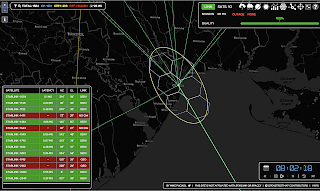
Last week, using Mike Puchol's Starlink tracking service, I found that users in Kyiv would have 100 percent uptime with connections through as many as nine satellites to ground stations in Turkey, Poland, and Lithuania. When the Turkish ground station was unreachable it dropped to as few as five, but uptime remained 100%.

I've since used his service to check connectivity snapshots in three geographically dispersed cities -- Odessa, Lviv, and Kharkiv. I always found between seven and ten satellites in service in Odessa and Lviv and between two and six in Kharkiv. This is not surprising since Lviv is west of Kyiv, hence closer to the Polish and Lithuanian ground stations, Odessa in the south is closer to the one in Turkey and Kharkiv is to the east -- near Russia.

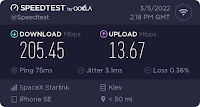
Starlink Speedtest in Kyiv
Puchol's simulation mode shows there should be 100% availability throughout the country at all times and, since there are few terminals, performance should be good. That was confirmed by an OOKLA Speedtest run by Oleg Kutkov in Kyiv. During the third quarter of 2021, OOKLA observed median upload and download speeds of 87.35 and 13.54 Mbps in the United States and as shown here, Kutkov observed much faster download speed and similar upload speed. The Kyiv test showed a "ping" time of 75 ms compared to a median "latency" of 44ms reported by OOKLA. I'm not sure if their reported "latency" is one-way or round trip. If the latter, they are comparable,

There have been several software updates since last week. Most importantly Elon Musk tweeted that SpaceX had enabled roaming in Ukraine so anyone with a terminal can transmit for a while then turn it off and move to another location or, if necessary, can remain online in a moving vehicle. In the same Tweet, Musk announced that they had reduced peak power consumption so the terminal could be powered by a car cigarette lighter. (There must have been some performance hit).

Musk also tweeted that "Some Starlink terminals near conflict areas were being jammed for several hours at a time" and they were bypassing the jamming with a software update. He added that he was curious to see what they tried next -- this sounds like "whack-a-mole."

It's noteworthy that in our "software-defined everything" world, SpaceX can make significant changes to the constellation with a software update. (The downside is illustrated in an over-the-air software hack of ViaSat modems).

Musk warned that Starlink terminals could be targeted and advised users to turn them on only when needed, to place an antenna as far away from people as possible, and to cover it with light camouflage. He also tweeted that some governments (not Ukraine) had asked him to block Russian news sources, but, as a "free-speech absolutist," he refused to do so.

President Zelenskyy Tweeted that the second shipment of terminals was on its way after speaking with Musk. 

In related news, Anonymous has declared cyberwar on Russia and there are Telegram channels for IT professionals in support of Ukraine, one of which is English-language.

Finally, there was also a PR tweet by Ukraine's famed heavyweight champion boxers the Klitschko brothers posing with a couple of Starlink terminals. 

Some Musk critics see his disaster-relief efforts or delivering terminals to Ukraine as publicity stunts of little practical value. Starlink terminals in Ukraine are terrific publicity, but they are also valuable tools for communication by political and resistance leaders if they are unable to safely access the Internet or it is blocked. For example, it has been reported that Mariupol is without electricity and water, and the Internet has been down since March 2. If there is a Starlink terminal there, it is still online.


Update 3/10/2022
Oleg Kutkov reported faster connectivity with a wired connection to the router instead of WiFi.

Update 3/14/2022

Photos of Starlink terminals in various locations have been posted on Telegram's Ukrainian IT Army and Facebook's SpaceX Starlink in Ukraine groups, but little was said about their use and users. 

Fifty of the square-antenna terminals from the second shipment have gone to the DTEK Group. Half of them will be used for support of Ukrainian energy infrastructure and half will go to DTEK businesses. Click here for more on DTEK's war effort

Update 3/17/2022

The Internet in the port city of Mariupol has been down since March 2 and the city is reported to be without electricity, gas, and water. If there are any Starlink terminals in the city, they should have no trouble getting online. I've periodically checked connectivity there and found between two and six satellites in service. (The rare time it got down to two satellites, the connection was through the Lithuanian ground station).

Six satellites in service over Mariupol

Update 3/19/2022

From the Washington Post: "A person familiar with Starlink’s effort in Ukraine, speaking on the condition of anonymity to discuss sensitive matters, said there are more than 5,000 terminals in the country. We'd seen pictures of three truckloads before, but this is a whole new level. Enough for armed forces, infrastructure companies like DTEK, NGOs, and government leaders.

Update 3/26/2022

DTEK's power engineers have received another 170 Starlink satellite terminals from SpaceX. The terminals "will help the company's power companies to maintain stable operation of power grids more efficiently and will help emergency repair crews to restore power as soon as possible." This sounds like part of the 5,000 terminals mentioned above. 

Update 5/5/2022

It's been over two months since I first wrote about Starlink terminals in Ukraine. At that time, a few hundred Starlink terminals had been delivered. Within a month there were 5,000 terminals and that was soon updated to 10,000. Now it's being reported that there are 150,000 daily users and the Starlink app has been downloaded 215,000 times. 

As predicted, Starlink has become an important government asset. This article shows some of the ways Starlink terminals are being used. The article is in Ukrainian, but the Google and Microsoft Translations are perfectly readable.


Update 10/13/20

I've previously written about the unprecedented role of the Internet in the war and the contribution of Starlink. Some current measures of the magnitude of the contribution of Starlink are:


Tuesday, March 01, 2022

SpaceX Starlink Service in Ukraine Is an Important Government Asset

The terminals will be used by key people who are running the government and resistance.

At 4:04 AM on February 26 Mykhailo Fedorov, Vice Prime Minister and Minister of Digital Transformation of Ukraine requested Starlink service from Elon Musk and at 2:45 PM on the 26th, Elon Musk tweeted "Starlink service is now active in Ukraine. More terminals en route." On February 28 at 12:29 PM Fedorov posted a photo of a truck load of terminals. (Kyiv is 10 hours ahead of California). 

I don't know where the terminals had been stored or how they shipped them, but the delivery time was impressive and twenty-four minutes after the truck arrival was posted, Oleg Kutkov, an engineer, tweeted an OOKLA Speedtest result. 

I don't know how many terminals are in Ukraine now -- Elon Musk has promised to send more -- or who will get them, but I assume it is a small number -- perhaps 100. They will be used by government and army officials who run the government and coordinate the resistance and journalists and communication specialists who report to Ukraine and the world. 

Until Starlink satellites are equipped with inter-satellite laser links, terminals will require access to ground stations. I checked for connectivity in Kyiv at two separate times using Mike Puchol's Starlink tracking Web service and found ground stations in Turkey, Lithuania, and Poland. 
Kyiv connects thru satellites (blue)
to ground stations (orange).
The first time I checked, there were nine satellites that could reach all three gateways (as shown here), and the second time five could reach two gateways -- the Turkish gateway was out of reach.

Does it matter?

In 2009 and 2011 the United States attempted to smuggle satellite Internet terminals into Cuba. The best-known effort was by Alan Gross, who spent five years in a Cuban prison when he was caught and the second was an attempt to bring equipment in by a faux surfing film production company with dishes disguised as boogie boards. (If you are curious, I covered both attempts in-depth on my blog on the Cuban Internet).

These attempts failed, but if they had succeeded, they would have been drops in the bucket -- of little importance to either the US or Cuba.

But Starlink in Ukraine is a very different case because there was no organized opposition in Cuba. These terminals will be used by key people who are running the government and resistance. They will be able to communicate synchronously or asynchronously from wherever they are in Ukraine with each other and the outside world. 

Concerns have been raised about the possibility of Russians finding and destroying these terminals using aerial direction finding, but that would be difficult. For one thing, Ukraine is a large country -- over 233,000 square miles and the terminals could be switched off when not in use. Furthermore, SpaceX is currently testing roaming in California and Nevada, The Starlink terminals are small and easily moved and SpaceX should enable roaming in Ukraine. As an added precaution, terminals could be set up a short distance from the people using them. 

This is more than a publicity stunt by SpaceX. 

Update 3/2/2020

I've been sporadically checking the state of connectivity in Kyiv today and have observed between five and nine links to ground stations. I've only seen as much as 2 seconds outage once and quality has been always 98 or 99%.


Update 3/3/2202

SpaceX has enabled fixed and mobile roaming in Ukraine and reduced peak power consumption. 


Update 5/9/2202

Survey article on SpaceX Starlink in Ukraine:
  • HOW STARLINK WORKS
  • WHO BROUGHT STARLINK TO UKRAINE?
  • WHO ALREADY USES STARLINK IN UKRAINE?
  • IS EVERYONE ALLOWED TO USE STARLINK IN UKRAINE?
  • HOW TO ORDER A TERMINAL IN UKRAINE AND HOW MUCH IT COSTS
  • HOW WELL STARLINK WORKS IN UKRAINE
  • HOW TO CONNECT TO STARLINK
  • DOES IT MAKE SENSE TO USE STARLINK AT ALL?
  • WHAT WILL HAPPEN TO STARLINK IN UKRAINE AFTER THE WAR?
The article is in Ukrainian, but the Google and Microsoft Translations are perfectly readable.

Update 5/12/2022

By March 26, 2022, 590 SpaceX Starlink satellite terminals had been transferred to Ukrainian medical and healthcare institutions according to Health Minister Viktor Lyashko.

Update 5/25/2022

Mykhailo Fedorov, Vice Prime Minister and Minister of Digital Transformation of Ukraine posted a short video saying 150,000 daily users were using over 10,000 Starlink terminals in support of key infrastructure, healthcare, financial institutions, and energy plants as well as providing mobile backhaul in several towns. Fedorov thanks Elon Musk. Pretty Good Publicity.


Update 6/9/2022

A recent Politico story on Starlink in Ukraine showed how quickly SpaceX was able to get their first terminals into and online in Ukraine. The request for terminals and subsequent spectrum access permission took place over twitter -- no dealing with regulatory bureaucracy.
USAID bought the first 1,300 Starlink terminals and SpaceX donated 3,600. The service is free.
The invasion occurred on a Thursday. On Friday Elon Musk said he wanted to get Starlink up over Ukraine. By Sunday Starlink was active and on Monday the first five hundred terminals were delivered. By Wednesday, 475 terminals were online.

Update 2/26/2025

There have been reports that SpaceX might cut Starlink connectivity in Ukraine but Oleg Kurtkov, perhaps the foremost Starlink expert in Ukraine, doubts that Starlink will be turned off. He points out that Ukraine is paying "millions of dollars a month" for over 170,000 active terminals. That is more terminals than in Europe, and the number is growing daily. He adds that cutting service off would lead to "massive reputational losses" and many countries and customers would "review their decisions and agreements."

The majority of the terminals are standard consumer models, costing about $95 per month, but 3,000 are Starshield terminals, costing $30,000 per month. The 30-pound Starshield terminals have Starshield antennas and SIM card slots, can use AC or battery power, have custom cables for quick battlefield repair, and are in hardened enclosures.

Update 5/26/2025

Oleg Kurtkov contacted me and reduced his estimate of the number of Starlink terminals in Ukraine to 130.000. 

On the other hand, Poland has contributed another 5.000 terminals, bringing the total number from Poland to 29,500, Ukraine’s Deputy Prime Minister for Innovations, Development of Education, Science, and Technology, and Minister of Digital Transformation, Mykhailo Fedorov, says these are "Enterprise" terminals, which can support more simultaneous users than standard terminals with faster, more stable connections.

The UK, France, Germany, and Czechia have also contributed Starlink terminals to Ukraine, and Germany has contributed OneWeb terminals. 


Thursday, February 24, 2022

SpaceX is testing Starlink roaming

A failed roaming test
Last April, Elon Musk tweeted that Starlink "should be fully mobile later this year, so you can move it anywhere or use it on an RV or truck in motion." It is good to know that mobility with a standard dish is in the works, but it's not yet available.
David Lang had been able to connect his Starlink terminal about fifteen miles from his home in Simi Valley, California, but when he brought it to my place in Carpinteria California, about forty-three miles away and in a different coverage cell, it failed to connect.

David's experience is not unique -- others have reported similar inconsistency on social media, but if one is willing to change the registered address of their terminal, it can be moved -- if there is available capacity at the new location.

Consider the experience of Marcus and Julie Tuck, who have been digital nomads for eight years and Starlink users since April 2021. As of December 16, 2021, they had registered at one hundred different addresses and had service at 157 locations. 

The Tucks and their truck
They experienced a significant roaming change while driving in central California. On February 11, 2022, they noticed they could move into a new cell and retain Starlink service without registering an address change. Later, when they crossed from California to Nevada, they had to enter a new address, but when they returned to California, they did not have to change it back. They have not changed it subsequently but will have to when they enter Mexico.

When David Lang brought his terminal to my home, he would have risked losing the ability to connect when he returned home if he had temporarily registered his terminal at my address. When the Tuck's experience becomes available, users will be able to leave home for a trip and return without risking the ability to reconnect at home.

David's visit was a week after the Tuck's experience, so roaming has not yet been rolled out. Perhaps the Tucks were in a limited test area or were selected by SpaceX because of their frequent address changes.

The Tucks had fixed roaming, not the in-motion connectivity Elon Musk promised, but it is a first step and there are still unanswered questions about roaming like:

  • Will terrestrial roaming while in motion require a different terminal? (It will at least have to be mounted differently). Planes, ships, and military vehicles will surely use different terminals. 
  • Since capacity must be reserved for roaming, the service will cost SpaceX. Will they charge for roaming and, if so, how -- by the month, the cell transition, the ground-station transition?
  • Will the roaming fee be less in low-demand, unsaturated areas? 
  • Will it be different for transitions into or out of high-demand areas? A function of the number of open slots at the time of transition?
  • Because of capacity limitations, they will not be able to guarantee 100% roaming success. Might we see a collective service-level guarantee like "99% success globally each month"?
  • How long will it be before a Starlink terminal is offered as an option on Tesla cars and trucks? 
  • How long will it be before a Geely Holding Group terminal is offered as an option on Volvo, Mercedes and other Geely brand autos?
  • SpaceX has begun launching satellites with inter-satellite laser links and the other LEO broadband operators will follow -- how will that affect roaming?
  • Eventually, I expect we will have optical links to ground stations with climate and weather-aware routing -- how would that affect roaming?
Elon missed his target date, but he seems confident that we will eventually have "full mobility" -- let's hope he is right.

Update 2/25/2022

This map shows the Tuck's most recent travels. Note that they did not have to re-register during the stops marked with green push points. They re-registered after crossing the state line into Nevada but did not re-register after returning to California.


Star = registered address

A. First of five locations after registering
B. First of seven locations after re-registering
C. First of fourteen locations after crossing the state line and re-registering
D. Fourteenth location after registering, 2/23/2022

Update 3/3/2022

SpaceX has enabled fixed and mobile roaming in Ukraine and reduced peak power consumption.

Update 3/12/2022

The Tucks mounted the Starlink dish horizontally on the top of their RV and used it while in motion. They have reported on a 101-mile drive at an average speed of 45 miles per hour and a top speed of 54. During the test, they live-streamed a video, and Marcus' wife listened to a live UK radio broadcast while doing a range of general Internet surfing, social media, etc. Below is a snapshot from a video log of the entire trip, speeded up to run in 2 minutes.


Update 3/13/2022

When the Tucks crossed into Mexico, they feared roaming would fail, but roaming and in-motion connectivity continued working.


Thursday, February 03, 2022

Update on China SatNet's GuoWang broadband constellation -- can they do it?

In 2020, China applied to operate GuoWang, a constellation of 12,992 low-Earth orbit (LEO) broadband Internet satellites, and in 2021, it became clear that it was intended to become China's global LEO broadband constellation. Can they do it? Maybe, but it will take a long time.

Launch capability

Chinese launch startups (source)
China does not have the capacity to launch 12,992 satellites today. I don't know the mass of their planned satellites, but GuoWang is informally referred to as China's answer to Starlink. Starlink's version 1 satellites were 262 kg each and version 2 is said to be between 800 and 1,250 kg. If, say, the GuoWang satellites turn out to weigh 500 kg, the constellation would require 260 launches using China's most powerful rocket, the Long March 5, assuming no failures and ignoring replacement, and it would be 867 launches using the forthcoming, reusable Long March 8.
But times are changing. In a recent DongFang Hour podcast, Jean Deville said there are about twenty new commercial launch companies in China, and they were raising an unprecedented amount of money. While none of these is in the class of SpaceX's Starship, which they say will be able to launch >100 tons to LEO, China's forthcoming Long March 9 is being designed to launch 150 tons to LEO. (Elon Musk tweeted that they might be able to get it up to ~150 tons in a reusable Starship).
Launching and maintaining a constellation of 12,992 satellites would require a coalition of commercial startups and/or the Long March 9. (In an idealistic, united world one could imagine iconoclastic Elon Musk offering to launch GuoWang satellites using Starships).

Satellite manufacture

GalaxySpace satellite "super factory" (source)
As of last September, China only had 431 satellites in orbit. Chinese state-owned enterprises clearly do not have the capacity to produce and maintain satellites for a mega constellation. As with launch, one or perhaps a coalition of private companies could be called upon to manufacture GuoWang satellites. 

As Deville put it, "2022 could be year one of the significant if not massive deployment of Chinese small satellites." He cited the example of the completion of the GalaxySpace satellite production line at their "super factory" in Nantong and showed the first six broadband communication satellites that were just completed. He also described several other satellite manufacturing companies including auto manufacturer Geely, which has a factory capable of producing 500 satellites per year and deep mass production experience.

Optical links and ground infrastructure

Inter-satellite optical links are a priority for LEO constellations -- they will reduce latency and the need for ground stations -- and China has relatively poor access to global ground infrastructure. As with launch and satellite manufacture, there are promising optical communication start-ups, but China lags established companies like Mynaric and Tesat and is precluded from using their products by the current technology cold war and Xi's Made in China 2025 policy. 

Optical links between satellites and the ground could compensate in part for a lack of radio-frequency ground stations and China's recently released Five-year Perspective white paper says they have tested satellite-ground laser communication. Ground station load can also be reduced by relaying data through geostationary satellites and the Five-year Perspective includes a commitment to a coordinated multi-orbit communication system.

Amazon offers ground-station service; AWS Aerospace and Satellite Solutions offers space/terrestrial systems consulting service and Microsoft offers Azure Orbital ground station service, which enables satellite access to its Azure cloud services. Will Chinese Web services and terrestrial infrastructure companies integrate with GuoWang?

Politics

Belt and Road nations, January 2021 (source)
GuoWang is behind SpaceX Starlink and nearly as far behind the OneWeb, Telesat, and Amazon Kuiper constellations, but the political division between China and the US may protect it enough to survive. Starlink service will not be allowed in China, and they will discourage it in nations that participate in their Belt and Road infrastructure initiative, and GuoWang service will not be allowed in the United States or nations with which we are closely allied. 

This division shields GuoWang from competitive market pressure and it locks in global waste and economic inefficiency by ensuring that LEO constellations will be able to route traffic but will otherwise be idle while orbiting over "enemy" nations. 

I've reviewed three areas in which GuoWang needs to catch up, but GuoWang, Starlink and the other would-be broadband Internet service providers also face joint constraints like LEO debris and spectrum scarcity, (Note that SpaceX has also applied to launch 30,000 more broadband satellites). Optical links between constellations and the ground may relax the spectrum constraint if inter-satellite routing algorithms are climate-sensitive but global collaboration is needed to deal with debris, collision avoidance, and spectrum scarcity.

GuoWang is facing an uphill battle. If SpaceX and the others do not go bankrupt, they will have been operating for years before GuoWang completes a 12,992-satellite constellation. On the other hand, the Chinese government has given GuoWang high priority, their lunar, Martian, and space station programs started long after ours, and China plans to "build a satellite communications network with high and low orbit coordination" within the next five years.

Update 2/22/2022

GuoWang got political affirmation recently when China Satnet signed a strategic cooperation agreement with the Shanghai Municipal Government. (Like state governments in the US, Chinese municipal governments often support commercial efforts). Satnet is a state-owned enterprise, but its executives visited commercial satellite constellation operator Guodian Gaoke signaling openness to cooperation with Chinese commercial space firms. 

It seems clear now that GuoWang will be China's global broadband provider, not Hongyun and Hongyan, less ambitious broadband constellation projects of powerful state-owned enterprises CASC and CASIC.

Update 3/13/2022

The Dongfang Hour reports that the Long March 9 will not be ready to launch for 8-10 years. How many satellites will GuoWang's competitors have in orbit by then? They also reported that the six broadband communication satellites mentioned above were launched. The satellites have a mass of 190kg and a throughput of 40 Gbps.

Several companies are ramping up to build satellites, so a coalition may be able to equip GuoWang, but launch capacity seems to be an even more significant constraint. Either way, they have a long way to go. Here's a wild dream -- SpaceX could launch GuoWang satellites. Elon Musk has been known to help competitors -- he put 249 Tesla patents in the public domain in 2014.

Update 7/22/2022

As we saw earlier, the Long March 9 was expected to be ready for launch in 8-10 years, but a revised design is being considered. Andrew Jones reports that Long Lehao, a veteran chief designer of the Long March rocket series, presented plans for a new reusable methane-liquid oxygen launch vehicle to be ready in 2035. He described a two-stage rocket capable of launching 150 tons to low-Earth orbit. That sounds a lot like SpaceX Starship, but without mention of the launch/land pad with "chopstick" arms to capture a returning booster.


Presentation on the revised Long March 9 (source)

There is no doubt that China is paying attention to and is way behind SpaceX's Starship development. If Starship succeeds, Elon Musk may have an apartment on Mars by 2035 :-).
Update 1/25/2023
Here is confirmation of the 2035 target date for the Long March 9. By that time, several LEO broadband providers hope to have been serving customers for several years. Note the emphasis here is on deep space exploration, not Internet service. 
"Around 2035, China will implement a one-time configuration flight verification mission of heavy rockets, and after the successful mission, heavy rockets will become one of the main forces of China's deep space exploration."
Update 4/18/2023
The 14th Central Inspection Team
China Satnet is undergoing a comprehensive political "physical" (on-site?)  examination by the 14th inspection team of the Central Committee and a new General Manager has been appointed They plan to work on the investigation for about two and a half months. 
The focus of the visit is to report and reflect on violations of political discipline, organizational discipline, integrity discipline, mass discipline, work discipline, and life discipline in addition to assessing progress toward strategic goals.
To an American, that sounds a bit like 1984 but it may be routine for China. (This update was based on a Google translation).
Update July 12, 2023
The seventh test satellite was launched three days ago. The first production satellites will be launched in the third quarter of this year.