![]() |
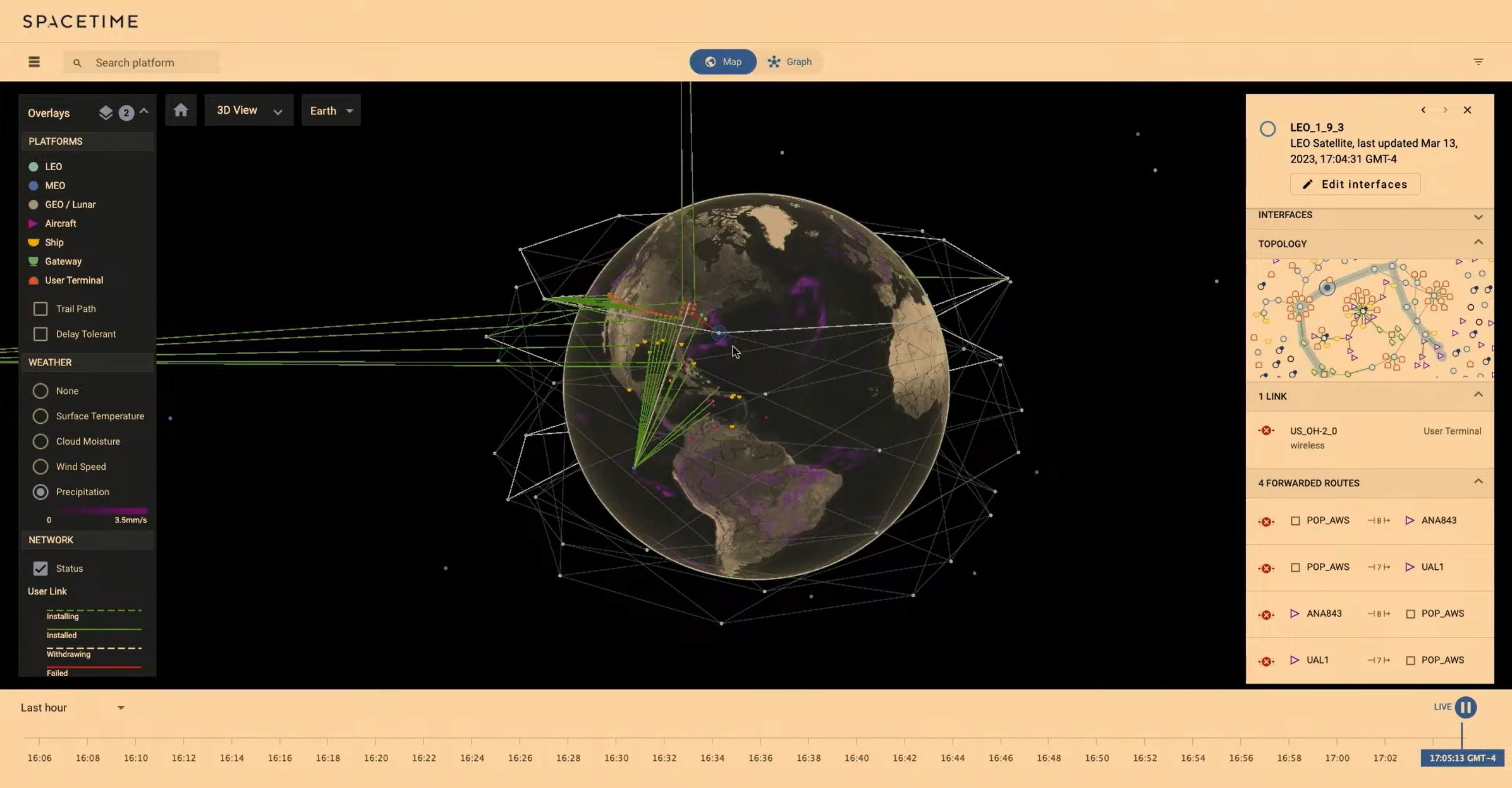
| Spacetime's user interface shows changing links and topology over time (source) |
Friday, October 28, 2022
Is the Defense Innovation Unit's Hybrid Space Architecture the "ARPANET" of space and will it run on Aalyria Spacetime?
Posted by
Larry Press
at
Permanent link as of 10:03 AM
0
comments
Tuesday, September 27, 2022
Aalyria, a space Internet startup with nearly a decade's worth of intellectual property from Alphabet
![]() |
| Loon balloons floated at an altitude of 18-25 km, above birds and the weather. They navigated by moving up or down to catch wind currents moving in different directions. |
![]() |
| Source |
- I don't know where the name Aalyria comes from. I Googled it and only got references to the company itself. (There were tons of hits -- the company is hot).
- I wonder if they plan to operate their own constellation or license the technology. I suspect that the prospective broadband licensees already have their own "Spacetime" but not their own "Tightbeam." At some point, Aalyria (or Amazon, Microsoft, or Google) will roll out optical ground stations.
- My guess is that Tightbeam was developed by Alphabet project Taara which had been working on optical communication for Loon and other applications.
- I tried for a couple of days to get more information on Tightbeam and its performance? Technical papers, experimental results, patents, etc. but email to Aalyria.com bounces.
- Finally, I notice that the Board of Advisors has eleven members, four of which have prior Defense Department experience. That may have helped Aalyria secure an initial $8m contract with the Defense Innovation Unit. Another member is Vint Cerf, co-designer of TCP/IP, a Google VP, and most relevant in this context, a long-time proponent of interplanetary networking. Only one employee is listed as an optics engineer, but Board member Dr. Donald A. Cox III is an optical communications expert.
Update 10/8/2022
Tim Deaver, VP of Strategic Solutions at Mynaric says they are working on space-ground, air-ground, and ground-ground terminals. Will they be able to write terminal drivers and have them work in a Spacetime network?
Update 9/30/2023
Aalyria CTO Brian Barritt described and demonstrated Spacetime in a terrific keynote talk at the Satellite 2033 conference. He reviewed SpaceTime's history, scope, and features, but the highlight of the talk was a live demonstration of a hypothetical network with mobile and fixed assets on the ground, sea, air, LEO, and the Moon. Stay tuned for a promised Fall update presentation on Tightbeam.
Posted by
Larry Press
at
Permanent link as of 10:18 AM
0
comments
Sunday, September 04, 2022
SpaceX introduces affordability based Starlink pricing
![]() |
| GDP per capita, 2022 (Source) |
![]() |
| A 56% service price cut in Brazil |
![]() |
| Source |
Posted by
Larry Press
at
Permanent link as of 2:02 PM
0
comments
Wednesday, August 17, 2022
OneWeb and Intelsat Sign the First Multi-Orbit Broadband Agreement – More to Come
![]() |
| A Boeing 777 connected to OneWeb LEO and Intelsat GEO satellites during this test flight. (Image from demo video). |
![]() |
| LEO, MEO, and GEO satellites (not to scale) |
In June, OneWeb and Stellar demonstrated in-flight connectivity to a Boeing 777 jetliner, achieving a download speed of 260 mb/s. Ben Griffin, OneWeb vice president, says the speed is constrained by the current aircraft antenna and their satellite spot beams are capable of 500 mb/s. (777 carrying capacity is from 312-388 passengers).
Last week, OneWeb announced the first of what I expect to be many multi-orbit deals. Intelsat, an established GEO provider of in-flight connectivity, will distribute OneWeb's forthcoming LEO in-flight connectivity. The companies expect the multi-orbit solution to be in service by 2024 and they promise seamless connectivity with OneWeb LEO satellites for latency-sensitive applications and Intelsat GEO satellites for applications where latency is not critical.
Note the emphasis on the word seamless above. The transition between constellations must be transparent to users. Automatic routing based on packet type is required and is well understood and implemented in different systems. For example, OneWeb had previously demonstrated LEO-GEO connectivity with Hughes using their ActiveClassifier technology that "automatically identifies different types of data and apps and tags them with a specific priority setting using advanced heuristics algorithms."
It is likely that OneWeb will soon be interoperating with three GEO operators. They have demonstrated seamless LEO-GEO integration with Hughes, have agreed to partner with Intelsat on in-flight connectivity, and have signed a memorandum of understanding to be acquired by GEO operator Eutelsat. This is the sort of interoperability promised by Neil Masterson.
Will we see multi-orbit connectivity standards?
This is the first LEO-GEO broadband effort, but I expect many others because they solve problems for both LEO and GEO Internet service providers. LEO service providers are capacity constrained. SpaceX's Starlink LEO service is currently over-subscribed at some locations in the U.S. and Canada. They will add capacity by launching improved satellites and offloading latency-tolerant traffic to a GEO partner, freeing capacity for more valuable latency-sensitive traffic
GEO operators will seek LEO partners or, as in the case of Telesat, develop their own LEO constellations to provide low look-angle connectivity in polar regions and to serve latency-sensitive applications. Dan Goldberg, CEO of GEO ISP Telesat, acknowledged this when explaining why they were creating their own LEO constellation saying, “I guess it’s something we had to do. For us, you have no choice but to land at LEO.”
This post focuses on one application, in-flight connectivity, and one LEO operator, OneWeb, but this is just the start. For example, Intelsat and OneWeb have also been working on military applications and Viasat is working on multi-orbit solutions with several non-GEO operators or prospective operators and conducting a multi-layer satellite communication study for the European Space Agency. Intelsat is reportedly in merger talks with MEO operator SES. The elephant in the room is SpaceX. Elon Musk is a big fan of do-it-yourself integration, but it's hard to imagine SpaceX operating its own GEO satellites -- partnering with and launching satellites for a GEO operator seems more likely. I wonder whether China SatNet is looking for a GEO partner.
Update 3/11/2023
OneWeb considers multi-orbit interoperability a strategic capability and now Eutelsat has signed a multi-million euro deal to provide their GEO capacity and OneWeb's LEO capacity to Intelsat.
OneWeb is expected to launch the final batch of its first-generation LEO satellites this month and be in full operation in a few months. Eutelsat operates a large constellation of GEO satellites as does Intelsat.
This gives OneWeb a lead over SpaceX and other potential LEO providers of aircraft connectivity. It will be interesting how the handoffs between LEO and GEO satellites are handled, how it affects the passenger user interface, and how well in-flight connectivity performs in a large, fully booked airliner.
Update 11/12/2023
Eutelsat has said full-scale OneWeb Gen 2 satellites would be bulkier, able to provide three to five times more capacity, and would only be around 300 in number because Eutelsat’s geostationary fleet would help cover high-demand areas. However, last year Eutelsat ordered a multi-orbit compatible geostationary broadband satellite serving the Americas, implying that multi-orbit connectivity would not be available with its legacy satellites.
Update 12/1/2023
Intelsat has signed multi-orbit deals with both SpaceX and OneWeb. The flat panel antenna on this vehicle can communicate with both Intelsat's GEO satellites and SpaceX's Starlink LEO satellites. This ruggedized antenna is only available for DOD and some other government agencies for now. Intelsat will also offer multi-orbit service with Eutelsat-OneWeb LEO satellites on 500 American Airlines regional jets starting in early 2024.
Posted by
Larry Press
at
Permanent link as of 2:51 PM
0
comments
Friday, August 05, 2022
SpaceX Starlink's variable pricing pilot in France is good business and good karma.
An idle satellite over Africa is neither generating revenue for SpaceX nor serving the population.
![]() |
| Source |
Starlink first became available in the U.S. and Canada and sales are beginning to outrun the available capacity. At oversubscribed locations, the best effort is unacceptable, median performance is slipping overall, and the recent announcement of new, non-residential services will exacerbate the problem. Launching new satellites will ease today's congestion and capacity will increase rapidly when version 2 satellites are launched, but demand will always be uneven and capacity limited,
Under the pilot program in France, the monthly service fee drops from €99 to €50/month. A Fair Use policy will begin in October. Users who consume 250 GB/month or less will be prioritized. Those who exceed 250 GB/month will still have access to unlimited data but may experience slower speeds during times of network congestion. They can also choose to purchase additional data to reclaim priority status for €10/100GB.
This is a pilot program, and it will be carefully studied and tweaked. For example, they will be able to vary the congestion threshold criteria, the performance goals of prioritized and limited service, and the frequency of checking a cell to determine whether prioritization is required. SpaceX may have selected France for the pilot study because it is demographically similar the U.S. and Canada.
It is not surprising to see Starlink begin to transition to variable pricing. When I was a child, phone call charges were reduced on Sundays and during the evening and mobile phone companies offer variable price plans today.
Starlink service is currently available in thirty-seven nations, four of which are in Latin America. None are in Africa or Asia and an idle satellite over Africa is neither generating revenue for SpaceX nor serving the population. Ideally, the full capacity of the satellite constellation would be utilized at every location and time because the marginal cost of serving a new customer when and where there is excess capacity is near zero. (SpaceX does not offer residential installation or support). That optimal goal is unreachable, but I would be surprised if, eventually, we do not see pricing for affordability -- different service plans and terminal prices in different countries.
(For a related discussion see this post).
Posted by
Larry Press
at
Permanent link as of 4:05 PM
0
comments
Thursday, July 28, 2022
Starlink sales are straining capacity in parts of the U.S. and Canada
![]() |
| OOKLA Speedtest results for the U/ S. and Canada (source) |
On June 5th Elon Musk said SpaceX had nearly 500,000 customers in 32 nations and 9 languages. By now there must be 500,000 customers most of whom are in the U. S. and Canada and their performance is suffering.
In the first quarter of this year, OOKLA reported that the median Starlink download speed fell from 104.97 to 99.55Mbps in the U.S. and from 106.64 to 97.4 Mbps in Canada. Upload speed dropped from 12.5 to 9.3Mbps in the U.S and from 12.82 to 10.7 in Canada and has been dropping slowly since the first quarter of last year in both nations. Median latency increased from 40 to 43ms in the U.S. and from 51 to 55ms in Canada during the year.
A few of the first-quarter customers were small businesses, rural schools or clinics, etc. but the overwhelming majority are residential. OOKLA hasn't published second-quarter results yet, but they may be worse because SpaceX has entered several non-residential markets -- business, roaming (RV), and maritime -- during the quarter. They have also deployed mobile roaming on trains and vehicles in Ukraine and they are testing aircraft connectivity so we may soon see these services offered commercially.
There are also anecdotal reports of declining performance like this one on Reddit Starlink discussion: "Speeds have slowed significantly. No obstructions, and support is no help. KY, USA." This post describes one person's experience but has 103 upvotes and 142 comments, many describing similar experiences. Note that the user found that "support is no help" and future customers will need more support than today's residential early adopters who tend to be technically proficient. SpaceX will soon be competing with OneWeb in the non-residential markets and this sort of experience and publicity will harm Starlink's reputation.
That's the bad news. The good news is that SpaceX is rapidly adding capacity. They are launching satellites at an unprecedented rate and the Version 1.5 satellites they are now launching have inter-satellite laser links. Furthermore, when Starship is ready, it will be capable of launching version 2 satellites which Elon Musk says will offer nearly an order of magnitude more data throughput than the version 1 satellites they will eventually replace. Maybe they should slow down sales in oversubscribed areas for a while.
Posted by
Larry Press
at
Permanent link as of 1:06 PM
0
comments
Saturday, June 18, 2022
Ten SpaceX Starlink updates
![]() |
| Starlink availability map (Source) |
![]() |
| Astronomers worry about reflections from larger Version 2 satellites. (source) |
| Phase 1 orbital shells -- 4408 satellites |
Posted by
Larry Press
at
Permanent link as of 8:56 PM
0
comments
Monday, June 13, 2022
Can SpaceX launch version 2 Starlink satellites this year?
![]() |
| A Starship spacecraft being lifted onto a Super Heavy booster |
![]() |
| Version 2 satellites will be ejected using a "Pez dispenser" mechanism modeled after industrial pallet stackers. |
![]() |
| Raptor 1 vs Raptor 2 (source SpaceX) |
![]() |
| Alternative plan -- booster returns to launch pad |
Posted by
Larry Press
at
Permanent link as of 9:00 PM
0
comments
Sunday, May 29, 2022
Putin's iron firewall is porous
Russians can see more of the Ukraine war after three months than we saw during the entire Vietnam war.
In 1946 Winston Churchill declared that Russia had lowered an iron curtain across Europe and in 2022 Vladimir Putin created an iron firewall between the Russian Internet and media and the rest of the world but, like its precursor, it is porous. Information wants to be free.
As of May 26, Russia had blocked access to 1,548 domains, including 1,142 news sites and 287 digital-resistance sites. The distribution of domain locales is also skewed -- Ukraine 647, the US 523, and Russia 218 are the top three. Given this blocking, it is not surprising that Russians turned to virtual private networks (VPNs).
As shown here, Russian interest in VPNs as measured by Google searches for the term "VPN" has spiked twice. The baseline level is roughly 5% of the peak period after Russia's invasion of Ukraine. The earlier spike -- 26% of the peak -- occurred when the US sanctioned Russia for interference in our 2016 election.![]() |
| Daily downloads of the ten most popular VPNs |
Several messaging services are currently unblocked in Russia. The most surprising to me is Telegram which has around 38 million Russian users visiting it at least once a month. If they have the same level of access as I do, they can see Washington Post coverage of the war, President Zelensky's standing-ovation addresses to parliaments and other important audiences, news and graphic photos, and videos of Russian war crimes. and follow the activities of The Ukrainian IT Army.
When Russia celebrated Victory in Europe Day, an audacious hack occurred. Hackers placed fake stories on Lenta.ru, a popular Russian news site. The hack was quickly discovered and corrected, but not before the Internet Archive backed it up. Below is a Google Translation of a portion of the hacked front page. Note that the hack went beyond the front page -- each front-page headline linked to a complete article.
Many Ukrainians speak Russian and have friends and family members in Russia. They can use the Internet to tell their friends and families what they have witnessed, and you can do the same using a messaging service created by Squad 103 a group of Polish programmers.
The service, which sent over 100 million messages in less than two months, allows anyone anywhere in the world to message cellphones and email addresses of random Russian individuals and companies. To send a message, you select a messaging application -- SMS, WhatsApp, email, Viber, Telegram, or phone call and write or select an appropriate message.
(I'm not sure how or if it is possible to distinguish between the activity of Squad 103, the Ukrainian IT Army, and Anonymous in Ukraine).
Ukraine is also using facial recognition to identify Russian soldiers who have been captured, killed, or are caught in the act of looting or other war crimes. They follow up by investigating the war crimes and informing the families of dead soldiers. They defend the latter by saying they offer the soldier's families the possibility of claiming the bodies and fighting Russian propaganda, but they say that is effective in only about 20% of the cases.
I've focused on the Internet, but mass media is also vulnerable. The Economist reports that the state controls the country’s television channels, newspapers, and radio stations, giving "guidance" as to what and how to cover. But, despite Putin's efforts, the truth sometimes appears in mass media.
![]() |
| The sign reads "NO WAR. Stop the war. Don't believe the propaganda. They are lying to you here." |
Military analyst & retired colonel Mikhail Khodarenok surprised fellow panelists by arguing with Olga Skabeyeva, the anchor of Russia's “60 Minutes” talk-show program. He said the war was going poorly and would get worse, arguing that a million patriotic Ukrainian soldiers were ready to fight to defend their nation while Russian army morale was low, Russia is geopolitically isolated, and Ukraine was well supplied by the west. My favorite moment in the argument is when Khodaryonok invoked the "classics" of Marxism-Leninism in refuting Skabeyeva when she challenged the professionalism of the Ukraine fighters. Two days later, on the same program, Khodaryonok predicted an ultimate Russian victory.
The most innovative mass-media hack occurred on Victory in Europe Day when every program listing in the online TV guide service was changed to read (in translation) "On your hands is the blood of thousands of Ukrainians and their hundreds of murdered children. TV and the authorities are lying. No to war".Writing this, I am reminded of the Vietnam war. Criticism of the war was freely available in print and electronic media in the US and public protests were common. It was nothing like Russia today. But the rate and quality of anti-war information reaching Russia today far exceed those of the Vietnam war.
We saw iconic photographs -- a terrified nine-year-old girl running screaming and naked after she was napalmed or Major General Nguyễn Ngọc Loan calmly shooting a bound prisoner in the head at point-blank range. Equally disturbing photos from Ukraine are posted to Telegram every day. We eventually learned of the Mỹ Lai massacre in Vietnam, but Russians can see Mariupol and Bucha today. (Do a Google Image search for Bucha atrocity or go to President Zelensky's Telegram channel and search for Bucha).
Update 7/18/2022
The Open Technology Fund, a U.S. government-funded nonprofit, is supporting three firms that offer their VPN service in Russia for free - nthLink, Psiphon, and Lantern and it's paying off. On May 27 there were 929,000 unique daily users of the Psiphon VPN in Russia, and it has grown steadily. It was 2.113 million on July 18th.
Update 8/27/2022
To celebrate Ukraine’s Independence Day, dozens of IP cameras with speaker outputs have been hacked to play patriotic music in Russia as well as occupied Crimea and Donbas. Here are a couple of stills from the video.
Posted by
Larry Press
at
Permanent link as of 10:18 AM
0
comments