Thursday, July 11, 2013

Four ways we can experiment with MOOCs -- Blackboard joins the fray

Provosts of 13 universities recently announced that they would be working together to take advantage of "new technologies and course redesign" to "improve instructional quality, enhance student learning outcomes, and extend the reach of campus instructional offerings."

It sounds like they want to keep open the option of remaining independent of the currently-dominant, well-funded, expensive MOOC platforms Udacity, Coursera and edX. How might a university do that? There are at least four alternative platforms, two of which are offered as hosted services:
  • Blackboard just announced that they will be hosting a new MOOC platform, which would be available free to existing Blackboard customers.
  • Blackboard competitor Canvas has a hosted MOOC platform that allows teachers to build modular courses with video lectures, quizzes, analytics, groups (inside the system or using external resources like Google Docs or Skype), etc.
There are also two open source platforms, which could be hosted by a university or other organization:
I do not know of any sites hosting Course Builder or EdX, but would not be surprised to see some in the future. For example, I can imagine (wish for) Google integrating Course Builder with some of their other services -- Docs, YouTube, Plus with hangouts on air, and Groups -- and offering a significant platform for developing and delivering courses.

We need these and other do-it-yourself alternatives to the major MOOC platforms -- the industry will eventually consolidate, but it is too soon to do so now. In the meantime, let a thousand flowers bloom.

-----

7/12/2013

In this interview, Jay Bhatt, Blackboard CEO says they will up spending on software development and sees MOOCs as one point on a contiuim, with support for on campus degree programs at the other. He welcomes competition from Google and others as it will push the entire industry to improve.

Monday, July 08, 2013

OECD study: investment in tertiary education pays for individuals and the public

The Organisation for Economic Cooperation and Development (OECD) has published Education at a Glance, 2013, which provides data on the structure, finances, and performance of education systems in more than 40 countries, including OECD members and G20 partners.  The title says "at a glance," but the report contains many education-related indicators along with analysis.  The OECD has also prepared detailed country profiles, and video, slide and Prezi presentations.

There is way too much to summarize here, so let me show you just one example -- the private and public returns on tertiary education for men.  (They also report on women).

The private returns on investment in tertiary education are substantial.  Not only does education pay off for individuals, but the public also benefits in the form of greater tax revenues and social contributions.  The following table shows the public and private gains associated with a man attaining tertiary education (2009) as compared with upper secondary or post-secondary non-tertiary education.


The net public return on investment for a man with tertiary education is over US$100,000 across OECD countries – almost three times the amount of public investment (direct cost plus foregone tax on earnings). For a woman, the public return is around US$60,000, almost twice the public investment.  Note that the public return for the United States is second only to that of Hungary.

The report includes the data in tables and downloadable spreadsheets and spells out the methodology and definition of indicators in detail.  Here, for example, are the indicators leading to the table shown above:


Most of this data is from 2009, so critics might counter that the cost of education has risen substantially since that time and the payoffs have dropped, and they would be correct.  On the other hand, we are experiencing a spurt of innovation in online education.
In the nations surveyed, education paid off handsomely for individuals and the public.  My guess is that, as we improve online education and begin to define its role in certification and employment, the payoff from education will grow.
If this report sounds interesting, you can download a copy  here.  Note that it includes links to Excel spreadsheets with all of the raw data, so you can draw your own conclusions. 

Wednesday, July 03, 2013

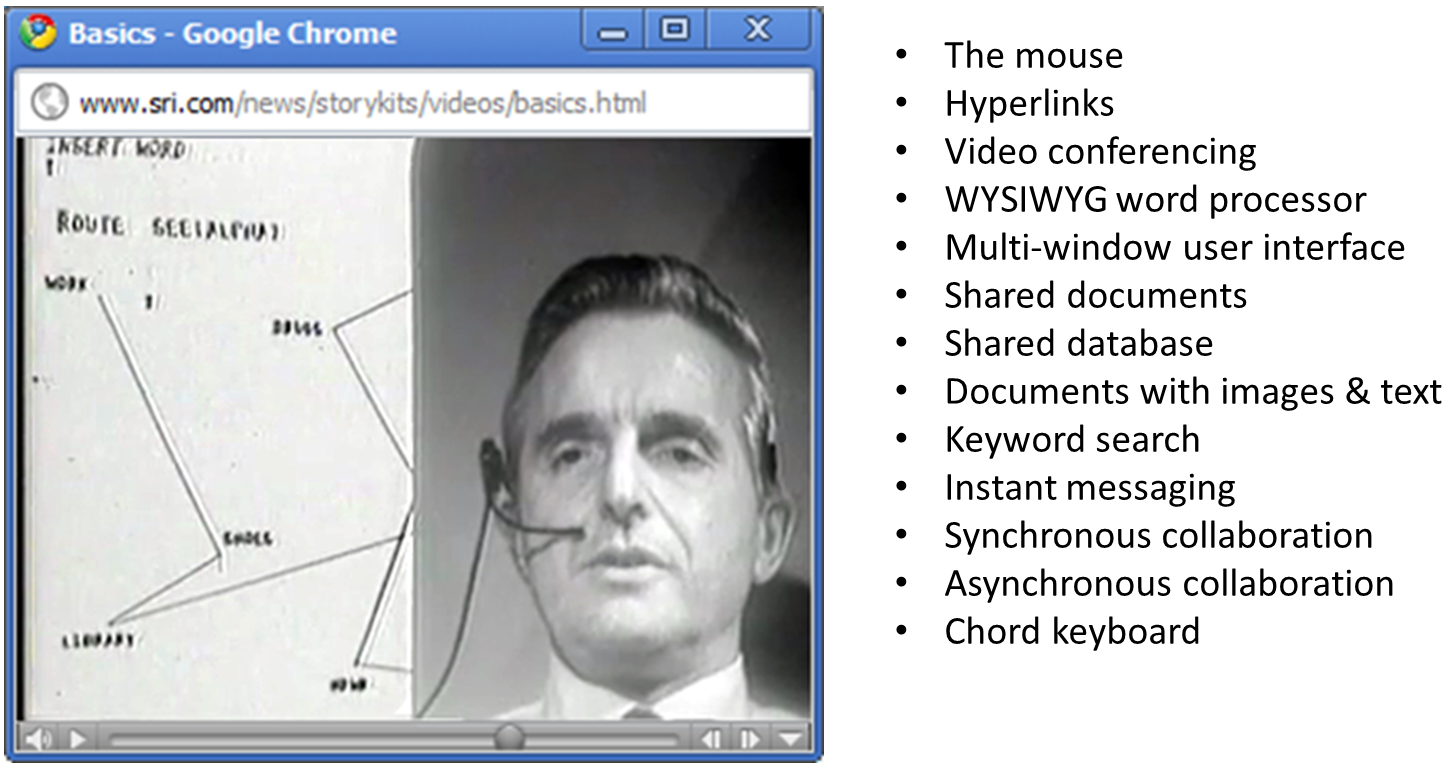
Doug Engelbart passes away

If you use a mouse, hyperlinks, video conferencing, WYSIWYG word processor, multi-window user interface, shared documents, shared database, documents with images & text, keyword search, instant messaging, synchronous collaboration, asynchronous collaboration -- thank Doug Engelbart.

Then go watch The Demo, where Doug unveiled them to the world:

I have a teaching module with a presentation that puts Doug's enormous contribution in context.

I had the privilege of visiting Doug's lab when I was a graduate student working on interactive data mining. Two researchers, G. H. Ball and D. J. Hall were already using Doug's equipment for data analysis. He was open, idealistic, optimistic and far ahead of his time.

Here is a picture of Doug delivering The Demo:


(I added the chord keypad to let you all know that Doug was not infallible :-).

Here is the abstract for The Demo at the 1968 Fall Joint Computer Conference (JCC). The Fall and Spring JCCs were major conferences at the time and Doug Spoke before a crowded auditorium. It was the most important presentation in the history of computer science.


One reason Doug and his team were so productive and successful is that they used the excellent collaboration-support tools they were building to support their own work. Doug emphasized the importance of their use of their own tools -- as they say "eating their own dogfood." The team used shared documents and databases as well as synchronous collaboration tools like what must have been the first computer-equipped meeting room:


People insist on summarizing Doug's contribution as being the "inventor of the mouse." That is an extreme understatement of the importance of his work and thinking, but I guess I have to say something about the mouse. Here is a figure from his patent application:


Today we all use tools derived from his lab prototypes.  Could an economist estimate the contribution to GDP of those tools?

The following are two famous images Doug used to illustrate his work. Unlike Steve Jobs, Doug believed that if a tool were sufficiently powerful, people would invest the time to learn to use it, so simplicity and being similar to familiar tools from the past was not necessary. We would not build a racing tricycle for high speed travel, but would invent something new, the modern racing bike:


He saw the computer as a companion tool that would augment human intelligence. To make that point, he taped a pencil to a brick to show the de-augmentation.:


The Demo and these images were crystal clear -- you "got it" as soon as you saw them. On the other hand, Doug's writing could be a bit hard to follow -- he worked within a theoretical framework which he expanded upon throughout is career. Check this defining document on his Conceptual Framework for Augmenting Human Intellect.

-----

Update 8/1/2013

I've put together a 17-image photo tribute to Doug Engelbart's work -- cool images with captions and links to more.


-----

Update 8/3/2013

Just as The Demo showed the ways in which computers could improve productivity, a demonstration of applications of the ARPANet illustrated the potential of computer networking at the 1972 International Conference on Computer Communication. Attendees could interact with networked applications using 40 terminals. The demonstrations spread interest in network applications beyond the small group that had designed and built the ARPANet.

This ARS Technica article describes the conference and demonstrations. Much of the article is excerpted from the book Where Wizards Stay Up Late by Katie Hafner and Matthew Lyon. If you like the article, you'll want to read the book.

Saturday, June 29, 2013

Speaking of surveillance -- face recognition

NSA email and phone surveillance has been big news the last couple of weeks, but they caught the Boston bombers with photos and we have no right of privacy in public.

This hi-res photo of Vancouver Canucks hockey fans is a composite with a total of 2.11 gigapixels.


Zooming in, we can clearly recognize people under the Homer Street sign near the back of the crowd.


Here is another example, a picture of President Obama's inauguration:


Zooming in, we see crowd sourcing the identification of the people -- over 1,500 people in the audience have been identified on Facebook:


These photos were made several years ago. A few turns of the Moore's Law crank and what will we (They) be able to do?

It turns out that facial recognition software has a hard time with sun glasses and hats.  Do you want to stay anonymous in a crowd? Here is one possible solution:

-----

Update 7/8.2013

The examples given above are based on facial recognition in public, but the new Microsoft Xbox One will bring a Kinect 2, with an always on camera, into your home and Rolling Stone wonders about the privacy implications. Rolling Stone notes that Microsoft has filed for a patent that would use the Kinect camera to monitor the number of viewers in a room. That sounds good in a pitch to an advertiser, but how about recognizing the people in the room? Who needs Big Brother?

-----

Update 8/21/2013

Here is a 360 degree spherical view of the people at a Steelers football game -- zooming in one can recognize individual faces:


The controls in the image viewer allow one to pan, tilt and zoom and the bubbles are associated with people whose faces have been recognized by crowd sourcing
-----

Update 8/24/2013

The New York Times reports (http://nyti.ms/179TFpy) on a Department of Homeland Security research project on surveillance in large crowds, the Biometric Optimal Surveillance System (BOSS). They say the technology is not ready for prime time, but they are making gains:

The federal government is making progress on developing a surveillance system that would pair computers with video cameras to scan crowds and automatically identify people by their faces, according to newly disclosed documents and interviews with researchers working on the project....
-----

Update 8/25/2013

This evening, CBS Sixty Minutes broadcasted a segment on face recognition.


The video and a transcript are online and the segment tag line, "say goodbye to anonymity," reveals the editorial slant.

Think of all the people you have identified and who have identified you in Facebook or Google Plus photographs. They are a database against which to run a facial recognition algorithm and once they have recognized a face, they can match it to the profile of interests, demographic data, likes and dislikes of that person.

Sixty Minutes emphasized commercial applications -- receiving a discount coupon for your favorite beverage seconds after you walk into a restaurant or seeing personalized ads at the mall.

They also mentioned the database of photographs of criminals the FBI is amassing. By next year they expect to be able to search by face as well as fingerprint and DNA.

The Web site includes a video segment titled "Facebook and the FBI," which was not broadcast.


The FBI representative says all the right things, but these days government credibility is not all that high. As Bruce Schneier points out in this Atlantic Monthly article, the government is relying on industry to do its surveillance.

Does any of this worry you? How long until Google or Facebook start getting warrants to turn over the names of the people walking through your hometown mall?
-----

Update 8/29/2013

Facebook may add profile photos to their facial recognition database. They are only considering it and would allow users to opt out if they implement it. (I imagine they will be clever enough to ignore cartoons or non-face photographs).
-----

Update 11/7/2013

Investigators sifted through surveillance video after the Boston Marathon bombing. They found pictures of the suspected bombers, but were unable to identify them given these images. With higher resolution cameras and improved software, would it have been possible to identify them using an Internet image search tool like Google Image Search? Would it be possible to automate the entire sifting and identification process?


-----

Update 11/7/2013

The New York Police Department deployed helicopters, police boats, scuba divers, bomb-sniffing dogs and hundreds of cameras, as well as hundreds of officers, at the November 3 New York City Marathon.

_____
Update 10/13/2014

Researchers at the Chinese Academy of Sciences Chongqing Institute have developed a facial recognition system which they say "can reach 99.5% accuracy." (I'm not sure how to interpret that statement). It is being used at border crossings.

Wednesday, June 26, 2013

The Los Angeles Unified School District buys iPad Trojan Horses for 30,000 students

The Los Angeles Unified School District (LAUSD) will spend $30 million over the next two years on iPads for 30,000 students.

The measure passed unanimously in spite of opponents arguing that the money would be better spent on staff or to pilot both Windows and Apple systems and saying facility bond money should not be used for relatively short-lived teaching tools.

But, IMHO, they missed the key point -- the machines are Trojan Horses for textbook giant Pearson.

The LAUSD received 13 proposals and the top three called for different hardware -- Apple, Dell and HP -- but all three included an app to deliver the Pearson Common Core System of Courses along with other third-party educational apps.

This comes at a good time for Pearson. The Common Core curriculum is not yet established, but many states are committed to it, starting next year. The new tablets and the new commitment to the Common Core curriculum will arrive around the same time, and busy faculty (and those hired to train them) will adopt the Pearson material.

I've seen nothing about the financial arrangement between Pearson and LAUSD.  I wonder what part, if any, of the $678 the schools are paying for the tablets will go to Pearson and what revenue, if any, Pearson will receive from adoption of their curriculum.

I do not mean to criticize Pearson's offerings -- I've not even seen them. (One must have a Pearson School account to see samples). This bundling of Pearson's material will give them a significant advantage, nipping competition in the bud.

Consider, for example, the Common Core math curriculum of the Khan Academy. Will a teacher or school be as likely to select that as the Pearson curriculum? I suspect not, and once they commit to one instruction/assessment platform, they will be locked in.

This situation reminds me of the introduction of the IBM PC in 1981. IBM's entering the PC market was a watershed event, legitimatizing the personal computer as a business and professional tool. IBM offered three operating systems, Microsoft PC-DOS, Digital Research CP/M and the UCSD P-System. Prior to the introduction of the PC, CP/M was the dominant operating system for business and professional applications, but it died almost over night because, although you could get it on an IBM PC, it cost more. Digital Research faded away and Microsoft became ... Microsoft.

After twenty years of serving up "pdf textbooks," we are starting to see innovation in Internet-based teaching material and systems -- will the new market be dominated by the same big-three textbook companies?

-----

Update 9/25/2013

The LA Times reports that the iPads were locked down so students could only do school work on them. As one student said when she realized they were for school work only "You can't do nothing with them ... You just carry them around."

Well, students quickly figured out a simple hack to get around the limitation, so they could do the things teenagers do with iPads. School district officials reacted immediately -- they halted home use of the Apple tablets until further notice.

I understand that they do not want the kids tweeting or whatever during class, but they are throwing out the baby with the bathwater. Expecting students to stay within the confines of some educational program developed by Pearson or anyone else will not work. It flies in the face of student culture and expectations and ignores all of the truly educational uses for an iPad or other tablet that are available to faculty and students.

-----
Update 8/27/2014

The Los Angeles Unified School District (LAUSD) has suspended its contract for iPads and Pearson Publishing software. The rollout program has had logistical problems, but, more important, critics (including me) have pointed out that it was a bad idea to invest so heavily in hardware that would become obsolete relatively soon and act as a "trojan horse," establishing Pearson as the publisher of LAUSD courseware. However, this move seems to have been precipitated by possible irregularities in the awarding of the contract.


-----
Update 4/16/2015

I told you so ... From coverage by Los Angeles raido station KPCC:
Los Angeles Unified told Apple Inc. this week that it will not spend another dollar on the Pearson software installed on its iPads and is seeking a multimillion-dollar refund from the technology giant.
Locking the school district into current hardware and a single courseware vendor made no sense in an era of rapidly changing technology and, even more important, pedagogical innovation.


Be sure to follow this link to KPCC's coverage.

Monday, June 24, 2013

The importance of government research

Blumeberg columnist Mark Buchanan has written an article with the catchy title Who Created the IPhone, Apple or the Government?, in which he argues that government sponsored research has played a major role in the invention of the iPhone and much more.

I wrote a recent post about Presidential science initiatives, including several by President Obama, and have written articles on the role of government sponsored research in developing the personal computer and the Internet:
  • Before the Altair: the history of personal computing, CACM 1993
  • Seeding networks: the federal role, CACM 1996
I also compiled a bibliography of early contributions in:
  • The precursors of personal computing, ACM SIGSMALL/PC Notes, 1988
To retrieve these articles click here and scroll down to or search for the titles.

-----

Update 7/1/2013

In a provocative blog post, Lee Vinsel asks what new technologies might come out of the NSA surveillance activity.  Will we get innovative new technologies or are they just using established techniques of big data mining and server farms? Also -- if there are new technologies, will they belong to the US people or to contractors like Booz Hamilton, which hired Edward Snowden?

This leads me to wonder whether the increasing reliance of government at all levels on contractors will diminish socially shared innovation.

University consortium will innovate in on-line education

Provosts from a consortium of 13 research universities (mostly in the Big Ten) have issued a position paper calling for shared effort to take advantage of "new technologies and course redesign" to "improve instructional quality, enhance student learning outcomes, and extend the reach of campus instructional offerings."

They do not say so explicitly, but they seem to be saying they can innovate themselves rather than rely on the MOOC industry, and they propose collaborting on their online offerings.

As we have noted, there are now two major open-source MOOC platforms, which could be used by these or other universities to develop and offer their own material for offering as MOOCs or to supplement other teaching material, and we hope to see them offered as hosted services in the future.

Hopefully other consortia and university systems like mine (California State University) are thinking along similar lines. Let a thousand flowers bloom.

Teaching with Google Glass

An article in the Chronicle of Higher Education quotes faculty members speculating on ways to use Google glass in teaching, for example:

  • Watch a teacher do something through his or her own eyes
  • Stream the conductor's view of an orchestra to an audience during a concert
  • See first-person point of view of a subject in a documentary film
  • See lecture notes without standing at the podium
Here is a promotional video of a teacher's first-person field trip to CERN that was streamed back to a physics class:

Peer-peer limitations for Skype (and others)

Matthew Kaufman, Principal Architect for Skype, explains the reasons for their transition from a relatively secure peer-peer architecture to a less secure client-server architecture. His comments take place in the context of a discussion of the NSA data gathering revelations on a popular discussion list.

Kaufman says the difficult, costly transition was driven by two things. The first was bugs in the most common peer operating system, Windows.

Second was the rise of phones, tablets and other portable devices. Desktop PCs are typically connected at high speed for long periods of time, but portable devices are not. When they are connected, it is over slow, expensive links and the protocol consumes a lot of power.

These considerations apply to any application, not just Skype.

Thursday, June 20, 2013

My old ACM publications -- 1965-2000

Between the years 1965-2000 I wrote 51 articles for Association for Computing Machinery (ACM) publications. ACM now allows authors to publish links to their articles on their own Web sites, so you can see some of what I was doing and paying attention to in those days by clicking here.

Update 6/28/2013

Temporary access to top Wiley computer science journal articles

The Internet is disrupting the business model of academic publishers who appear to be charging a lot for articles that are written and refereed by volunteers. They do have coordination and overhead costs, but are also trying to improve the way they are perceived and operate.

Through July 31, Wiley Computer Science is granting free access to their top cited articles from 2010 to 2011. That is a small step in the right direction, but not nearly as useful as ACM's offering.

Monday, June 17, 2013

Common Core meets MOOC -- fortuitous?

Nearly every state has adopted the Common Core Standards (CC) in an effort to standardize and improve K-12 language and math education in the US. To some, that might sound like a straight jacket that limits the options for teachers and forces a cookie cutter uniformity on students with diverse skills and interests.

The critics may be right and I would have agreed with them when I was young -- won over by school reformers like Paul Goodman and working to establish "alternative schools" in Los Angeles, but, today, I am ready to give the CC a chance. As a professor at a state university, I have seen the math and writing skills of our average undergraduates -- they are very poor. For example, I have had many students who were unable to convert units of measurement, understand percents and proportions or write a coherent, on-topic paragraph.

The push for the CC coincides with the rise of MOOCs and flipped classes, which might be fortuitous. For example, the Khan Academy has a CC math curriculum. I would be surprised if using that material turned out to be less effective on the average than what we are doing today.

Teaching material is one critical ingredient, another is assessment. There are efforts at developing CC assessment material. For example, the Smarter Balance Assessment Consortium has 21 governing states and is working to develop CC assessment material for the 2014-15 school year. They have posted some sample questions, and they go beyond rote multiple choice. Consider this 11th grade math question:


The student answers by dragging parabola to the proper place on the graph. The reading and writing questions are also complex and challenging.

It is to soon to declare victory for the CC, but it is a serious effort and worth a try. We should consider using CC materials and techniques in our remedial classes, and, if the CC succeeds, it will change the role of the university -- we will offer fewer remedial classes and our students will be better prepared.

Saturday, June 15, 2013

Executive order directs sharing of Federal spectrum within ten years

Citizen surveillance has been headline news for several days, but something just happened under the radar that may be more important in the long run. The President issued an executive order with a list of actions to be taken by federal agencies and offices to "accelerate shared access to spectrum."

This did not happen over night -- it was preceded by a couple years of research and politicking -- here are two key milestones:If you are interested in this topic, you should check the executive order and the post announcing it. We are venturing into new political and technical territory here, and The President has also authorized $100 million to fund research on spectrum sharing.

No doubt AT&T et al will do their best to thwart this effort as they were able to derail the attempt to create competition by way of the 1996 Telecommunication Act. They may win this battle too, but if they don't, we may be using some interesting technology within the next decade.

Friday, June 14, 2013

High and low end approaches to telepresence

Marvin Minsky of MIT published an article on telepresence in Omni in 1980. He credits science fiction visionaries and goes on to describe several practical applications for manipulating things at a distance. Minsky's examples involve point-to-point links between the operator and the remote device.

When the Internet came along, it became possible to make that link across the network. My first encounter with Internet-based telepresence was the remotely operated telescope at Bradford University in the UK. One visited the telescope Web site and filled in a form like the one shown here. Your request was queued, and you were informed by email when your image was ready.

(If you are not an ACM Digital Library member, you can view the above article by clicking here and searching for the article entitled "The Internet is not TV: Web publishing").

Well, the technology (and the science fiction visions) have progressed significantly since that time. Let's look at two current examples -- one high end and one low end.

The high end example is AVA 500 a robot that can wander autonomously around a building and put you in a remote teleconference. Developed by Cisco and iRobot, the AVA 500 will lease for around $2,500 per month. Check it out in this video:

At the low end, we have Romo, a $149 trainable robot that uses an iPhone as a camera/processor and can be controlled from any iOS device. Financing for Romo has been on Kickstarter.
I don't know about you, but I expect that I will have a Romo before I have an AVA 500.

-----

Update 6/20/2013

Mat Lee pointed me to a Kickstarter project that hopes to put a telescope in space. The project will be run by NASA veterans and has reached its $1 million goal with ten days to go. What a difference 18 years makes!

Thursday, June 06, 2013

EdX is out and open -- let a thousand flowers bloom

EdX and Stanford merged their course delivery platforms several months ago and announced that they would open source the combined code base in June.  EdX is now out and open.

The description of the code is terse and I can only get a rough feel for the overall architecture. The edX-platform is the main repository, covering both the learning management system and the authoring tool, Studio. XBlock is a component architecture for building courseware and there are modules for machine learning, voting, nested comments, discussion and automated, staff and peer grading.

They have a modular architecture and hope to attract a broad developer community. The current release contains code from Stanford, Berkeley, the University of Queensland in Australia, 10gen (Mongo DB) and the Concord Consortium, an education technology research group.

We now have two new open source teaching platforms, Google's Course Builder and edX.  It is encouraging to note that Google's slogan is "don't be evil" and EdX, a non-profit, has lofty teaching and research goals.

Much of today's Internet-based education is repackaged material from the textbook-and-lecture era -- old wine in a new bottle.  These open source platforms promise innovation -- new wine for our new bottle, the Internet.

EdX has a "simple, flexible" configurator to deploy ready-to-go instances in the Amazon cloud.  That will be cheaper and simpler than running one's own server, but deploying an edX (or Google) server still requires technical expertise.

These early versions will evolve rapidly and I suspect that, when the code is more mature, hosted versions will be made available.  That will lower the cost and hassle barriers further -- and a thousand flowers will bloom.

Thursday, May 30, 2013

Authorizer -- a breach in the ACM Digital Library paywall

The Association for Computing Machinery (ACM), the leading computer science professional society, publishes many technical journals. The articles are online in the ACM Digital Library, but one must either be a member or pay to access them.

I am nearly two years behind the times, but I just learned that, in fall 2011, ACM decided to allow authors to publish links to their Digital Library articles on their own Web sites.

ACM calls the service "Authorizer," and it enables an ACM author to publish links to their articles on their Web sites. Users who follow those links will get free copies of the articles.

The decision to make the articles available is left up to the author, but doing so is very simple. The author merely registers a free Digital Library site and completes a form giving the URL of his or her Web site. A single click generates an HTML document with links to the articles in the Digital Library. The author can put that document on their Web site as is or edit as they wish.

I asked Bernard Rous, Director of publications at ACM, how many authors had signed up reported that 1,850 authors had created 14,000 links resulting in 44,000 downloads.  That is a small percentage of the Digital Library and its authors, and ACM is going to contact authors and publicize the opportunity.

If an ACM author does not bother to Authorize their articles, they will remain behind the ACM paywall, but Authorizing access takes just a few minutes and I would think most authors would jump at the chance.  I Authorized my ACM articles in about in about five minutes and they are now available online.  I can spend a little more time, and add an abstract to each when I find the time.

I understand that that the Authorizer services is not enough to satisfy open access purists, who would prefer that the copyright remains with authors, leaving them free to place their work in the public domain or use a Creative Commons license, but it is a big step in the right direction.

Tuesday, May 28, 2013

Are poor students excluded from online education?

Can peer-peer support compensate for disadvantages?
Corey Davis, director of online learning at Our Lady of the Lake University, was interviewed recently on the Chronicle of Higher Education's Tech Therapy podcast. Davis says the discussion of MOOCs and other online courses often fails to consider minority (poor) students and the obstacles they face.

Davis addresses two general issues -- lack of access to technology and poor preparation in terms of both technical proficiency and conception of education.

He has addressed the technology access problem by developing an online course for Latino oil workers, who only have access to mobile phones, not computers with broadband connections. Presumably those workers also have poor computer/Internet skills and do not have an academically-oriented background.

The problems he addresses are very real, and his effort valuable, but there are a couple of problems with the mobile, low tech approach.

Let's imagine the same course, developed twice -- once for delivery on a broadband-connected computer and once for delivery on a 4G cell phone. Which will be the most frustrating and confusing? Taking the course using the computer will be simpler, faster and less frustrating than using the phone. If we restrict this to a 3G phone, the gap will be wider and if we restrict it to a 2G phone (most common among poor people world wide) it will be impossible to deliver the same course.

The people Davis wishes to support need and deserve the broadband/computer version.

The second problem has to do with attitudes toward and expectations about education. Someone raised in a family that values education and has learned to learn effectively has an advantage regardless of technology access or skill.

One solution to this problem would be monitoring and mentoring students who are doing poorly, but that is expensive and does not scale to MOOC proportions. Might a course on how to take a course help?

Explicit support of student peer groups might also be helpful -- formally tying the success of each group member to the performance of the group as a whole. The efficacy of peer tutoring is well documented. (This is reminiscent of both executive bonuses on Wall Street and the five-member groups of Bangladeshi village women who receive Grameen micro-loans -- quite a range).

I don't have a lot of solutions, but, as Davis says, these are important problems. If they are not addressed, online education may be part of the inequality problem, not part of the solution.

-----

Update 5/29/2013

I just finished this post saying we would be short-changing poor students if we only gave them material on cell phones, but, I do a lot of work in developing nations and there are things we can do now -- even with 2G phones.

FrontLineSMS has an SMS server that has been used for many applications in developing nations.  I just learned that they have an education-oriented version in beta.  Check it out.

I've got to throw in a photo that I show my classes -- motivated students studying under street lamps because they have no electricity at home:


Netflix drops Sponge Bob Square Pants (and why it matters)

Netflix is on a roll. They had the first big "made for the Internet" drama, House of Cards; they are by far the largest source of North American Internet traffic and their stock price and subscriber rolls are growing.

But, when my grand daughter and I settled down to watch an episode of Sponge Bob Square Pants yesterday, it was not available! (It still turns up as a search choice -- a tantalizing bug for fans of The Sponge).

A quick Google search turned up this quote in Netflix' bullish April 22nd, 2013 letter to shareholders:

As we continue to focus on exclusive and curated content, our willingness to pay for non exclusive, bulk content deals declines. At the end of May we’ll be allowing our broad Viacom Networks deal for Nickelodeon, BET, and MTV content to expire.
That sounds good in theory, but in practice, they zapped Sponge Bob, one of the leading entries in the frequently-viewed list in my house. We are still a long way from ala-carte TV.

-----

Update 6/5/2013

Sponge Bob is back -- Amazon picked up the children's programming that Netflix dropped.

This is a strange market -- -- we have two (three if you count Hulu) buyers and one seller (more if you think of the item for sale as TV content in general).  Kind of an oligopsony, but not.

Monday, May 27, 2013

President Obama's effort to open healthcare data is paying off

President Obama and his opponents agree that market competition is a good thing, as long as the market is fair and free. A free market requires information, and Tom Friedman's latest New York Times column is about Obama administration initiatives to make healthcare data available online.

Friedman says it started in March 2010 when Health and Human Services (HHS) met with 45 entrepreneurs and offered them access to aggregate data on hospital quality, nursing home patient satisfaction and regional health care system performance. Ninety days later, HHS held a “Health Datapalooza” — a public event to showcase innovators who had harnessed the power of that data to improve health and care.

The entrepreneurs showed up and demonstrated over 20 new or upgraded apps they had built that leveraged open data to do everything from helping patients find the best health care providers to enabling healthcare leaders to better understand patterns of health care system performance across communities.

Free markets with information for consumers — sounds like something even Tea Party members might like. They can see more at Health Datapalooza 2013 next month.

In the mean time, they can check out this "infomercial" — they'll like it.

Thursday, May 23, 2013

Report on public, online education in California

The Twenty Million Minds Foundation has published a report on using online education to address bottleneck courses in California.

They survey the current efforts (California Virtual Campus, Cal State Online and UC
Online), outline approaches for the future and and offer a number of recommendations, including:

1. Making sure students have access to support services and academic mentoring, akin to what many institutions already offer within their own classrooms, but extended outside the parameters of the campus, when their students, for example, sign up for third-party offerings

(Important because "Online education classes typically require more self discipline, better reading skills, and better awareness of when to seek help than traditional classes do" -- for example see http://bit.ly/URnHKA).

2. Encouraging faculty to experiment with the integration of technology into their instructional practices

(Important because we are at the start of an expansion of online services that will enable faculty to develop novel online material -- for example, see http://bit.ly/121z9rU).

Innovation from MOOCs and modular courseware

I gave a talk on innovation from MOOCs and modular courseware at EduSoCal 13 last Tuesday.

The presentation format is annotated slides, most of which are self contained -- images with long captions. A couple of examples:
  • Money is flooding into educational technology
  • Google is in a good position with their forthcoming play store for education, open source MOOC platform, Hangouts, Google Plus and Google Docs.
  • Thirteen sources of modular courseware
  • Fifteen historical new medium innovations
  • Eleven areas for MOOC innovation
You can download the presentation here.


Wednesday, May 22, 2013

The first business application of IBM's "cognitive computer," Watson

IBM has a General Manager for Watson Solutions, implying they expect Watson to do more than beat people on the Jeopardy quiz show.

That General Manager is Manoj Saxena, who announced the first Watson Solution -- a call center service. In the following video, he says call centers receive 261 billion calls per year and human operators perform poorly, resolving only half the issues people report.


The wording of the video is interesting. Mr. Saxena states that Watson is the first of a new generation of "cognitive computers ... a new class of machines that understand human language and are able to learn themselves and program themselves."

There are two Watson call center models -- agent-assisted and self-service -- and IBM says they have ten customers.

When the self-service applications are up and running, it should be possible to conduct a special-case Turing test to see if users can tell whether they are talking with a human or with Watson. I'll be impressed if it passes!

Monday, May 20, 2013

New UI and content incompatible with older Roku boxes

Roku recently changed their user interface and added a lot of new PBS and PBS Kids content to their offering, but older models cannot run the new version of their software or display the PBS content.

I have two Roku boxes. One received the Roku Version 5 update, but the other is older hardware and is stuck with Version 3. (Was there a Version 4)?

I do not care all that much about not being able to use the new, improved interface, but I was surprised and disappointed that I could not see the new content. In retrospect, I can think of business and technical reasons for Roku not supporting the new content format.

Well, I am going to have to replace my older Roku, and, this time, I will be aware that it may not be capable of playing future Roku content. It would also be good if they published a list of their channels, indicating which ones are compatible with which hardware.

Saturday, May 18, 2013

Sixty Minute interviews of Bill Gates on the early days, philanthropy and Steve Jobs

If you missed Bill Gates' appearance on Sixty Minutes last Sunday, you should check it out.

(Transcript)

Gates talks about his goals of eradicating diseases like malaria and tuberculosis and improving health and standard of living in the poorest developing nations.

While he was at Microsoft, Gates quipped that he spent his mornings trying to make money and his afternoons giving it away. He is now a full time philanthropist, looking for appropriate technology and choosing and managing philanthropic projects as a hard-nosed business man.

You also get a look at Gates as a person -- he reads and watches videos of college lectures voraciously. He also became emotional when talking about his relationship with Steve Jobs and his last visit near the end of Jobs' life.


In a separate video, Gates also talks about the school where he learned to program


These are worth watching.

-----

Update 5/18/2013

Bill gives away a lot of money, but there is more where that came from -- he has regained his spot as the richest person in the world.

Friday, May 17, 2013

New Yorker Strongbox -- citizen+mainstream journalism

Internet-based citizen journalism predates the Web and has played an important role in hotspots around the world. Conventional jourlists typically rely upon and magnify the impact of citizen journalism, as exemplified by the use of Twitter by television stations in the coverage of the Boston Marathon bombing.

The New Yorker Magazine has taken another step toward citizen+mainstream journalism -- The New Yorker Strongbox -- a secure, anonymous means of communicating with New Yorker editors.

Strongbox uses Tor servers to hide the identity and location of a citizen journalist who submits automatically encrypted messages and files to the New Yorker. The New Yorker editors communicate with the submitter using a randomly generated code name and they have no way to learn who the person is or where they are located.

In the past, Wikileaks has served as an intermediary between anonymous citizen journalists and mainstream publications. The New Yorker is now directly reachable. Will other mainstream publications follow their lead?

(If you cover citizen journalism as a teacher, these teaching modules may be of interest).

-----

Update 5/17/2013

Steve Gibson talked about Strongbox during episode 404 of his Security Now podcast. The Strongbox segment begins at the 22m 50s point. Gibson talks about the history of the project, which was developed by Internet Activist Aaron Swartz. Gibson expects many news organizations to follow the New Yorker's lead and he pointed out that the open source project is freely available on GitHub.

Thursday, May 16, 2013

Google Play Store for Education and the new 3Rs

Google announced Google Play for Education at Google I/O yesterday.

The store will be geared toward K-12 schools and organized by subject and grade, as shown here.

The apps will be focused on the Common Core State Standards which spell out the language and math skills and concepts students are expected to learn for success in college and careers.

The subject-grade organziation and focus on The Common Core, will make discovery of good apps relatively efficient.

The store will not be online till next fall, but they are encouraging developers to build apps now.  I'd be surprised if folks like The Khan Academy and MathisPower4U were not far down this path already. If they and independent developers and creative teachers begin building apps, we may see a loosening of the textbook publisher's grip. (Apple can't be too happy about this announcement either).

This is a K-12 Play store, but it sounds like it could be used as remedial source for today's university students -- you would be astounded by the math and language skills of many of today's undergraduates.

Some may chafe at the standardization and focus of Google Play for Education, but it only addresses a portion of the school day and the material is essential -- the 3Rs of our time.